
...
Documentation and Quality

Semaglutide in Published Incretin Research

Semaglutide in Published Incretin Research is best understood as the literature examining semaglutide as a long-acting GLP-1 analog within the incretin field. For laboratory teams, that literature spans incretin physiology, peptide engineering, receptor signaling, absorption science, pharmacokinetics, and analytical characterization rather than one single experimental question. This article reviews the topic in a research-use-only frame and focuses on how to interpret the evidence, compare study types, and review documentation for semaglutide-related laboratory work. [1][2][3]

Fast Answer

Semaglutide in published incretin research refers to the body of academic work studying semaglutide as a modified GLP-1 receptor agonist and as a model compound for incretin-pathway pharmacology. Products discussed in this article are intended for laboratory research use only and are not intended for human or animal consumption. The most useful way to read this literature is to separate mechanism papers, exposure papers, formulation papers, and quality-documentation questions instead of treating them as one category. [1][2][3]

What Semaglutide Represents in Incretin Research

Semaglutide sits inside a wider scientific conversation about incretins, especially GLP-1 and GIP. Incretin biology classically describes the observation that oral glucose produces a larger insulin response than an isoglycemic intravenous glucose challenge because gut-derived hormones amplify endocrine signaling after nutrient exposure. That baseline matters because semaglutide literature is usually interpreted against endogenous GLP-1 physiology, not as a disconnected stand-alone peptide topic. [1][2]

At the pathway level, published GLP-1 work centers on the GLP-1 receptor, a class B G protein-coupled receptor whose signaling is commonly discussed through Gs-mediated cAMP pathways and then expanded into pancreatic islet biology, gastric motility, appetite regulation, natriuretic responses, and broader cardiometabolic physiology. In that setting, semaglutide is not simply “another peptide” in the catalog. It is a deliberately engineered GLP-1 analog used to study how chemical modification changes receptor engagement, exposure time, and systems-level readouts across the incretin axis. [4][5]

That distinction helps resolve a common search-intent problem. Many readers looking for semaglutide research actually want three separate answers at once: what semaglutide is, what published incretin papers examine, and what kind of documentation matters when selecting research material. The literature answers those questions, but not in the same paper category. Review articles explain physiologic context, medicinal chemistry papers explain the compound design, structural papers explain receptor engagement, and analytical or documentation-focused sources explain how material quality should be assessed. [1][2][4][5]

How Its Molecular Design Shapes Published Research

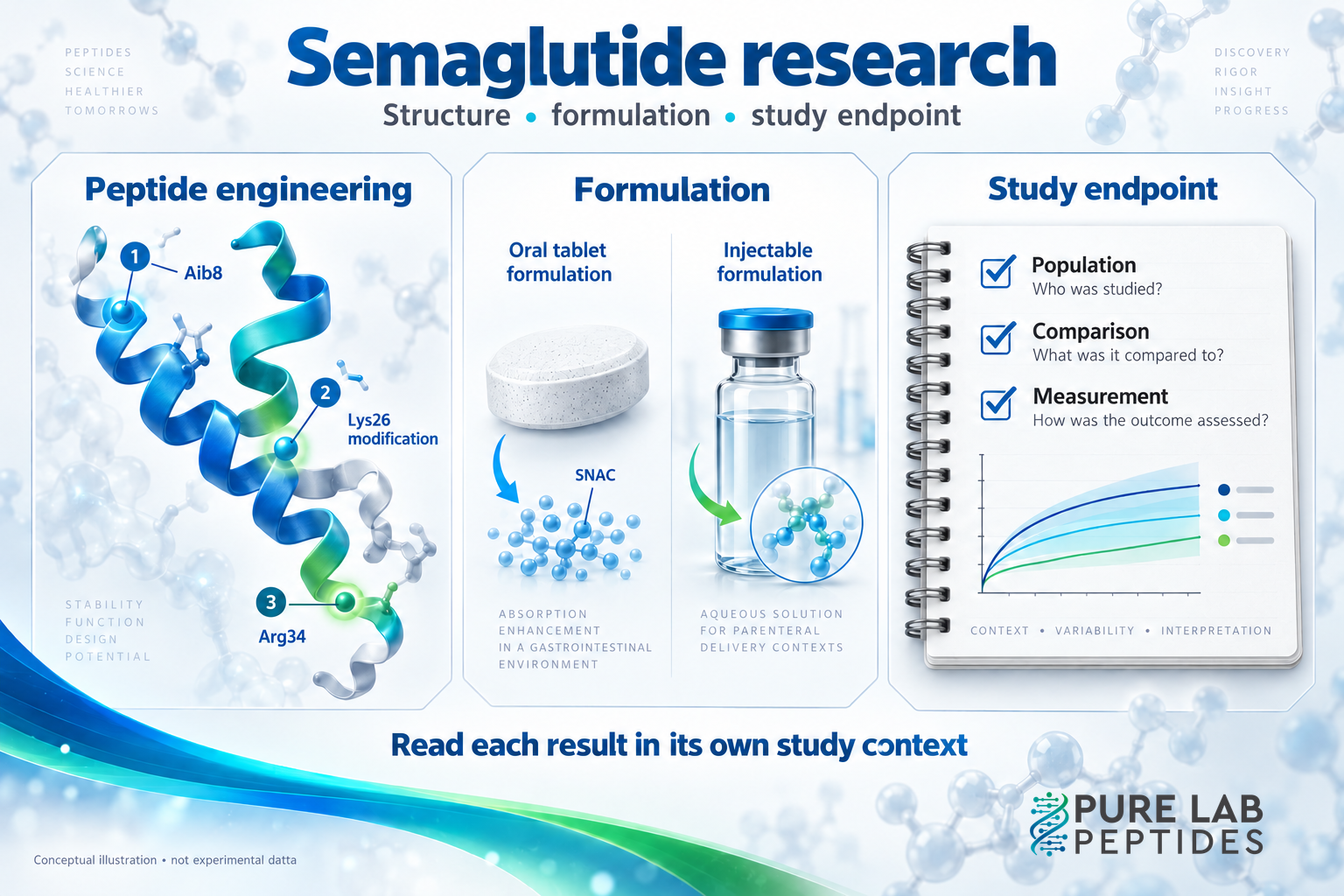
Semaglutide became prominent in incretin research because it was engineered to address two classic constraints of native GLP-1: rapid enzymatic degradation and short exposure time. The published discovery and development record describes two amino acid substitutions relative to human GLP-1, Aib at position 8 and Arg at position 34, together with derivatization at Lys26 using a long fatty di-acid-containing linker to improve albumin interaction while preserving GLP-1 receptor activity. Those modifications are central to why semaglutide appears so often in longer-duration incretin-pathway studies. [2][3]

Published structural biology added another layer to that story. Cryo-EM work on semaglutide-bound GLP-1R-Gs complexes reported peptide-receptor interactions that were broadly similar to GLP-1, but not identical in dynamic behavior. The authors described different motions within the receptor and the bound peptide, which matters for researchers because semaglutide is not merely a slower version of endogenous GLP-1. It is a modified ligand with its own conformational profile inside the receptor system. [6]

The design also changed the tempo of the literature. Once exposure windows lengthened, semaglutide became useful in studies that sampled metabolism, disposition, and systems physiology over time scales that would be difficult to examine with rapidly degraded native GLP-1. Published ADME work later reported that intact semaglutide remained the primary circulating component in plasma across human and nonclinical datasets in radiolabeled studies, reinforcing why pharmacokinetic and metabolism papers became a major branch of the semaglutide evidence base. [3][7]

The flowchart below is an editorial synthesis of the design logic and research expansion described in the published semaglutide literature. [2][3][6][7][8]

flowchart TD A[Native GLP-1 research problem] --> B[Rapid degradation and short exposure] B --> C[Semaglutide engineered with targeted substitutions and acylation] C --> D[Improved stability and albumin interaction] D --> E[Longer observation window in published studies] E --> F[Receptor structure and signaling papers] E --> G[ADME and persistence papers] E --> H[Oral absorption and formulation papers]

Caption: This flowchart is an editorial synthesis rather than a direct figure from one publication. [2][3][6][7][8]

What Published Semaglutide Literature Actually Covers

Published semaglutide literature is broad, but it is not homogeneous. Some papers ask chemistry and receptor-level questions, while others investigate metabolism, oral absorption technology, gastrointestinal physiology, or larger endpoint-driven study programs. Reading those categories separately prevents overgeneralization and makes the primary keyword “Semaglutide in Published Incretin Research” much easier to interpret as a literature map rather than a single claim. [1][2][3][6]

Literature area Representative source What the papers examine How to interpret that evidence
Incretin physiology baseline Nauck and Meier, 2018 [1] GLP-1, GIP, the incretin effect, and the physiologic frame into which GLP-1 analogs are placed Useful for understanding pathway context, but not specific enough for batch qualification or semaglutide identity review
Molecular engineering and analog design Lau et al., 2015; Knudsen and Lau, 2019 [3][2] Amino acid substitutions, acylation strategy, albumin interaction, and long-acting design logic Best starting point for understanding why semaglutide behaves differently from native GLP-1
Receptor structure and dynamics Zhang et al., 2021 [6] Cryo-EM structures and dynamic analysis of semaglutide-bound GLP-1R-Gs complexes Most relevant for mechanism, ligand engagement, and structure-informed pathway interpretation
ADME and persistence Jensen et al., 2017 [7] Absorption, metabolism, excretion, intact parent signal, and routes of elimination Useful when the research question involves exposure, stability, and metabolite interpretation
Oral absorption platform Buckley et al., 2018 [8] SNAC-enabled oral semaglutide absorption and stomach transcellular transport Important because oral semaglutide literature answers formulation and delivery questions beyond peptide backbone chemistry
Gastrointestinal physiology Jalleh et al., 2024 [9] Mechanistic review of GLP-1 receptor agonist effects across gastrointestinal physiology Useful for interpreting gastric and intestinal readouts in semaglutide-adjacent incretin literature
Endpoint-driven semaglutide programs Aroda et al., 2019; Marso et al., 2016 [10][11] Larger published programs and outcome papers involving glycemic, cardiovascular, renal, and body-mass-related endpoints Important for understanding semaglutide’s place in the field, but they do not replace mechanism papers or analytical evidence

That evidence map clarifies why search terms around semaglutide often feel mixed. A query about “semaglutide mechanism” usually belongs in the medicinal chemistry, receptor-structure, or GLP-1 physiology literature. A query about “semaglutide oral research” belongs partly in formulation science. A query about “published semaglutide studies” often surfaces SUSTAIN summaries or cardiovascular outcome work. All of those are real parts of the record, but they are not interchangeable evidence layers. [6][8][10][11]

The practical takeaway is that literature volume should be interpreted by research question. A landmark endpoint paper does not substitute for receptor-level mechanistic data, and a receptor-structure paper does not answer formulation questions about oral semaglutide. Researchers, laboratory buyers, and institutions all benefit from reading the semaglutide corpus as a stack of evidence types rather than as a single undifferentiated body of proof. [1][5][10][11]

What Researchers Review Before Selecting RUO Semaglutide Material

For RUO procurement, the first useful question is not whether semaglutide is widely published. The real question is whether the specific material under review is documented by analytical procedures that are fit for the intended purpose. ICH Q2(R2) places intended purpose, identity, impurity or purity, assay, specificity or selectivity, accuracy, precision, range, robustness, system suitability, and validation strategy at the center of analytical procedure evaluation. That framework is directly relevant when a laboratory is reviewing a semaglutide COA, chromatogram, or supporting method summary. [12]

Synthetic peptides are analytically demanding materials. Regulatory and scientific reviews describe peptides as occupying a middle ground between small molecules and larger biologics, with challenges that include structural characterization, manufacturing controls, aggregate formation, and impurity profiles produced during synthesis or storage. LC-MS-focused reviews then add a second layer of complexity by showing how related impurities can include truncations, sequence variants, structural isomers, and stereochemical variants that may not be fully explained by one chromatographic readout alone. [13][14]

That is why semaglutide material review is strongest when it is orthogonal. In practice, researchers often look for a COA paired with method context: a chromatographic purity or related-substances result, mass-based identity confirmation, explicit lot identification, test conditions or method references, and any available stability or storage notes that explain how the analytical result should be read. Peptide-specific guidance from the EMA similarly emphasizes manufacturing process, characterization, specifications, and analytical control for synthetic peptides rather than treating peptide quality as a simple one-number purity claim. [12][13][14][15]

  • Identity: Does the documentation show sequence-consistent or mass-consistent confirmation rather than only a product name and a purity percentage? [12][14][15]
  • Purity and related substances: Is the chromatographic method described well enough to understand what the reported purity value includes or excludes? [12][13][14]
  • Lot traceability: Are lot number, test date, and method references explicit enough for downstream internal records and research reproducibility? [12][15]
  • Context: If the project depends on formulation or release behavior, are you reviewing the correct semaglutide format instead of assuming all published data are interchangeable? [7][8][15]

Recent quality-focused work on follow-on GLP-1 polypeptide products shows why this scrutiny matters. Hach and colleagues reported impurity-pattern differences in follow-on injectable semaglutide materials, including high molecular weight proteins, trace metals, anions, counterions, and residual solvents, and they also described altered semaglutide quantity or release behavior in several commercialized oral follow-on products. Their conclusion was appropriately cautious: the downstream impact of those differences remained unknown, but the analytical differences themselves were measurable and relevant to documentation review. [16]

Common Reading Errors in Semaglutide Research

The most common interpretation error is to treat every semaglutide paper as if it addresses the same layer of evidence. It does not. A peptide-design paper explains why semaglutide persists, a cryo-EM paper explains receptor engagement, an ADME paper explains disposition and metabolite handling, an oral absorption paper explains formulation behavior, and endpoint-driven studies map semaglutide’s place in the broader published incretin field. Those layers complement each other, but they should not be collapsed into one conclusion. [2][3][6][7][8][10][11]

  • Do not equate semaglutide with native GLP-1. The backbone relationship is important, but the substitutions and acylation change degradation resistance, albumin interaction, and exposure characteristics. [2][3][4]
  • Do not collapse oral and non-oral semaglutide datasets. Oral semaglutide papers often answer additional questions about SNAC-enabled absorption and release behavior that are absent from backbone-only discussions. [7][8][16]
  • Do not let publication volume replace fit-for-purpose qualification. A heavily cited semaglutide paper still does not establish that a specific RUO lot meets the analytical needs of a given assay or workflow. [12][13][14][15][16]

For qualified research readers, the most accurate working model is to treat semaglutide literature as a layered dossier. The compound has a published medicinal chemistry history, a receptor-signaling and structural biology record, an ADME and oral absorption record, and a separate analytical quality record that matters when real material is selected for laboratory work. Keeping those layers distinct supports both stronger interpretation and stronger RUO compliance. [3][6][7][12][15]

FAQs

Is semaglutide the same as native GLP-1?

Semaglutide is not the same as native GLP-1. Published chemistry and development papers describe semaglutide as a modified GLP-1 analog with targeted substitutions and acylation that change degradation resistance, albumin interaction, and exposure behavior. That is why researchers discuss endogenous GLP-1 physiology and semaglutide pharmacology as related but not interchangeable topics. [2][3][4]

What does “published incretin research” usually include for semaglutide?

Published incretin research around semaglutide usually includes peptide design, receptor-structure studies, ADME work, oral absorption science, gastrointestinal physiology, and larger semaglutide study programs summarized in reviews or endpoint-driven papers. In other words, the phrase does not identify one paper type. It describes a research stack spanning chemistry, pharmacology, formulation, and translational literature. [1][6][7][8][10][11]

Why are identity and purity reviewed separately for semaglutide material?

Identity and purity answer different analytical questions. Identity asks whether the material is the expected peptide, while purity asks how much of the measured sample corresponds to that intended species versus related substances or process-derived components. Current analytical-validation guidance and peptide-quality reviews treat those as distinct quality attributes, which is why LC-MS and chromatography are often used as complementary evidence streams. [12][13][14]

Does a certificate of analysis establish suitability for every project?

A certificate of analysis is important, but a COA alone does not establish suitability for every research project. Analytical guidance is fit-for-purpose, which means the relevance of a reported identity, purity, or assay number depends on the laboratory’s intended workflow, measured attribute, and level of method context. For synthetic peptides, peptide-specific characterization and lot traceability still matter after the COA is reviewed. [12][15][16]

Why is oral semaglutide literature often discussed separately from other semaglutide papers?

Oral semaglutide literature is often discussed separately because it adds a formulation and absorption question on top of backbone chemistry. Published work on oral semaglutide examines SNAC-enabled stomach absorption and related release behavior, so those papers are not only about the peptide sequence itself. For literature review, oral semaglutide belongs partly to formulation science and not only to receptor pharmacology. [7][8][16]

Next Steps

Review batch-specific documentation before selecting any research-use-only peptide. Explore Pure Lab Peptides for RUO peptide compounds with clear labeling, research-focused product information, and available documentation.

References

  1. Nauck MA, Meier JJ. “Incretin hormones: Their role in health and disease.” Diabetes, Obesity and Metabolism. 2018. https://doi.org/10.1111/dom.13129
  2. Knudsen LB, Lau J. “The Discovery and Development of Liraglutide and Semaglutide.” Frontiers in Endocrinology. 2019. https://doi.org/10.3389/fendo.2019.00155
  3. Lau J, Bloch P, Schaffer L, et al. “Discovery of the Once-Weekly Glucagon-Like Peptide-1 (GLP-1) Analogue Semaglutide.” Journal of Medicinal Chemistry. 2015. https://doi.org/10.1021/acs.jmedchem.5b00726
  4. Muller TD, Finan B, Bloom SR, et al. “Glucagon-like peptide 1 (GLP-1).” Molecular Metabolism. 2019. https://doi.org/10.1016/j.molmet.2019.09.010
  5. Drucker DJ. “Mechanisms of Action and Therapeutic Application of Glucagon-like Peptide-1.” Cell Metabolism. 2018. https://doi.org/10.1016/j.cmet.2018.03.001
  6. Zhang X, Belousoff MJ, Liang YL, et al. “Structure and dynamics of semaglutide- and taspoglutide-bound GLP-1R-Gs complexes.” Cell Reports. 2021. https://doi.org/10.1016/j.celrep.2021.109374
  7. Jensen L, Helleberg H, Roffel A, et al. “Absorption, metabolism and excretion of the GLP-1 analogue semaglutide in humans and nonclinical species.” European Journal of Pharmaceutical Sciences. 2017. https://doi.org/10.1016/j.ejps.2017.03.020
  8. Buckley ST, Baekdal TA, Vegge A, et al. “Transcellular stomach absorption of a derivatized glucagon-like peptide-1 receptor agonist.” Science Translational Medicine. 2018. https://doi.org/10.1126/scitranslmed.aar7047
  9. Jalleh RJ, Wu T, Hausken T, et al. “Gastrointestinal effects of GLP-1 receptor agonists: mechanisms, management, and future directions.” The Lancet Gastroenterology and Hepatology. 2024. https://doi.org/10.1016/S2468-1253(24)00188-2
  10. Aroda VR, Ahmann A, Cariou B, et al. “Comparative efficacy, safety, and cardiovascular outcomes with once-weekly subcutaneous semaglutide in the treatment of type 2 diabetes: Insights from the SUSTAIN 1-7 trials.” Diabetes and Metabolism. 2019. https://doi.org/10.1016/j.diabet.2018.12.001
  11. Marso SP, Bain SC, Consoli A, et al. “Semaglutide and Cardiovascular Outcomes in Patients with Type 2 Diabetes.” New England Journal of Medicine. 2016. https://doi.org/10.1056/NEJMoa1607141
  12. International Council for Harmonisation. “Validation of analytical procedures Q2(R2).” ICH Guideline. 2023. https://database.ich.org/sites/default/files/ICH_Q2%28R2%29_Guideline_2023_1130.pdf
  13. Wu LC, Chen F, Lee SL, Raw A, Yu LX. “Building parity between brand and generic peptide products: Regulatory and scientific considerations for quality of synthetic peptides.” International Journal of Pharmaceutics. 2017. https://doi.org/10.1016/j.ijpharm.2016.12.051
  14. Lian Z, Wang N, Tian Y, Huang L. “Characterization of Synthetic Peptide Therapeutics Using Liquid Chromatography-Mass Spectrometry: Challenges, Solutions, Pitfalls, and Future Perspectives.” Journal of the American Society for Mass Spectrometry. 2021. https://doi.org/10.1021/jasms.0c00479
  15. European Medicines Agency. “Guideline on the Development and Manufacture of Synthetic Peptides.” EMA Scientific Guideline. 2025. https://www.ema.europa.eu/en/documents/scientific-guideline/guideline-development-manufacture-synthetic-peptides_en.pdf
  16. Hach M, Engelund DK, Mysling S, et al. “Impact of Manufacturing Process and Compounding on Properties and Quality of Follow-On GLP-1 Polypeptide Drugs.” Pharmaceutical Research. 2024. https://doi.org/10.1007/s11095-024-03771-6