



BPC-157 Research: How to Read the Studies

TL;DR · The short version
BPC-157 research includes cell experiments, animal injury models and limited human reports. Read the model and measured outcome before interpreting a headline. Changes in cell migration or signaling do not establish a treatment benefit in people.
“Promotes healing” sounds straightforward. In a research summary, though, that phrase may compress several different observations: cells moving across a surface, a change in a signaling protein, or a mechanical test of an animal tendon.
BPC-157 is a synthetic 15-residue peptide. To understand its literature, start with what each experiment actually measured. The studies below make those distinctions visible.
BPC-157 research in cells, animal models and people
TL;DR: Cells, animal models and human observations answer different questions.
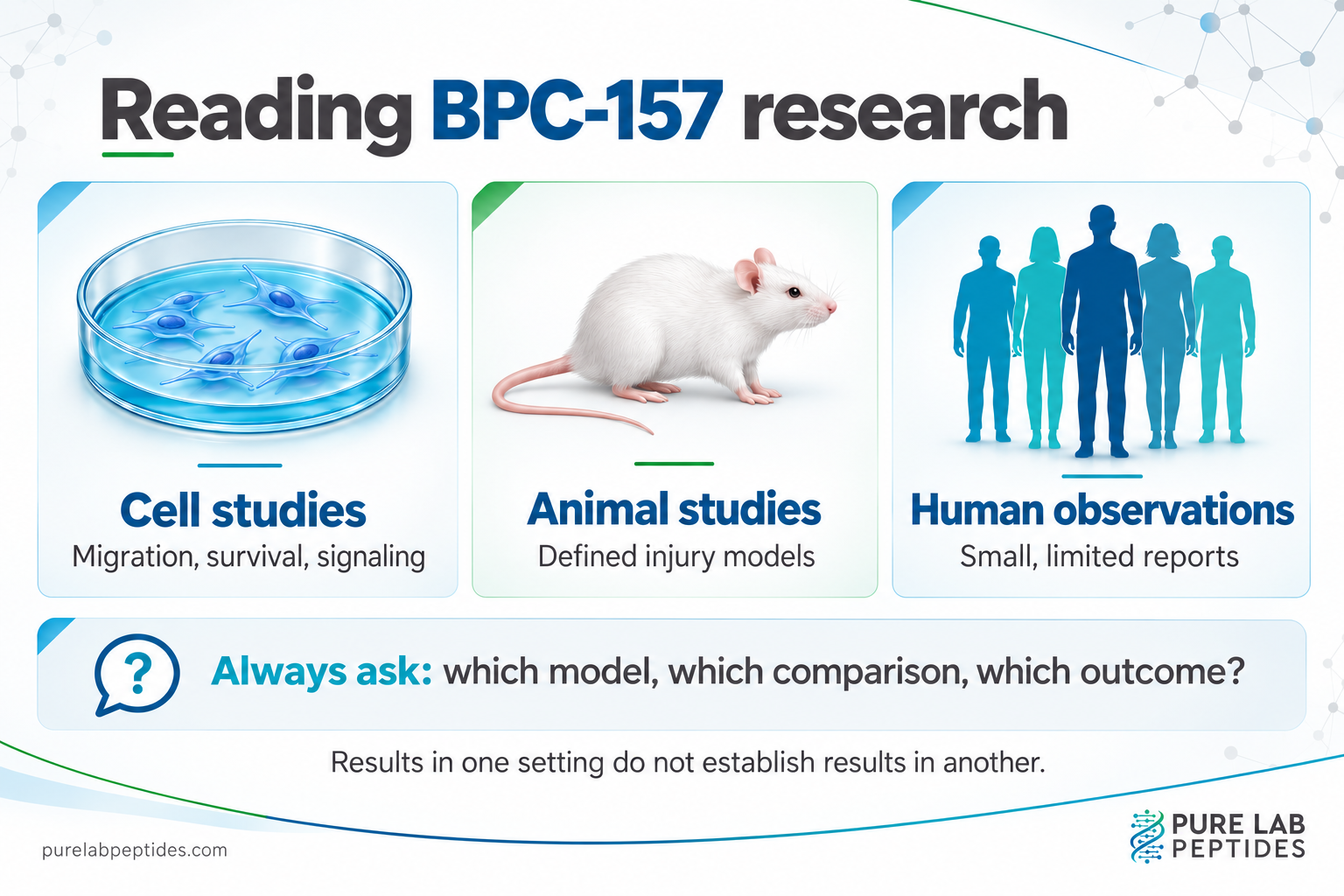
A cell experiment can isolate a response that would be harder to examine in a whole organism. An animal study can measure outcomes in a defined injury model. A human report adds observations in people, but its size, comparison group and follow-up still matter.
Before reading the conclusion, find three details in the methods: what was studied, what it was compared with and what counted as an outcome. Keep those details beside the finding rather than dropping them from the summary.
Tendon studies: movement, growth and strength are different readouts
TL;DR: The tendon papers report several distinct outcomes; they should not be collapsed into one “healing” claim.
In a 2003 study of transected rat Achilles tendons, researchers reported improvements in functional and biomechanical measures, including load to failure. The result concerns an animal injury model with defined testing conditions.
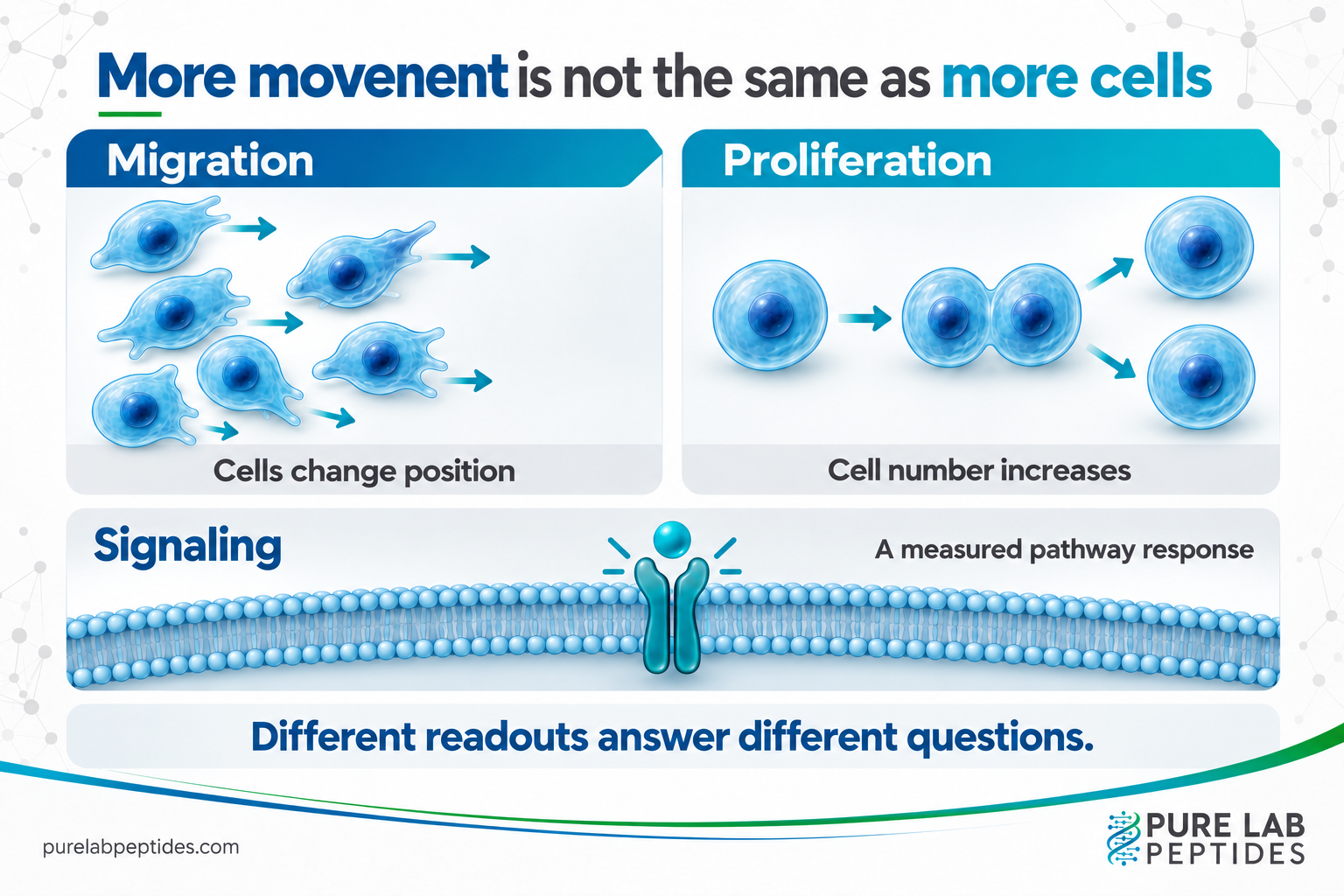
A 2011 rat tendon-fibroblast study examined a different question. BPC-157 increased tendon-explant outgrowth, cell migration and survival under oxidative stress. The MTT assay did not show a direct increase in cell proliferation. FAK and paxillin phosphorylation also changed.
That distinction is easy to miss: more migration means cells moved; it does not mean the experiment demonstrated more cells. The accompanying signaling results help describe the response without proving every step of a repair mechanism.
In 2014, another rat tendon-fibroblast study reported increased growth hormone receptor expression and examined responses after growth hormone was added. It does not establish that BPC-157 alone produces the same combined response in a person.
Vascular signaling: keep the pathway result in context
TL;DR: A measured pathway response supports a mechanistic finding within the model tested.
A 2016 study investigated BPC-157 in human endothelial cells, a chick membrane assay and rat hindlimb ischemia. It connected angiogenesis (new blood-vessel formation) with VEGFR2–Akt–eNOS signaling. The last term refers to endothelial nitric oxide synthase. Blocking parts of that pathway reduced some responses.
The distinction between VEGFR2 and VEGF-A matters. The researchers reported increased VEGFR2 expression without a corresponding increase in VEGF-A expression. Replacing that with “increases VEGF” loses the result the paper actually reported.
These preclinical experiments provide a basis for further mechanistic work. They do not establish a predictable vascular outcome for an individual customer or certify the activity of a commercial vial.
What do the small human reports tell us?
TL;DR: The reports are too limited to establish general safety or treatment effectiveness.
A 2025 pilot report followed two adults who had previously received BPC-157. No adverse effects were reported during the short observation period. Two previously exposed participants cannot establish population-wide safety, uncommon risks or long-term effects.
A 2021 retrospective knee-pain report obtained follow-up from 16 people: 12 had received BPC-157 and four had received a combination including thymosin beta-4. The report relied on self-reported outcomes and lacked an untreated comparison group.
It also did not use standardized measures of function, stiffness or quality of life. Reported pain improvement therefore cannot be treated as proof of structural repair or as a clean estimate of the effect of BPC-157 alone.
A five-question check for the next paper
TL;DR: Look for the model, comparator, endpoint, follow-up and limits before accepting the headline.
- What was studied? Identify the cells, species or participant group.
- Compared with what? Find the control or comparator and how groups were assigned.
- What changed? Name the measured endpoint: migration, protein expression, mechanical strength or a reported symptom.
- For how long? Check the observation period rather than assuming lasting effects.
- What remains unanswered? Note sample size, missing comparisons and limits on transferring the result to another setting.
For a broader paper-reading approach, see how to read peptide research literature. When reviewing a product, keep its batch documentation separate: a certificate about the supplied material and a published biological experiment answer different questions.