
How to Read Peptide Research Literature
How to Read Peptide Research Literature starts with a simple question: what exact material, assay system, and evidence type does a paper actually describe? For research teams working with research-use-only compounds, that distinction matters because peptide findings can change with sequence disclosure, structural characterization, chromatographic behavior, and method quality. This article explains how to read peptide papers critically, separate analytical facts from interpretation, and keep the discussion anchored to laboratory research rather than consumer-style claims.[1][2]
Fast Answer
To read peptide research literature well, verify the exact peptide and its characterization first, then judge the paper by assay type, controls, reporting quality, and evidence level rather than by the headline conclusion. Products discussed in this article are intended for laboratory research use only and are not intended for human or animal consumption. A strong peptide paper usually makes sequence, identity, method suitability, and analytical context explicit before drawing broader mechanistic inferences.[3][4]
Start With the Exact Peptide Being Studied
The first job is not to read the conclusion. It is to identify the material. A peptide paper is only as interpretable as its description of sequence, modifications, molecular characteristics, and analytical characterization. That is especially important in the peptide field because published activity alone does not prove structural homogeneity, and papers on synthetic peptides have historically underreported deeper structural characterization beyond a purity value and a mass callout.[1][2]
In practice, researchers should cross-check the paper’s compound name, reported sequence, molecular weight, and target context against stable public resources. PubChem organizes chemical records around unique structures and related data, UniProt provides curated sequence and functional information for proteins and peptides, and ChEMBL curates assay-linked bioactivity data from the primary literature with assay-type labels and target-assignment confidence scoring. Those databases do not replace the paper, but they are useful for confirming whether the authors are discussing the same entity throughout the manuscript.[5][6][7][8]
A useful rule is this: if the paper does not let you answer “what exact peptide was tested?” in one pass through the Methods, your confidence should drop. Missing sequence information, unclear terminal modifications, incomplete identity data, or vague sourcing language make later claims harder to interpret, especially when the paper compares multiple studies that may not have used analytically equivalent materials.[1][3]
Practical screening questions for the opening read.[5][6][7][1]
| Element to verify | Why it matters | Where to look first |
| Sequence or unambiguous identifier | Prevents confusion between similarly named peptides or related analogs | Methods, supplementary data, database cross-reference |
| Molecular characterization | Shows whether the reported material was analytically examined, not just named | Methods, figure legends, analytical appendix |
| Assay type | Distinguishes binding, functional, physicochemical, and broader screening data | Abstract, Methods, assay tables |
| Target assignment confidence | Reduces the risk of over-reading results from cell-level or multi-target assays | ChEMBL records, target notes, discussion |
| Source consistency | Helps determine whether one lot or several differently characterized materials were used | Methods, acknowledgments, supplementary methods |
Identify What Kind of Evidence the Paper Provides
After identifying the material, the next question is what kind of evidence the paper actually contributes. In peptide research, different study types answer different questions. A binding assay can show an interaction under stated conditions, a functional assay can show a measured response in a defined system, an analytical paper can show separation or identity evidence, and a systematic review can summarize a larger evidence base if its search and selection methods are transparent. Treating all of those as interchangeable is one of the most common reading errors.[7][9][10]
Evidence hierarchy matters here, but it should be read carefully. Higher-order evidence sources such as systematic reviews and meta-analyses can be more useful for broad summary questions, while mechanistic and analytical papers are often more useful for narrow questions about sequence confirmation, target engagement, or assay construction. Lower on a general evidence hierarchy does not mean low value. It means the paper is answering a different research question and should be interpreted at that resolution.[9][11]
When the article is a review, look for reporting discipline rather than assuming completeness. PRISMA 2020 emphasizes clear reporting of information sources, selection methods, appraisal, and synthesis. If a “review” paper does not disclose how literature was found and screened, it may still be useful background reading, but it should not be treated as a systematic capture of the field.[10]
Table: common peptide paper types, what they can answer, and what they cannot answer on their own. This is an editorial synthesis grounded in assay taxonomy, evidence-hierarchy guidance, and review-reporting standards.[7][9][10]
| Paper type | Best suited to answer | Main limitation | What to verify |
| Analytical method paper | Whether a peptide species was identified, separated, quantified, or profiled under stated conditions | May not address biological relevance | Validation, orthogonal methods, impurity handling |
| Binding assay paper | Whether an interaction with a stated target was detected | Binding alone does not establish downstream function | Target assignment, controls, assay format, confidence level |
| Functional assay paper | Whether a measured response occurred in a defined cell or biochemical system | Responses can be model-specific or off-target | Endpoint choice, orthogonal confirmation, replication |
| Preclinical model paper | Whether a signal was observed in a published preclinical model context | Reporting quality and bias control vary widely | Randomization, blinding, exclusion criteria, sample size, statistics |
| Systematic review | How a defined body of literature trends when searched and screened transparently | Only as reliable as the underlying studies and review methods | PRISMA elements, eligibility criteria, risk-of-bias approach |
Read the Methods Before Trusting the Results
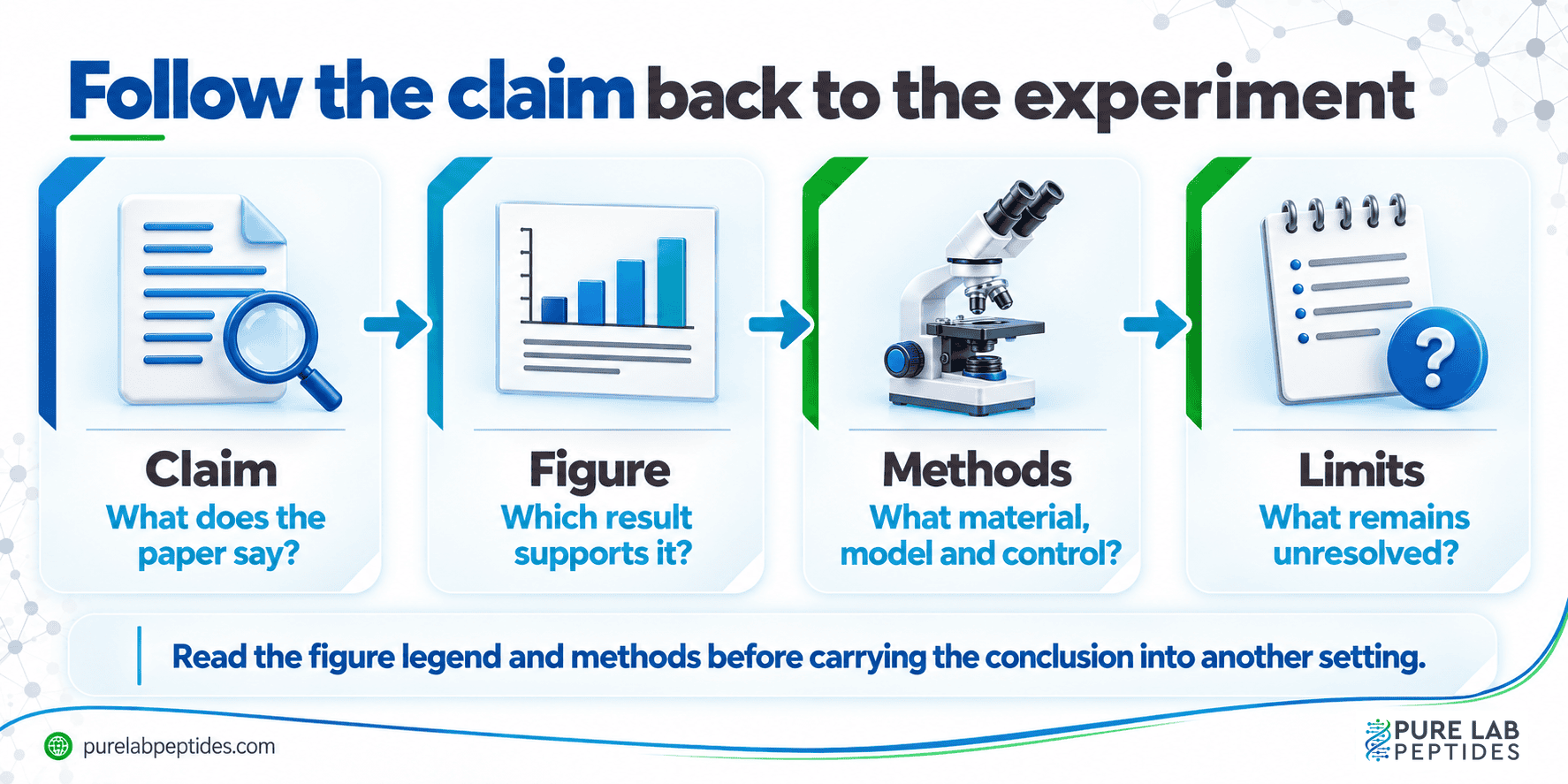
For most peptide papers, the highest-value reading sequence is: identify the material, classify the assay, read the Methods, inspect the figures, and only then read the discussion. That order sounds obvious, but it counters a common failure mode in literature review, which is to let the abstract supply a conclusion before the reader has checked whether the study design can actually support it.[11][15]
Reporting frameworks make this easier. ARRIVE 2.0 organizes the “Essential 10” around study design, sample size, inclusion and exclusion criteria, randomization, blinding, outcome measures, statistical methods, experimental model details, procedures, and results. NIH guidance on rigor and reproducibility similarly emphasizes the rigor of prior research, robust experimental design, relevant biological variables, and authentication of key biological or chemical resources. Even if a peptide paper is not written to those frameworks explicitly, they provide a strong checklist for readers evaluating whether the reported findings are likely to be interpretable and reproducible.[12][13]
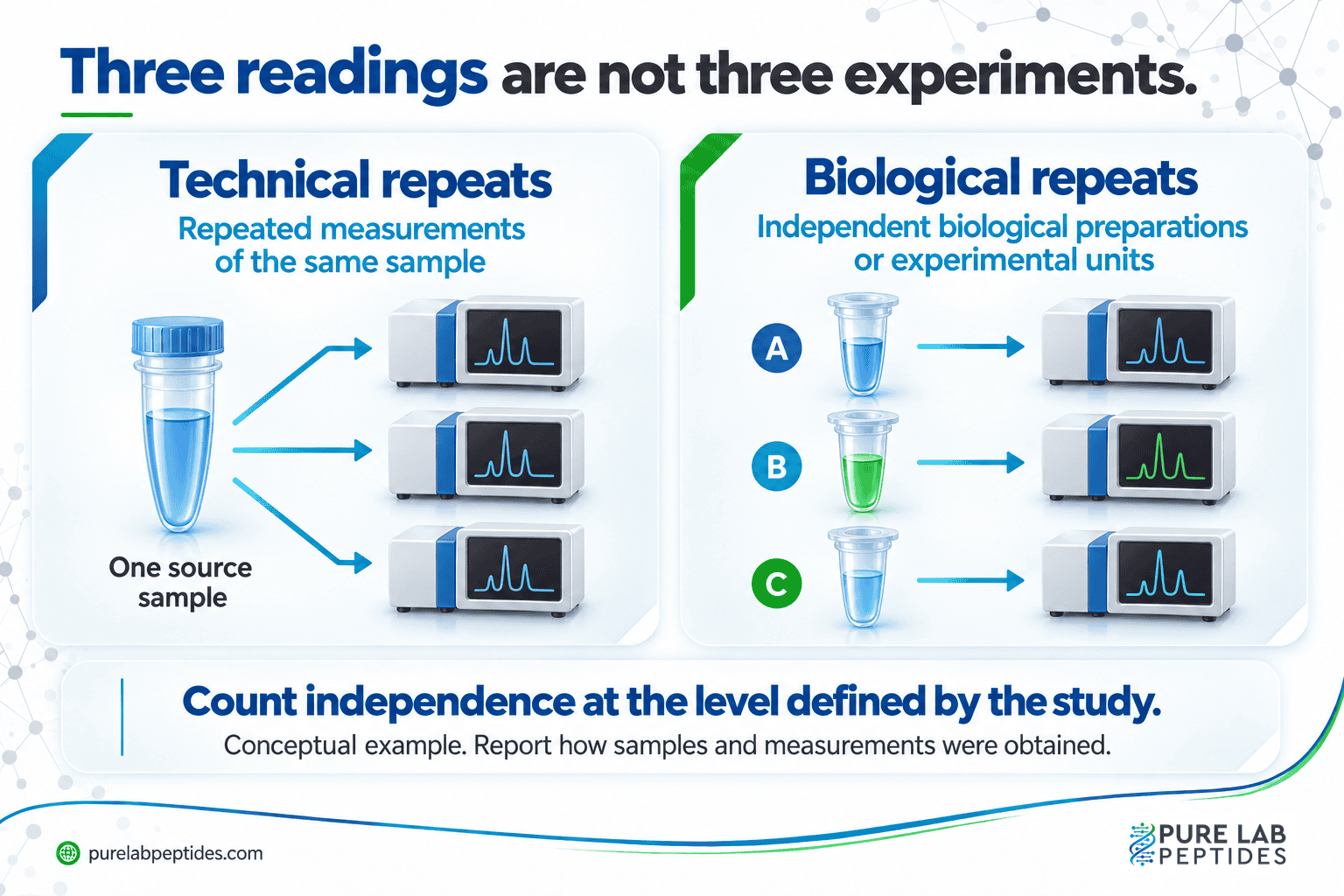
NIH’s principles for reporting preclinical research add the details readers often need most: whether experiments were repeated, whether the paper distinguishes technical from biological replicates, what statistics were used, whether randomization and blinding were reported, how sample size was determined, what inclusion and exclusion rules applied, and whether underlying datasets or materials are available. Those are not administrative extras. They are load-bearing parts of interpretation.[14][15]
For published preclinical model studies, bias tools are also useful. SYRCLE’s tool adapts risk-of-bias logic to animal-study literature and gives readers a structured way to ask whether allocation, housing, outcome assessment, attrition, and selective reporting may have distorted the result. You do not need to score every paper formally, but once you know those domains, weak reports become much easier to spot.[16]
Diagram: a practical workflow for screening peptide papers. This workflow is an editorial synthesis based on critical-appraisal and reporting guidance rather than a published figure.[11][12][14]
A brief laboratory-reading checklist is often enough. Check whether the endpoint is direct or surrogate, whether negative and positive controls are visible, whether replicate structure is clear, whether figures match the statistics section, and whether the discussion stays inside what the assay actually measured. If several of those pieces are missing, the paper may still be worth reading for hypothesis generation, but not for strong sourcing claims.[14][15][16]
Check Analytical Documentation and Batch-Level Context
Peptide literature is unusually sensitive to analytical context. ICH Q2(R2) frames analytical validation around suitability for intended purpose and emphasizes specificity or selectivity, precision, reportable range, quantitation limits, and robustness. FDA bioanalytical guidance adds a directly relevant point for readers: reference standards and critical reagents should be characterized and documented for identity, purity, and stability. When a paper relies on assays built from poorly described standards or undocumented reagents, confidence in the downstream data decreases sharply.[3][4]
Mass spectrometry, chromatography, amino acid analysis, and peptide mapping each contribute different information. Mass spectrometry is central for molecular-mass and impurity work, chromatography is central for separation behavior and related-species visibility, amino acid analysis supports composition work, and peptide mapping is a standard way to confirm desired structure in more regulated settings. ICH Q6B explicitly notes peptide mapping and mass spectrometry as useful methods for confirming desired structure and evaluating disulfide features, while analytical reviews of synthetic peptides describe chromatography and LC-MS as complementary rather than interchangeable tools.[17][18][19][2]
The key reading implication is that a single purity number rarely settles the question. Multiple sources in the peptide-analysis literature make the same broader point from different angles: purity does not equal identity, and identity does not automatically equal complete impurity knowledge. Boutin and colleagues argue directly that biological activity cannot prove purity or correct higher-order structure for chemically synthesized peptides. Petersson and colleagues show that main-peak purity assessment can require two-dimensional LC because isomeric species may not be distinguished by mass alone. Lian and colleagues review the broader LC-MS challenge of characterizing structurally complex peptide impurities, including isomers and stereochemical variants.[1][21][22]
Reference-standard literature points in the same direction. McCarthy and colleagues describe peptide reference standards as depending on a mix of analytical testing, stability assessment, and value assignment, often using multiple analytical approaches rather than one isolated test. That is a useful reading model for RUO buyers and scientific readers alike: stronger peptide documentation is usually orthogonal documentation.[20]
Regulatory guidance is not the same thing as RUO sourcing guidance, but it is still informative for literature interpretation because it shows what experienced analytical frameworks consider important. FDA guidance for certain highly purified synthetic peptides calls for sensitive, high-resolution procedures to detect and characterize peptide-related impurities, and EMA’s synthetic-peptide guideline specifically centers characterization, specifications, and analytical control. USP chapter <1503> likewise focuses on quality attributes of synthetic peptide drug substances. For a literature reader, the takeaway is simple: if method transparency would be expected in high-control settings, its absence in a paper should lower confidence in any broad claim derived from that paper.[23][24][25]
Table: what common analytical signals add to peptide-paper interpretation.[3][17][18][19][21][22]
| Analytical signal in the paper | What it adds | What it does not prove by itself |
| HPLC or UPLC chromatogram | Shows separation behavior and a reported purity profile under stated conditions | Complete structural identity or absence of co-eluting isomers |
| Intact mass spectrometry | Supports expected mass and can reveal some related species | Full sequence confirmation or separation of all isobaric variants |
| MS/MS or peptide mapping | Improves structural confirmation and impurity interpretation | Universal coverage of every low-level impurity without method limitations |
| Amino acid analysis | Supports compositional assessment and reference-standard work | Complete spatial or stereochemical characterization |
| Reference-standard and stability data | Improves lot-to-lot interpretability and assay traceability | Automatic transferability of findings across different batches or suppliers |
Common Reading Errors in Peptide Papers
Reading the headline instead of the assay
A peptide paper should be interpreted from the endpoint upward, not from the title downward. If the assay measured binding, the conclusion should stay near binding. If it measured a cell response, the conclusion should stay near that model. If it was a review, the reader should ask how evidence was selected and appraised. This sounds basic, but it is exactly the habit that prevents abstract-driven overreading.[7][10][11]
Equating purity with full identity
One of the most persistent peptide-literature mistakes is to treat a stated purity percentage as full proof of material identity. The analytical literature does not support that shortcut. Chromatographic purity, intact mass, sequence confirmation, impurity profiling, and reference-standard context answer related but different questions. Better papers make those distinctions visible. Weaker papers collapse them into a single number.[1][2][21][22]
Ignoring target-assignment confidence
ChEMBL’s documentation is useful here because it formalizes two ideas readers often overlook: assay type and target-assignment confidence. A direct single-protein target assignment carries a different interpretive weight than a cell-line or organism-level assay entry. When peptide papers move between molecular targets, cell systems, and broader phenotypes without clarifying that shift, the reader should slow down and separate what was observed from what was inferred.[7][8]
Overgeneralizing from one paper
A single peptide study can be useful, but it is rarely decisive. Better practice is to compare one paper against related analytical papers, database entries, and broader evidence summaries. Reviews that follow explicit search and screening methods are more informative than narrative summaries with unclear selection logic, and preclinical papers with clear reporting of randomization, blinding, replicates, and statistics are more informative than papers that omit those elements.[10][12][14][16]
FAQs
What is the first thing to check in a peptide paper?
The first thing to check in a peptide paper is the identity of the material being studied. That means looking for a sequence or unambiguous identifier, plus enough analytical context to understand what the authors actually tested. If those details are vague, every later claim becomes harder to interpret, no matter how strong the headline sounds.[1][5][6]
Is peptide purity the same as peptide identity?
No. Peptide purity and peptide identity are related but not identical concepts. A chromatographic purity value can describe what was resolved under one method, while identity questions may require mass spectrometry, mapping, compositional work, or multiple orthogonal methods. Reading peptide literature well means asking what each method actually confirms rather than treating one metric as complete characterization.[19][21][22]
How should a review article be weighed against an original peptide study?
A review article should be weighed by its methods. If the review clearly reports information sources, selection criteria, and appraisal methods, it can be a strong way to map the field. If it is a narrative overview without transparent search logic, it is better treated as background context. An original study is narrower but can still be more informative for a specific assay or analytical question.[10][11][9]
Which databases are most useful for verifying peptide details?
The most useful databases depend on the question, but PubChem, UniProt, and ChEMBL are strong starting points. PubChem helps with chemical-record context, UniProt helps with curated sequence and function data, and ChEMBL helps readers inspect assay type, target mapping, standardized activity context, and confidence scoring. Used together, they reduce naming confusion and improve literature screening efficiency.[5][6][7][8]
What makes a peptide paper more reproducible?
A peptide paper becomes more reproducible when it reports the material clearly, authenticates key resources, distinguishes biological from technical replicates, explains statistics, and states whether randomization, blinding, inclusion criteria, and sample-size planning were used where relevant. Those details make the study easier to evaluate and easier for other researchers to interrogate critically.[12][13][14][15]
Next Steps
Review batch-specific documentation before selecting any research-use-only peptide. Explore Pure Lab Peptides for RUO peptide compounds with clear labeling, research-focused product information, and available documentation. For research teams comparing suppliers, prioritize sequence clarity, analytical transparency, and lot-level documentation over broad marketing language.
References
- Boutin JA, Tartar AL, van Dorsselaer A, Vaudry H. “General lack of structural characterization of chemically synthesized long peptides.” Protein Science. 2019. https://doi.org/10.1002/pro.3601
- Sharma N, Kukreja R, Phale D. “Synthetic pharmaceutical peptides characterization by chromatography principles and method development.” Journal of Separation Science. 2022. https://doi.org/10.1002/jssc.202101034
- International Council for Harmonisation. “Validation of Analytical Procedures Q2(R2).” ICH Harmonised Guideline. 2023. https://database.ich.org/sites/default/files/ICH_Q2%28R2%29_Guideline_2023_1130.pdf
- U.S. Food and Drug Administration. “Bioanalytical Method Validation Guidance for Industry.” FDA Guidance Document. 2018. https://www.fda.gov/files/drugs/published/Bioanalytical-Method-Validation-Guidance-for-Industry.pdf
- Kim S, Thiessen PA, Bolton EE, et al. “PubChem Substance and Compound databases.” Nucleic Acids Research. 2016. https://doi.org/10.1093/nar/gkv951
- UniProt Consortium. “UniProt: the Universal Protein Knowledgebase in 2025.” Nucleic Acids Research. 2025. https://doi.org/10.1093/nar/gkae1010
- European Bioinformatics Institute. “Assay and Activity Questions.” ChEMBL Interface Documentation. 2026. https://chembl.gitbook.io/chembl-interface-documentation/frequently-asked-questions/chembl-data-questions
- European Bioinformatics Institute. “General Questions.” ChEMBL Interface Documentation. 2025. https://chembl.gitbook.io/chembl-interface-documentation/frequently-asked-questions/general-questions
- Wallace SS, Barak G, Truong G, Parker MW. “Hierarchy of Evidence Within the Medical Literature.” Hospital Pediatrics. 2022. https://doi.org/10.1542/hpeds.2022-006690
- Page MJ, McKenzie JE, Bossuyt PM, et al. “The PRISMA 2020 statement: an updated guideline for reporting systematic reviews.” BMJ. 2021. https://www.bmj.com/content/372/bmj.n71
- Greenhalgh T. “How to read a paper. Getting your bearings.” BMJ. 1997. https://doi.org/10.1136/bmj.315.7102.243
- NC3Rs. “The ARRIVE guidelines 2.0.” ARRIVE Guidelines. 2026 access. https://arriveguidelines.org/arrive-guidelines
- National Institutes of Health. “Guidance: Rigor and Reproducibility in Grant Applications.” NIH Grants & Funding. Updated 2024. https://grants.nih.gov/policy-and-compliance/policy-topics/reproducibility/guidance
- National Institutes of Health. “Principles and Guidelines for Reporting Preclinical Research.” NIH Grants & Funding. Current access. https://grants.nih.gov/policy-and-compliance/policy-topics/reproducibility/principles-guidelines-reporting-preclinical-research
- Landis SC, Amara SG, Asadullah K, et al. “A call for transparent reporting to optimize the predictive value of preclinical research.” Nature. 2012. https://doi.org/10.1038/nature11556
- Hooijmans CR, Rovers MM, de Vries RBM, Leenaars M, Ritskes-Hoitinga M, Langendam MW. “SYRCLE’s risk of bias tool for animal studies.” BMC Medical Research Methodology. 2014. https://doi.org/10.1186/1471-2288-14-43
- Zhang G, Annan RS, Carr SA. “Overview of peptide and protein analysis by mass spectrometry.” Current Protocols in Protein Science. 2010. https://doi.org/10.1002/0471140864.ps1601s62
- Højrup P. “Analysis of Peptides and Conjugates by Amino Acid Analysis.” Methods in Molecular Biology. 2015. https://doi.org/10.1007/978-1-4939-2999-3_8
- International Council for Harmonisation. “Specifications: Test Procedures and Acceptance Criteria for Biotechnological/Biological Products Q6B.” ICH Guideline. 1999. https://database.ich.org/sites/default/files/Q6B%20Guideline.pdf
- McCarthy D, Han Y, Carrick K, et al. “Reference Standards to Support Quality of Synthetic Peptide Therapeutics.” Pharmaceutical Research. 2023. https://doi.org/10.1007/s11095-023-03493-1
- Petersson P, Buckenmaier S, Euerby MR, Stoll DR. “A strategy for assessing peak purity of pharmaceutical peptides in reversed-phase chromatography methods using two-dimensional liquid chromatography coupled to mass spectrometry. Part I: Selection of columns and mobile phases.” Journal of Chromatography A. 2023. https://doi.org/10.1016/j.chroma.2023.463874
- Lian Z, Wang N, Tian Y, Huang L. “Characterization of Synthetic Peptide Therapeutics Using Liquid Chromatography-Mass Spectrometry: Challenges, Solutions, Pitfalls, and Future Perspectives.” Journal of the American Society for Mass Spectrometry. 2021. https://doi.org/10.1021/jasms.0c00479
- U.S. Food and Drug Administration. “ANDAs for Certain Highly Purified Synthetic Peptide Drug Products That Refer to Listed Drugs of rDNA Origin.” FDA Guidance for Industry. 2021. https://www.fda.gov/media/107622/download
- European Medicines Agency. “Guideline on the Development and Manufacture of Synthetic Peptides.” EMA Scientific Guideline. 2025. https://www.ema.europa.eu/en/documents/scientific-guideline/guideline-development-manufacture-synthetic-peptides_en.pdf
- United States Pharmacopeia. “Quality Attributes of Synthetic Peptide Drug Substances.” USP-NF General Chapter <1503>. 2021. https://doi.org/10.31003/USPNF_M12935_02_01