



Peptide Freeze-Thaw Cycles: What to Check and Record

TL;DR · The short version
A count of peptide freeze-thaw cycles is a starting point, not a pass or fail result. You’ll need the formulation and handling record, plus stability evidence that applies to them. Looking clear doesn’t establish that a sample is unchanged.
The three thaw dates on a tube label give you a partial history. They leave out how long the tube stayed out and what happened between those dates. Without the contents and formulation, even that history is hard to assess.
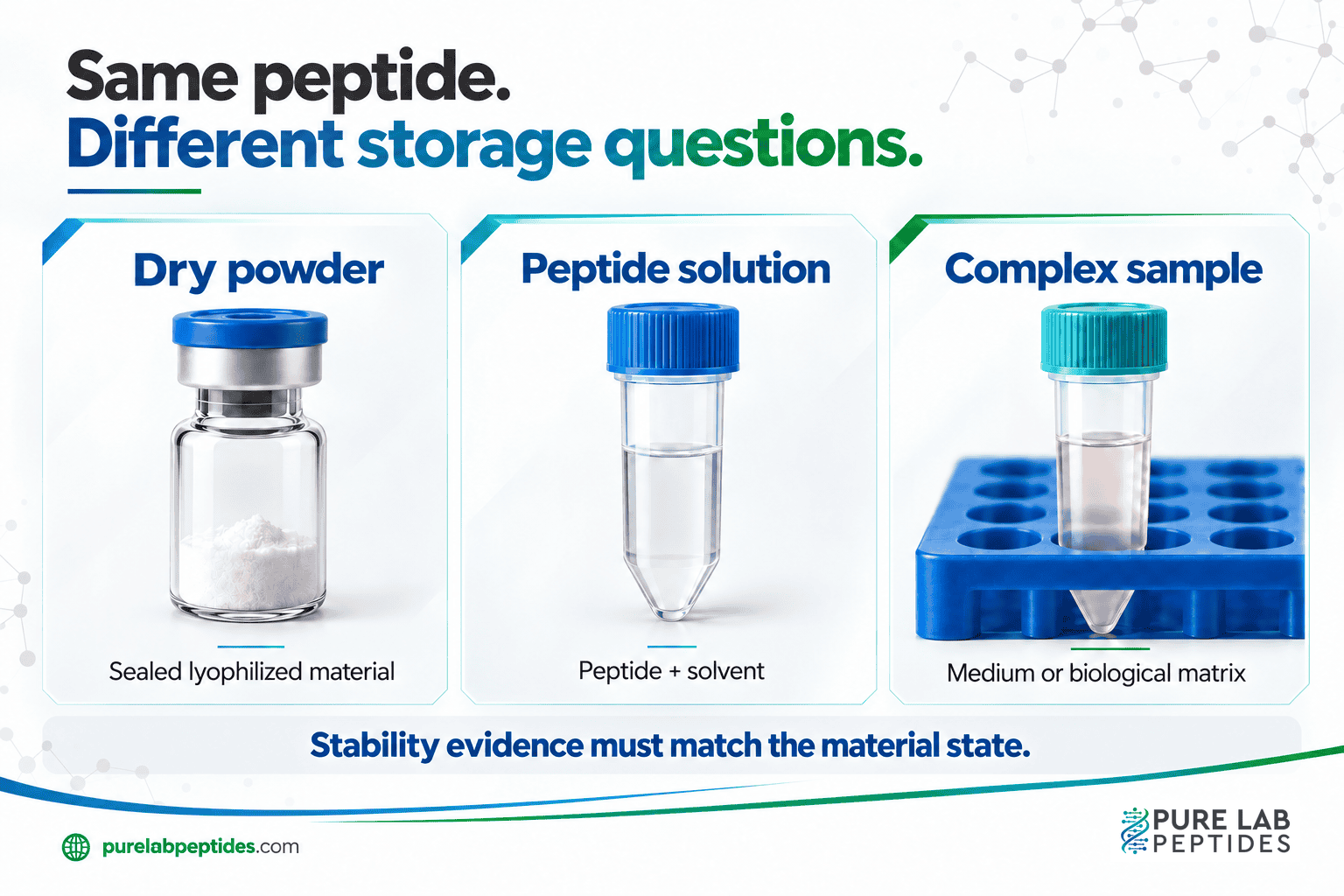
This is why the review starts with the material, rather than a permitted number of cycles. Dry peptide in a sealed vial and peptide dissolved in buffer have different storage questions.
Start with what is actually in the container
TL;DR: Check the material state before comparing advice for dry powder, solutions or complex samples.
The label and material documentation should establish whether the sample is lyophilized powder, a prepared solution or peptide in culture medium or another biological matrix. A solution record also needs its solvent or buffer, concentration and added ingredients. Together, these details describe the sample you’re trying to assess.
In the CSP7 formulation study, defined solutions and lyophilized preparations were examined separately. That separation makes the findings easier to use: you can compare a preparation with the relevant study conditions instead of relying on a shared peptide name.
What freeze-thaw studies show about peptide stability
TL;DR: Keep the study’s formulation and conditions beside its freeze-thaw result.
During freezing, ice forms while solutes become concentrated in the liquid that’s left. That changes the local environment around the peptide. How much the change matters remains a question for the formulation and measurement being studied.
In the glucagon study using differential scanning calorimetry, researchers tested how trehalose and lactose affected aggregation. That’s evidence about formulation during freeze-thaw experiments. It doesn’t tell you how many cycles an unrelated research peptide can withstand.
The CSP7 researchers found no aggregation after five cycles in their tested solutions. Those last words matter. “Five cycles are fine” drops the condition that makes the finding useful.
A study is useful here only to the extent that it matches the sample. Differences in material, medium, container, temperature history or test method leave a gap in the comparison. Naming the gap helps the laboratory decide what evidence is still needed.
Where aliquots help, and what they add
TL;DR: Aliquots may spare the rest of a stock from thawing, at the cost of more handling.
Using a separate portion needn’t thaw the whole stock. It also lets you follow that portion’s history without assuming that every tube went through the same events.
The extra handling is the catch. More transfers mean more container surfaces, and there may be less material in each tube. CPTAC’s recommendations on peptide handling discuss peptide adsorption to surfaces. Container choice and portion size therefore need a validated laboratory workflow; more portions aren’t automatically better.
Label each portion with its parent sample and preparation record. Neat labels won’t recover a history you never recorded.
A useful record is short and specific
TL;DR: Record enough for someone else to reconstruct this sample’s history.
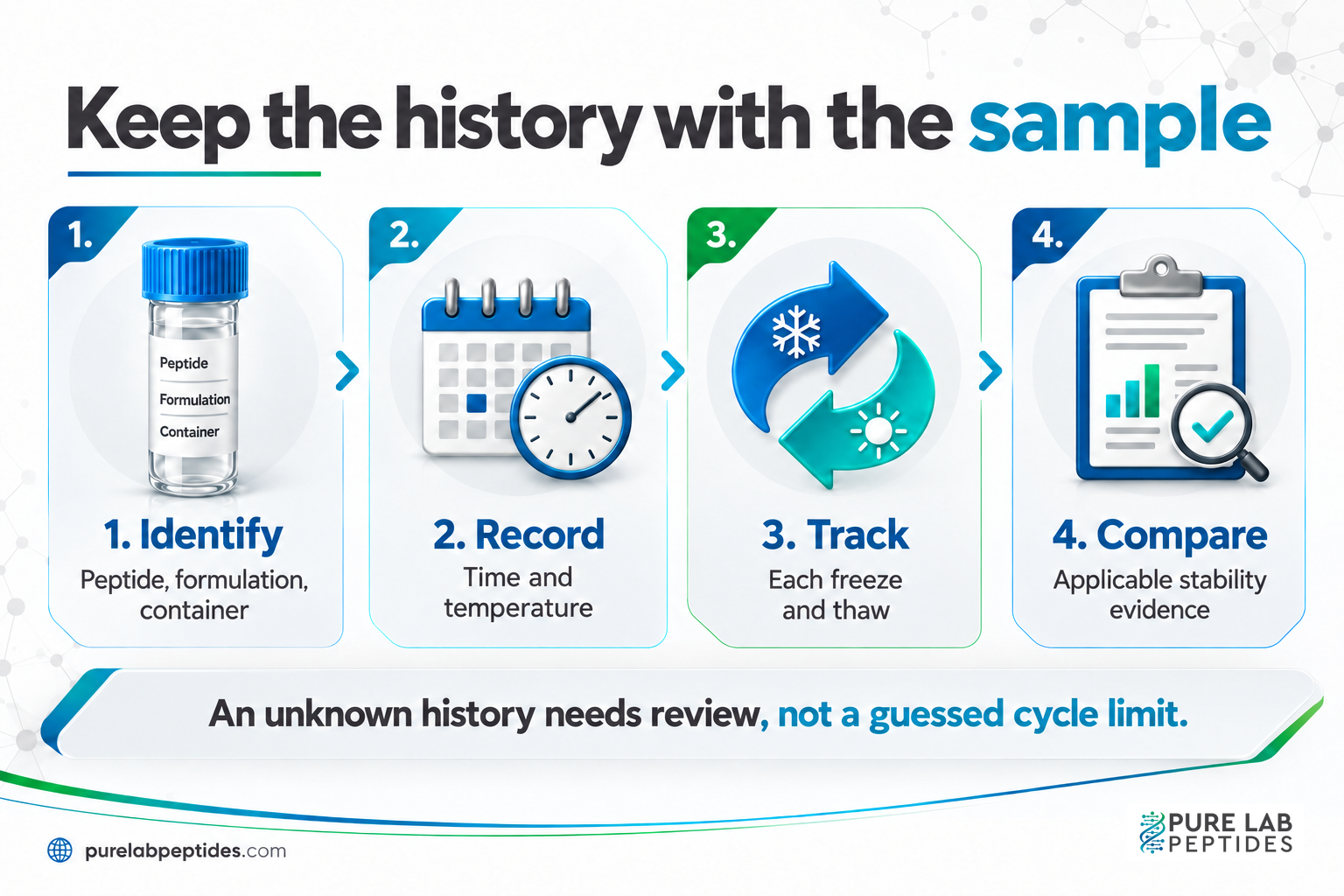
The next person reading the record shouldn’t have to reconstruct it from a long narrative. A small set of clear fields is easier to follow:
- Identity: material name, lot or sample ID, formulation and container.
- Events: preparation, removal from storage, thawing, transfers and return to storage.
- Conditions: the recorded times and temperatures, including known excursions.
- Evidence: the applicable stability document or test result and any unresolved gaps.
An “unknown” entry is useful information. It tells the reviewer where the record ends. A guessed temperature or cycle count hides that boundary and can make an incomplete history look settled.
What if the history is incomplete?
TL;DR: Review the missing information before deciding that the sample is acceptable or unusable.
Labels, transfer records, storage logs and supplier documentation can establish parts of the history. Some events may remain unknown. Keeping the two separate gives the laboratory a clearer basis for its review.
The remaining question is whether available stability evidence covers this material and its history. Further testing or a decision under the laboratory’s procedures may be needed if it doesn’t. A sample’s appearance can’t settle analytical questions about identity, content or degradation.
Give the reviewer the confirmed events, the gaps and the evidence. “It was probably only thawed once” leaves them with another assumption to check.
Our guide to peptide storage and handling covers the wider record you may need alongside the thaw history.