

...
Documentation and Quality

Peptide Storage and Handling for Laboratory Research

Research-use-only framing and article scope

This article should be published and interpreted as a laboratory-research resource. FDA’s intended-use rule explains that the “objective intent” of a product can be shown by expressions, labeling claims, advertising matter, written or oral statements, the design or composition of the article, and the circumstances surrounding distribution. In practice, that means RUO positioning is not created by a footer disclaimer alone. It is created by the combined effect of title, metadata, headings, product copy, labels, COA language, support content, and internal links. [9]

FDA’s RUO device materials are not a one-to-one rulebook for peptide-commerce content, but they are still highly instructive on claim boundaries. FDA’s IVD labeling materials and RUO/IUO guidance explain that products in the laboratory research phase of development should be prominently labeled “For Research Use Only. Not for use in diagnostic procedures” and should not be represented as effective diagnostic products. FDA has also enforced against situations where “research use only” disclaimers were inconsistent with the broader commercial presentation of the product. By reasonable inference, a peptide supplier article should keep every content layer aligned with research-only positioning rather than relying on a contradictory disclaimer. [10]

For that reason, the article below stays at the laboratory-operations level. It explains storage and handling variables, recordkeeping expectations, and analytical follow-through for research materials. It does not provide formulation-specific preparation parameters, route-of-administration guidance, dosing information, therapeutic claims, or personal-use advice.

Stability science that should drive storage decisions

Peptide stability is state-dependent. The same sequence can behave differently when stored as a dry or lyophilized solid, when dissolved in an aqueous working solution, when exposed to oxygen or light, when repeatedly frozen and thawed, or when handled in high-adsorption consumables. Reviews of peptide stability in aqueous systems identify both chemical instability pathways and physical instability pathways. Chemically, peptides may undergo oxidation, hydrolysis, β-elimination, deamidation, racemization, isomerization, and disulfide exchange. Physically, they may aggregate, adsorb to surfaces, or precipitate. That makes “storage” inseparable from “handling,” because the losses seen in the lab may come from chemistry, surfaces, or both. [11]

Official stability guidance points in the same direction. FDA’s Q5C page for biotechnological and biological products notes that proteins and polypeptides are particularly sensitive to temperature changes, oxidation, light, ionic content, and shear. FDA’s Q1B page adds that light testing should be an integral part of stress testing. Although those documents were written for regulated development programs rather than supplier blog copy, they are still useful for research operations because they identify the environmental variables that most often compromise stability. [12]

The most important operational divide is often between sealed dry storage and solution-state handling. Aqueous exposure tends to increase the relevance of hydrolysis, deamidation, oxidation, aggregation, and adsorption, which is why working-solution stability usually has to be treated as a controlled variable rather than an assumption. FDA’s analytical-method guidance explicitly says that sample preparation and standards/control solution preparation should include information on the stability of solutions and storage conditions. It also warns that reference standards should be handled according to storage and usage conditions to avoid modification, contamination, additional impurities, and inaccurate analysis. [13]

Solid-state storage is usually favored over solution storage when the alternative is repeated aqueous handling, but “dry” does not mean “risk-free.” Broader lyophilized peptide and polypeptide literature shows that residual moisture, water activity, oxygen exposure, excipient behavior, and even salt form can affect long-term stability. One classic peptide study found that substance P acetate degraded during storage in the solid state and in neutral aqueous solution, with N-terminal diketopiperazine-related cleavage dominating under the study conditions, while hydrochloride and trifluoroacetate salts were more stable than the acetate. In adjacent lyophilized protein and polypeptide literature, higher moisture, water activity, and unfavorable excipient crystallization behavior are repeatedly linked to worse storage outcomes. [14]

Surface adsorption is often underappreciated in research settings because it can look like unexplained “instability” when it is really a handling-loss problem. In a PMC-indexed study of cationic peptides, only about 10–20% of peptide was recovered from 1 μM solutions after 1 hour in borosilicate glass vials or polypropylene tubes, while low-binding tubes reduced loss. A more recent assay-based vial-comparison study likewise found significant peptide adsorption to polypropylene and especially glass, with some low-protein-binding polypropylene formats performing much better than conventional surfaces. For low-concentration, sticky, hydrophobic, or surface-active peptides, container choice is a methodological variable, not a trivial accessory choice. [15]

The chart below is a qualitative editorial synthesis of the guidance and literature, not a universal experimental dataset. It is meant to visualize the general pattern that degradation pressure usually rises as materials move from sealed dry storage into warmer, reconstituted, repeatedly handled states. [16]

xychart-beta
title “Qualitative degradation pressure by storage condition”
x-axis [“Sealed lyophilized cold”,”Sealed lyophilized ambient”,”Reconstituted refrigerated”,”Reconstituted ambient”,”Repeated freeze-thaw handling”]
y-axis “Relative pressure index” 0 –> 10
bar “Hydrolysis / deamidation” [1,2,5,8,6]
bar “Oxidation / light” [2,3,4,7,5]
bar “Adsorption / handling loss” [1,1,5,6,8]

Evidence landscape

Evidence area What the sources establish Operational implication for an RUO lab article
Intended-use and RUO framing Product context is shaped by labeling, claims, statements, and distribution environment Keep the article, labels, metadata, and internal links consistently research-only
Stability guidance Temperature, oxidation, light, ionic content, and shear are recurring stability variables Storage recommendations should be framed as variable-control and documentation issues
Peptide degradation literature Oxidation, hydrolysis, deamidation, isomerization, disulfide exchange, aggregation, and adsorption can all matter Avoid one-size-fits-all stability language
Sample and standard preparation guidance Methods should include solution stability and storage conditions Working solutions and standards require documented preparation and storage controls
GLP-style handling and labeling Storage, identification, and batch documentation are core controls Lot-level traceability and storage logs belong in routine peptide handling
Laboratory safety guidance Inventory, storage, transport, housekeeping, and waste discipline reduce risk Handling sections should include containment, labeling, and disposal discipline

This table is a synthesis of FDA and eCFR materials, FDA analytical-method guidance, ISO 17025, peptide-stability reviews, adsorption studies, and laboratory-safety guidance. [17]

Laboratory storage and handling framework

A publishable article on peptide storage should begin at receipt, not at the freezer. Under GLP-style handling principles, identity, purity, strength, composition, stability, storage conditions, and batch documentation matter from the first moment a test or control article is received. The rules in 21 CFR Part 58 are written for nonclinical laboratory studies, not blog-copy formatting, but they are still valuable design cues for research operations. They require batch characterization and documentation, labeling of storage containers with identifying information and storage conditions, proper storage, identification throughout distribution, and documentation of batch receipt and distribution. [18]

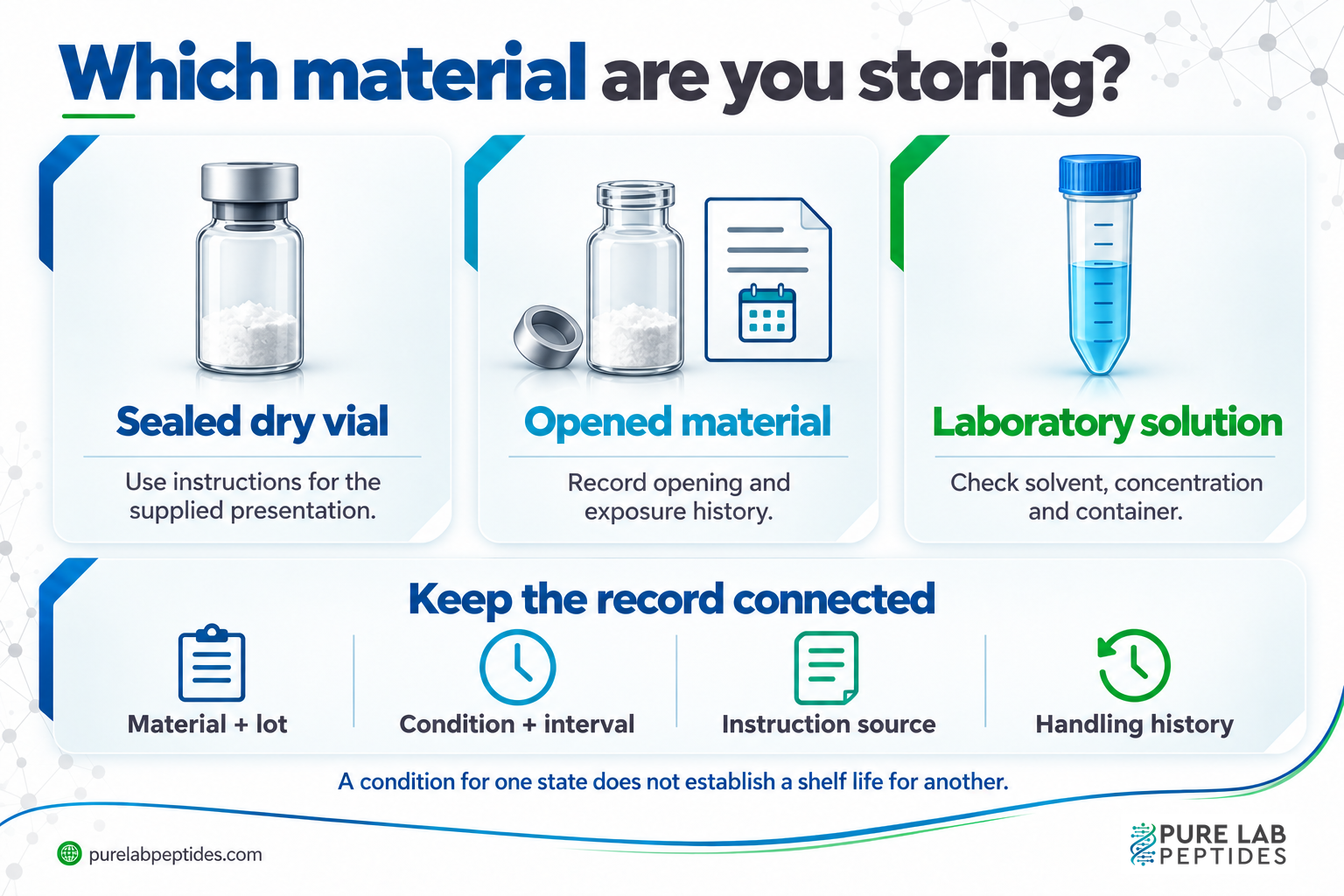
For a research peptide workflow, that means intake should at minimum capture compound name, lot or batch number, supplier, condition on receipt, linked COA, storage instruction from the label or documentation, and the initial storage assignment. If site practice includes repackaging or aliquoting under an SOP, the child container should remain traceable back to the parent lot and COA. That recommendation is an operations inference from GLP-style identification and batch-tracking rules, not a claim that one universal relabeling format is legally mandated for every research lab. [19]

Sealed storage should be framed conservatively: follow batch-specific storage conditions first, not generic internet habits. FDA’s analytical guidance expects storage conditions and documented shelf life to be part of reference-standard and analytical documentation, while GLP provisions require storage conditions on the container when needed to preserve identity, strength, purity, and composition. Research-lab housekeeping guidance also supports keeping containers closed when not in use, properly labeled, orderly stored, and returned to designated storage locations. The high-level message for a blog article is therefore simple: protect the sealed material from avoidable temperature excursions, light, moisture ingress, and mix-ups, and keep the documentation chain intact. [20]

Working-solution handling is where most peptide-storage articles become either too vague or too absolute. The stronger approach is to say that once a peptide enters solution, storage time and storage conditions should be treated as a defined laboratory variable controlled by validated supplier documentation, lot-specific information, or internal SOPs—not by a universal rule. FDA’s analytical guidance requires stability information for prepared solutions and standards, and peptide-stability reviews make clear why: solution conditions can shift degradation pressure through pH, oxidation, deamidation, aggregation, adsorption, and precipitation. In other words, opening and dissolving a peptide changes the stability problem. [21]

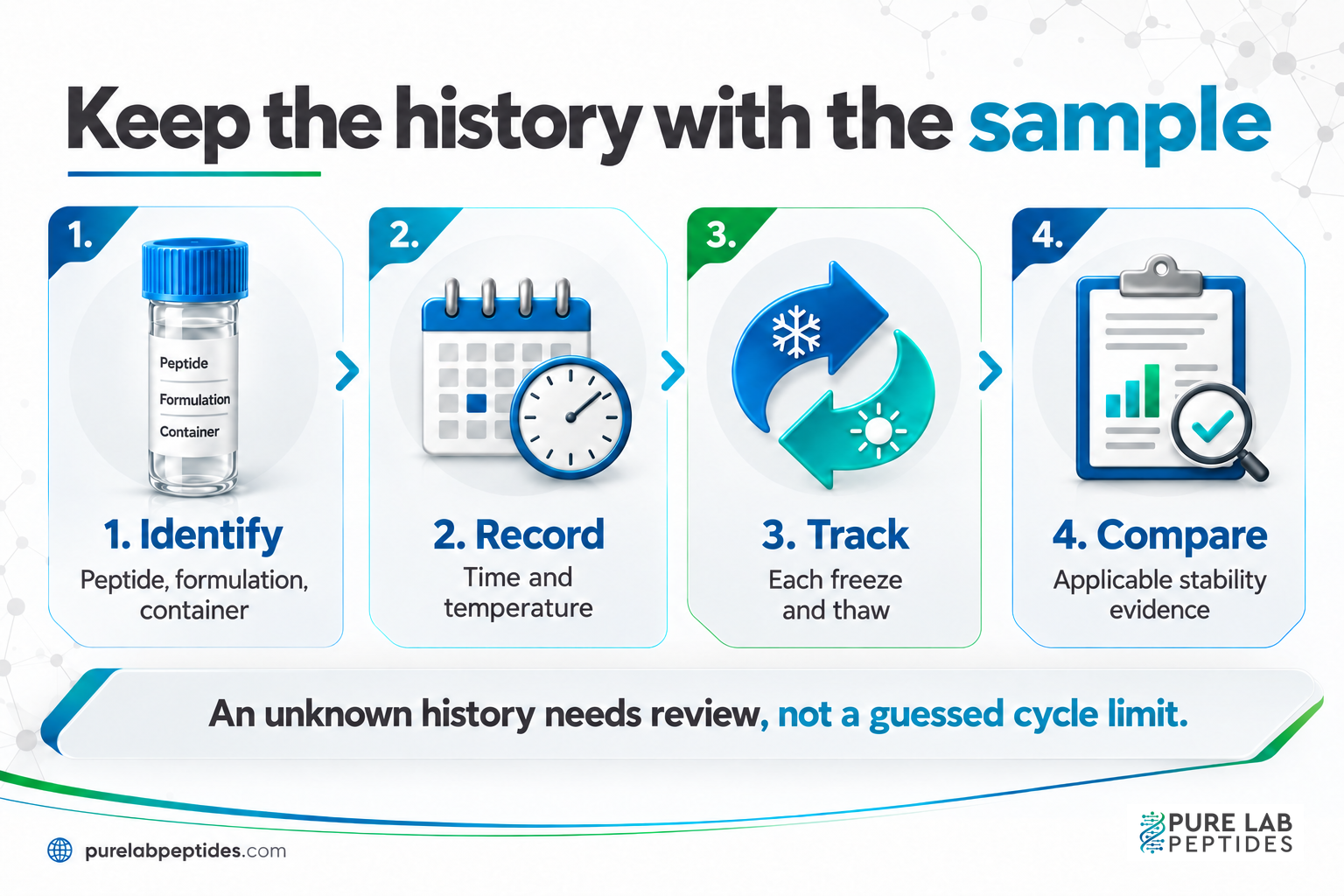
Aliquoting is often used in research environments to reduce repeated freeze–thaw exposure and repeated surface contact, but it should be presented as an SOP-governed control strategy rather than a blanket instruction. The literature on peptide-related analytes shows measurable decline after repeated freeze–thaw cycles, and the broader frozen-solution literature explains the mechanistic reasons: changes in pH, salt concentration, and ice–solution interfaces can destabilize fragile biomolecules. If aliquoting is adopted, the publish-ready message should be that aliquot size, container type, label content, and maximum reuse rules belong in lab documentation. [22]

Container choice also belongs in the handling framework. For peptides prone to surface loss, low-binding or low-adsorption consumables may materially improve recovery, while standard glass and polypropylene can be problematic at low concentrations. A careful article should therefore advise readers to treat transfers, autosampler vials, and storage tubes as variables worth validation—especially in low-concentration analytical workflows. It should also recommend minimizing unnecessary transfers, because every transfer increases both adsorption opportunity and documentation complexity. [15]

Transport and bench handling matter too. Prudent Practices in the Laboratory recommends break-resistant secondary containment during transport, routine housekeeping, clearly labeled transfer vessels, closed containers when not in use, and proper waste handling. Those are not peptide-specific rules, but they are exactly the kind of general controls that reduce spills, misidentification, contamination, and sample loss in a peptide lab. [23]

Documentation and analytical control

Storage and handling should be tied explicitly to analytics. FDA’s 2015 analytical-method guidance says sample preparation should include information on stability of solutions and storage conditions, and that standards/control solution preparation should include information on stability of standards and storage conditions. The same document says reference standards should be used under appropriate storage and handling instructions to avoid modifications, contamination, extra impurities, and inaccurate analysis. It also emphasizes system suitability and qualified instrumentation in validation work. For a peptide blog article, this means the freezer is only half the story; the other half is whether handling history is reflected in HPLC, LC-MS, and standard-control practices. [13]

ICH’s current Q2(R2) and Q14 pages reinforce the same analytical mindset by framing validation and development as scientific, fit-for-purpose, and risk-based. ISO/IEC 17025 adds the broader laboratory-quality perspective by centering competence, impartiality, and consistent laboratory operation. In a publish-ready article, these sources justify telling readers that excursion logs, opening dates, solution-preparation records, and standard-storage history are not administrative clutter. They are part of the evidence base behind credible results. [24]

Documentation matrix

Documentation element What to record Why it matters
Receipt log Date received, supplier, lot, package condition, storage instruction at receipt Establishes chain of custody and initial condition
Container label record Compound name, lot/batch, storage condition, expiration or review date if provided, parent-child link if aliquoted Prevents mix-ups and supports traceability
COA link COA identifier, lot match, purity and identity method references, analyst/reviewer sign-off Connects the physical material to analytical documentation
Storage location log Assigned freezer/cabinet position, move history, access restrictions if used Makes retrieval and audit follow-up possible
Opening/reconstitution log Date opened, preparer, solvent/buffer record if applicable, child-container map, return-to-storage event Captures when the stability problem changed from sealed to handled
Excursion log Time out of storage, temperature excursion, light exposure or transport event, disposition decision Supports later interpretation of analytical shifts
Freeze–thaw log Number of cycles, aliquot identifiers, analyst initials Helps explain loss of signal, adsorption, or degradation
Analytical follow-up HPLC/LC-MS review, standard suitability review, re-test decision, disposition notes Connects storage history to data quality

This matrix is a recommended synthesis of GLP-style article characterization and handling, FDA analytical guidance, and general laboratory quality practice. Exact fields can be adapted to site SOPs. [25]

Documentation workflow

flowchart TD A[Receive peptide lot] --> B[Verify RUO label, compound identity, lot number, and COA match] B --> C[Record arrival condition and assigned storage requirement] C --> D[Place in designated storage location] D --> E{Opened or prepared as working material?} E -- No --> F[Maintain sealed storage and access log] E -- Yes --> G[Document opening date, preparer, container type, and child aliquots] G --> H[Record each return-to-storage event and any excursion] H --> I[Track freeze-thaw history and transfers] I --> J[Review HPLC, LC-MS, standards, and system suitability when needed] J --> K[Archive records and document disposition]

This workflow is an operations template built from FDA analytical guidance, GLP-style handling provisions, and laboratory-safety/quality recommendations. It is intended as a site-adaptable pattern rather than a regulation-specific mandate for every laboratory. [26]

Documentation checklist

Checklist item Minimum expected evidence Status field for internal use
RUO labeling verified Label image or documented label text
Lot matched to COA Lot number confirmed on vial and COA
Storage condition recorded Label instruction or supplier documentation logged
Initial location assigned Freezer/cabinet/box position recorded
Opening date recorded Date and analyst/preparer noted
Child aliquots traceable Parent lot linked to each child container
Container type justified Standard or low-binding consumable rationale if relevant
Transfer/excursion history captured Time out of storage and event note
Freeze–thaw history updated Numeric cycle count or “not applicable”
Standards and controls reviewed Stability/storage conditions documented for standards
Analytical follow-up completed HPLC/LC-MS/system-suitability note if triggered
Final disposition recorded Returned to storage, quarantined, re-tested, or retired

This checklist is derived from the same guidance base: batch characterization, proper storage and identification, SOP coverage, equipment records, analytical sample/standard stability documentation, and prudent laboratory handling. [27]

Publishing package and editorial controls

Claim-boundary table

Research-safe statement Why it is safe Statement to avoid
“Peptide stability depends on temperature, moisture, light, oxygen, handling history, and solution state.” It summarizes the literature and guidance without promising a product outcome “All peptides remain stable as long as they are kept cold.”
“Batch-specific labels, COAs, and SOPs should govern exact storage conditions.” It points readers back to documentation rather than generic internet rules “This storage rule applies to every peptide regardless of sequence or format.”
“Working-solution stability should be documented and analytically supported.” It matches FDA analytical-method expectations “Once reconstituted, a peptide is fine for a fixed universal time window.”
“Low-binding consumables may reduce loss for adsorptive peptides.” It reflects adsorption literature without overclaiming “Container material does not affect peptide recovery.”
“Repeated freeze–thaw history should be minimized or logged under SOP.” It is a conservative lab-control statement supported by stability evidence “Freeze–thaw cycles never matter for peptides.”
“This article discusses laboratory research handling only.” It preserves RUO framing “This compound is intended for human or animal use.”
“Published pathway literature does not replace lot-specific storage and analytical records.” It separates scientific context from product handling claims “The literature proves this vial is fit for therapeutic or diagnostic use.”

This boundary table is a compliance-focused synthesis of intended-use rules, RUO labeling guidance, GLP-style handling provisions, FDA analytical guidance, and adsorption/stability literature. [28]

Frequently asked questions

Why is peptide storage a documentation issue and not only a freezer issue?

Because major guidance sources treat storage as part of the method and record system, not just part of the physical environment. FDA’s analytical-method guidance expects solution stability and storage conditions to be documented for samples, standards, and controls, and GLP-style provisions require proper storage, labeling, identification, and batch documentation. If a storage event cannot be reconstructed from the records, it becomes difficult to explain later changes in chromatographic or mass-spectrometric results. [29]

Are lyophilized peptides always more stable than peptides in solution?

Not automatically. Dry or lyophilized storage often reduces the number of active degradation pathways relative to aqueous handling, but solid-state stability still depends on variables such as residual moisture, water activity, oxygen, light, excipient behavior, and salt form. The substance P study is a useful reminder that even solid-state stability can differ meaningfully by formulation details, and broader lyophilized polypeptide literature shows that moisture and excipient crystallization can materially alter storage outcomes. [14]

Why do low-binding containers matter for some peptides?

Because adsorption can create large apparent losses even when no chemical degradation has occurred. The peptide-adsorption literature shows that standard glass and polypropylene can retain substantial amounts of peptide, especially at low concentration, while some low-binding plastics reduce that loss. For research workflows built around trace-level solutions, standards, or low-abundance analytical samples, container selection can therefore affect recovery and apparent stability. [15]

Should freeze–thaw history be logged for research peptides?

Yes, as a prudent laboratory control. Repeated freeze–thaw cycles have been shown to reduce stability for peptide-related analytes, and broader frozen-solution reviews explain mechanistic stresses such as pH shifts, solute concentration changes, and ice–solution interfaces. Not every peptide will respond identically, but logging the cycle history makes later analytical interpretation far more defensible. [30]

When should HPLC or LC-MS review be revisited after a storage event?

A reasonable trigger is any meaningful deviation from the documented handling pathway: unexplained signal loss, adsorption concerns, an unplanned temperature/light excursion, repeated freeze–thaw exposure, or a change in standard/control behavior. That approach is consistent with FDA expectations for method suitability, solution stability documentation, and controlled reference-standard handling, and it also fits the peptide LC-MS literature showing that storage conditions can contribute to structural modifications and impurity profiles. [31]

What should an RUO storage article avoid saying?

It should avoid universal stability guarantees, therapeutic or diagnostic framing, human-use or animal-use implications, dosing or administration instructions, and consumer-style benefit claims. FDA’s intended-use rule and RUO guidance both show why contradictory language can undermine a research-only position. A good storage article talks about documentation, environmental controls, sample integrity, and analytical follow-through—not about personal or clinical outcomes. [32]

References

  1. https://www.law.cornell.edu/cfr/text/21/58.105 [1] [4] [5] [18] [19] [25] [27]
  2. https://www.ecfr.gov/current/title-21/chapter-I/subchapter-C/part-201/subpart-D/section-201.128 [2] [6] [8] [9] [17] [28] [32]
  3. https://pubmed.ncbi.nlm.nih.gov/28053839/ [3] [22] [30]
  4. https://pubmed.ncbi.nlm.nih.gov/36986796/ [7] [11]
  5. https://www.fda.gov/medical-devices/device-labeling/in-vitro-diagnostic-device-labeling-requirements [10]
  6. https://www.fda.gov/regulatory-information/search-fda-guidance-documents/q5c-quality-biotechnological-products-stability-testing-biotechnologicalbiological-products [12] [16]
  7. https://www.fda.gov/files/drugs/published/Analytical-Procedures-and-Methods-Validation-for-Drugs-and-Biologics.pdf [13] [20] [21] [26] [29] [31]
  8. https://pubmed.ncbi.nlm.nih.gov/7681812/ [14]
  9. https://pmc.ncbi.nlm.nih.gov/articles/PMC4416745/ [15]
  10. https://www.ncbi.nlm.nih.gov/sites/books/NBK55872/ [23]
  11. https://www.fda.gov/regulatory-information/search-fda-guidance-documents/q2r2-validation-analytical-procedures [24]
Pure Lab Peptides Logo with Black Letters