



Sermorelin Research: GHRH Mechanism and Human Studies

TL;DR · The short version
Sermorelin research investigates the amidated GHRH(1–29) fragment and its effects on growth hormone release. The compound’s concentration, the resulting GH response and any later clinical outcome are different measurements. Original human studies show why the construct, route, sampling schedule and assay need to stay attached to each result.
A peptide can disappear from circulation before the hormone response ends. That isn’t a contradiction if the paper measured both separately. Sermorelin’s early literature lets you follow the specified fragment and the growth hormone released in response to it.
The fragment and terminus identify the construct
Quick take: GHRH(1–29)-NH2 identifies a defined fragment with an amidated C-terminus.
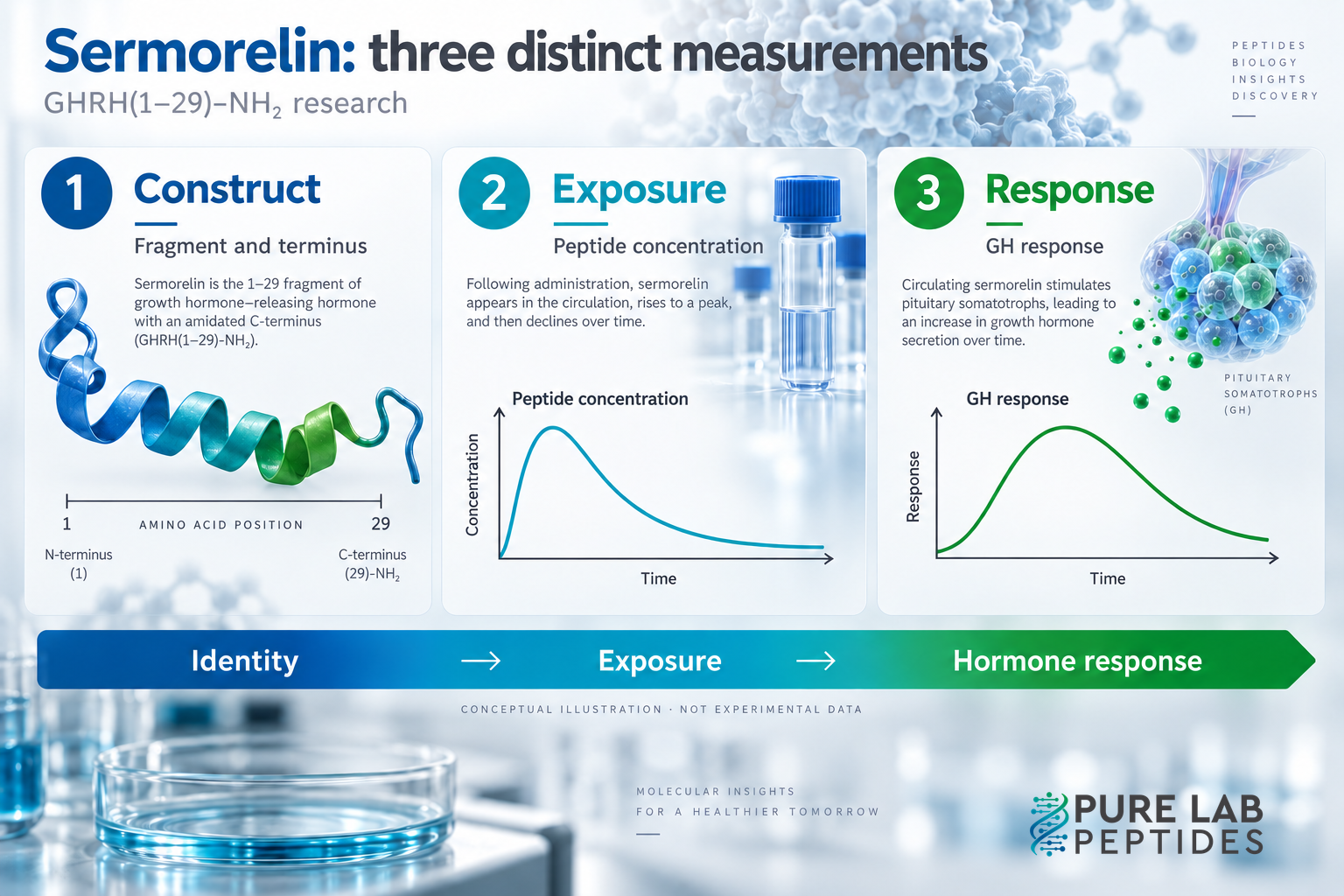
Sermorelin is a synthetic peptide corresponding to the first 29 amino acids of human growth hormone-releasing hormone. The official PubChem record gives the sequence and amidated terminal notation. The “1–29” describes the residues represented; NH2 identifies the terminal amide. Those details distinguish a specified structure from a loose reference to the GHRH family.
Sermorelin supplies the stimulus being studied, not growth hormone itself. In these experiments, GHRH stimulates release and circulating GH is a measured response. Keep those names separate when reading the results.
The chemical record identifies the named compound; another sample needs its own identity evidence. The peptide sequence guide explains the notation. Here we’ll follow the measurements made in the original experiments.
Sermorelin’s mechanism: a signal to release growth hormone
Quick take: Receptor signaling, circulating peptide and the resulting hormone response are different parts of the investigation.
GHRH receptors are expressed by somatotropic cells of the pituitary gland. Their activation connects a peptide signal to cAMP-dependent pathways involved in growth hormone secretion. An original cryo-EM study examined human GHRH receptor recognition and its interaction with a stimulatory G protein. This is receptor-level research, distinct from the human hormone-challenge studies below.
Look for the part of the mechanism the experiment actually measures. A signaling assay examines receptor response; blood sampling follows circulating hormones. A later clinical outcome needs its own evidence, even when the mechanism makes it seem plausible.
Similar GH peaks do not make fragments interchangeable
Quick take: A shared result for one endpoint does not establish identical behavior in every respect.
In Losa and colleagues’ 1984 comparison, five normal volunteers received GRF fragments of different lengths: 1–44, 1–40 and 1–29. All produced significant GH increases compared with placebo, with maxima occurring 15–30 minutes after the study challenge. No significant difference in the maximum GH increase was found between those fragments.
The small study supports its acute hormone comparison. It doesn’t establish identical clearance, responses in other populations or long-term outcomes. Original fragment-comparison report reports a maximum measurement, so keep your conclusion at that level.
| Reading question | Measurement to look for | Detail that can change the comparison |
|---|---|---|
| Which peptide was tested? | Sequence, fragment and terminal chemistry | Native fragment versus a substituted analog |
| How did peptide exposure change? | Peptide concentration over time | Route, assay and sampling window |
| How large was the GH response? | Peak, mean or integrated GH concentration | The chosen endpoint and reference condition |
| How did the response unfold? | Time to peak and decline after the peak | Sampling schedule and experimental condition |
| What did the assay detect? | Immunoreactivity or biological activity | Antibody recognition versus a functional readout |
Timing can change even when peak responses look similar
Quick take: The highest point on a curve leaves out much of the response.
A 1994 dose-response study compared saline and several GHRH(1–29)-NH2 challenge conditions in random order in ten adult male volunteers. Two of the tested conditions produced significant peak GH responses compared with saline. Their peaks were similar, but the response after the higher tested exposure declined more slowly and reached its peak later.
This is a response study, not an administration schedule. Height, timing and decline describe different features of a curve. Original challenge-study abstract is useful precisely because a maximum alone would miss part of its finding.
Two hypothetical curves reach similar heights, but one remains elevated longer. Calling them the same response loses that difference. Check which feature the authors compared before reducing the curves to one number.
Peptide exposure and GH response use different clocks
Quick take: Duration of a hormone response is not the peptide’s half-life.
In Wilton and colleagues’ 1993 study, GHRH(1–29)-NH2 was examined after intravenous or intranasal administration in 30 healthy men aged 19–43. The peptide was rapidly eliminated following intravenous administration, while GH levels remained elevated for about three hours. Intranasal bioavailability was low, reported as 3–5% under the study conditions.
Those findings separate the measured stimulus from the measured response and show why route matters. A hormone-release duration cannot be relabeled as time that the peptide remains in circulation. Nor can one route’s exposure findings be assigned to another route without supporting measurements. Original pharmacokinetic and hormone-response report.
When you read “short acting,” find out which curve it describes. Was it peptide concentration or hormone response? The assay and observation period make that description interpretable; a minute count without them doesn’t.
A modification needs evidence in the model being compared
Quick take: A stronger animal response does not automatically predict a stronger human response.
The 1989 human bioactivity comparison examined GHRH(1–29)-NH2 alongside an Ac-D-Tyr1,D-Ala2-substituted analog. Under the tested subcutaneous conditions, peak GH responses and areas under the GH curves were similar. The markedly enhanced activity previously observed in rats was not reproduced in that human comparison.
The authors proposed species differences in receptor interaction as a possible explanation. That is an interpretation, not a resolved mechanism proving how every modified analog behaves. Keep the modified construct in its own entry and retain the species beside the finding. The in vitro and in vivo research guide covers the wider problem of moving results between models.
The assay can change what “GH increased” means
Quick take: An antibody-based measurement and a biological assay need not describe exactly the same response.
A 1996 study in four adult volunteers compared GH immunoactivity with bioactivity after pulsed GHRH(1–29)-NH2 challenges. Responses varied among individuals. Although the measurements generally agreed, bioactivity-to-immunoactivity ratios increased near some response peaks. The authors suggested changing GH isoform concentrations as an explanation.
The small comparison isn’t a conversion rule between assays. It does show why “GH level” needs a method beside it. Don’t substitute one assay’s result into another study just because both measure the same named hormone. The paper-reading guide helps track that context.
Questions that keep a sermorelin summary precise
Quick take: Separate identity, exposure and hormone response before drawing a broader conclusion.
Is sermorelin the same as growth hormone?
No. It is the specified GHRH fragment discussed above. The studies examine GH released in response to that stimulus.
Does a GH response establish a clinical benefit?
It establishes the response measured under the experimental conditions. A clinical claim needs the relevant clinical endpoint, population and comparison. The mechanism-versus-efficacy guide explains that distinction.
What should go into the research note?
Note the construct, model or participants, route, assay and sampling period. Then specify the result: peptide exposure, GH peak, timing, integrated response or another endpoint. Someone reading your summary can then trace it to the right measurement.