

...
Analytical Methods

In Vitro vs In Vivo Peptide Research for RUO Labs

In Vitro vs In Vivo Peptide Research is the difference between controlled laboratory assays performed outside the body and the broader literature on peptide behavior inside living systems. For peptide science, that distinction matters because stability, permeability, clearance, and tissue context can shift interpretation as experimental complexity rises. Pure Lab Peptides positions its catalog for in-vitro laboratory research and development, so the in vivo discussion here is educational literature context rather than product-use positioning.[1][2][3][4][5]

Fast Answer

In Vitro vs In Vivo Peptide Research differs mainly in experimental complexity: in vitro studies isolate variables under controlled laboratory conditions, while published in vivo studies add whole-system exposure, distribution, metabolism, elimination, and physiological feedback that can change the apparent peptide profile. Products discussed in this article are intended for laboratory research use only and are not intended for human or animal consumption.[1][2][3][4][5]

What The Terms Mean In Peptide Research

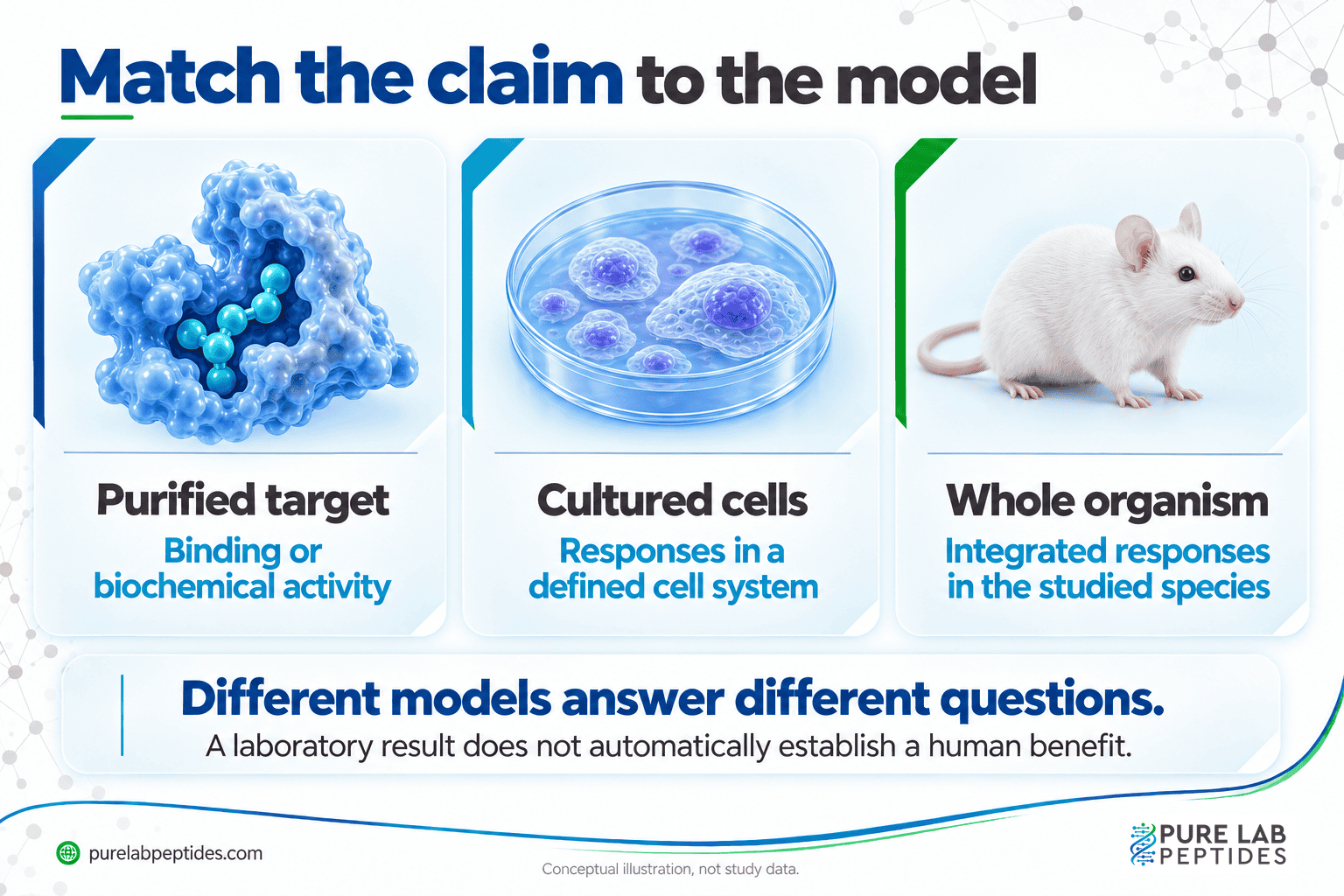
At the most basic level, “in vitro” means in the laboratory outside the body, while “in vivo” means in the body. In peptide research, however, the distinction is more useful when framed as a difference in model scope: in vitro work is designed to isolate selected variables, whereas published in vivo literature captures many interacting variables at once. That is why the same peptide can look highly interpretable in a defined assay and much less predictable in a more complex biological setting.[1][2][4][5]

For peptides, in vitro research can include physicochemical characterization, receptor-binding or enzyme assays, cultured-cell functional assays, serum or plasma stability screens, and barrier models such as epithelial transport systems. OECD guidance on Good In Vitro Method Practices emphasizes that credible in vitro data depend on defined roles, quality considerations, apparatus and reagent control, SOPs, method performance, clear reporting, and retention of records. NC3Rs likewise highlights animal-free in vitro technologies as a route to improved science, reproducibility, and reduced animal use, which is relevant when laboratories want strong mechanistic data before consulting more complex literature.[5][6][7]

That framing matters especially for RUO suppliers. Pure Lab Peptides states in its public FAQ that its products are intended strictly for in-vitro laboratory research and development and are not intended for in vivo use, diagnostic testing, or therapeutic application. In other words, a comparison article like this one should help laboratory teams interpret evidence categories, not blur intended-use boundaries.[3]

Why Peptide Findings Often Change Across Model Systems

Peptides have properties that make cross-model comparison especially important. A major review in Signal Transduction and Targeted Therapy notes two intrinsic drawbacks of many peptides: weak membrane permeability and poor in vivo stability. The same review explains that peptides are often chemically and physically unstable in vivo, with short half-life and fast elimination, while the 2022 Advanced Drug Delivery Reviews review by Klepach and colleagues highlights how effective size, hydrophobicity, net charge, proteolytic stability, and albumin binding can materially alter peptide disposition.[4][5]

That means a clean signal in buffer or cell media does not automatically survive contact with biological matrices. Powell and colleagues described human serum or plasma stability determination as a powerful screening assay for eliminating unstable peptides from further development, and Jenssen and Aspmo later focused an entire methods chapter on serum stability assays for peptides in both in vitro and in vivo settings. Those sources are still useful because they make an enduring point: before a peptide is overinterpreted biologically, its stability liabilities should be understood in the matrix that matters for the question being asked.[8][9]

Transport and barrier effects introduce another layer of uncertainty. Foltz and colleagues showed how intestinal stability, Caco-2 permeability, and in vitro activity can diverge for dipeptides, while Lundquist and Artursson reviewed why oral absorption of peptides across the human intestine remains difficult and why cell and tissue models are used for in vitro-in vivo extrapolation rather than as exact replicas of whole-system behavior. For peptide research, this is the core interpretive risk: one model can confirm a mechanism, while another exposes the limits of whether the peptide can realistically maintain that signal in a more complex environment.[10][11]

Research question Common in vitro emphasis What broader biological literature adds Why interpretation can diverge
Does the peptide engage the intended target? Binding, enzyme, or cell-based signaling assays under defined conditions.[4] Exposure, tissue access, clearance, and competing physiology that can reshape the observed signal.[5] Target engagement can look strong in isolation yet weaken when permeability and biological turnover are introduced.[4][5]
Is the peptide stable enough to remain interpretable? Serum, plasma, or other matrix stability screens.[8][9] System-level degradation, elimination, and time-dependent loss of signal.[4] Proteolysis and elimination can dominate once the peptide leaves a tightly controlled assay matrix.[8][4]
Can the peptide cross a relevant barrier? Caco-2 or related transport models, digestion or permeability studies.[10][11] Absorption constraints and route-dependent disposition in more complex systems.[11] Barrier models are informative, but they are still surrogates rather than full physiological replicas.[11]
Will the signal persist over time? Short-window activity and stability observations.[9] Time-resolved exposure and disposition patterns shaped by ADME factors.[5] Half-life, albumin binding, and clearance can change the practical concentration range seen by the system.[4][5]
How much variability should be expected? Lower biological complexity and tighter experimental control.[6] Higher biological variability and more interacting confounders.[4][5] Added realism often comes with added noise, making analytical baselines even more important.[6][5]

The practical takeaway is that neither category should be overread. In vitro peptide research is strongest for mechanism isolation, comparability, and controlled ranking. Published in vivo literature is strongest for showing whether the peptide signal survives integrated biology. Good interpretation depends on respecting what each model can answer and, equally important, what it cannot answer by itself.[4][5][6]

What Researchers Usually Evaluate In Vitro First

Serious peptide research typically begins with material characterization before biological interpretation. The FDA M10 guidance describes harmonized expectations for validation of chromatographic and ligand-binding assays used to generate nonclinical and clinical bioanalytical data, while the EMA synthetic peptide guideline specifically addresses characterization, specifications, and analytical control for synthetic peptides. Even when a laboratory is working in an RUO context rather than a regulated submission pathway, those sources are still useful benchmarks for what disciplined documentation looks like: identity, method scope, controls, and fit-for-purpose analytical readouts should be visible before a biological claim is trusted.[12][13]

After that analytical baseline is established, early in vitro peptide work usually focuses on a small set of recurring questions: does the material match the expected peptide, does it engage the target under defined conditions, does it remain stable in the matrix being studied, and does it cross any barrier that is central to the research question. Peptidomics literature adds an important warning here: peptide instability in biological matrices can complicate measurement itself, which means sample collection, preparation, and processing can change what appears to be “activity” or “absence of activity” if those steps are not tightly controlled.[8][9][10][11][14]

  • Analytical identity and purity are usually established before any mechanistic readout is weighed heavily, because an assay cannot rescue a mislabeled or poorly characterized batch.[12][13]
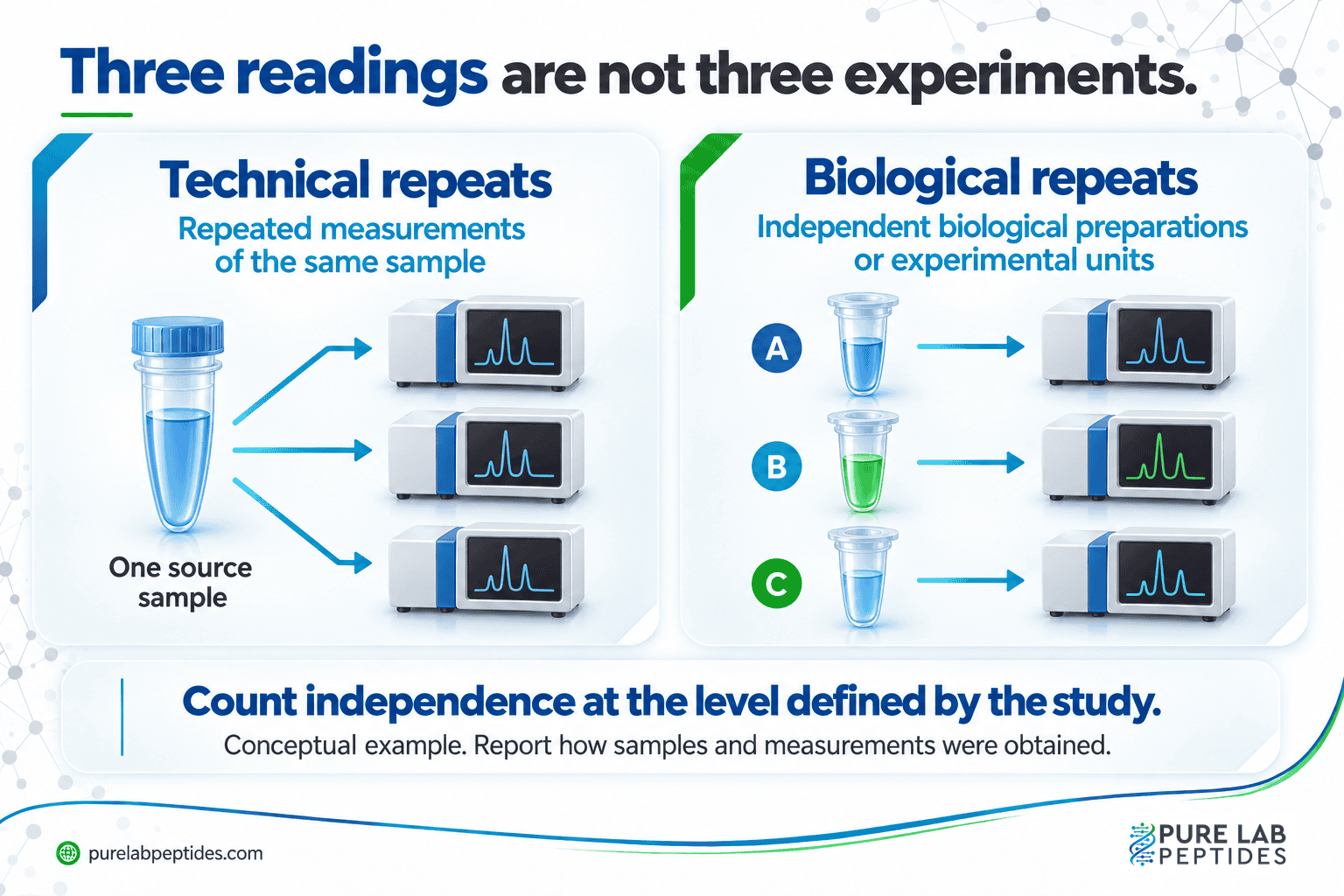
  • Activity screens can be informative only when the assay conditions, controls, and reporting are tight enough to separate peptide effect from platform artifact.[6][12]
  • Matrix stability testing matters because peptides may degrade quickly in serum, plasma, or digestion models even if the same sequence looks robust in simpler media.[8][9]
  • Barrier and permeability models become relevant when the literature question depends on transport across intestinal, epithelial, or other interfaces rather than target binding alone.[10][11]

Related reading for this documentation-first layer includes peptide purity vs peptide identity, LC-MS testing for peptide identity, and peptide purity testing explained. Those articles fit naturally beside this topic because they help clarify what should be known about the peptide itself before any comparison between in vitro and in vivo evidence is attempted.

What Published In Vivo Literature Adds

Published in vivo peptide literature adds information that isolated assays cannot fully reproduce: exposure over time, tissue distribution, clearance, protein binding, route-specific barriers, and feedback from integrated physiology. The reason this matters for peptides is straightforward. Their practical behavior is often shaped less by intrinsic target affinity than by whether they remain intact, reach the relevant compartment, and persist at interpretable concentrations long enough to generate a measurable signal.[4][5][11]

At the same time, published in vivo results are not automatically “more correct” than in vitro data. Wong and colleagues, writing about protein and peptide formulation characterization, note that lack of standardized testing protocols can limit accurate interpretation of both in vitro and in vivo findings. That caution generalizes well beyond one delivery route: model species, formulation architecture, sample timing, endpoint choice, and analytical sensitivity can all change the apparent peptide story. In practice, in vivo literature adds realism, but it also adds variables that must be examined rather than assumed away.[15][5]

For RUO sourcing and method review, the safest reading is that published in vivo literature should pressure-test a peptide hypothesis, not replace analytical characterization. If a peptide appears promising in a complex model but the batch identity, purity context, matrix stability, or sample-processing details are weak, the biological narrative may still be less reliable than it first appears. That is why literature interpretation and lot-level documentation belong together rather than in separate workflows.[13][14][15]

How Labs Bridge In Vitro Data To Broader Biological Context

The bridge between in vitro peptide data and broader biological relevance is not guesswork. The National Toxicology Program’s NICEATM program describes in vitro to in vivo extrapolation, or IVIVE, as a workflow that applies PK or PBPK models to calculate an equivalent administered dose corresponding to an in vitro assay endpoint. Bell and colleagues describe IVIVE as an important tool for prioritization and decision-making because it helps relate assay concentrations to external exposure levels rather than treating every in vitro concentration as equally plausible.[16][17]

For peptide research, that bridge is especially valuable because peptides do not move through biological systems as inert objects. Stability losses, protein binding, barrier interactions, and clearance can all compress the concentration window that a living system actually experiences. A strong in vitro signal is therefore most informative when laboratories also ask whether that concentration range is compatible with what the peptide could plausibly maintain under broader biological constraints described in the literature.[5][16][17]

Conceptual workflow for interpreting peptide evidence as model complexity increases. This diagram is an editorial synthesis based on the cited literature rather than a direct figure from one source.

flowchart TD A[Research question defined] --> B[Peptide identity and purity confirmed] B --> C[In vitro binding or functional assay] C --> D[Matrix stability and permeability screens] D --> E{Does the signal survive exposure constraints?} E -- Yes --> F[IVIVE and PK modeling] E -- No --> G[Refine sequence formulation or assay design] F --> H[Compare with published in vivo literature] H --> I[Update hypothesis and documentation package]

A staged workflow is increasingly visible across peptide discovery literature. A 2024 systematic review of peptides examined across in silico, in vitro, and in vivo stages illustrates why multi-stage comparison matters: cross-stage agreement can be informative, but disagreement is often the more useful signal because it reveals where potency, stability, transport, or model translation began to break down. For laboratories, that is the right mindset for comparing in vitro vs in vivo peptide research: not as a contest, but as a sequence of filters that progressively remove false confidence.[18][16][17]

Documentation And Sourcing Considerations For RUO Peptide Work

For a research-use-only supplier, the central procurement question is not whether a peptide has an interesting headline claim. It is whether the batch can be interpreted responsibly in laboratory work. Pure Lab Peptides publicly positions its materials for in-vitro laboratory research and development only, and official FDA and EMA guidance on assay validation, characterization, specifications, and analytical control offers a useful framework for what “responsibly interpreted” should mean in practice: clear intended-use language, lot-level documentation, method transparency, and separation of identity, purity, and assay claims rather than collapsing them into a single number.[3][12][13]

  1. Confirm the intended-use statement first. If supplier language blurs RUO boundaries, the interpretive risk begins before any assay data are read.[3]
  2. Match the exact lot to the supporting documentation. Method details that are not tied to the lot under review are less useful for laboratory records.[12][13]
  3. Separate identity, purity, and bioanalytical performance. These are related attributes, but they answer different questions and should not be collapsed into one headline percentage.[12][13]
  4. Review matrix context and sample handling when peptide measurements come from biological material. Peptidomics workflows show that processing choices can materially change peptide detectability and interpretability.[14]
  5. Keep analytical evidence and biological interpretation linked. A peptide literature claim is easier to evaluate when the material, method, and matrix are all documented together.[13][14]

For additional site-specific context, related Pure Lab resources include peptide stability documentation basics, COA red flags in research peptide documentation, RUO vs clinical use, and peptide storage and handling for laboratory research. Those pages fit this topic because they keep the focus on documentation quality, intended use, and experimental interpretability rather than consumer-style claims.

FAQs

Is in vitro peptide research more reliable than in vivo peptide research?

In Vitro vs In Vivo Peptide Research is not a hierarchy where one category is always superior. In vitro work usually offers tighter control of variables and cleaner mechanistic readouts, while published in vivo literature adds exposure, clearance, tissue access, and physiological feedback. The better question is whether the model actually answers the research question and whether the peptide material is analytically well characterized.[4][5][6][13]

Can a peptide that looks potent in vitro still lose signal in broader biological models?

Yes. A peptide that appears potent in vitro can still lose signal once stability, permeability, protein binding, or clearance become important. Reviews of peptide ADME and stability repeatedly note that short half-life, proteolysis, and transport barriers can narrow the effective concentration range seen by a more complex system, even when the same sequence performs well in a tightly controlled assay.[4][5][8][11]

What in vitro measurements matter most before comparing peptide studies?

The most important in vitro measurements before comparing peptide studies are usually identity, purity context, fit-for-purpose assay performance, and matrix stability. That answer matters because a peptide result is only as interpretable as the batch and method behind it. FDA and EMA guidance both reinforce the value of method scope, validation, characterization, and analytical control before downstream conclusions are weighed heavily.[12][13][14]

Does RUO labeling mean a peptide is appropriate for in vivo work?

No. For Pure Lab Peptides specifically, published FAQ language states that products are intended strictly for in-vitro laboratory research and development and are not intended for in vivo use, diagnostic testing, or therapeutic application. In this article, in vivo literature is discussed only to help readers interpret evidence categories and model limitations, not to position any catalog material for that use.[3]

How do laboratories connect an in vitro result to broader biological relevance?

Laboratories connect an in vitro result to broader biological relevance by combining analytical characterization with exposure-aware interpretation, often through IVIVE concepts, PK or PBPK modeling, and comparison against staged literature that moves from computational screening to in vitro confirmation and then to broader biological evidence. That approach is more reliable than treating an isolated assay concentration as self-explanatory.[16][17][18]

Next Steps

Review batch-specific documentation before selecting any research-use-only peptide. Explore Pure Lab Peptides resources, the FAQ, and the research catalog for RUO peptide materials with clear labeling and documentation review pathways consistent with the brand’s published intended-use boundary.[3]

References

  1. National Cancer Institute. “in vitro.” NCI Dictionary of Cancer Terms. n.d. https://www.cancer.gov/publications/dictionaries/cancer-terms/def/in-vitro
  2. National Cancer Institute. “in vivo.” NCI Dictionary of Cancer Terms. n.d. https://www.cancer.gov/publications/dictionaries/cancer-terms/def/in-vivo
  3. Pure Lab Peptides. “FAQs.” Pure Lab Peptides. 2026. https://purelabpeptides.com/faqs/
  4. Wang L, Wang N, Zhang W, et al. “Therapeutic peptides: current applications and future directions.” Signal Transduction and Targeted Therapy. 2022. https://doi.org/10.1038/s41392-022-00904-4
  5. Klepach A, Tran H, Mohammed FA, ElSayed MEH. “Characterization and impact of peptide physicochemical properties on oral and subcutaneous delivery.” Advanced Drug Delivery Reviews. 2022. https://doi.org/10.1016/j.addr.2022.114322
  6. OECD. “Guidance Document on Good In Vitro Method Practices (GIVIMP).” OECD Series on Testing and Assessment No. 286. 2018. https://doi.org/10.1787/9789264304796-en
  7. NC3Rs. “Animal-free in vitro technologies.” NC3Rs Resource Library. n.d. https://nc3rs.org.uk/3rs-resource-library/animal-free-vitro-technologies
  8. Powell MF, Stewart T, Otvos L Jr, et al. “Peptide Stability in Drug Development. II. Effect of Single Amino Acid Substitution and Glycosylation on Peptide Reactivity in Human Serum.” Pharmaceutical Research. 1993. https://doi.org/10.1023/A:1018953309913
  9. Jenssen H, Aspmo SI. “Serum stability of peptides.” Methods in Molecular Biology. 2008. https://doi.org/10.1007/978-1-59745-419-3_10
  10. Foltz M, van Buren L, Klaffke W, Duchateau GSMJE. “Modeling of the relationship between dipeptide structure and dipeptide stability, permeability, and ACE inhibitory activity.” Journal of Food Science. 2009. https://doi.org/10.1111/j.1750-3841.2009.01301.x
  11. Lundquist P, Artursson P. “Oral absorption of peptides and nanoparticles across the human intestine: Opportunities, limitations and studies in human tissues.” Advanced Drug Delivery Reviews. 2016. https://doi.org/10.1016/j.addr.2016.07.007
  12. U.S. Food and Drug Administration. “M10 Bioanalytical Method Validation and Study Sample Analysis.” FDA Guidance for Industry. 2022. https://www.fda.gov/regulatory-information/search-fda-guidance-documents/m10-bioanalytical-method-validation-and-study-sample-analysis
  13. European Medicines Agency. “Development and manufacture of synthetic peptides – Scientific guideline.” European Medicines Agency. 2025. https://www.ema.europa.eu/en/development-manufacture-synthetic-peptides-scientific-guideline
  14. Foreman RE, George AL, Reif DW. “Peptidomics: A Review of Clinical Applications and Considerations for Sample Collection, Processing, and Analysis.” Journal of Proteome Research. 2021. https://doi.org/10.1021/acs.jproteome.1c00295
  15. Wong CYJ, Baldelli A, Tietz O, et al. “An overview of in vitro and in vivo techniques for characterization of intranasal protein and peptide formulations for brain targeting.” International Journal of Pharmaceutics. 2024. https://doi.org/10.1016/j.ijpharm.2024.123922
  16. National Toxicology Program Interagency Center for the Evaluation of Alternative Toxicological Methods. “In Vitro to In Vivo Extrapolation.” NICEATM, National Institute of Environmental Health Sciences. n.d. https://ntp.niehs.nih.gov/whatwestudy/niceatm/comptox/ct-ivive/ivive
  17. Bell SM, Chang X, Wambaugh JF, et al. “In vitro to in vivo extrapolation for high throughput prioritization and decision making.” Toxicology in Vitro. 2018. https://doi.org/10.1016/j.tiv.2017.11.016
  18. Aguiar AJFC, de Medeiros WF, da Silva-Maia JK, et al. “Peptides Evaluated In Silico, In Vitro, and In Vivo as Therapeutic Tools for Obesity: A Systematic Review.” International Journal of Molecular Sciences. 2024. https://doi.org/10.3390/ijms25179646
Pure Lab Peptides Logo with Black Letters