 Skip to content
GHK-Cu and Copper-Dependent Pathway Research (RUO focus)
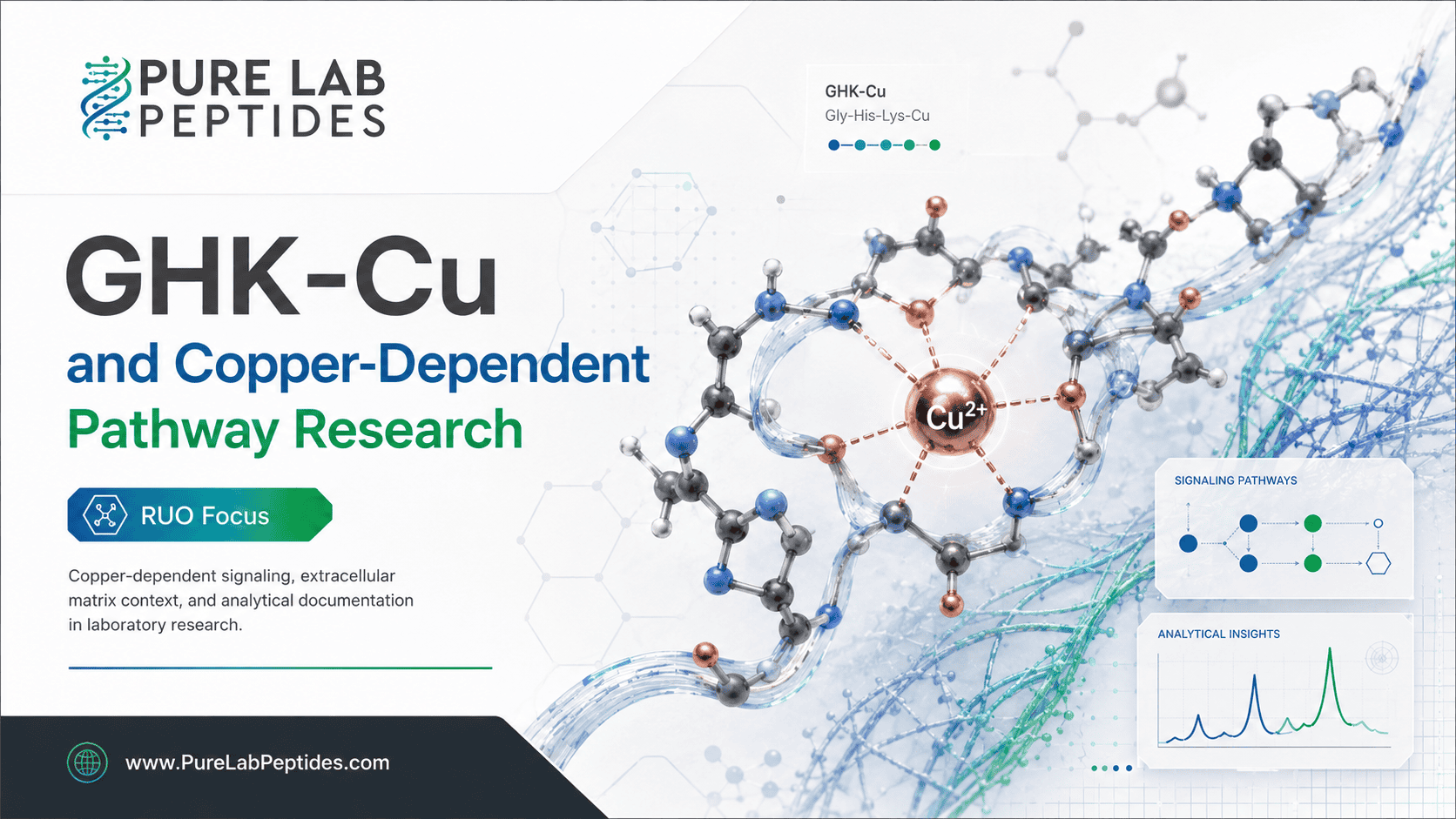
GHK-Cu (glycyl-L-histidyl-L-lysine copper complex) is a naturally occurring peptide research compound that binds Cu(II). It forms when the GHK tripeptide chelates copper, enabling delivery of copper ions into cells [1]. In laboratory studies, GHK-Cu is evaluated as a copper carrier that influences pathways like extracellular matrix production and antioxidant defense [3][2]. This article focuses on GHK-Cu in a strictly research-use-only context.
Fast Answer
GHK-Cu is studied in laboratory research as a copper-binding peptide that delivers copper to cells and modulates copper-dependent pathways (e.g. collagen synthesis, antioxidant enzymes) [1][3]. Products discussed in this article are intended for laboratory research use only and are not intended for human or animal consumption.
GHK-Cu Structure and Copper Binding
GHK-Cu is a tripeptide (glycine-histidine-lysine) that tightly chelates Cu(II) in a 1:1 complex. The peptide coordinates copper via the histidine imidazole and amine groups, forming a stable GHK–Cu complex that is water-soluble and biologically active [1]. In human plasma, GHK can acquire Cu2+ from albumin, the primary copper carrier, effectively acting as a mobile copper delivery agent [4]. The resulting GHK-Cu complex suppresses copper’s redox activity, allowing safe transport of copper into cells without catalyzing harmful free radical reactions [1]. This copper-bound form is the research material used in biochemical studies (see Table below).
Mechanism: Copper Delivery and Pathway Modulation
In cell and tissue research models, GHK-Cu is thought to facilitate copper uptake and activate copper-dependent biochemical pathways [1][4]. For example, GHK binds Cu2+ from plasma albumin and carries it to the site of interest [4]. After cellular uptake, the bound copper can be released to metalloenzymes or signaling molecules. Key cuproenzymes include those for antioxidant defense and matrix crosslinking. Many cellular enzymes rely on copper redox cycling (e.g., cytochrome c oxidase for respiration, Cu/Zn-superoxide dismutase for oxidative stress defense) [3]. By delivering bioavailable Cu2+ in a nontoxic form, GHK-Cu may enhance activities of these copper-dependent enzymes [1][3].

Text version of this diagram
- Plasma albumin–Cu(II) — GHK binds Cu → GHK–Cu complex.
- GHK–Cu complex — Cellular uptake → Intracellular.
- Intracellular — Supplies Cu → Copper-dependent enzymes (e.g. SOD, LOX).
- Intracellular — Gene regulation → Modulates ECM & antioxidant genes.
Diagram: Conceptual flowchart of GHK peptide binding Cu(II), forming GHK-Cu, entering a cell, and delivering Cu to enzymes or gene pathways (illustrative).
Effects on Extracellular Matrix and Gene Expression
Research studies report that GHK-Cu modulates expression of extracellular matrix (ECM) components and related pathways. In cultured dermal fibroblasts, GHK-Cu increased collagen and elastin synthesis as well as glycosaminoglycan (decorin) production [3]. Correspondingly, it regulates matrix remodeling by altering protease activity: GHK-Cu suppresses matrix metalloproteinases (MMP-2, MMP-9) and boosts tissue inhibitors of metalloproteinases (TIMPs) in wound models [3]. These effects suggest a role in balancing ECM turnover, preventing excessive protein breakdown and supporting tissue repair [3].
GHK-Cu also influences oxidative stress and growth factor pathways. Preclinical data show GHK-Cu elevates antioxidant enzyme levels (notably Cu/Zn-SOD activity) by providing necessary Cu2+ [2]. In wound or injury models, GHK-Cu treatment raised intracellular glutathione and SOD activities. It additionally upregulated angiogenic growth factors like basic fibroblast growth factor (bFGF) and vascular endothelial growth factor (VEGF) [2]. Such changes could promote vascular growth in tissue culture models. Overall, GHK-Cu’s lab-observed effects include increased ECM proteins and antioxidant defenses, along with modulation of MMPs and growth factors (see Table 1 for a summary).
| Biological Target | GHK-Cu Effect (Research Findings) | Reference |
| Collagen (skin fibroblasts) | ↑ production and gene expression | [3] |
| Elastin (skin fibroblasts) | ↑ synthesis | [3] |
| Decorin (proteoglycan) | ↑ synthesis | [3] |
| MMP-2, MMP-9 (ECM proteases) | ↓ activity/levels in wounds | [3] |
| Antioxidant enzymes (e.g. Cu/Zn-SOD) | ↑ activity | [2] |
| Growth factors (bFGF, VEGF) | ↑ expression | [2] |
| Inflammatory cytokines (e.g. TNF-β) | ↓ levels in healing tissue | [3] |
Table 1. Summary of laboratory research findings on GHK-Cu’s effects. Arrows indicate upregulation (↑) or downregulation (↓) observed in preclinical models [3][2]. (ECM = extracellular matrix.)
Analytical Characterization and Quality Standards
In line with research-use standards, GHK-Cu batches are characterized by analytical tests. The identity of GHK-Cu is typically verified by liquid chromatography–mass spectrometry (LC-MS): the expected [M+H]+ ion for GHK appears at m/z 341. Purity is assessed by high-performance liquid chromatography (HPLC), aiming for high peptide purity to avoid assay confounders. Standard COA parameters include peptide purity by HPLC, LC-MS identity, and assay for copper content. For example, HPLC often shows a single dominant GHK peak; MS confirms the tripeptide’s mass. Other QA tests may include water content (Karl Fischer), residual solvents, and amino acid analysis. Researchers should review the batch-specific COA to ensure ≥95% purity (typical for research peptides). Detailed documentation (HPLC chromatogram and MS spectrum) is expected to accompany RUO peptides, providing confidence in quality and consistency (see Table 2).
| Specification | Analytical Test | Expected Outcome |
| Identity | LC-MS (electrospray ionization) | [M+H]+ ion at m/z 341 (GHK peptide) |
| Purity | Analytical RP-HPLC | Major peak ≥95% of total area |
| Copper Content | ICP-MS or AAS | Matching theoretical Cu:peptide ratio |
| Moisture/Residues | Karl Fischer titration / UV | Low water and solvent levels per specification |
Table 2. Typical quality control parameters for a research-grade GHK-Cu peptide. Identity and purity are confirmed by LC-MS and HPLC, respectively. Copper content is verified to ensure the correct metal loading. (These are examples; actual COAs may include additional tests.)
FAQs
What is GHK-Cu used for in research?
GHK-Cu is used in laboratory settings to study how copper interacts with cells and proteins. It serves as a model copper carrier to investigate copper-dependent pathways (such as collagen synthesis and antioxidant enzyme activity) under controlled conditions [1][3]. Researchers apply GHK-Cu to cell cultures or tissue models to observe changes in gene expression, extracellular matrix production, and other biomarkers relevant to tissue repair and oxidative stress.
How does GHK-Cu deliver copper to cells?
GHK-Cu binds copper ions tightly and can extract Cu2+ from carrier proteins like albumin [4]. The peptide-copper complex then enters cells and releases copper internally. By chelating copper, GHK-Cu neutralizes its redox activity during transport and delivers Cu2+ in a form usable by enzymes and signaling pathways [1]. This mechanism is inferred from biochemical studies of copper binding and cellular uptake.
What effects does GHK-Cu have on cells in research?
In cell studies, GHK-Cu has been found to stimulate production of collagen, elastin, and other extracellular matrix molecules, while also modulating enzymes that degrade matrix proteins [3][2]. It tends to increase activity of antioxidant enzymes (e.g. superoxide dismutase) and enhance expression of growth factors like VEGF and FGF in culture [2]. These observations suggest that GHK-Cu may create a cellular environment supportive of tissue maintenance and repair (in preclinical models). Importantly, these are laboratory findings and do not imply direct clinical benefits.
How is GHK-Cu verified and tested analytically?
GHK-Cu identity is confirmed by LC-MS (mass spectrometry) by matching its known molecular weight, and its purity is assessed by HPLC (high-performance liquid chromatography). A standard certificate of analysis will include an HPLC chromatogram showing the peptide’s purity and an MS spectrum confirming the [M+H]+ mass at 341. Other tests may check copper content and moisture. Researchers should review these reports to ensure the RUO peptide meets expected quality specifications before use.
Is GHK-Cu safe for laboratory use?
GHK-Cu is handled as a standard research chemical. It should be treated with appropriate lab safety practices (gloves, eye protection, etc.) as described in its safety data sheet. GHK-Cu is intended only for in vitro or preclinical research use and is not approved for any human or veterinary use. There are no standardized dosing or therapeutic guidelines for research use – protocols are experiment-specific.
Next Steps
Researchers should review batch-specific documentation before selecting any research peptide. Pure Lab Peptides offers RUO GHK-Cu with detailed COA data (HPLC and LC-MS results) and transparent labeling. When sourcing peptides, prioritize suppliers that provide clear documentation, certificate of analysis, and research-focused information to support your work.
References
- Pickart L, Freedman JH, Loker WJ. “Growth-modulating plasma tripeptide may function by facilitating copper uptake into cells.” Nature. 1980. doi.org/10.1038/288715a0
- Pickart L, Bova R, Wenz J, et al. “The human tripeptide GHK-Cu in prevention of oxidative stress and degenerative conditions of aging: implications for cognitive health.” Oxid Med Cell Longev. 2012;2012:324832. doi.org/10.1155/2012/324832
- Pickart L, Margolina A. “Regenerative and Protective Actions of the GHK-Cu Peptide in the Light of the New Gene Data.” Int J Mol Sci. 2018;19(7):1987. doi.org/10.3390/ijms19071987
- Pickart L, Vasquez-Soltero JM. “GHK-Cu may prevent oxidative stress in skin by regulating copper and modifying expression of numerous antioxidant genes.” Cosmetics (Basel). 2015;2(3):236–247. doi.org/10.3390/cosmetics2030236
- Maquart FX, Pickart L, Laurent M, et al. “Stimulation of collagen synthesis in fibroblast cultures by the tripeptide-copper complex Glycyl-L-histidyl-L-lysine-Cu2+.” FEBS Lett. 1988;238(2):343–346. doi.org/10.1016/0014-5793(88)80509-X