



Albumin Binding Peptide Research: Affinity, DAC and Half-Life

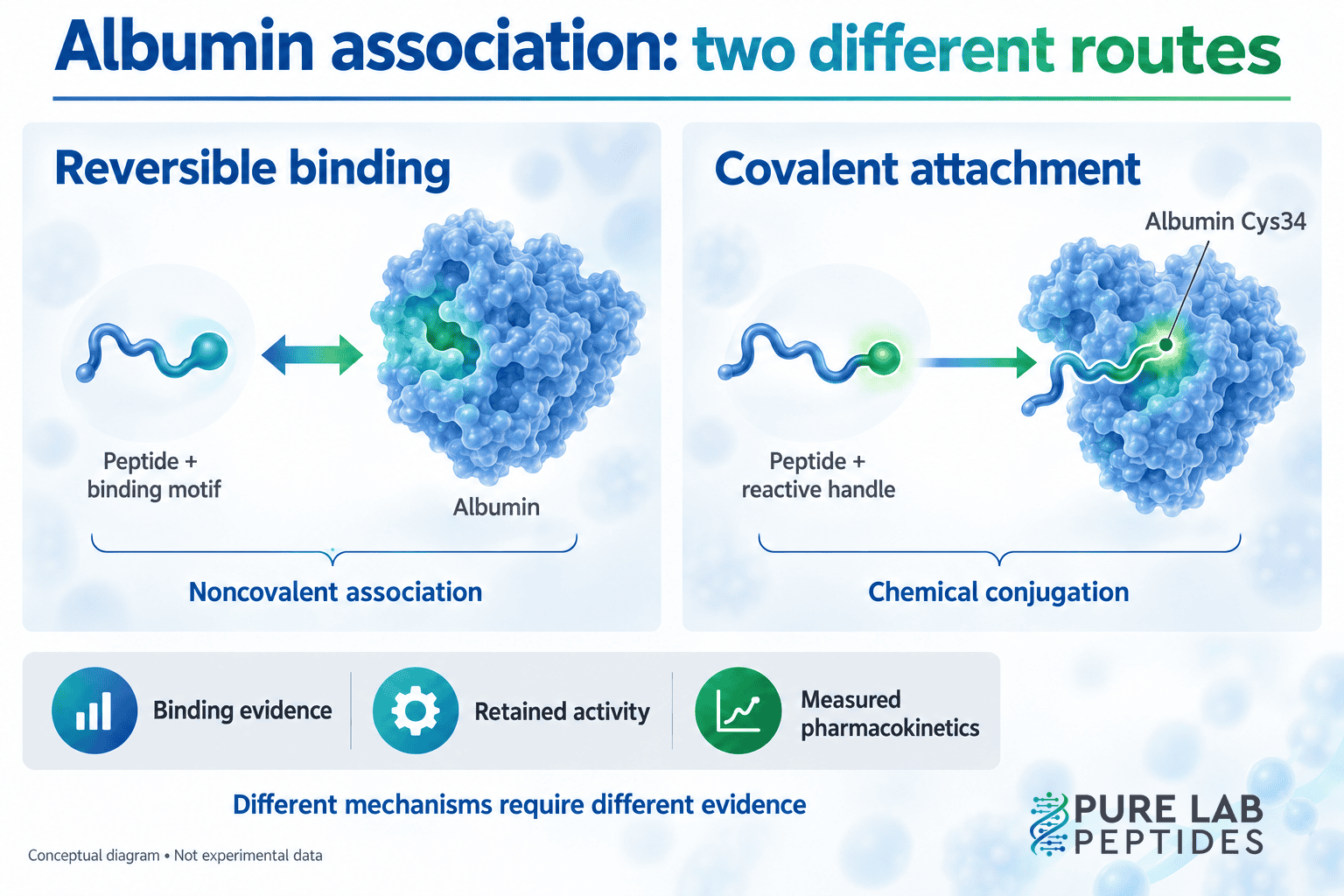
An albumin binding peptide is a peptide sequence selected or designed to associate with serum albumin. That association can change how an attached molecule circulates. But “albumin binding” also gets used loosely for strategies with different chemistry. A recognition sequence that binds reversibly and a DAC reactive handle that forms a covalent attachment need different evidence. [1] [2]
TL;DR · The short version
Distinguish reversible association from DAC-type chemical attachment before comparing half-lives. Then read association, retained activity and pharmacokinetics as separate evidence. A modification’s name supplies neither fixed duration nor verification of a batch.
Two albumin-associated strategies, two kinds of evidence
Quick take: “Binds albumin” is incomplete until you know whether binding is reversible or a conjugate forms.
Albumin-binding research covers more than one molecular design. This guide focuses on two routes that are easy to confuse in peptide discussions: a noncovalent recognition sequence and the reactive chemistry used in the original CJC-1295 research.
| Design | Interaction | Evidence to look for |
|---|---|---|
| Albumin-binding sequence | A peptide motif recognizes albumin through noncovalent association. | Direct binding measurements, affinity and species comparison. The SA21 study is an example. [1] |
| DAC-type reactive handle | Suitable reactive chemistry permits covalent attachment to albumin. | Evidence that an albumin conjugate forms and that the modified construct retains relevant activity. The original CJC-1295 study examined this route. [2] |
These are two routes into albumin research, not its entire design space. Either still needs pharmacokinetic measurements for a duration claim.
What an albumin binding peptide study can establish
Quick take: A binding result belongs to a named construct, a particular albumin and a defined assay.
Dennis and colleagues used phage display to identify albumin-binding peptide sequences. Their SA21 construct bound rat, rabbit and human serum albumin (HSA), with different affinities measured by surface plasmon resonance. The study also examined related peptide–Fab fusions and their clearance in animal models. A Fab is an antibody fragment; in this design, the binding sequence was fused to a larger construct. [1]
That supplies a concrete example of recognition-based association. It doesn’t mean every molecule called an “albumin binding peptide” contains SA21 or behaves like it. The authors tested specific sequences and constructs. Those identities remain part of the finding. [1]
Include motif, attachment position and larger construct in a summary. The peptide sequence and identity guide explains how to clarify an unclear sequence or terminal description before making the comparison.
Kd, the dissociation constant, describes equilibrium association. A lower value indicates stronger association within comparable measurements. Convert and retain the units; a smaller micromolar number isn’t automatically smaller than a nanomolar one.
How DAC differs from reversible albumin binding
Quick take: DAC is a conjugation strategy. It shouldn’t be described as though it were the SA21 recognition sequence.
In the original CJC-1295 study, researchers examined modified growth hormone-releasing factor analogues carrying maleimide-based reactive chemistry. The CJC-1295 construct included a modified lysine at the C-terminus that permitted covalent attachment to albumin’s free Cys34 thiol. The work assessed albumin conjugation, stability and biological activity, rather than assuming those properties from the name. [2]
A reversible binder raises association and dissociation questions. A reactive handle raises a bond-formation question. Evidence for either route doesn’t directly demonstrate the other.
A DAC label refers to the albumin-associated design, but doesn’t establish the supplied material’s sequence, modification or behavior. Keep identity testing separate from explanation of the mechanism.
Our CJC-1295 and ipamorelin evidence guide addresses another frequent mix-up: evidence for an individual compound and evidence for a blend aren’t automatically interchangeable.
Stronger affinity doesn’t answer every pharmacokinetic question
Quick take: Binding affinity, clearance and terminal half-life are separate results, even when they are related.
An albumin-binding Fab study varied affinity and measured pharmacokinetics in rats and rabbits. Lower affinity was associated with shorter half-life and greater clearance within those experimental comparisons. The authors also found that solution-binding measurements better reflected the in vivo behavior of the constructs they studied. [3]
That is evidence that affinity can be a design variable. It isn’t evidence that maximizing affinity gives the best result for every peptide. A reading summary should retain the construct, albumin species, measurement method and pharmacokinetic model alongside the trend. [3]
Purified-albumin and whole-plasma binding experiments describe different preparations. If the conclusion assigns the plasma result to albumin specifically, check the comparison supporting that attribution.
Find which form the concentration-time method detects: intact construct, conjugate or other material. More signal and retained activity are separate findings, so don’t infer one from the other.
Where FcRn fits into the explanation
Quick take: Albumin has recycling biology. An attached or associated construct still needs its own measurements.
The neonatal Fc receptor, FcRn, binds albumin in a pH-dependent manner. In an original mouse study, FcRn deficiency shortened albumin’s lifespan and reduced its circulating concentration. This helps explain why albumin is a useful partner in circulation research. [4]
Albumin biology doesn’t give every associated peptide the same half-life. Its construct and association route need their own concentration-time measurements.
Early human CJC-1295 research measured pharmacokinetics as well as GH and IGF-I responses in controlled studies. That illustrates the distinction between exposure and downstream response. A measured half-life is one endpoint; the duration and magnitude of a biological response are others. The limited early studies don’t establish long-term safety or turn a research article into use instructions. [5]
A practical record for comparing albumin-association papers
Quick take: Record the chemistry first, then the association measurement, activity and pharmacokinetics.
A hypothetical reversible-binder affinity for human albumin and conjugate half-life in rats both provide evidence. They don’t directly rank the constructs’ human duration.
Keep a compact comparison record:
- Identity: exact sequence, modification, terminal groups and attachment site.
- Association route: reversible binding or covalent conjugation.
- Binding evidence: protein species, assay, units and the form measured.
- Activity: target-response assay and reference construct.
- Pharmacokinetics: model, concentration-time measurements and the endpoint reported.
Batch documentation remains a separate record. The COA results library provides analytical reports tied to tested material. A mechanism paper doesn’t certify a supplied batch, and a purity result doesn’t establish albumin association or duration.
Common albumin-binding research questions
Quick take: The most useful short answer identifies the mechanism and the missing measurement.
Is there one standard albumin-binding peptide sequence?
No single sequence should be assumed from the generic phrase. SA21 is a specific published example; it doesn’t identify every binder or modified peptide. [1]
Does an albumin-binding result establish half-life?
It establishes a binding observation under the reported conditions. Pharmacokinetic behavior needs concentration-time evidence in the relevant model. Affinity and measured clearance can be related without becoming the same endpoint. [3]
Is DAC the same as noncovalent albumin association?
The original CJC-1295 work examined reactive chemistry that forms an albumin conjugate. That differs from reversible recognition-based binding. [2]
Primary research cited
- Dennis et al., albumin-binding peptides and fusion constructs, 2002.
- Jetté et al., albumin-conjugating GRF analogues including CJC-1295, 2005.
- Albumin-binding Fab affinity and pharmacokinetics, 2006.
- FcRn binding and albumin lifespan, 2003.
- Teichman et al., early controlled human CJC-1295 studies, 2006.