



CJC-1295 Ipamorelin Blend: How to Read the Evidence

TL;DR · The short version
A CJC-1295 ipamorelin blend needs a separate identity and amount for each component. Check whether CJC has DAC, distinguish component studies from mixture studies, and do not read a purity percentage as a measured blend ratio.
Two reports both say CJC-1295, but only one describes albumin-binding chemistry. That difference matters before you compare anything else.
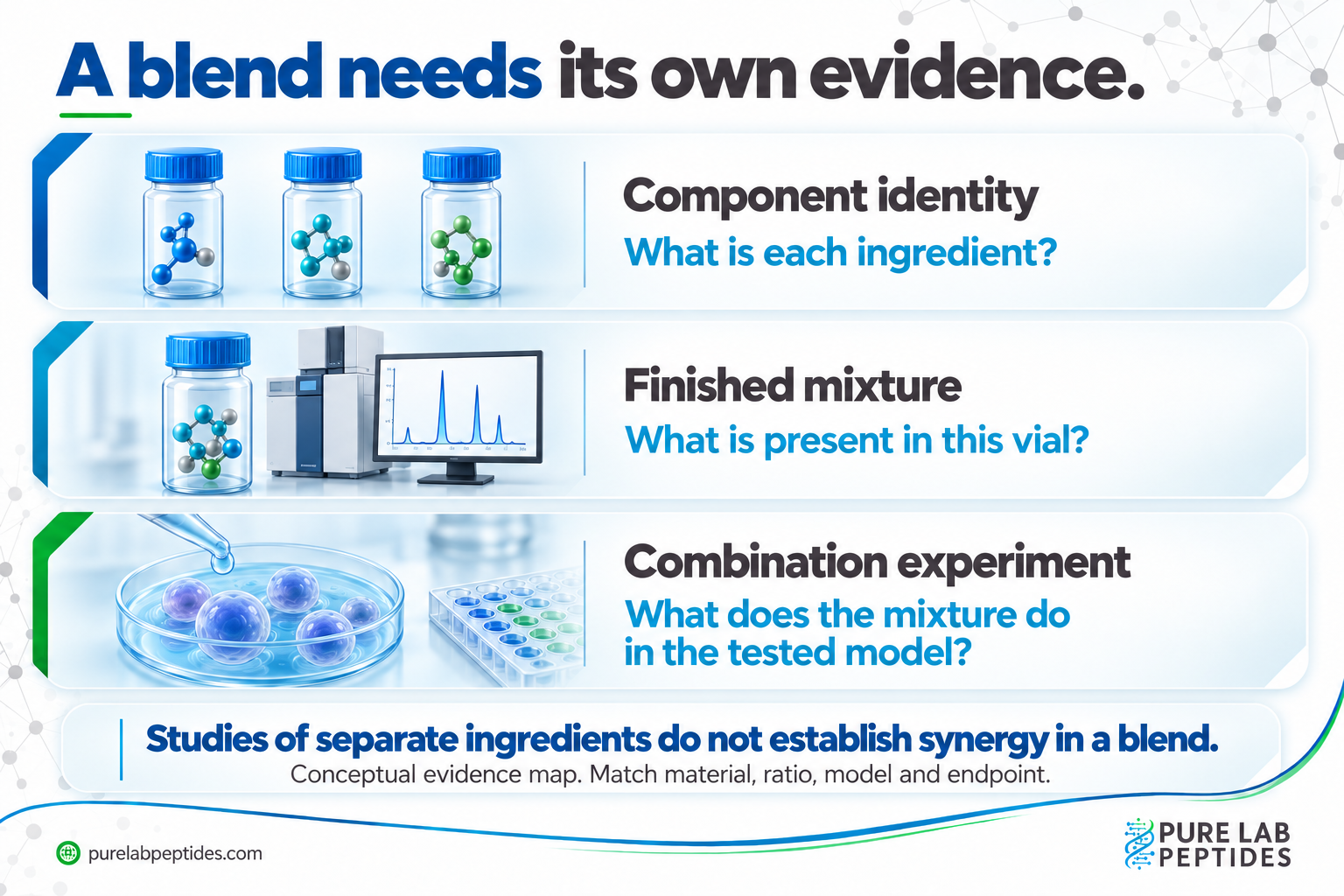
For a CJC-1295 ipamorelin blend, start with the exact CJC variant and the amount of each component. Then ask what the evidence tested: one component, a finished mixture, or the biological response to a particular combination. Those are three separate questions.
What the original CJC-1295 paper studied
TL;DR: The albumin-binding modification is part of the material studied. A similar name does not establish the same persistence.
Jetté and colleagues’ 2005 paper describes a modified growth-hormone-releasing factor analogue with albumin-binding chemistry. That modification is part of the studied material. A similar name without the same structural feature is not enough to support the same persistence claim.
The documentation should identify the sequence, terminal chemistry and modification status. If a name, formula and report disagree, the discrepancy needs resolution before the material is matched to a publication.
Ipamorelin remains a separate analyte
TL;DR: Ipamorelin needs its own identity and amount, even when supplied in a shared vial.
Raun and colleagues’ original ipamorelin study examined growth-hormone-secretagogue activity in defined experimental systems. It establishes research context for that compound, not the composition or performance of a later blend.
A blend record should therefore identify ipamorelin separately and state its amount. Neither a total milligram value nor a single major chromatographic peak establishes both components.
Different receptor systems, a shared secretion question
TL;DR: The two receptor systems are distinct. A greater combined response needs a defined comparison before it can be called synergy.
GHRH analogs and ghrelin-receptor secretagogues approach GH secretion through different receptor systems: GHRHR and GHSR1a. The cloning of the secretagogue receptor established it as distinct from the GHRH receptor. A shared GH endpoint should therefore not be mistaken for identical upstream signaling.
A combination comparison needs each component alone at matched concentrations, the mixture, an appropriate baseline and a defined endpoint. Receptor signaling, secreted GH and a response over time answer different questions. An increase over one component alone does not establish synergy without a stated comparison model.
What to match across the records
TL;DR: Match both component specifications and the finished-blend lot to the relevant analytical records.
- The exact CJC variant, including the relevant modification status.
- The ipamorelin identity and declared chemical form.
- Each component’s labeled amount and the total amount.
- The finished-blend lot number and the sample tested.
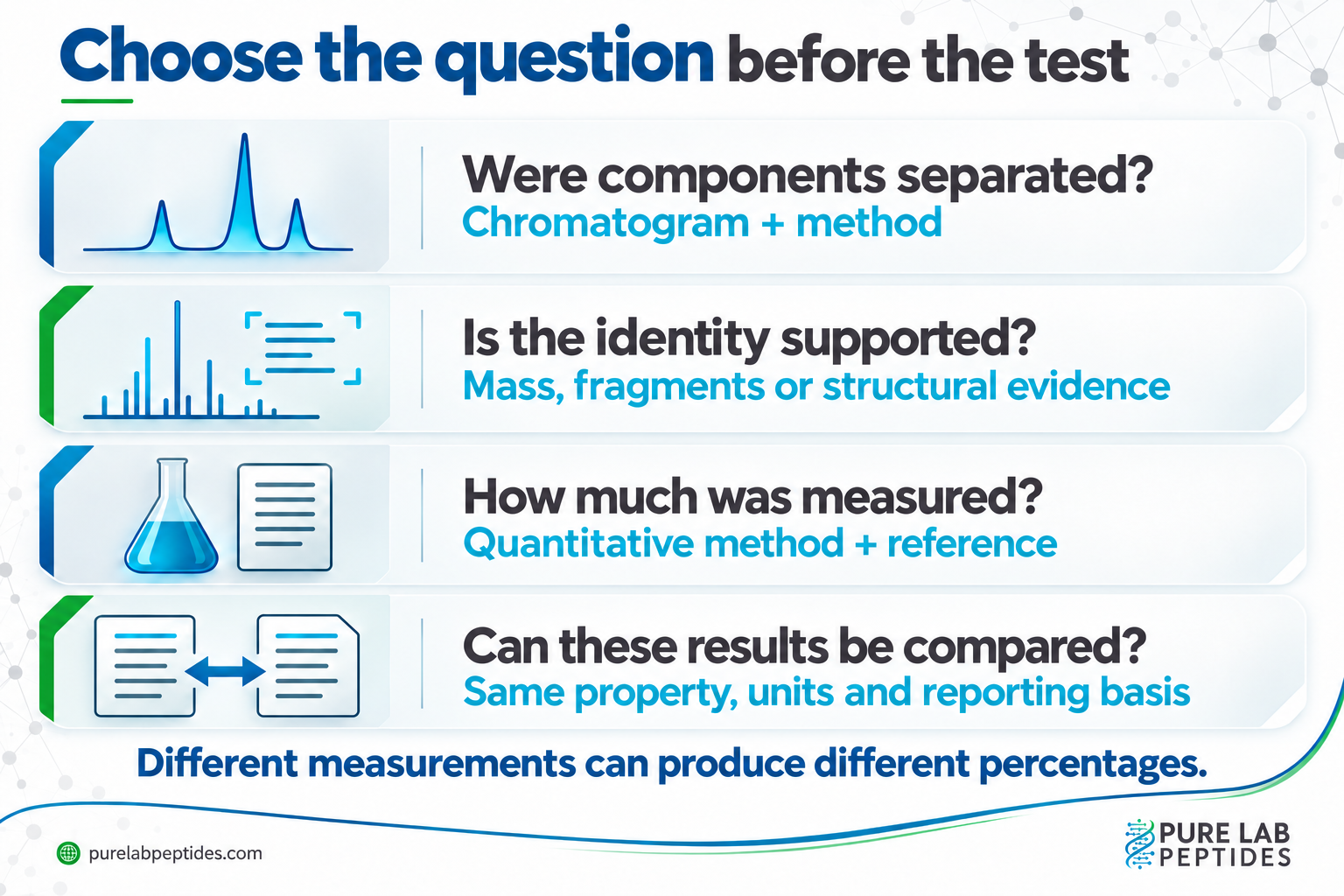
- The methods and reference materials used for identity and quantitative results.
Two starting-material COAs provide useful records, but they do not by themselves test the final combined preparation. Mixing, packaging and storage create a distinct sample whose composition and condition need to be described accurately.
For example, a hypothetical label reading “5 mg A + 5 mg B” declares 10 mg in total. It does not say the vial contains 10 mg of each. It also does not establish that a laboratory measured either amount. Keep the declared amounts beside the quantitative results rather than replacing one with the other.
Purity and ratio should not be conflated
TL;DR: Chromatographic area proportions are not automatically component mass proportions.
A chromatographic result depends on separation and detection. Different components may not have identical detector responses, so area proportions should not automatically be read as mass proportions. Peptide reference-standard work explains the broader importance of defining what a quantitative result is based on.
What the available records can answer
TL;DR: Component papers, finished-blend tests and combination experiments support different conclusions.
Component papers explain why the mixture might be investigated. Tests of the finished blend address what is in that preparation. A controlled exact-mixture experiment addresses its combined response. Keep those evidence categories separate: the sources discussed here do not establish an optimal ratio, a human-use regimen or synergistic effects for a marketed blend.
For the method question, our peptide testing guide compares separation, identity and content measurements. Our mechanism and efficacy guide explains how to keep a receptor finding separate from a broader outcome claim.