
...
Documentation and Quality

Peptide Solubility as a Research Documentation Topic

Peptide Solubility as a Research Documentation Topic helps qualified researchers evaluate how a peptide material is described, characterized, and compared across lot-specific records. In chemistry, solubility is defined for a designated solute in a designated solvent, and peptides are molecular structures formed through peptide bonds between amino carboxylic acid units. This article frames solubility documentation for research-use-only review, not preparation guidance or product-use instruction. [1] [2]

Fast Answer

Peptide solubility documentation is the recorded evidence of how a peptide material behaves under specified laboratory conditions, not a universal promise that it will behave identically in every assay system. Products discussed in this article are intended for laboratory research use only and are not intended for human or animal consumption. Strong records identify condition variables, analytical method context, and lot-level documentation. [1] [3]

What Peptide Solubility Means in Research Documentation

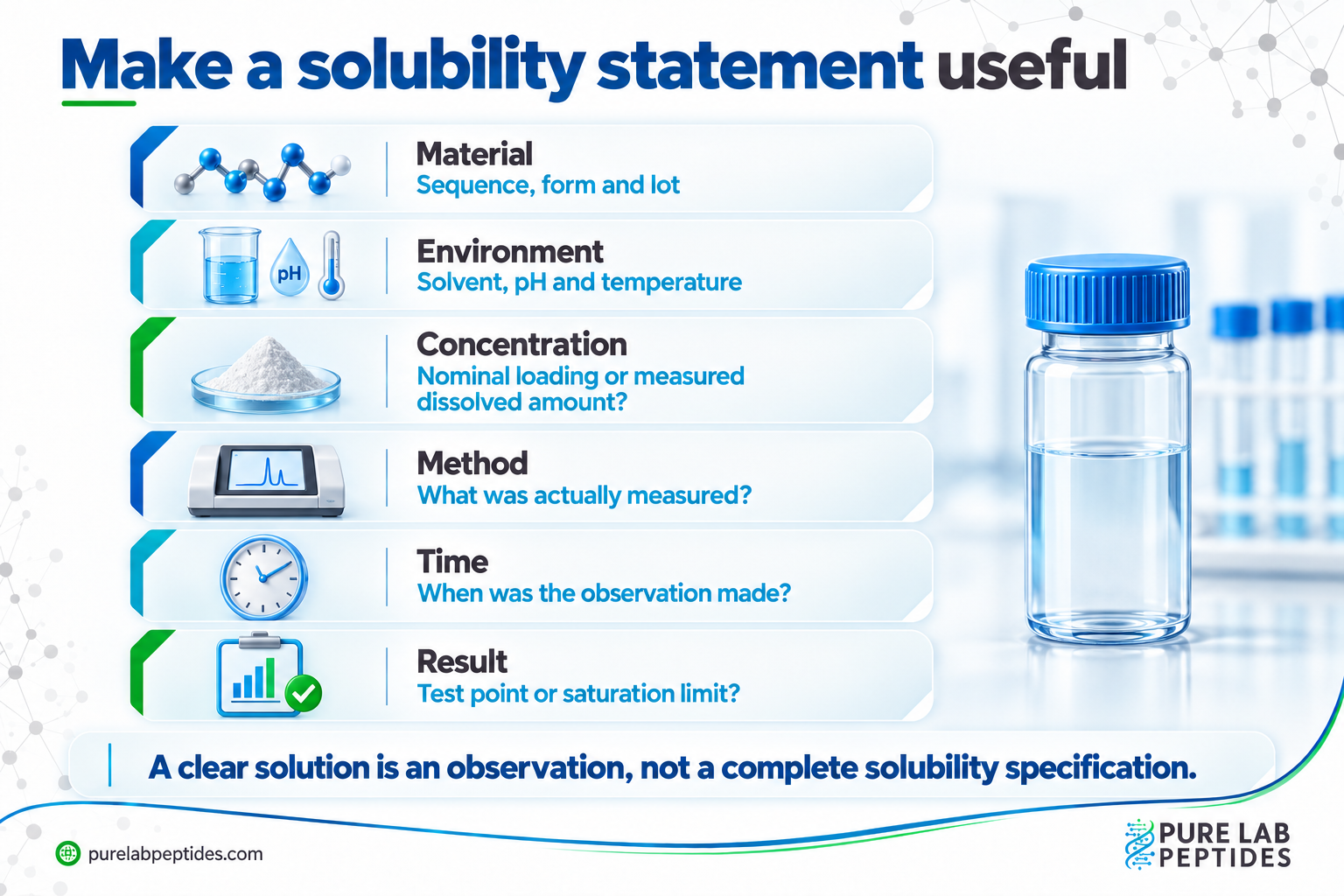
Solubility is not a single free-standing label. IUPAC defines solubility as the analytical composition of a saturated solution for a named solute in a named solvent, expressed through units such as concentration, molality, mole fraction, or mole ratio. For peptide documentation, that means a useful solubility statement should identify the material, the solvent or matrix category, the condition set, and the way the observation or measurement was obtained. [1]

Peptides add complexity because their structures contain repeated amide linkages and amino acid residues with side chains that may be hydrophobic, polar, acidic, basic, aromatic, or chemically modified. Sequence-based solubility research has shown that peptide solubility can be approached through physicochemical predictors such as charge, hydrophobicity, and sequence context, especially when evaluating modified or non-natural amino acids in research settings. [2] [3]

Why a simple “soluble” label is incomplete

A bare claim that a peptide is “soluble” leaves out the information needed to interpret the statement. Researchers need to know whether the statement refers to a predicted property, a visual observation, an analytical-method condition, or a controlled measurement. The same peptide sequence may be described differently depending on pH, ionic environment, solvent system, concentration range, and observation endpoint. pH-dependent solubility prediction work further illustrates why condition context matters when charged groups and isoelectric behavior are relevant. [4]

  • Define the peptide record by name, sequence where available, lot number, and batch-specific documentation.
  • Separate predicted solubility, observed dispersion behavior, and analytical-method suitability.
  • Record the solvent or matrix category without turning the article into preparation guidance.
  • Document pH, ionic environment, concentration range, temperature condition, and observation endpoint when those fields are available.
  • Connect solubility notes to the certificate of analysis, HPLC record, LC-MS record, and lot traceability file where applicable.

Why Solubility Records Belong Beside Identity, Purity, and Lot Data

Peptide solubility documentation is best treated as one part of a broader research documentation package. Identity testing addresses whether the material corresponds to the expected molecular entity. Purity testing estimates the proportion of target material relative to detectable related components under a defined method. Solubility documentation describes behavior under stated conditions. These categories are related, but none of them replaces the others. [5]

Documentation field What it records Why it matters for solubility review Boundary to maintain
Peptide identity Name, sequence, molecular formula, molecular weight, and identity method where available Clarifies which molecular entity the solubility note concerns Identity does not prove solubility under every condition
Lot number Batch-specific identifier tied to COA and release records Allows the solubility note to be linked to the same material record A lot record should not be generalized to unrelated lots without evidence
Purity result Analytical result from a defined chromatographic or related method Helps distinguish purity documentation from solubility observations Purity percentage does not establish complete identity or universal solubility
Solvent or matrix category Documented condition category used in the record Solubility is defined with reference to a designated solvent or matrix This should remain documentation, not preparation instruction
pH or ionic context Condition variables that affect charge state and intermolecular behavior Useful for interpreting peptide behavior across records Condition notes are not product-use guidance
Analytical method HPLC, LC-MS, visual observation, or other documented method context Shows whether the solubility statement supports a method record or a broader characterization note Method suitability does not mean suitability for every research model

For research teams, the key question is not whether solubility appears somewhere on a page. The key question is whether the solubility statement is specific enough to interpret alongside COA data, purity testing, identity confirmation, and lot-level documentation. A well-scoped solubility record can support reproducibility; an overbroad solubility statement can create confusion. [11]

Physicochemical Variables Researchers Document

Peptide solubility depends on a combination of intrinsic and external factors. Intrinsic variables include sequence, backbone interactions, side-chain chemistry, charge patterning, hydrophobicity, and structural tendencies. External variables include pH, ionic strength, solvent environment, concentration, temperature, and surfaces or interfaces encountered during laboratory workflows. Reviews of peptide physical stability and aggregation emphasize that both intrinsic and external variables can influence observed behavior. [5] [6]

Backbone and side-chain interactions are especially relevant because peptide association can involve hydration behavior, hydrogen-bonding patterns, hydrophobic association, and other intermolecular contacts. Computational and experimental work on peptide solubility limits has examined how backbone and side-chain interactions affect aggregation and solubility in aqueous systems. [5]

Hydrophobic peptide segments can require separate interpretive care. A review of hydrophobic peptides related to membrane-anchoring protein regions reported that solvent and solubilization context can influence measured secondary structure, reinforcing that documentation should distinguish the observed condition from a general statement about the peptide. [7]

Variable Research documentation value What researchers should avoid concluding
Sequence and side-chain composition Supports interpretation of hydrophobic, charged, polar, or modified residues Sequence alone should not be treated as a complete batch-specific solubility result
pH context Helps interpret charge state, isoelectric behavior, and condition-dependent solubility A pH-specific observation should not be generalized to all conditions
Ionic environment Can influence peptide association, screening of charges, and physical stability observations Ionic context should not be converted into a universal performance claim
Hydrophobicity Helps explain why some sequences require more careful characterization records Hydrophobicity does not automatically define identity, purity, or method suitability
Concentration range Shows the range in which an observation or measurement was made A single range should not be presented as comprehensive solubility mapping
Temperature and handling environment Provides context for physical stability observations Storage or condition notes should not become use instructions

Analytical Context: Solubility, HPLC, LC-MS, and Method Fitness

Solubility matters to analytical documentation because a material must be presented in a form that is compatible with the intended test method. ICH Q14 describes science- and risk-based approaches for analytical procedure development, including identifying the attribute to be tested, selecting appropriate technology, evaluating performance characteristics, and documenting the analytical procedure and control strategy. [8]

ICH Q2(R2) states that validation of an analytical procedure is intended to demonstrate that the procedure is fit for its intended purpose, and it identifies common analytical purposes such as identity, purity, impurity, assay, and other qualitative or quantitative measurements. For peptide records, this means solubility notes should be interpreted in the context of the analytical method rather than treated as a substitute for method validation or identity confirmation. [9]

FDA analytical-method guidance similarly discusses analytical procedures and method validation data as part of documenting attributes such as identity, quality, and purity in regulated submissions. RUO peptide documentation is not the same as a regulated submission package, but the analytical principle is still useful: a record should make clear what was measured, how it was measured, and what the result does and does not establish. [10]

Analytical context How solubility documentation appears Research-safe interpretation
HPLC documentation May note sample presentation, mobile-phase compatibility, chromatographic conditions, and purity result context Supports interpretation of the chromatographic record, not broad product-use claims
LC-MS documentation May connect sample condition to molecular-mass confirmation and mass-to-charge data Supports identity-related analytical review when the method is fit for that purpose
COA review May include solubility notes, method references, lot number, purity, and identity records Allows researchers to compare the solubility note with other lot-specific documentation
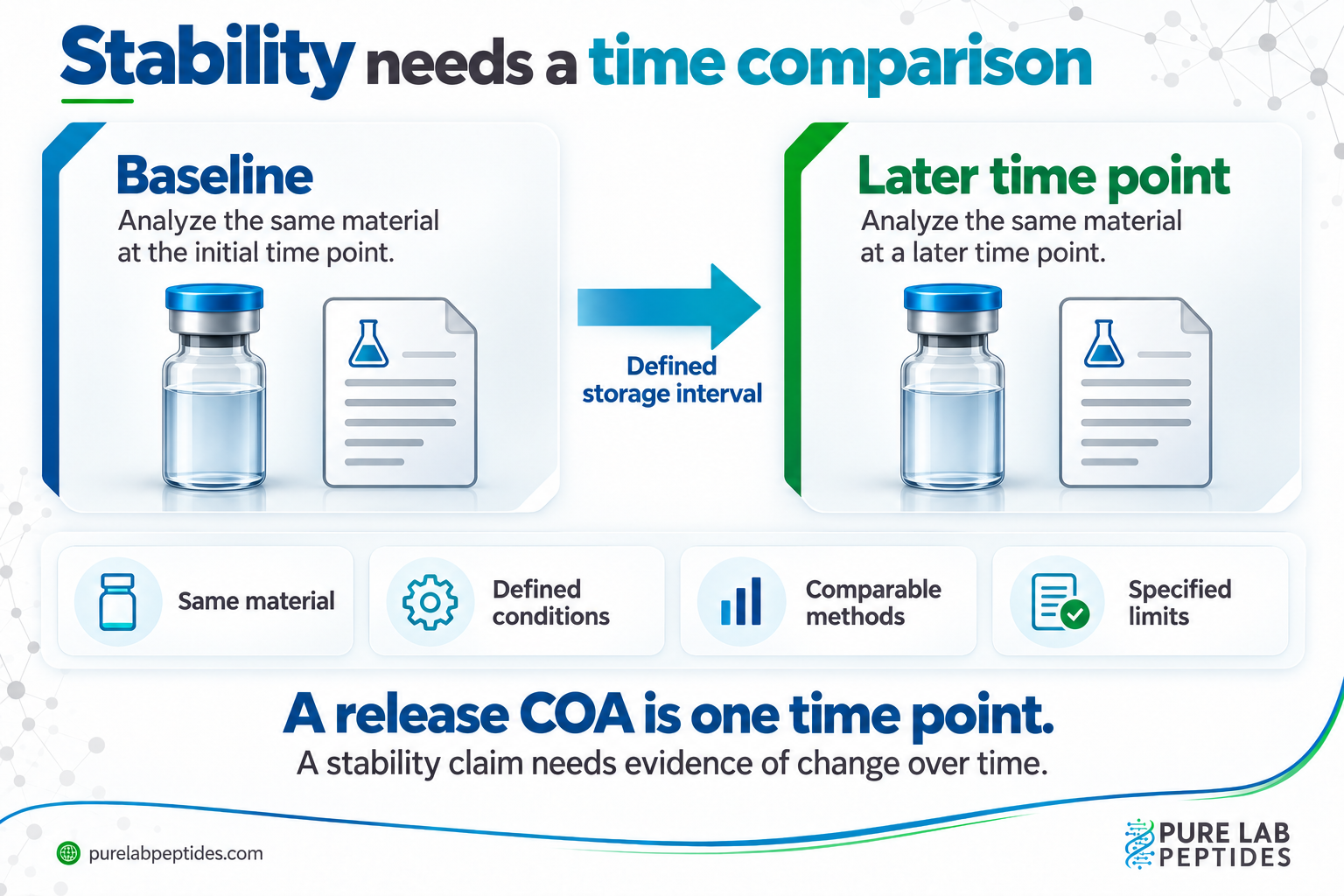
Stability or storage records May document condition variables associated with material integrity over time Supports laboratory recordkeeping without becoming preparation or administration guidance
Computational prediction May estimate sequence-linked intrinsic or pH-dependent solubility behavior Can inform research interpretation but should not replace batch-specific analytical records

Suggested Documentation Workflow for Solubility Records

The following Mermaid diagram is an editorial synthesis for research documentation planning. It is not a published dataset and should not be read as a protocol.

flowchart TD A[Start with peptide record] --> B[Confirm name sequence and lot] B --> C[Identify documentation purpose] C --> D{Observation or measurement?} D -- Observation --> E[Record visible condition notes] D -- Measurement --> F[Record method units and range] E --> G[Add solvent or matrix category] F --> G G --> H[Record pH ionic context and temperature if available] H --> I[Link to COA HPLC LC-MS and lot records] I --> J[State limitations and RUO boundary]

Caption: This workflow shows how solubility information can be organized as documentation. It does not provide preparation, administration, or product-use guidance.

A practical documentation workflow begins with identity and lot data because a solubility note should be tied to the same material record as the COA. It then separates observations from measurements, records the relevant condition fields, and connects those fields to analytical records. This structure is consistent with the broader laboratory quality principle that results should be clear, objective, and reliable within the scope of the method and laboratory system. [11]

Claim Boundaries and Documentation Checklist

Solubility documentation is research information, not product-use positioning. In the IVD context, FDA RUO guidance emphasizes that RUO labeling should be consistent with intended use; while that guidance is specific to in vitro diagnostic products, it illustrates the broader documentation discipline of aligning labels, claims, and intended-use boundaries. [12]

Research-safe statement Why it is acceptable Non-compliant version to avoid
This lot includes a solubility note under defined laboratory conditions. It ties the statement to a batch-specific record and condition set. This peptide is universally soluble.
Solubility documentation should be interpreted alongside identity and purity data. It separates different analytical concepts instead of merging them. Solubility proves identity and purity.
Published solubility literature can inform research interpretation. It frames literature as context, not as a product claim. Published research proves this material is suitable for every study design.
Analytical-method compatibility should be documented for the intended test. It stays within method fitness and laboratory recordkeeping. One analytical observation establishes all downstream performance.
RUO materials require clear labeling and research-focused documentation. It supports intended-use consistency and avoids personal-use positioning. Solubility notes are product-use instructions.

Quality and documentation checklist

  • Verify that the peptide material is labeled for research use only.
  • Review the batch-specific certificate of analysis before comparing solubility notes.
  • Confirm that identity and purity records are separate from solubility documentation.
  • Check whether the solubility statement names a solvent or matrix category.
  • Record pH, ionic context, temperature condition, and concentration range when those fields are available.
  • Compare solubility notes against HPLC and LC-MS method context rather than treating them as stand-alone claims.
  • Assess whether the documentation uses lot-level language instead of broad universal statements.
  • Document limitations, observation type, method used, date, and analyst or laboratory where applicable.
  • Avoid converting academic findings into product-use claims for RUO materials.

Common Misunderstandings About Peptide Solubility Records

Misunderstanding 1: Solubility is the same as purity

Solubility and purity answer different questions. Solubility describes a material condition in a designated solvent or matrix. Purity is an analytical estimate generated under a specific method, often chromatographic. A peptide can have a purity record and still require separate solubility documentation for the relevant research context. [1] [9]

Misunderstanding 2: Solubility proves identity

Solubility behavior can support documentation review, but it does not prove molecular identity. Identity-related records usually rely on sequence, molecular weight, mass spectrometry, or another fit-for-purpose analytical approach. Solubility notes should therefore be reviewed beside identity documentation, not substituted for it. [9] [10]

Misunderstanding 3: One condition applies to every research context

A condition-specific solubility observation should not be generalized to every assay, matrix, or analytical system. Sequence, charge, pH, solvent environment, concentration, hydrophobicity, and physical stability variables can all affect observed behavior. This is why the most useful records state the conditions and limitations clearly. [3] [6]

Misunderstanding 4: Predicted solubility replaces batch-specific documentation

Computational prediction can be useful for research interpretation, particularly when sequence, pH, charge, and hydrophobicity are being evaluated. It should not replace lot-specific records such as COAs, identity tests, purity tests, and method documentation. Prediction and batch documentation serve different evidence functions. [3] [4]

FAQs

What does peptide solubility as a research documentation topic mean?

Peptide solubility as a research documentation topic means recording how a peptide material is described under defined laboratory conditions, including the material record, solvent or matrix category, condition set, method context, and limitations. It is not a universal claim about all possible systems and should be reviewed alongside identity, purity, and lot documentation. [1]

Why is peptide solubility not the same as peptide purity?

Peptide solubility is not the same as peptide purity because each term describes a different evidence category. Solubility concerns behavior in a designated solvent or matrix, while purity is an analytical estimate from a defined method. Researchers should compare both records, but a purity percentage does not prove complete solubility behavior. [9]

What conditions belong in a peptide solubility record?

A peptide solubility record should identify the peptide, lot, solvent or matrix category, pH context, ionic environment, concentration range, temperature condition, observation type, method reference, date, and limitations when available. These fields help researchers interpret the record without turning the document into product-use guidance. [6]

How do HPLC or LC-MS records relate to solubility documentation?

HPLC or LC-MS records relate to solubility documentation when sample presentation and method compatibility influence the analytical record. The solubility note may help interpret whether a material was suitable for a specific test condition, but it does not replace method validation, identity confirmation, or purity testing. [8] [9]

Is solubility documentation product-use guidance?

Solubility documentation is not product-use guidance. In an RUO context, solubility records should support laboratory documentation, analytical interpretation, and lot-level review. They should not be written as preparation instructions, administration guidance, or claims about outcomes. Products discussed here remain limited to laboratory research-use-only positioning. [12]

Next Steps

Review batch-specific documentation before selecting any research-use-only peptide. For research teams comparing peptide suppliers, prioritize COA availability, transparent labeling, lot-level documentation, and research-focused product information from Pure Lab Peptides.

References

  1. International Union of Pure and Applied Chemistry. “Solubility.” IUPAC Compendium of Chemical Terminology. 2025. https://goldbook.iupac.org/terms/view/S05740
  2. International Union of Pure and Applied Chemistry. “Peptides.” IUPAC Compendium of Chemical Terminology. 2025. https://goldbook.iupac.org/terms/view/P04479
  3. Oeller M, Kang RJD, Bolt HL, et al. “Sequence-based prediction of the intrinsic solubility of peptides containing non-natural amino acids.” Nature Communications. 2023;14:7475. https://doi.org/10.1038/s41467-023-42940-w
  4. Oeller M, Kang RJD, Bell R, et al. “Sequence-based prediction of pH-dependent protein solubility using CamSol.” Briefings in Bioinformatics. 2023;24(2):bbad004. https://doi.org/10.1093/bib/bbad004
  5. Sarma R, Wong KY, Lynch GC, Pettitt BM. “Peptide Solubility Limits: Backbone and Side-Chain Interactions.” The Journal of Physical Chemistry B. 2018;122(13):3528-3539. https://doi.org/10.1021/acs.jpcb.7b10734
  6. Zapadka KL, Becher FJ, Gomes dos Santos AL, Jackson SE. “Factors affecting the physical stability (aggregation) of peptide therapeutics.” Interface Focus. 2017;7(6):20170030. https://doi.org/10.1098/rsfs.2017.0030
  7. Lhor M, Bernier SC, Horchani H, Bussières S, Cantin L, Desbat B, Salesse C. “Comparison between the behavior of different hydrophobic peptides allowing membrane anchoring of proteins.” Advances in Colloid and Interface Science. 2014;207:223-239. https://doi.org/10.1016/j.cis.2014.01.015
  8. International Council for Harmonisation. “Q14 Analytical Procedure Development.” ICH Harmonised Guideline. 2023. https://database.ich.org/sites/default/files/ICH_Q14_Guideline_2023_1116_1.pdf
  9. International Council for Harmonisation and U.S. Food and Drug Administration. “Q2(R2) Validation of Analytical Procedures.” FDA Guidance Document. 2024. https://www.fda.gov/media/161201/download
  10. U.S. Food and Drug Administration. “Analytical Procedures and Methods Validation for Drugs and Biologics.” FDA Guidance Document. 2015. https://www.fda.gov/regulatory-information/search-fda-guidance-documents/analytical-procedures-and-methods-validation-drugs-and-biologics
  11. International Organization for Standardization. “ISO/IEC 17025:2017 General requirements for the competence of testing and calibration laboratories.” ISO International Standard. 2017, confirmed 2023. https://www.iso.org/standard/66912.html
  12. U.S. Food and Drug Administration. “Distribution of In Vitro Diagnostic Products Labeled for Research Use Only or Investigational Use Only.” FDA Guidance Document. 2013. https://www.fda.gov/regulatory-information/search-fda-guidance-documents/distribution-in-vitro-diagnostic-products-labeled-research-use-only-or-investigational-use-only
Pure Lab Peptides Logo with Black Letters