 Skip to content

GHRP-2 vs GHRP-6: Research Comparison of GH Secretagogues
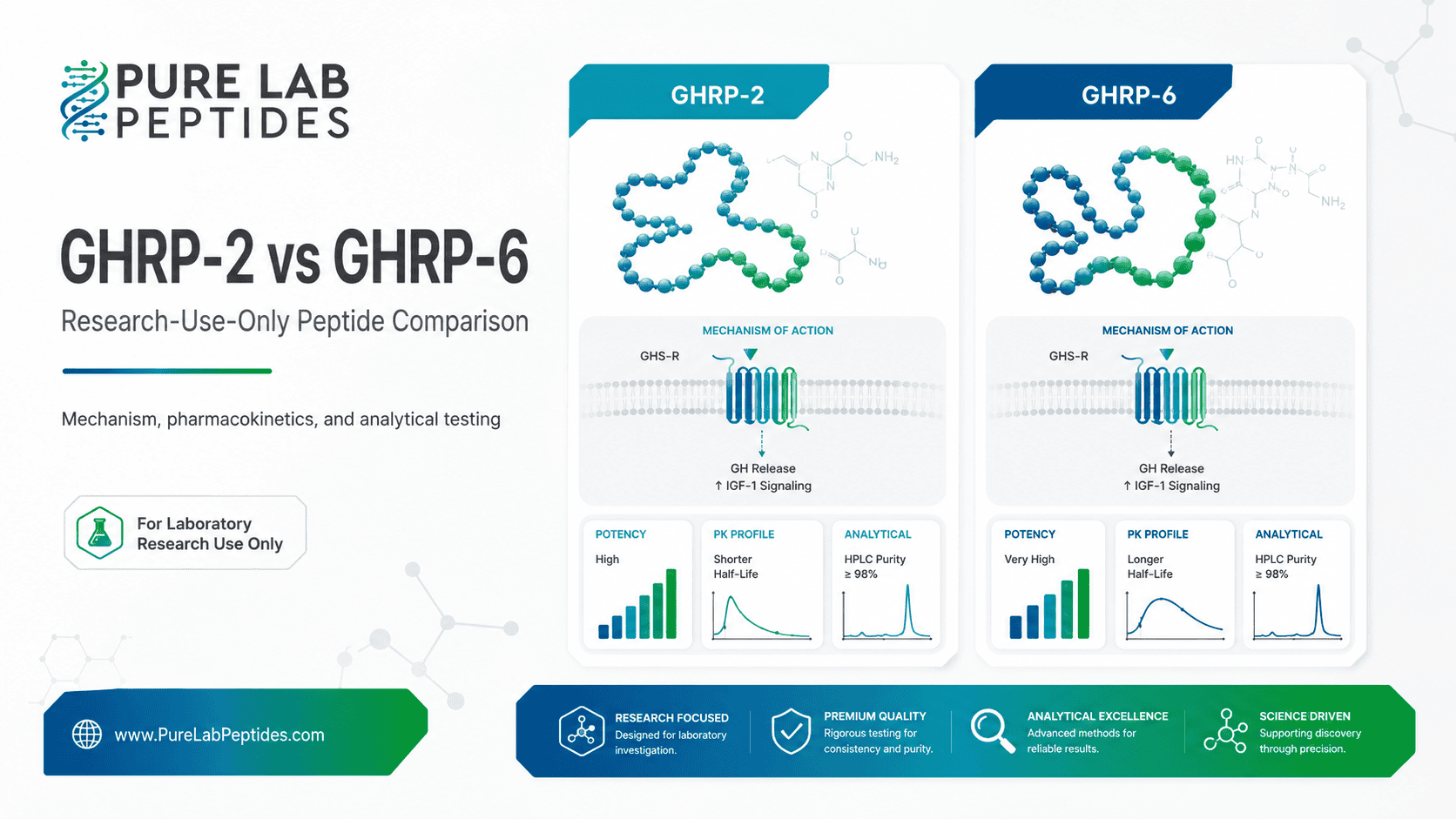
GHRP-2 vs GHRP-6 is a comparison between two synthetic growth hormone-releasing hexapeptides used as research tools in growth hormone (GH) secretagogue studies. Both compounds stimulate GH release in experimental systems, but published work shows that the result depends on the cell model, species, receptor context, endpoint, and concentration. The most defensible comparison therefore focuses on controlled laboratory findings—not broad claims that one peptide is universally “stronger” or “better.”
Fast Answer: What Is the Difference Between GHRP-2 and GHRP-6?
GHRP-2 and GHRP-6 share a closely related research pathway, yet they are not interchangeable. In rat primary pituitary cells, both acted through the same apparent receptor mechanism, showed synergy with growth hormone-releasing factor (GRF/GHRH), and produced cross-desensitization. In cultured human pituitary tumor cells, both stimulated phosphatidylinositol signaling and GH secretion, but GHRP-2 was considerably more potent in that model. A separate ovine-versus-rat study found different intracellular cAMP responses, demonstrating why species and assay design must remain attached to any comparison claim.[1][2][3]
GHRP-2 vs GHRP-6 Comparison Table
| Comparison dimension | GHRP-2 | GHRP-6 |
|---|---|---|
| Research class | Synthetic growth hormone-releasing hexapeptide | Synthetic growth hormone-releasing hexapeptide |
| Primary pathway studied | Growth hormone secretagogue receptor-related signaling | Growth hormone secretagogue receptor-related signaling |
| Rat primary pituitary-cell comparison | Both stimulated GH release through the same apparent receptor mechanism, acted synergistically with GRF, and cross-desensitized the cells.[1] | |
| Human pituitary tumor-cell comparison | More potent in the reported phosphatidylinositol-hydrolysis and GH-secretion assays | Produced the same types of responses, but with lower potency in that specific system[2] |
| Ovine and rat somatotroph findings | Increased cAMP in ovine somatotrophs but not rat pituitary cells | Released GH without increasing cAMP in ovine cells; potentiated GRF-related cAMP accumulation in rat cells[3] |
| Correct interpretation | Model-specific research ligands whose potency, signaling, and GH response must be interpreted within the tested system | |
Shared Growth Hormone Secretagogue Pathway
GHRP-2 and GHRP-6 are members of the GHRP class. The growth hormone secretagogue receptor was identified as a G-protein-coupled receptor expressed in pituitary and hypothalamic tissues and responsive to synthetic GH secretagogues.[4] This receptor pathway is distinct from the classical GHRH receptor pathway, even though GHRPs and GHRH can interact functionally in pituitary models.
The direct rat pituitary-cell comparison is especially useful because the investigators tested both compounds in the same experimental design. GHRP-2 and GHRP-6 each acted synergistically with GRF. Combining the two GHRPs at maximal concentrations did not increase GH release beyond the response to either compound alone. Each peptide also desensitized the cells to the other, but not to GRF. Those results support a shared receptor mechanism in that rat system while separating it from the GRF pathway.[1]
Where the Experimental Profiles Differ
Potency in a human pituitary cell model
In cultured human pituitary somatotropinoma cells, both peptides increased phosphatidylinositol hydrolysis and GH secretion in a concentration-dependent manner. The investigators reported GHRP-2 as considerably more potent than GHRP-6. Both responses were reduced or abolished by inhibitors associated with protein kinase C and calmodulin, while antagonism of the GHRH receptor did not block their stimulatory effects.[2]
That result is evidence of a potency difference in a defined cell system. It is not proof that GHRP-2 produces higher GH levels in every model, nor does it establish clinical superiority. Potency describes the concentration associated with a defined response in a particular assay; it should not be confused with maximum response, duration, or suitability for another research question.
Intracellular signaling varies by species and cell context
A study of ovine and rat somatotrophs found that GHRP-2 and GHRP-6 did not produce identical intracellular cAMP patterns. In partially purified sheep somatotrophs, GHRP-2 increased cAMP and caused GH secretion, whereas GHRP-6 caused GH release without an increase in cAMP. In rat pituitary cells, GHRP-6 potentiated GRF-related cAMP accumulation, while GHRP-2 did not increase cAMP. The authors interpreted these findings as evidence of species differences in the pituitary response to the peptides.[3]
This is why statements about a single mechanism of action need precision. The two compounds can converge on GH secretion while displaying different signaling behavior across ovine, rat, and human-derived cell systems. Receptor expression, second-messenger coupling, somatostatin tone, calcium influx, and the presence of GHRH can all affect the observed activation profile.
Why ACTH, Cortisol, Prolactin, and Appetite Claims Need Caution
Search results often frame the difference between GHRP-2 and GHRP-6 around appetite, cortisol, or prolactin. Those endpoints do appear in the broader GHRP literature, but many frequently cited studies evaluated one peptide, used a different comparator, or involved a different biological model. For example, a GHRP-2 study compared the compound with hexarelin and other endocrine stimuli, while a separate GHRP-6 study evaluated GH, ACTH, cortisol, and sleep-related endpoints.[5][6]
Results from separate protocols should not be presented as though they were a controlled head-to-head experiment. A sound research comparison identifies whether ACTH and cortisol, cortisol and prolactin, feeding behavior, or a GH pulse were actually measured for both compounds under equivalent conditions. If the models, timing, analytical methods, or comparison groups differ, the conclusion must remain limited to each study.
Assay Design for a Defensible Comparison
A laboratory comparing GHRP-2 or GHRP-6 should define the research question before interpreting the compounds. At minimum, the experimental record should identify:
- the species, tissue, cell line, and receptor-expression context;
- the endpoint, such as GH release, phosphatidylinositol turnover, intracellular cAMP, calcium signaling, or receptor desensitization;
- the concentration range and response window;
- the positive, negative, GHRH/GRF, and somatostatin controls;
- whether potency, maximum response, synergy, or signal duration is being compared; and
- the identity, purity, and lot record for each research material.
This design prevents an assay-specific observation from becoming an unsupported universal claim. It also helps explain apparently conflicting findings: GHRP-2 and GHRP-6 may share a receptor target while producing different second-messenger or potency results in another system.
Identity, Purity, and Lot Documentation
Biological comparisons are only interpretable when the research materials are traceable. A lot-specific Certificate of Analysis should connect the peptide name and lot number to the methods and reported results. HPLC can describe chromatographic purity, while mass spectrometry or another orthogonal technique addresses molecular identity. A headline purity percentage alone does not establish that two vials contain the intended compounds.
For documentation context, see the guides to reading a peptide Certificate of Analysis, peptide purity versus peptide identity, and HPLC, LC-MS, and NMR testing methods. These resources explain how lot matching and method scope affect the interpretation of research peptides.
Common Misreadings of GHRP-2 and GHRP-6 Research
“They share a receptor, so they are interchangeable.”
No. Cross-desensitization and the absence of an additive response at maximal concentrations support a shared mechanism in rat pituitary cells, but other studies found different potency and intracellular signaling patterns. Shared pathway activity does not erase ligand- or model-specific differences.[1][2]
“GHRP-2 is always stronger than GHRP-6.”
No. GHRP-2 was more potent in one human pituitary tumor-cell study, but the correct conclusion remains tied to that assay. “Stronger” is incomplete unless the model, endpoint, concentration-response curve, and statistical definition are stated.
“Different cAMP results mean one peptide does not work.”
No. The ovine and rat study showed GH secretion despite different cAMP responses, illustrating that a single second messenger does not capture the entire signaling pathway. Experimental design and species context determine what can be concluded.[3]
Frequently Asked Questions
Do GHRP-2 and GHRP-6 act through the same receptor pathway?
Direct work in rat primary pituitary cells found that they acted through the same apparent receptor and mechanism in that system. Broader receptor research identifies the growth hormone secretagogue receptor as a G-protein-coupled receptor responsive to synthetic secretagogue ligands.[1][4]
Did GHRP-2 produce a larger response than GHRP-6?
In cultured human pituitary somatotropinoma cells, GHRP-2 was considerably more potent for the reported phosphatidylinositol and GH-secretion responses. That finding is model-specific and should not be generalized to every tissue, species, or endpoint.[2]
Can the compounds be compared using one GH measurement?
A single measurement is rarely sufficient. A defensible comparison may require a concentration-response curve, a defined response window, appropriate controls, and separate reporting of potency, maximum response, signaling, and desensitization.
Does this comparison establish clinical or consumer use?
No. This page summarizes published research models and analytical documentation principles. Products discussed here are sold strictly for in-vitro laboratory research and development purposes and are not intended for human or veterinary use or consumption.
Related Product Records
- GHRP-2 5 mg research product record
- GHRP-2 10 mg research product record
- GHRP-6 2 mg research product record
- GHRP-6 5 mg research product record
- GHRP-6 10 mg research product record
Next Steps
For a GHRP-2 vs GHRP-6 study, define the model, endpoint, controls, and interpretation rules before comparing results. Review the original publications, document the exact lot used, and distinguish receptor-pathway evidence from assay-specific potency or endocrine findings.
References
- Cheng J, Wu TJ, Butler B, Cheng K. “Growth hormone releasing peptides: a comparison of the growth hormone releasing activities of GHRP-2 and GHRP-6 in rat primary pituitary cells.” Life Sciences. 1997;60(16):1385–1392. PubMed PMID: 9096259. DOI: 10.1016/S0024-3205(96)00655-8.
- Adams EF, Petersen B, Lei T, et al. “Protein kinase C-dependent growth hormone releasing peptides stimulate cyclic adenosine 3′,5′-monophosphate production by human pituitary somatotropinomas expressing gsp oncogenes.” Molecular Endocrinology. 1996;10(4):432–438. PubMed PMID: 8721987. DOI: 10.1210/mend.10.4.8721987.
- Wu D, Chen C, Zhang J, Bowers CY, Clarke IJ. “The effects of GH-releasing peptide-6 (GHRP-6) and GHRP-2 on intracellular adenosine 3′,5′-monophosphate levels and GH secretion in ovine and rat somatotrophs.” Journal of Endocrinology. 1996;148(2):197–205. PubMed PMID: 8699133. DOI: 10.1677/joe.0.1480197.
- Howard AD, Feighner SD, Cully DF, et al. “A receptor in pituitary and hypothalamus that functions in growth hormone release.” Science. 1996;273(5277):974–977. PubMed PMID: 8688086. DOI: 10.1126/science.273.5277.974.
- Arvat E, di Vito L, Maccagno B, et al. “Effects of GHRP-2 and hexarelin, two synthetic GH-releasing peptides, on GH, prolactin, ACTH and cortisol levels in man.” Peptides. 1997;18(6):885–891. PubMed PMID: 9285939. DOI: 10.1016/S0196-9781(97)00016-8.
- Frieboes RM, Murck H, Maier P, Schier T, Holsboer F, Steiger A. “Growth hormone-releasing peptide-6 stimulates sleep, growth hormone, ACTH and cortisol release in normal man.” Neuroendocrinology. 1995;61(5):584–589. PubMed PMID: 7617137. DOI: 10.1159/000126883.