


$49.99
Research Studies:


FREE Shipping on
orders over $200
ALL ARTICLES AND PRODUCT INFORMATION PROVIDED ON THIS WEBSITE ARE FOR INFORMATIONAL AND EDUCATIONAL PURPOSES ONLY. The products offered on this website are intended solely for research and laboratory use. These products are not intended for human or animal consumption. They are not medicines or drugs and have not been evaluated or approved by the FDA to diagnose, treat, cure, or prevent any disease or medical condition. Any form of bodily introduction is strictly prohibited by law.
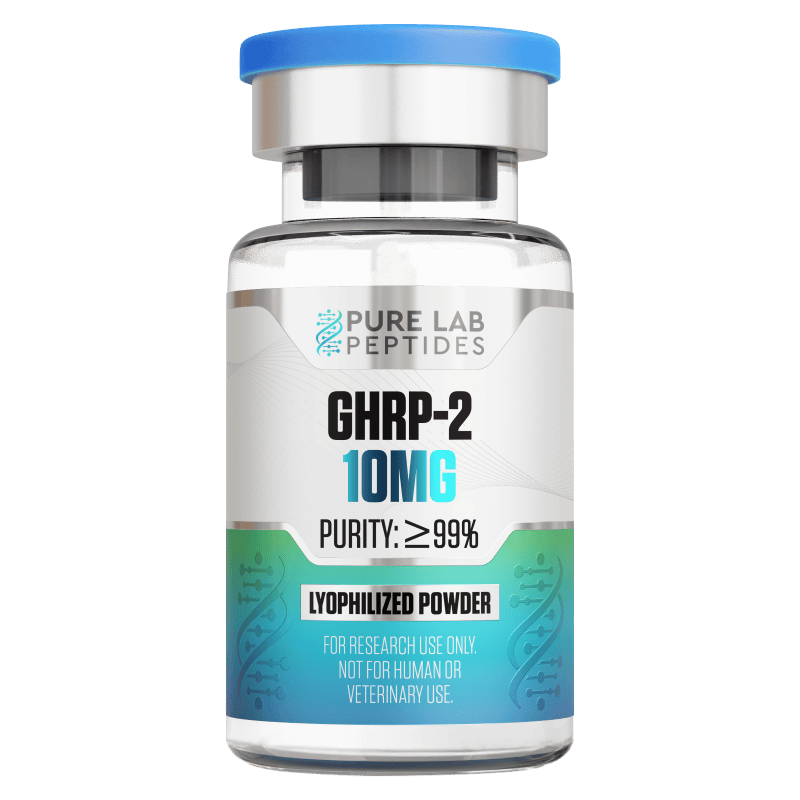
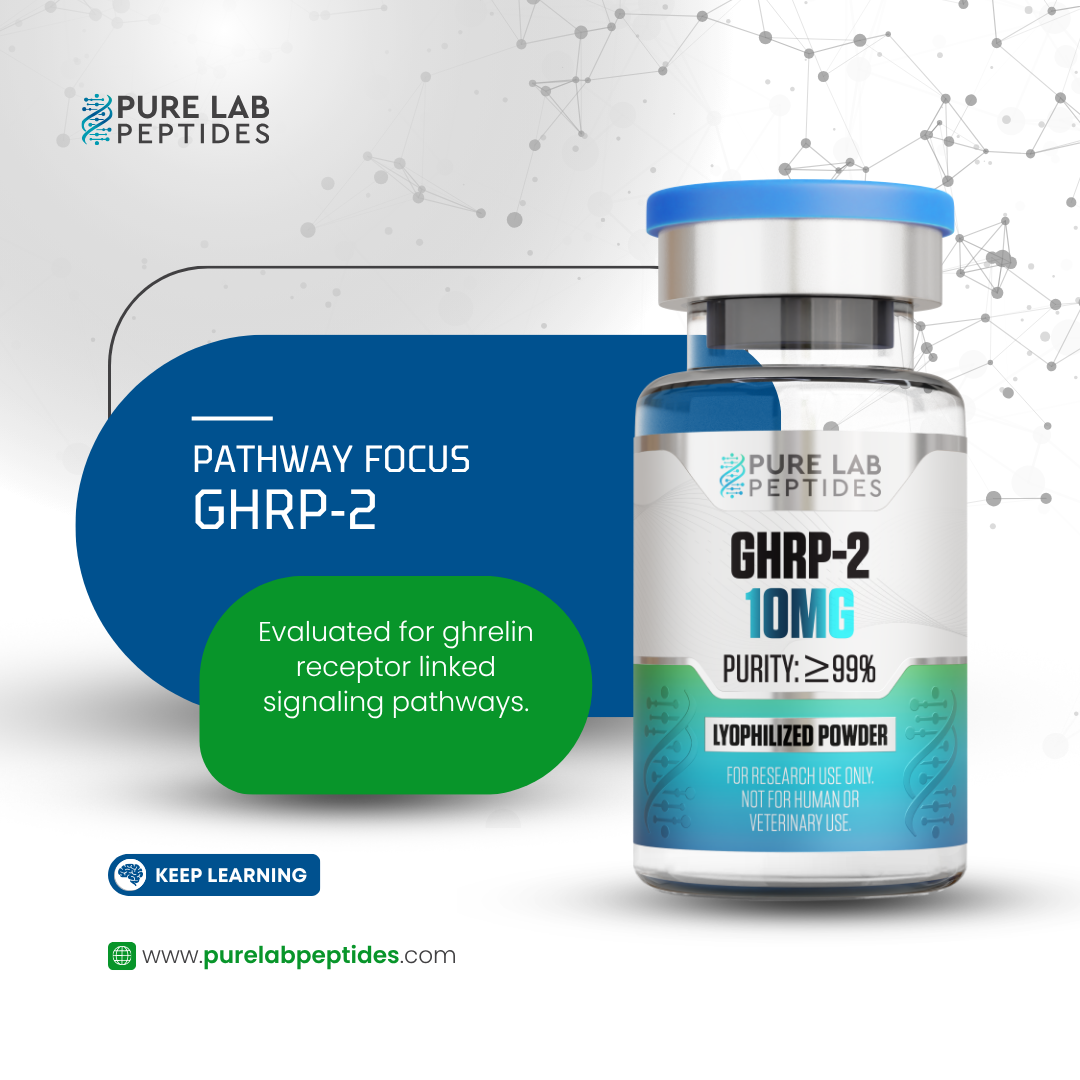
GHRP-2 10mg is a research-use-only laboratory material supplied for controlled research workflows, compound characterization, and analytical documentation review. It is manufactured under rigorous quality standards to support consistency, traceability, and batch-specific verification for qualified laboratory settings.
GHRP-2 10mg is intended strictly for laboratory research use only. This product is not intended for human or animal consumption, therapeutic use, diagnostic use, clinical use, veterinary use, or as a food, drug, cosmetic, dietary supplement, or household product.
| CAS No. | 158861-67-7 |
|---|---|
| Purity | ≥99% |
| Sequence | H-D-Ala-D-(βNal)-Ala-Trp-D-Phe-Lys-NH₂ |
| Molecular Formula | C45H55N9O6 |
| Molecular Weight | 4113.64 g/mol |
| Synthesis | Solid-phase synthesis |
| Solubility | Soluble in water or 1% acetic acid |
| Stability & Storage | Stable for up to 24 months at -20°C. After reconstitution, may be stored at 4°C for up to 4 weeks or at -20°C for up to 6 months. |
| Applications | Metabolic function research, obesity management, type 2 diabetes studies |
| Appearance | White lyophilized powder |
| Shipping Conditions | Shipped at ambient temperature; once received, store at -20°C |
| Regulatory/Compliance | Manufactured in a facility that adheres to cGMP guidelines |
| Safety Information | Refer to provided MSDS |
Consider these supplementary peptides for a comprehensive research approach.
Researchers searching for buy GHRP-2 online should evaluate GHRP-2 as a research-use-only laboratory material, not a consumer product. For laboratory buyers, the key considerations are compound identity, purity documentation, batch-specific COAs, lot traceability, product labeling, and storage information. This guide explains how to evaluate GHRP-2 for controlled research procurement through Pure Lab Peptides, with emphasis on supplier documentation, analytical review, and research-use-only boundaries.
Researchers can buy GHRP-2 online for laboratory research by reviewing RUO labeling, batch-specific COA documentation, purity data, identity information, storage guidance, and supplier transparency before selecting a source. Products discussed in this article are intended for laboratory research use only and are not intended for human or animal consumption.
The phrase “buy GHRP-2 online” is addressed here as laboratory research procurement intent, not personal-use intent. In a research setting, online procurement means evaluating whether a supplier presents the compound as a research-use-only material, provides batch-specific documentation, supports lot traceability, and avoids consumer-oriented claims.
Research-use-only language is especially important because RUO materials are not positioned as medicines, supplements, diagnostic tools, or consumer products. FDA labeling language for research-use-only in the in vitro diagnostic context uses the wording “For Research Use Only. Not for use in diagnostic procedures,” which illustrates the regulatory importance of separating research materials from clinical or diagnostic positioning [1]. FDA guidance on RUO and investigational-use-only in vitro diagnostic products further emphasizes that labeling and distribution context matter when evaluating intended use [2].
For qualified researchers, laboratory buyers, and technical procurement teams, the online evaluation process should focus on documentation. Relevant procurement questions include whether the GHRP-2 COA is batch-specific, whether the lot number on the product matches the documentation, whether analytical methods are identified, and whether product language remains restricted to controlled laboratory research. Quality-management expectations for testing and calibration laboratories are also relevant when teams review analytical competence, traceability, and documentation practices [3].
GHRP-2 is commonly identified in scientific databases and literature under names including pralmorelin, growth hormone-releasing peptide-2, and KP-102. PubChem lists pralmorelin with the molecular formula C45H55N9O6 and identifies GHRP-2 as a synonym [4]. ChEMBL also records pralmorelin as CHEMBL106593, with the same molecular formula and a listed molecular weight of 817.99 [5].
In research literature, GHRP-2 appears in the category of growth-hormone secretagogue peptide analogs. The IUPHAR/BPS Guide to Pharmacology identifies pralmorelin as a peptide ligand and lists synonyms including GHRP-2, growth hormone-releasing peptide-2, and KP 102; it also describes the compound in relation to the growth hormone secretagogue receptor, also known as the ghrelin receptor [6]. UniProt identifies the human growth hormone secretagogue receptor, GHSR, as a receptor for ghrelin [7].
Published receptor research provides historical context for this compound class. Howard and colleagues reported a receptor in pituitary and hypothalamus that functions in growth hormone release [8]. Kojima and colleagues later described ghrelin as an acylated peptide from stomach tissue in Nature, adding important pathway context for secretagogue receptor research [9]. Bowers reviewed how early synthetic growth hormone-releasing peptides contributed to later ghrelin research [10].
These sources support research context only. They do not establish product-use guidance for a GHRP-2 research material, and they should not be converted into claims about outcomes. Pathway relevance in published literature does not establish product-use guidance for RUO materials.
Researchers may search “buy GHRP-2 online” to identify RUO availability, compare supplier documentation, review product form, and confirm whether a vendor provides a batch-specific COA. A procurement-focused search is not a request for use instructions; it is a documentation review process for a laboratory research material.
Before teams buy GHRP-2 for controlled laboratory work, they should evaluate the supplier’s labeling, product page, COA availability, stated purity, identity information, storage documentation, and lot-level traceability. A research procurement search should also confirm that supplier language does not present the material as a consumer product, therapeutic product, or clinical product. For catalog review, researchers can compare the relevant research-use-only peptide collection with the specific GHRP-2 product documentation provided by Pure Lab Peptides.
The procurement objective is to document what the material is, how it is identified, how purity is supported, and whether the supplier’s claims remain within RUO boundaries. For GHRP-2 supplier documentation, the most useful materials are those that help a laboratory record compound identity, lot number, product form, and analytical support without implying personal-use or clinical application.
When qualified laboratory buyers buy GHRP-2 online for laboratory research, quality review should begin with documentation rather than promotional language. A well-supported procurement file connects the product label, product page, COA, lot number, identity testing, purity data, and storage information.
| Evaluation Area | What Researchers Should Review | Why It Matters for RUO Procurement |
| RUO labeling | Confirm the product is clearly labeled for research use only | Helps separate research procurement from human-use positioning |
| COA availability | Review the available batch-specific certificate of analysis | Supports lot-level documentation and quality review |
| Purity data | Look for analytical support for the stated purity | Helps evaluate material consistency |
| Identity testing | Review HPLC, LC-MS, mass spectrometry, or related identity data where available | Helps confirm the material matches the listed compound |
| Lot traceability | Match lot numbers across product and documentation | Supports research recordkeeping |
| Product form | Confirm whether the material is supplied as lyophilized powder or another documented form | Supports laboratory planning |
| Storage information | Review storage and handling documentation | Helps maintain material integrity in laboratory settings |
| Supplier language | Confirm the supplier avoids dosing, therapeutic, or personal-use claims | Supports research-use-only positioning |
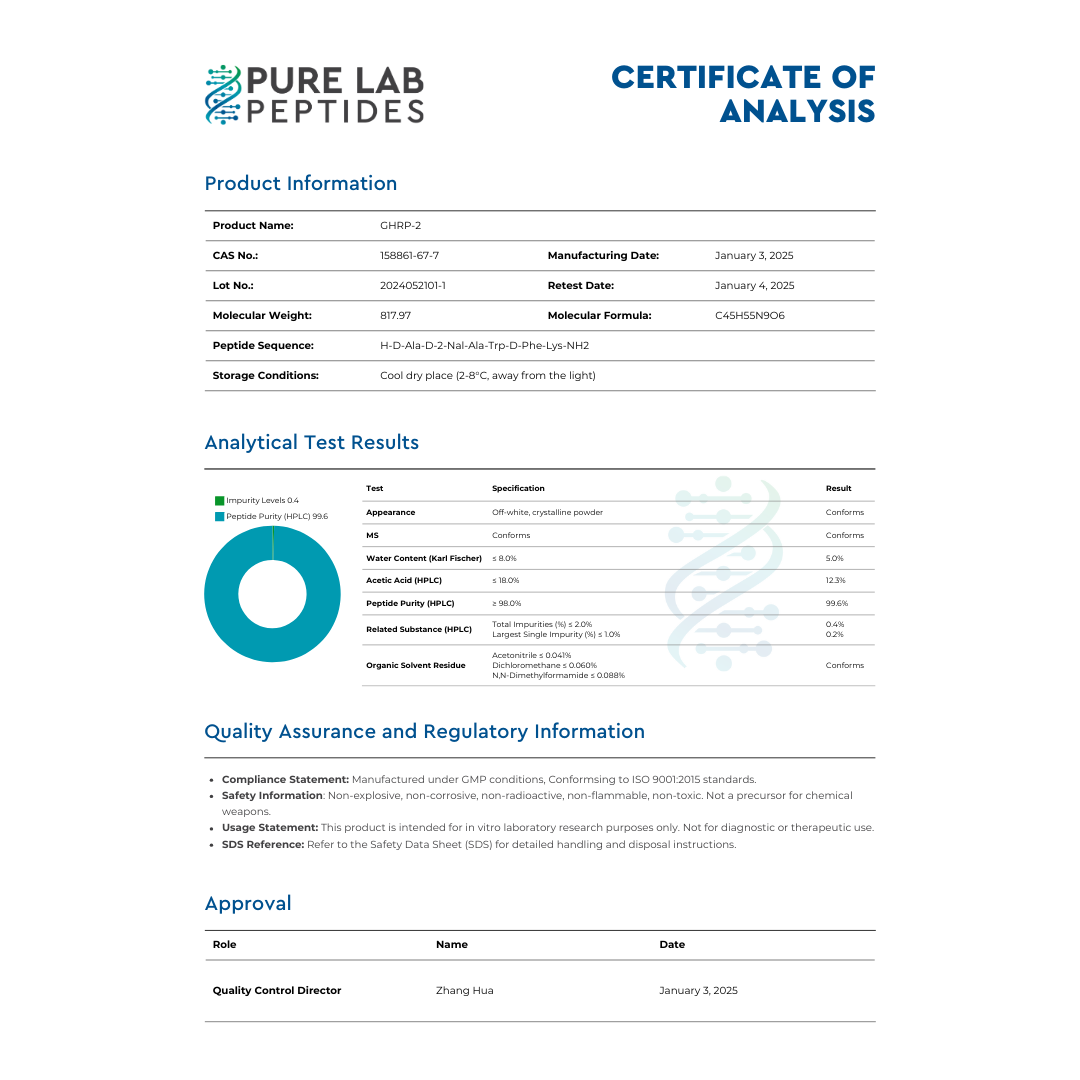
A GHRP-2 COA should be reviewed as a batch-level document, not as a generic marketing statement. Researchers should look for the compound name, lot number, test date, purity percentage, testing method, identity confirmation, product form, and storage documentation. Where applicable to the supplier’s documentation, chromatographic traces or mass data can help support GHRP-2 identity testing.
A purity percentage alone does not establish complete compound identity; researchers should evaluate purity, identity, method, lot number, and documentation together. ICH Q2(R2) describes validation characteristics for analytical procedures, while ICH Q14 discusses analytical procedure development, providing useful context for method review and documentation expectations [11] [12]. FDA guidance on analytical procedures and methods validation for drugs and biologics also describes the importance of method suitability, validation, and data support in analytical documentation [13].
For peptides, HPLC and mass spectrometry are common analytical tools used in characterization. Mant and colleagues describe HPLC analysis and purification of peptides as a core laboratory method for peptide work [14]. Chrone and colleagues describe mass spectrometry approaches for synthetic peptide characterization [15]. Reference-standard literature also emphasizes the role of appropriate standards and quality expectations for synthetic peptide materials [16].
Storage and product form documentation should be included in the procurement file. Lyophilization is a process in which water is removed from a frozen material under vacuum, and lyophilized presentation is commonly discussed in laboratory and manufacturing contexts for materials that require controlled handling [17]. Literature on protein and peptide instability also illustrates why handling, storage, and stability documentation should be treated as part of quality review rather than as afterthoughts [18].
Research literature on GHRP-2 includes database records, receptor pathway studies, in vitro experiments, preclinical models, and clinical literature outside the scope of RUO product use. McDowell and colleagues described growth hormone secretagogues, including structural and bioactivity considerations for the class, in Proceedings of the National Academy of Sciences [19]. Chen and colleagues examined GHRP-2 in pituitary cell research and identified the peptide sequence in that research context [20]. Wu and colleagues studied KP-102, also identified as GHRP-2, in primary cultured ovine pituitary cells [21].
Additional published literature has evaluated GHRP-2 or KP-102 in pharmacological and model-specific settings. Doi and colleagues reported pharmacological characteristics of KP-102 in a peer-reviewed article [22]. Peroni and colleagues examined GHRP-2 in a mouse model related to research on growth hormone deficiency [23]. Chihara and colleagues published clinical literature involving GHRP-2 in an adult diagnostic research setting [24].
Published clinical literature should not be interpreted as use guidance for RUO materials. The evidence landscape is relevant for understanding how GHRP-2 appears in scientific literature, database records, and analytical discussions, but it does not convert a GHRP-2 research-use-only material into a clinical, diagnostic, therapeutic, or consumer product.
| Research Area | What Literature Examines | Evidence Type | RUO Interpretation |
| Compound identity | Molecular structure, synonyms, formula, sequence, or classification | Database / analytical | Supports identification, not product-use claims |
| Pathway or category context | Secretagogue receptor, ghrelin receptor, or peptide analog research | Review / in vitro / preclinical | Useful for research context, not therapeutic claims |
| Analytical testing | Purity, identity, and batch verification | HPLC / LC-MS / mass spectrometry / COA | Supports documentation review |
| Storage and stability | Material form and handling considerations | Laboratory documentation | Supports research workflow planning |
| Research-Safe Statement | Why It Is Acceptable | Non-Compliant Version to Avoid |
| “GHRP-2 is discussed in published research related to secretagogue receptor research.” | Describes literature context without making a product claim | “GHRP-2 helps with a personal outcome.” |
| “Researchers should review COA and identity data before procurement.” | Focuses on documentation and quality review | “Users should buy GHRP-2 for results.” |
| “Pure Lab Peptides supplies GHRP-2 as a research-use-only material.” | Clarifies intended use | “Pure Lab Peptides supplies GHRP-2 for therapy.” |
| “The phrase buy GHRP-2 online is addressed as research procurement intent.” | Qualifies commercial search intent | “Buy GHRP-2 online for personal use.” |
| “GHRP-2 purity documentation and identity testing should be reviewed together.” | Connects quality review to analytical documentation | “A purity number alone proves everything a buyer needs to know.” |
Pure Lab Peptides presents GHRP-2 10mg as a research-use-only laboratory material. The product is supplied as lyophilized powder with a stated ≥99% purity claim, and a batch-specific COA is available for documentation review. Researchers should review the product page, COA, lot-level traceability information, storage and handling documentation, and supplier language before adding the material to a research procurement file.
Review the Pure Lab Peptides GHRP-2 research-use-only product page for RUO labeling, product details, purity information, and batch-specific documentation. Technical procurement teams may also review the broader research peptide collection, the documentation-focused blog resources, and shipping and returns information as part of supplier evaluation.
Buy GHRP-2 online should not be interpreted as personal-use guidance on this page. The phrase is addressed as laboratory procurement intent for qualified researchers reviewing RUO labeling, documentation, purity data, identity information, and supplier transparency. The evaluation should remain focused on research material documentation.
Published literature can help researchers understand how GHRP-2 appears in scientific databases, receptor pathway research, and peptide characterization studies. It does not create instructions for a specific RUO material. Published literature discussing pathway context should not be converted into supplier claims or laboratory-use assumptions.
A stated purity percentage is only one part of GHRP-2 purity documentation. Researchers should also review the compound name, lot number, identity method, product form, analytical data, and COA consistency. Identity and purity are related quality signals, but they are not the same documentation category.
For research procurement, the most useful COA is tied to the specific batch or lot under review. Batch-specific documentation helps technical teams connect the material, product label, lot number, and analytical support. Generic documentation is less useful for research recordkeeping than a COA linked to the supplied material.
RUO labeling does not support human or animal consumption. It clarifies that the material is intended for laboratory research settings and should be evaluated through documentation, analytical support, and supplier transparency. RUO positioning separates research procurement from consumer, veterinary, clinical, or therapeutic positioning.
Researchers can buy GHRP-2 online for laboratory research by reviewing RUO suppliers that provide clear labeling, available batch-specific COA documentation, purity information, identity support, product form details, and lot traceability. Pure Lab Peptides provides a GHRP-2 10mg product page for research-focused procurement review.
Before buying GHRP-2 online, researchers should check RUO labeling, the GHRP-2 COA, product name consistency, lot number matching, purity documentation, identity testing, storage information, and supplier language. The supplier should present GHRP-2 as a laboratory research material rather than a consumer product.
A COA matters when buying GHRP-2 because it helps researchers connect a specific lot to documented analytical information. A useful COA may include compound name, lot number, test date, purity data, analytical method, and identity support. Researchers should review the COA together with the product label and supplier documentation.
GHRP-2 research-use-only material discussed here is not intended for human or animal consumption. The procurement focus is laboratory documentation, including COA review, purity data, identity testing, storage information, lot traceability, and supplier transparency. RUO labeling should be treated as a boundary, not as a use instruction.
Research use only means GHRP-2 is positioned as a laboratory research material, not as a consumer, clinical, diagnostic, veterinary, or therapeutic product. For procurement teams, RUO review means confirming documentation, analytical support, product form, lot traceability, and supplier language before selecting a material.
Published literature about GHRP-2 should be interpreted as scientific context. Database records, receptor studies, peptide characterization papers, and clinical publications outside RUO product use can inform background review, but they should not be treated as guidance for any research-use-only material or converted into product-use claims.
For research teams comparing GHRP-2 suppliers, prioritize COA availability, transparent labeling, purity documentation, identity testing, and lot-level traceability. Review the GHRP-2 product page for RUO labeling, purity information, and available batch-specific documentation before completing procurement records.
Our team is ready to assist you with any inquiries regarding our catalogue of peptides and their applications.
Discount Applied Successfully!
Your savings have been added to the cart.
Pure Lab Peptides
You must be at least 21 years of age to enter this site. By entering, you confirm that you are of legal age and agree to our terms.
For research use only.
There are no reviews yet.