
Researchers searching for buy 5-Amino-1MQ online should evaluate 5-Amino-1MQ as a research-use-only laboratory material, not a consumer product. For laboratory buyers, the key considerations are compound identity, purity documentation, batch-specific COAs, lot traceability, product labeling, and storage information. This guide explains how to evaluate 5-Amino-1MQ for controlled research procurement through Pure Lab Peptides.
Fast Answer: buy 5-Amino-1MQ online for research procurement
Researchers can buy 5-Amino-1MQ online for laboratory research by reviewing RUO labeling, batch-specific COA documentation, purity data, identity information, storage guidance, and supplier transparency before selecting a source. Products discussed in this article are intended for laboratory research use only and are not intended for human or animal consumption.
What Does “Buy 5-Amino-1MQ Online” Mean in a Research Context?
The phrase `buy 5-Amino-1MQ online` is addressed here as laboratory research procurement intent, not personal-use intent. In this context, the search is about whether a qualified laboratory buyer can evaluate the material, documentation, and supplier controls before adding a research-use-only compound to a controlled inventory.
Research procurement requires more than confirming that a product page exists. A technical buyer should review RUO labeling, a 5-Amino-1MQ COA, lot number consistency, purity documentation, identity testing, storage instructions, and supplier transparency. FDA guidance for RUO and IUO labeling in the IVD context emphasizes that research-only labeling must align with intended use, and federal labeling language distinguishes research-only status from diagnostic use [1] [2]. Although 5-Amino-1MQ is not presented here as an IVD, these sources provide useful compliance context for laboratory-only positioning.
5-Amino-1MQ Research Material Overview
5-Amino-1MQ is commonly used as a short name for 5-amino-1-methylquinolinium, a small-molecule quinolinium research compound. PubChem lists 5-amino-1-methylquinolinium as a cationic chemical record with formula C10H11N2+, and a related PubChem record identifies 5-amino-1-methylquinolinium iodide under the synonym NNMTi [3] [4]. PubChem is a public NIH chemical information resource used for compound identifiers, structures, synonyms, and linked literature [5].
In the research literature, 5-Amino-1MQ appears in NNMT-focused biochemical and medicinal chemistry contexts. UniProt describes nicotinamide N-methyltransferase, or NNMT, as an enzyme that catalyzes N-methylation of nicotinamide using S-adenosyl-L-methionine, while NCBI Gene identifies NNMT as a protein-coding gene record [6] [7]. Early biochemical work cloned and characterized human liver NNMT, and later reviews describe NNMT as part of nicotinamide methylation and related biochemical models [8] [9]. These findings support neutral compound classification only; they do not create product-use instructions.
Why Researchers Search “Buy 5-Amino-1MQ Online”
Researchers may search buy 5-Amino-1MQ when they need to compare RUO product availability, product form, supplier documentation, and batch-level traceability. A buyer evaluating 5-Amino-1MQ research material should look for identity references, a batch-specific COA, a purity claim that can be checked against the COA, and a product label that consistently names the compound.
The procurement question is whether the supplier provides 5-Amino-1MQ supplier documentation sufficient for an internal purchasing file. A complete file may include the product page, invoice, lot number, label image or receiving record, COA, storage information, and any analytical method notes available from the supplier.
Research Procurement Checklist for 5-Amino-1MQ
- Verify that 5-Amino-1MQ is labeled for research use only.
- Review the batch-specific certificate of analysis before procurement.
- Confirm that the COA includes identity and purity documentation.
- Check whether HPLC, LC-MS, mass spectrometry, or another analytical method is listed.
- Compare the product name, amount, lot number, and documentation for consistency.
- Assess whether the supplier avoids dosing, injection, therapeutic, or human-use claims.
- Document storage and handling information in laboratory purchasing records.
- Evaluate whether the lyophilized powder form matches the research workflow.
- Confirm that the product is not marketed for human or animal consumption.
5-Amino-1MQ Quality Signals to Review Before Buying Online
Researchers searching to buy 5-Amino-1MQ online for laboratory research should prioritize documentation over promotional language. Medicinal chemistry work has described quinolinium NNMT inhibitor scaffolds and related structure-activity research, but that literature should be treated as scientific context, not a substitute for supplier testing records [10]. Metabolic pathway literature should not be translated into weight-loss, performance, or wellness claims for RUO materials.
| Quality signal | What to review | Why it matters for RUO procurement |
| RUO labeling | Product page, label language, and purchasing records | Confirms the material is positioned for controlled laboratory research, not personal use. |
| Batch-specific COA | COA tied to the received lot number | Supports lot-level traceability and helps prevent mismatched documentation. |
| Purity documentation | Purity percentage, chromatogram, and method notes where available | Shows how the stated purity claim was evaluated. |
| Identity testing | Mass data, LC-MS, HPLC, or equivalent analytical information | Helps confirm that the material identity aligns with the product name. |
| Product form | Lyophilized powder description and storage information | Helps receiving teams document the material without adding use instructions. |
| Supplier transparency | Clear product URL, COA access, support channel, and returns policy | Helps procurement teams retain a complete audit trail. |
COA, Purity, and Identity Documentation
A 5-Amino-1MQ purity documentation review should begin with the compound name, lot number, test date, purity percentage, analytical method, and identity confirmation. A purity percentage alone does not establish complete compound identity; researchers should evaluate purity, identity, method, lot number, and documentation together.
Analytical literature on NNMT inhibitors and 5-amino-1-methyl quinolinium includes LC-MS/MS method development, while review literature summarizes inhibitor classes and biochemical assay contexts [11] [12]. ICH Q2(R2) describes validation principles for procedures used for identity, purity, impurities, assay, and related measurements, and FDA method-validation guidance discusses documentation supporting identity, quality, purity, and potency for drug substances and products [13] [14]. RUO procurement teams can use these principles as general documentation concepts without implying regulatory approval of a research material.
flowchart TD
A[Receive product and COA] --> B{RUO labeling present?}
B -- No --> C[Flag procurement gap]
B -- Yes --> D{Lot number matches across label and COA?}
D -- No --> E[Request batch-specific documentation]
D -- Yes --> F{Identity supported by analytical method?}
F -- No --> G[Request HPLC, LC-MS, or equivalent]
F -- Yes --> H[Proceed to laboratory documentation and storage]
Research Literature Context
Published literature discusses 5-Amino-1MQ primarily as a small-molecule NNMT inhibitor research tool and as a compound appearing in biochemical, medicinal chemistry, analytical, and nonclinical model-system work. Structure-activity research on N-methylated quinolinium analogs identified quinolinium scaffolds as relevant to NNMT inhibition research, while later NNMT reviews describe multiple inhibitor strategies and limitations in translating enzyme findings beyond controlled models [10] [12].
Published work involving NNMT inhibitors, including 5-amino-1-methylquinolinium, should not be converted into product-use claims for a 5-Amino-1MQ research-use-only material. A procurement article can cite the literature to explain compound identity, classification, and analytical relevance. It should not describe protocols, administration, expected outcomes, or personal-use guidance. Published literature should not be interpreted as use guidance for RUO materials.
Evidence Landscape
| Evidence area | What it can support | RUO limitation |
| Database identity records | Synonyms, formula records, related salt-form names, and external identifiers [3] [4] | Database records do not verify a supplier lot or replace a batch-specific COA. |
| Enzyme and gene records | NNMT nomenclature and biochemical context [6] [7] | Target context is not product-use guidance. |
| Medicinal chemistry literature | Quinolinium scaffold discussion and inhibitor-class context [10] | Inhibitor literature is not a substitute for supplier identity testing. |
| Analytical literature | LC-MS/MS measurement context for 5-amino-1-methyl quinolinium [11] | Published assays do not prove the identity or purity of a commercial RUO lot. |
| Method and quality guidance | General principles for analytical procedure development, validation, chromatography, and laboratory competence [15] [16] [17] | These frameworks guide documentation review; they do not approve an RUO product. |
| Curated bioactivity and inhibitor literature | Bioactivity databases and broader NNMT inhibitor papers can help researchers cross-check target and compound context [18] [19] [20] | Background literature does not replace lot-specific COA, purity, or identity review. |
Claim Boundary Table
| Acceptable research phrasing | Unsafe product claim |
| “5-Amino-1MQ appears in NNMT-related biochemical literature.” | “5-Amino-1MQ produces a user outcome.” |
| “Review the batch-specific COA before procurement.” | “A purity number alone proves the product is ready for use.” |
| “Evaluate 5-Amino-1MQ identity testing and lot traceability.” | “Supplier claims can replace analytical documentation.” |
| “Research literature is scientific context for compound classification.” | “Published findings are product-use instructions.” |
| “This product is positioned as a research-use-only compound.” | “RUO labeling supports personal or clinical use.” |
How Pure Lab Peptides Presents 5-Amino-1MQ
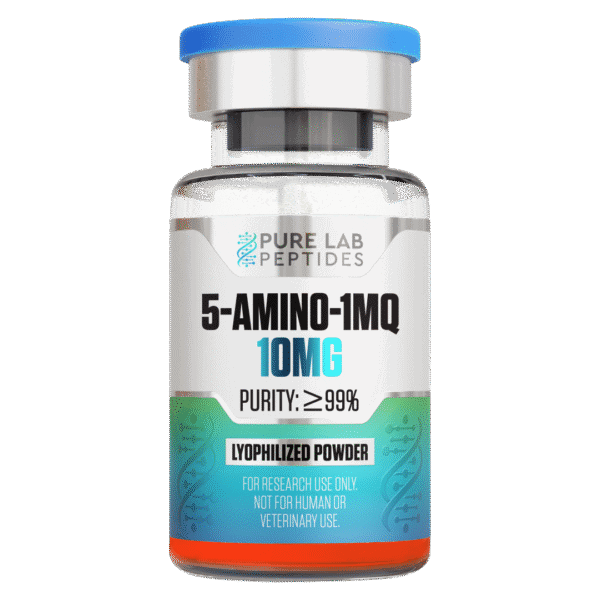
Pure Lab Peptides presents 5-Amino-1MQ 50mg as a research-use-only laboratory material in lyophilized powder form with a >=99% purity claim and batch-specific COA availability. Researchers should review the product page and batch-specific documentation for product details, purity information, identity documentation, storage and handling information, and lot-level traceability.
Review the Pure Lab Peptides 5-Amino-1MQ research-use-only product details page for RUO labeling, product details, purity information, and batch-specific documentation. Researchers comparing suppliers can also review the broader research peptide and compound collection, the research documentation blog, and shipping and returns information as part of supplier evaluation.
Common Misunderstandings About Buying 5-Amino-1MQ Online
Misunderstanding 1: “Buy 5-Amino-1MQ online” means personal use
In this article, buying language is limited to procurement by qualified researchers, laboratory buyers, research institutions, and technical purchasing teams. The article does not provide consumer purchasing advice, self-use instructions, or outcome expectations.
Misunderstanding 2: Published literature equals product-use guidance
Published literature can help classify a compound and understand why researchers cite it, but literature context is not a product instruction sheet. Researchers should separate scientific background from supplier-specific 5-Amino-1MQ supplier documentation, including COA, label, lot number, and storage records.
Misunderstanding 3: Purity percentage alone proves identity
Purity and identity are related but separate documentation questions. A COA may report a purity percentage, but 5-Amino-1MQ identity testing should also be reviewed through method information, mass data where available, chromatographic evidence, and lot-level consistency.
Misunderstanding 4: COA documentation does not need to be batch-specific
For procurement records, a generic COA is less useful than a batch-specific COA tied to the material received. The product name, lot number, amount, test date, and analytical result should align across the label, product page, and receiving records.
Misunderstanding 5: Pathway relevance equals a product claim
NNMT-related pathway literature can explain why 5-Amino-1MQ appears in biochemical research. It should not be used to promote expected outcomes, wellness positioning, or personal-use decisions. The correct procurement focus is documentation, identity, purity, and RUO labeling.
FAQs About Buying 5-Amino-1MQ Online for Research
Where can researchers buy 5-Amino-1MQ online for laboratory research?
Researchers can evaluate 5-Amino-1MQ online through RUO suppliers that provide clear product labeling, batch-specific COA access, purity documentation, identity information, and traceable product records. Pure Lab Peptides provides a 5-Amino-1MQ 50mg product page for research procurement review.
What should researchers check before buying 5-Amino-1MQ online?
Before buying 5-Amino-1MQ online, researchers should check RUO labeling, the batch-specific COA, purity documentation, identity testing, lot number consistency, product form, storage information, and supplier documentation. These records help build a controlled purchasing file.
Why does a COA matter when buying 5-Amino-1MQ?
A COA matters when buying 5-Amino-1MQ because it connects the supplier lot to analytical documentation. A useful 5-Amino-1MQ COA should identify the compound, lot number, reported purity, analytical method, and relevant identity information so the purchasing team can compare it with the received material.
Is 5-Amino-1MQ intended for human or animal consumption?
5-Amino-1MQ discussed here is not intended for human or animal consumption. The procurement context is research use only, which means the material is evaluated for controlled laboratory documentation, not personal use, clinical use, veterinary use, diagnosis, or treatment.
What does research use only mean for 5-Amino-1MQ?
Research use only for 5-Amino-1MQ means the material is positioned as a laboratory research compound. Researchers should evaluate labeling, COA availability, 5-Amino-1MQ purity documentation, identity testing, storage information, and lot traceability before procurement.
How should published literature about 5-Amino-1MQ be interpreted?
Published literature about 5-Amino-1MQ should be interpreted as scientific background for compound identity, NNMT-related research context, or analytical method relevance. It should not be treated as product-use guidance, a procurement shortcut, or a replacement for batch-specific supplier documentation.
Next Steps
Qualified researchers evaluating 5-Amino-1MQ should review product labeling, COA status, identity documentation, storage information, and supplier transparency before selecting any research-use-only material. Review the 5-Amino-1MQ laboratory research material page for RUO labeling, purity information, and available batch-specific documentation.
References
- U.S. Food and Drug Administration. “Distribution of In Vitro Diagnostic Products Labeled for Research Use Only or Investigational Use Only.” FDA Guidance. 2013. https://www.fda.gov/regulatory-information/search-fda-guidance-documents/distribution-in-vitro-diagnostic-products-labeled-research-use-only-or-investigational-use-only
- Electronic Code of Federal Regulations. “21 CFR 809.10 – Labeling for in vitro diagnostic products.” eCFR. Current. https://www.ecfr.gov/current/title-21/chapter-I/subchapter-H/part-809/subpart-B/section-809.10
- National Center for Biotechnology Information. “5-Amino-1-methylquinolinium.” PubChem Compound CID 950107. https://pubchem.ncbi.nlm.nih.gov/compound/5-Amino-1-methylquinolinium
- National Center for Biotechnology Information. “NNMTi.” PubChem Compound CID 66522933. https://pubchem.ncbi.nlm.nih.gov/compound/NNMTi
- Kim S, Chen J, Cheng T, et al. “PubChem 2025 update.” Nucleic Acids Research. 2025;53(D1):D1516-D1525. https://pubmed.ncbi.nlm.nih.gov/39558165/
- UniProt Consortium. “Nicotinamide N-methyltransferase – Homo sapiens (Human), P40261.” UniProtKB. https://www.uniprot.org/uniprotkb/P40261/entry
- National Center for Biotechnology Information. “NNMT nicotinamide N-methyltransferase [Homo sapiens].” NCBI Gene ID 4837. https://www.ncbi.nlm.nih.gov/gene/4837
- Aksoy S, Szumlanski CL, Weinshilboum RM. “Human liver nicotinamide N-methyltransferase. cDNA cloning, expression, and biochemical characterization.” Journal of Biological Chemistry. 1994;269:14835-14840. https://www.jbc.org/article/S0021-9258(17)36700-5/fulltext
- Pissios P. “Nicotinamide N-Methyltransferase: More Than a Vitamin B3 Clearance Enzyme.” Trends in Endocrinology and Metabolism. 2017;28(5):340-353. https://pmc.ncbi.nlm.nih.gov/articles/PMC5446048/
- Neelakantan H, Wang HY, Vance V, et al. “Structure-Activity Relationship for Small Molecule Inhibitors of Nicotinamide N-Methyltransferase.” Journal of Medicinal Chemistry. 2017;60(12):5015-5028. https://pubmed.ncbi.nlm.nih.gov/28548833/
- Awosemo O, Neelakantan H, Watowich S, et al. “Development and validation of LC-MS/MS assay for 5-amino-1-methyl quinolinium in rat plasma: Application to pharmacokinetic and oral bioavailability studies.” Journal of Pharmaceutical and Biomedical Analysis. 2021;204:114255. https://pubmed.ncbi.nlm.nih.gov/34304009/
- Iyamu ID, Huang R. “Mechanisms and inhibitors of nicotinamide N-methyltransferase.” RSC Medicinal Chemistry. 2021;12:1254-1261. https://pmc.ncbi.nlm.nih.gov/articles/PMC8372200/
- International Council for Harmonisation. “Q2(R2) Validation of Analytical Procedures.” ICH/FDA Guidance. 2024. https://www.fda.gov/media/161201/download
- U.S. Food and Drug Administration. “Analytical Procedures and Methods Validation for Drugs and Biologics.” FDA Guidance. 2015. https://www.fda.gov/regulatory-information/search-fda-guidance-documents/analytical-procedures-and-methods-validation-drugs-and-biologics
- U.S. Food and Drug Administration. “Q14 Analytical Procedure Development.” FDA Guidance. 2024. https://www.fda.gov/regulatory-information/search-fda-guidance-documents/q14-analytical-procedure-development
- United States Pharmacopeia. “<621> Chromatography.” USP General Chapter. 2021 harmonization document. https://www.usp.org/sites/default/files/usp/document/harmonization/gen-chapter/harmonization-november-2021-m99380.pdf
- International Organization for Standardization. “ISO/IEC 17025 – Testing and calibration laboratories.” ISO. https://www.iso.org/ISO-IEC-17025-testing-and-calibration-laboratories.html
- Zdrazil B, Felix E, Hunter F, et al. “The ChEMBL Database in 2023: a drug discovery platform spanning multiple bioactivity data types and time periods.” Nucleic Acids Research. 2024;52(D1):D1180-D1192. https://academic.oup.com/nar/article/52/D1/D1180/7337608
- Babault N, Allali-Hassani A, Li F, et al. “Discovery of Bisubstrate Inhibitors of Nicotinamide N-Methyltransferase.” Journal of Medicinal Chemistry. 2018;61(4):1541-1551. https://pmc.ncbi.nlm.nih.gov/articles/PMC5823789/
- Kannt A, Rajagopal S, Kadnur SV, et al. “A small molecule inhibitor of Nicotinamide N-methyltransferase for the treatment of metabolic disorders.” Scientific Reports. 2018;8:3660. https://pmc.ncbi.nlm.nih.gov/articles/PMC5826917/
There are no reviews yet.