
...

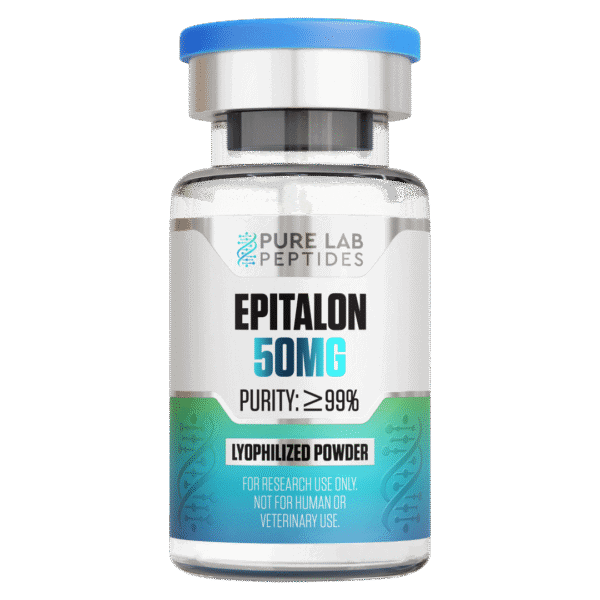
Epitalon (Epithalon) 10mg

$39.99

(5.0) (57 customer reviews)

Research Studies:

  • Facilitates analysis of telomerase activation and telomere length maintenance in assays
  • Supports investigation into peptide-DNA interactions within pineal gland chromatin architecture
  • Enables research on melatonin secretion regulation and circadian rhythm metabolic pathways
  • Useful for evaluating epigenetic modulation of cellular senescence and repair mechanisms

Quantity:

Free Shipping
Buy Peptides with confidence: Stripe-powered secure checkout and major cards accepted.
Secure payment methods for buying peptides: Visa, MasterCard, AMEX, and more.
Buy Peptides with confidence: Stripe-powered secure checkout and major cards accepted.
Secure payment methods for buying peptides: Visa, MasterCard, AMEX, and more.

FREE Shipping on 

orders over $200

ALL ARTICLES AND PRODUCT INFORMATION PROVIDED ON THIS WEBSITE ARE FOR INFORMATIONAL AND EDUCATIONAL PURPOSES ONLY. The products offered on this website are intended solely for research and laboratory use. These products are not intended for human or animal consumption. They are not medicines or drugs and have not been evaluated or approved by the FDA to diagnose, treat, cure, or prevent any disease or medical condition. Any form of bodily introduction is strictly prohibited by law.

Description

Epitalon (Epithalon) 10mg is a research-use-only laboratory material supplied for controlled research workflows, compound characterization, and analytical documentation review. It is manufactured under rigorous quality standards to support consistency, traceability, and batch-specific verification for qualified laboratory settings.

Key Product Details

  • Manufactured in accordance with rigorous quality standards to support ≥99% purity, as reflected in batch-specific documentation where available.
  • Every batch is third-party analyzed for identity, assay/potency, and sterility documentation where applicable.
  • Supplied in lyophilized powder form to help preserve stability throughout transport and storage.
  • Produced with lot-level traceability to support research documentation and laboratory recordkeeping.

Research Documentation Context

  • Supports compound characterization in controlled laboratory settings.
  • Provides batch-specific identity and purity documentation for research review.
  • Allows lot-level traceability across laboratory documentation workflows.
  • Supports comparison of product labeling, analytical documentation, and storage information during research planning.
  • Supports analytical review of short peptide research materials within a strictly laboratory-focused context.

Specifications and Documentation

  • Certificate of Analysis: Available with batch-specific documentation where applicable.
  • Material Safety Data Sheet: Coming Soon.
  • Handling and Storage Instructions: Coming Soon.
  • Product Form: Lyophilized powder.
  • Purity Specification: ≥99% purity.
  • Intended Use: Laboratory research use only.

Epitalon (Epithalon) 10mg is intended strictly for laboratory research use only. This product is not intended for human or animal consumption, therapeutic use, diagnostic use, clinical use, veterinary use, or as a food, drug, cosmetic, dietary supplement, or household product.

Additional information

CAS No.

307297-39-8

Purity

≥99%

Sequence

Ala-Glu-Asp-Gly

Molecular Formula

C14H22N4O9

Molecular Weight

390.35 g/mol

Synthesis

Solid-phase synthesis

Format

Lyophilized powder

Solubility

Soluble in water or 1% acetic acid

Stability & Storage

Stable for up to 24 months at -20°C. After reconstitution, may be stored at 4°C for up to 4 weeks or at -20°C for up to 6 months.

Applications

Cellular longevity studies, senescence delay research, lifespan and aging research

Appearance

White lyophilized powder

Shipping Conditions

Shipped at ambient temperature; once received, store at -20°C

Regulatory/Compliance

Manufactured in a facility that adheres to cGMP guidelines

Safety Information

Refer to provided MSDS

There are no reviews yet.

We value your feedback. Please leave a review below:

Research Procurement Information

Buy Epithalon Online for Research | RUO COA Guide

Researchers searching for buy Epithalon online should evaluate Epithalon as a research-use-only laboratory material, not a consumer product. For laboratory buyers, the key considerations are compound identity, purity documentation, batch-specific COAs, lot traceability, product labeling, and storage information. This guide explains how to evaluate Epithalon 10mg for controlled research procurement through Pure Lab Peptides while keeping the discussion focused on analytical documentation, supplier transparency, and RUO compliance.

Fast Answer: buy Epithalon online for laboratory research

Researchers can buy Epithalon online for laboratory research by reviewing RUO labeling, batch-specific COA documentation, purity data, identity information, storage guidance, and supplier transparency before selecting a source. Products discussed in this article are intended for laboratory research use only and are not intended for human or animal consumption.

What Does “Buy Epithalon Online” Mean in a Research Context?

The phrase buy Epithalon online is addressed here as laboratory research procurement intent, not personal-use intent. In a compliant RUO context, the search is about whether a qualified laboratory buyer can evaluate a documented Epithalon research material with appropriate identity, purity, and lot-level records.

For technical procurement teams, buying online should mean reviewing supplier documentation before a material enters a controlled workflow. That review includes the product name, research-use-only labeling, certificate of analysis, analytical method references, product form, lot number, and storage information. It also includes a language review: an RUO supplier should not frame Epithalon research-use-only material with dosing, therapeutic, diagnostic, consumer, veterinary, or wellness positioning.

Epithalon supplier documentation should help researchers connect the catalog listing, product label, COA, and internal receiving record. A batch-specific COA is especially important because it allows a laboratory to document the specific lot being received rather than relying only on a generic product description.

Epithalon Research Material Overview

Epithalon is a spelling variant commonly associated with Epitalon, a synthetic short peptide also listed as Ala-Glu-Asp-Gly or AEDG. PubChem identifies Epitalon with the molecular formula C14H22N4O9 and a computed molecular weight of approximately 390.35 g/mol, and lists Epithalon and Epithalone among related synonyms [1]. NCATS Inxight Drugs identifies Epitalon with the same molecular formula, molecular weight near 390.35, and the amino acid sequence Ala-Glu-Asp-Gly [2].

From a procurement perspective, Epithalon should be treated as a short peptide/bioregulator research compound. Published literature discusses AEDG in short-peptide, chromatin, telomere, pineal peptide, and cell-model research contexts; that literature is scientific context, not a basis for product-use claims. Short peptide research literature should be discussed as scientific context, not as product-use guidance.

Laboratory characterization of an Epithalon research material generally centers on sequence, molecular mass, purity, identity testing, and product form. Researchers should evaluate Epithalon identity testing with the same discipline used for other synthetic peptide materials: a purity percentage is useful, but identity-supporting data such as HPLC, LC-MS, mass spectrometry, chromatographic trace, or related analytical documentation provide a stronger documentation package. Review literature has also noted that much of the Epitalon research base is concentrated in limited research groups, which is another reason to separate literature context from supplier or product claims [3].

Why Researchers Search “Buy Epithalon Online”

Researchers may search buy Epithalon online to determine whether an RUO supplier provides transparent documentation before procurement. The search intent is commercial, but in a laboratory setting it should be documentation-first: COA access, purity support, identity confirmation, lot number matching, label consistency, storage information, and supplier language all matter.

A qualified laboratory buyer may also search buy Epithalon when comparing product form and documentation standards across suppliers. For Pure Lab Peptides, Epithalon 10mg is positioned as a research-use-only material supplied as lyophilized powder with a batch-specific COA available. That information should be reviewed together with product page details and laboratory receiving records.

Researchers should not treat search results as scientific validation. A supplier page can describe an Epithalon research material, but it should not replace peer-reviewed literature, analytical records, or internal procurement controls. Epithalon purity documentation, Epithalon COA review, and Epithalon supplier documentation are the relevant procurement topics for this page.

Research Procurement Checklist for Epithalon

  • Verify that Epithalon is labeled for research use only.
  • Review the batch-specific certificate of analysis before procurement.
  • Confirm that the Epithalon COA includes purity documentation and identity-supporting information.
  • Check whether HPLC, LC-MS, mass spectrometry, or another analytical method is listed.
  • Compare the product name, lot number, and documentation for consistency.
  • Assess whether the supplier avoids dosing, injection, therapeutic, diagnostic, or human-use claims.
  • Document storage and handling information in laboratory records.
  • Evaluate whether the lyophilized powder form matches the needs of the research workflow.
  • Confirm that the product is not marketed for human or animal consumption.

Epithalon Quality Signals to Review Before Buying Online

Researchers evaluating where to buy Epithalon online for laboratory research should prioritize quality signals that can be documented at the lot level. Useful signals include RUO labeling, a batch-specific COA, analytical support for the stated purity, identity confirmation, lot traceability, storage guidance, and supplier language that remains limited to controlled research procurement.

Evaluation Area What Researchers Should Review Why It Matters for RUO Procurement
RUO labeling Confirm the product is clearly labeled for research use only Helps separate research procurement from human-use positioning
COA availability Review the batch-specific certificate of analysis supplied for the lot Supports lot-level documentation and quality review
Purity data Look for analytical support for the stated purity Helps evaluate material consistency
Identity testing Review HPLC, LC-MS, mass spectrometry, or related identity data Helps confirm the material matches the listed compound
Lot traceability Match lot numbers across product and documentation Supports research recordkeeping
Product form Confirm whether the material is supplied as lyophilized powder or another documented form Supports laboratory planning
Storage information Review storage and handling documentation Helps maintain material integrity in laboratory settings
Supplier language Confirm the supplier avoids dosing, therapeutic, or personal-use claims Supports research-use-only positioning

COA, Purity, and Identity Documentation

A strong Epithalon COA review starts with basic consistency checks. Researchers should compare the compound name, product amount, product form, lot number, test date, purity percentage, testing method, identity confirmation, and storage notes. For a short peptide such as Epithalon, documentation may also include molecular weight, sequence, chromatographic data, or mass data when available.

A purity percentage alone does not establish complete compound identity; researchers should evaluate purity, identity, method, lot number, and documentation together. ICH Q2(R2) describes analytical validation concepts that support review of procedure performance characteristics, while ICH Q14 describes science- and risk-based development of analytical procedures [4] [5]. FDA analytical-method guidance similarly describes documentation supporting identity, quality, purity, and related analytical information for regulated submissions; RUO procurement teams can use the same general documentation mindset without treating RUO materials as clinical products [6].

For peptide materials, published analytical guidance emphasizes that peptide procurement, characterization, storage, and handling records should be documented carefully, especially when peptides are used in mass-spectrometry-based assays [7]. HPLC is widely used for peptide analysis and purification, while LC-HRMS and related LC-MS workflows can support peptide identity and impurity characterization [8] [9].

flowchart TD A[Receive product and COA] --> B{RUO labeling present?} B -- No --> C[Flag procurement gap] B -- Yes --> D{Lot number matches across label and COA?} D -- No --> E[Request batch-specific documentation] D -- Yes --> F{Identity supported by analytical method?} F -- No --> G[Request HPLC, LC-MS, or equivalent] F -- Yes --> H[Proceed to laboratory documentation and storage]

The same workflow should be recorded internally. If a lot number does not match, or if the COA does not support identity, the issue should be treated as a procurement gap rather than a laboratory assumption.

Research Literature Context

Published literature refers to Epithalon/Epitalon primarily as AEDG, a four-amino-acid peptide. Scientific databases and reviews identify it as a short peptide that appears in literature related to chromatin, ribosomal gene activity, telomere-related cell models, pineal peptide research, and other preclinical or cell-model contexts [1] [2] [3]. That literature should be read as research context only.

Several publications have examined AEDG in cell-culture or model systems. A 2020 Molecules paper discussed AEDG peptide in gene-expression and protein-synthesis research during neurogenesis models [10]. Earlier publications examined telomerase-related cell-culture endpoints, proliferative-limit models, and chromatin-related observations in cultured human cells [11] [12] [13]. Other studies evaluated chromosome-aberration or carcinogenesis-related endpoints in preclinical models [14] [15].

These publications do not establish product-use guidance for Epithalon research-use-only materials. Published clinical literature should not be interpreted as use guidance for RUO materials. The evidence landscape includes database records, reviews, cell-culture work, and preclinical reports; it does not convert an Epithalon research material into a therapeutic, diagnostic, consumer, or veterinary product.

Evidence Landscape

Research Area What Literature Examines Evidence Type RUO Interpretation
Compound identity Molecular structure, sequence, formula, and synonym records for Epithalon/Epitalon Database / analytical Supports identification, not product-use claims
Short peptide category context AEDG sequence, short peptide literature, chromatin models, and cell-model research areas Review / in vitro / preclinical Useful for research context, not therapeutic claims
Analytical testing Purity, identity, peptide characterization, and batch verification HPLC / LC-MS / mass spectrometry / COA Supports documentation review
Storage and stability Material form, handling records, and peptide storage considerations Laboratory documentation Supports research workflow planning

Peer-reviewed peptide methodology papers support the use of orthogonal analytical thinking. LC-MS workflows are used to characterize synthetic peptide therapeutics and related impurities, and mass spectrometry can help evaluate synthetic peptide authenticity and integrity [16] [17]. These methods support laboratory documentation; they do not create product-use claims.

Claim Boundary Table

Research-Safe Statement Why It Is Acceptable Non-Compliant Version to Avoid
“Epithalon is discussed in published research related to short peptide and AEDG research contexts.” Describes literature context without making a product claim “Epithalon helps with a human outcome.”
“Researchers should review COA and identity data before procurement.” Focuses on documentation and quality review “Users should buy Epithalon for results.”
“Pure Lab Peptides supplies Epithalon as a research-use-only material.” Clarifies intended use “Pure Lab Peptides supplies Epithalon for therapy.”
“The phrase buy Epithalon online is addressed as research procurement intent.” Qualifies commercial search intent “Buy Epithalon online for personal use.”
“Epithalon purity documentation should be evaluated with identity testing and lot records.” Connects quality review to analytical documentation “Purity alone proves the product should be used.”

How Pure Lab Peptides Presents Epithalon

Pure Lab Peptides presents Epithalon 10mg as a research-use-only material. The product is supplied as lyophilized powder, carries a stated purity claim of >=99%, and has a batch-specific COA available for review. Researchers should review the product page, COA, purity information, storage and handling documentation, and lot-level traceability before procurement.

Review the Pure Lab Peptides Epithalon research-use-only product page for RUO labeling, product details, purity information, and batch-specific documentation. Researchers comparing related materials can also review the Pure Lab Peptides research peptide collection, the Pure Lab Peptides research documentation blog, and shipping and returns information for procurement planning.

Supplier transparency is not a single claim. It is the combined presence of clear RUO positioning, lot-level traceability, batch-specific COA access, documented product form, storage information, and disciplined language that avoids human-use or animal-use positioning.

Common Misunderstandings About Buying Epithalon Online

Misunderstanding: “Buy Epithalon online” means personal use

Buy Epithalon online should not be interpreted as personal-use guidance on this page. The phrase is addressed as laboratory procurement intent for qualified researchers reviewing RUO labeling, documentation, purity data, identity information, and supplier transparency.

Misunderstanding: Published literature equals product-use guidance

Published Epithalon literature may provide scientific background for research teams, but it does not define how an RUO material should be used. Short peptide research literature should be discussed as scientific context, not as product-use guidance.

Misunderstanding: Purity percentage alone proves identity

Epithalon purity documentation is important, but purity alone does not prove complete identity. Researchers should review the compound name, lot number, analytical method, identity-supporting data, product form, and COA together before accepting a material into laboratory records.

Misunderstanding: COA documentation does not need to be batch-specific

A generic specification is not the same as a batch-specific COA. Lot-level documentation allows a research team to match the received material to the analytical record. NIST reference-material guidance similarly highlights the role of certificates and lot or serial identifiers in traceable documentation systems [18].

Misunderstanding: RUO labeling supports clinical or diagnostic use

RUO labeling does not support clinical, diagnostic, personal, or veterinary use. FDA RUO/IUO guidance explains that RUO labeling must be consistent with intended use, and 21 CFR 809.10 includes the RUO statement “For Research Use Only. Not for use in diagnostic procedures.” [19] [20]

FAQs About Buying Epithalon Online for Research

Where can researchers buy Epithalon online for laboratory research?

Researchers can buy Epithalon online for laboratory research by reviewing suppliers that provide RUO labeling, batch-specific COA access, purity documentation, identity information, storage guidance, and transparent lot-level records. Pure Lab Peptides provides an Epithalon 10mg product page for qualified research procurement review.

What should researchers check before buying Epithalon online?

Before buying Epithalon online, researchers should check the product name, RUO label, batch-specific COA, stated purity, identity testing method, product form, lot number, and storage documentation. They should also confirm that the supplier avoids therapeutic, diagnostic, personal-use, and animal-use positioning.

Why does a COA matter when buying Epithalon?

A COA matters when buying Epithalon because it documents the batch-specific analytical record that a laboratory can compare against the received material. The Epithalon COA should be reviewed alongside the product label, lot number, purity data, identity-supporting method, and internal receiving records.

Is Epithalon intended for human or animal consumption?

No. Epithalon discussed here is a research-use-only laboratory material and is not intended for human or animal consumption. This page addresses procurement documentation, COA review, purity documentation, identity testing, supplier transparency, and laboratory recordkeeping for qualified research settings.

What does research use only mean for Epithalon?

Research use only means Epithalon is positioned for controlled laboratory research workflows, not for clinical, diagnostic, consumer, veterinary, therapeutic, or personal-use purposes. RUO review should focus on documentation, identity, purity, storage records, lot traceability, and supplier language.

How should published literature about Epithalon be interpreted?

Published literature about Epithalon should be interpreted as scientific background, not as use guidance for an RUO material. Research teams may review database records, cell-model papers, preclinical reports, and analytical methodology sources, but those sources do not create product-use instructions or outcome claims.

Next Steps

Qualified researchers evaluating Epithalon should review product labeling, COA status, identity documentation, storage information, and supplier transparency. Review the Epithalon 10mg product page for RUO labeling, purity information, and available batch-specific documentation before selecting any research-use-only material.

References

  1. National Center for Biotechnology Information. “Epitalon.” PubChem Compound Database. Updated database record. https://pubchem.ncbi.nlm.nih.gov/compound/Epitalon
  2. National Center for Advancing Translational Sciences. “EPITALON.” Inxight Drugs. Updated database record. https://drugs.ncats.io/drug/O65P17785G
  3. Araj SK, et al. “Overview of Epitalon-Highly Bioactive Pineal Tetrapeptide with Promising Properties.” International Journal of Molecular Sciences. 2025. https://pubmed.ncbi.nlm.nih.gov/40141333/
  4. International Council for Harmonisation. “Q2(R2) Validation of Analytical Procedures.” ICH Harmonised Guideline. 2023. https://database.ich.org/sites/default/files/ICH_Q2%28R2%29_Guideline_2023_1130.pdf
  5. International Council for Harmonisation. “Q14 Analytical Procedure Development.” ICH Harmonised Guideline. 2023. https://database.ich.org/sites/default/files/ICH_Q14_Guideline_2023_1116.pdf
  6. U.S. Food and Drug Administration. “Analytical Procedures and Methods Validation for Drugs and Biologics.” FDA Guidance for Industry. 2015. https://www.fda.gov/files/drugs/published/Analytical-Procedures-and-Methods-Validation-for-Drugs-and-Biologics.pdf
  7. Hoofnagle AN, Whiteaker JR, Carr SA, et al. “Recommendations for the Generation, Quantification, Storage, and Handling of Peptides Used for Mass Spectrometry-Based Assays.” Clinical Chemistry. 2016. https://pubmed.ncbi.nlm.nih.gov/26719571/
  8. Mant CT, Hodges RS. “HPLC Analysis and Purification of Peptides.” Methods in Molecular Biology. 2007. https://pmc.ncbi.nlm.nih.gov/articles/PMC7119934/
  9. Zeng K, Geerlof-Vidavsky I, Gucinski A, Jiang X, Boyne MT II. “Liquid Chromatography-High Resolution Mass Spectrometry for Peptide Drug Quality Control.” AAPS Journal. 2015. https://pubmed.ncbi.nlm.nih.gov/25716148/
  10. Khavinson V, Diomede F, Mironova E, et al. “AEDG Peptide (Epitalon) Stimulates Gene Expression and Protein Synthesis during Neurogenesis: Possible Epigenetic Mechanism.” Molecules. 2020. https://pubmed.ncbi.nlm.nih.gov/32019204/
  11. Khavinson VK, Bondarev IE, Butyugov AA. “Epithalon Peptide Induces Telomerase Activity and Telomere Elongation in Human Somatic Cells.” Bulletin of Experimental Biology and Medicine. 2003. https://pubmed.ncbi.nlm.nih.gov/12937682/
  12. Khavinson VK, Bondarev IE, Butyugov AA, Smirnova TD. “Peptide Promotes Overcoming of the Division Limit in Human Somatic Cell.” Bulletin of Experimental Biology and Medicine. 2004. https://pubmed.ncbi.nlm.nih.gov/15455129/
  13. Khavinson VK, Lezhava TA, Monaselidze JR, et al. “Peptide Epitalon Activates Chromatin at the Old Age.” Neuro Endocrinology Letters. 2003. https://pubmed.ncbi.nlm.nih.gov/14647006/
  14. Rosenfeld SV, Togo EF, Mikheev VS, Popovich IG, Zabezhinski MA, Anisimov VN. “Effect of Epithalon on the Incidence of Chromosome Aberrations in Senescence-Accelerated Mice.” Bulletin of Experimental Biology and Medicine. 2002. https://pubmed.ncbi.nlm.nih.gov/12360351/
  15. Kossoy G, Ben-Hur H, Stark A, et al. “Epitalon and Colon Carcinogenesis in Rats.” Bulletin of Experimental Biology and Medicine. 2003. https://pubmed.ncbi.nlm.nih.gov/12964022/
  16. Lian Z, Xu Y, Wang X, et al. “Characterization of Synthetic Peptide Therapeutics Using Liquid Chromatography-Mass Spectrometry.” Journal of the American Society for Mass Spectrometry. 2021. https://pubmed.ncbi.nlm.nih.gov/34110145/
  17. Prabhala BK, Mirza UA. “Characterization of Synthetic Peptides by Mass Spectrometry.” Methods in Molecular Biology. 2015. https://pubmed.ncbi.nlm.nih.gov/26424265/
  18. National Institute of Standards and Technology. “Standard Reference Materials FAQs.” NIST. Updated resource. https://www.nist.gov/srm/faqs
  19. U.S. Food and Drug Administration. “Distribution of In Vitro Diagnostic Products Labeled for Research Use Only or Investigational Use Only.” FDA Guidance Document. 2013. https://www.fda.gov/regulatory-information/search-fda-guidance-documents/distribution-in-vitro-diagnostic-products-labeled-research-use-only-or-investigational-use-only
  20. Electronic Code of Federal Regulations. “21 CFR 809.10 – Labeling for In Vitro Diagnostic Products.” eCFR. Current regulation. https://www.ecfr.gov/current/title-21/chapter-I/subchapter-H/part-809/subpart-B/section-809.10
  21. International Organization for Standardization. “ISO/IEC 17025:2017 General Requirements for the Competence of Testing and Calibration Laboratories.” ISO. 2017, confirmed 2023. https://www.iso.org/standard/66912.html
  22. National Institute of Standards and Technology. “Reference Materials.” NIST. Updated resource. https://www.nist.gov/reference-materials

Have Questions?

Our team is ready to assist you with any inquiries regarding our catalogue of peptides and their applications.

0