
...
Documentation and Quality

How to Read a Peptide Certificate of Analysis

Fast Answer

A peptide COA is a batch-linked laboratory document that summarizes what material was tested, which analytical methods were used, what results were obtained, and whether those results met the supplier’s stated specifications. In a research-use-only peptide context, the most important questions are not consumer questions. They are laboratory questions: does the COA match the product name and lot number, are the methods identified, is identity supported, is purity reported in a meaningful way, are dates and storage statements traceable, and does the document read like a real analytical record rather than a generic marketing insert. [7]

Products discussed in this article are intended for laboratory research use only and are not intended for human or animal consumption.

Research-use-only context

A peptide COA should always be read inside the larger RUO context. The intended-use rule in 21 CFR § 201.128 says a product’s objective intent can be shown by expressions, design or composition, labeling claims, advertising matter, written or oral statements, and the surrounding circumstances of distribution. That matters because a technically formatted COA does not rescue a page or catalog that otherwise implies clinical, consumer, veterinary, diagnostic, cosmetic, or personal-use intent. If the surrounding content points in the wrong direction, the documentation package is already compromised from a compliance perspective. [8]

The clearest federal RUO phrase appears in 21 CFR § 809.10 for certain in vitro diagnostic products in laboratory research phases: “For Research Use Only. Not for use in diagnostic procedures.” Although that regulation is specific to IVDs rather than peptide e-commerce generally, it is still highly instructive because it shows how regulators think about limiting statements, intended use, lot or control numbers, storage instructions, performance characteristics, and the need for users to determine whether a reagent meets appropriate standards. Those same ideas map neatly onto a peptide COA review framework. [9]

FDA’s February 4, 2026 safety communication on unapproved GLP-1 products strengthens the point even further. The agency states that it has warned companies selling unapproved drugs falsely labeled “for research purposes” or “not for human consumption” while offering them directly to consumers with dosing instructions. That is exactly the pattern an RUO peptide knowledge base should avoid. A compliance-safe COA article can discuss how to read a laboratory document; it should never pivot into consumption guidance or personal-outcome narratives. [10]

What a peptide COA is

A certificate of analysis is best understood as a structured summary of batch-specific testing. Federal current good manufacturing practice requirements for finished pharmaceuticals are not a one-to-one rulebook for every RUO peptide listing, but they are still an excellent benchmark for understanding what serious laboratory documentation looks like. Under 21 CFR § 211.194, laboratory records are supposed to include a description of the sample, source, quantity, lot number or other distinctive code, each test method used, complete data secured in each test, including graphs, charts, and spectra, calculations, results, comparison with established standards, and review signatures. The same section also requires documenting method modifications, reference standards, instrument calibration records, and stability records. Those recordkeeping principles are exactly why a peptide COA carries real value when it is genuinely batch-specific and method-linked. [11]

For peptide materials specifically, the identity side of the COA often depends on peptide chemistry basics. Peptides are short amino-acid chains linked by peptide bonds, and the identity of a peptide is not exhausted by the compound name alone. Sequence, residue count, terminal features, modifications, and expected molecular weight all matter when deciding whether the tested material is the material being represented. The NCBI Bookshelf peptide overview describes peptides as short strings of amino acids joined by covalent bonds and notes that synthetic peptide production in laboratory settings is commonly performed by solid-phase peptide synthesis. That context matters because it explains why peptide COAs often center on sequence-linked identity and analytical verification rather than on broad descriptive labels. [12]

A useful peptide COA therefore does not merely say “passed.” It should help a laboratory reader answer the following questions: what batch was tested, what analyte was intended, what methods were used to assess the sample, how were the results expressed, which specification limits were applied, and how confidently can the document be traced back to the vial or listing under review. Those questions are also consistent with 21 CFR § 211.160 and § 211.165, which stress scientifically sound specifications, sampling plans, test procedures, and documented test-method performance characteristics such as accuracy, sensitivity, specificity, and reproducibility. [13]

The documentation matrix below translates those regulatory and analytical principles into a practical peptide-COA reading grid. It is a synthesis of eCFR recordkeeping rules, FDA analytical-method guidance, and peptide-analysis literature, rather than a literal checklist copied from a single source. [14]

COA element What it should tell you Why it matters If it is missing or vague
Compound identity Product name, and ideally sequence and key modification information Confirms the document is about the right analyte You may not know whether the COA refers to the same peptide listed for sale
Lot or batch number Distinctive code tied to the tested material Enables traceability between vial, label, and COA The document may be generic rather than batch-specific
Test panel Which attributes were actually evaluated Prevents overreading the COA You cannot assume unlisted attributes were assessed
Analytical methods HPLC, LC-MS, MALDI-TOF, or other method stated clearly Makes reported results interpretable A bare purity or identity claim is weak without method context
Results versus specifications Numerical result and pass/fail versus stated standard Shows whether the batch met the supplier’s own criteria “Pass” without a spec is minimally informative
Supporting data Chromatogram, mass data, graphs, charts, or spectra where available Lets the reader validate the summary conclusion You are forced to trust a summary with no underlying evidence
Dates Manufacture, test, report, re-test, or expiry basis where relevant Helps interpret document recency and storage significance The document may be stale or detached from current inventory
Reviewer sign-off Analyst and/or reviewer approval Signals review and record completeness The COA may look more like marketing collateral than laboratory documentation

How to review a peptide COA

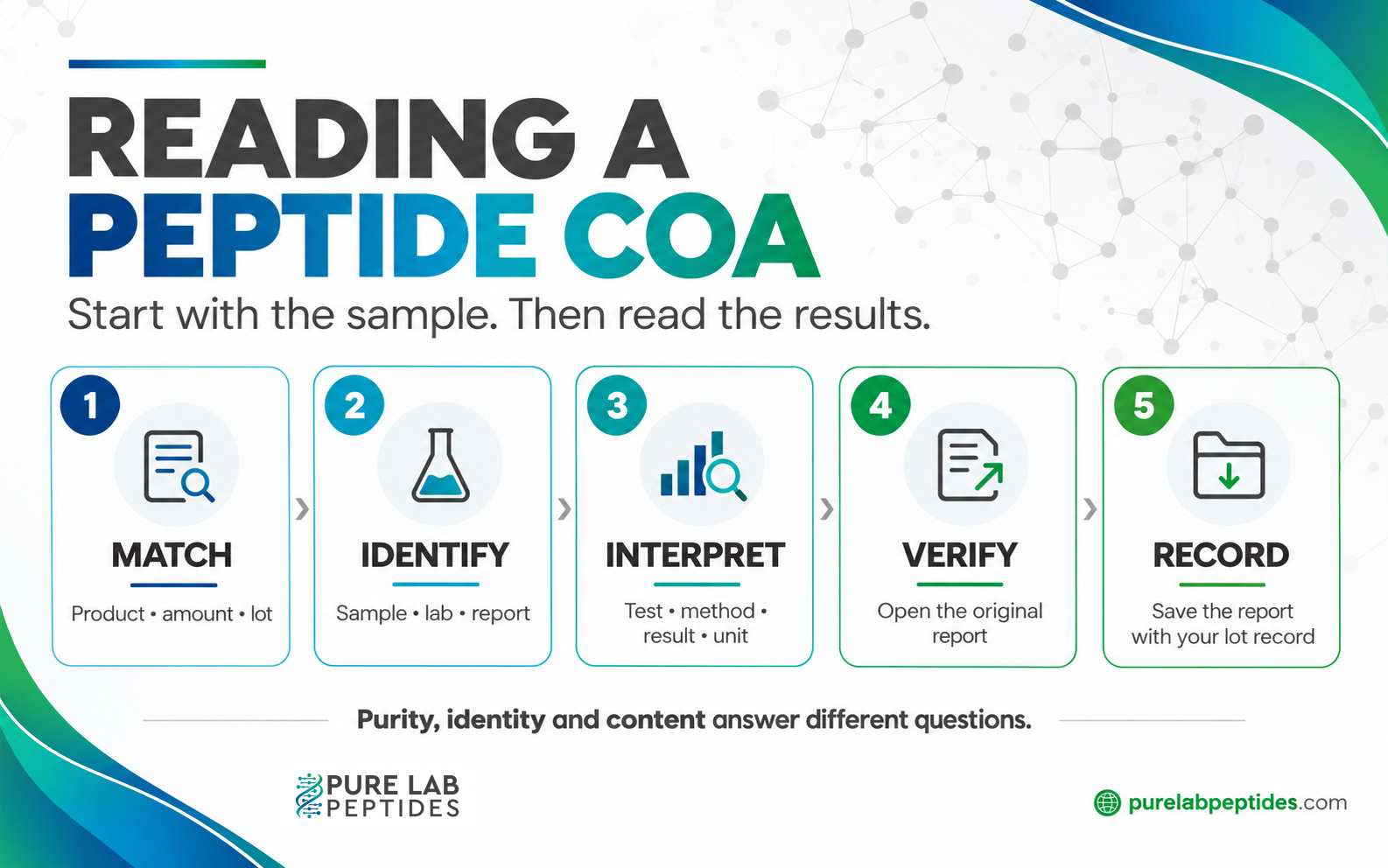
The first step is identity and batch matching. A reader should compare the product title, the peptide name on the COA, the lot number, and any sequence or molecular-weight descriptors that appear across the listing, label, and document. Under 21 CFR § 211.194, the tested sample should be identified by source, quantity, lot number or other distinctive code, and the record should connect the result back to that tested lot. In practical peptide work, that means one of the easiest ways to spot a weak COA is to notice that the listed batch number on the vial or product page is absent, inconsistent, or presented in a format that cannot be matched confidently. [15]

The second step is method-before-result reading. Laboratory records are only as useful as the procedures behind them. 21 CFR § 211.194 requires a statement of each method used and the location of the data showing that those methods meet proper standards of accuracy and reliability as applied to the product tested, while 21 CFR § 211.165 requires the accuracy, sensitivity, specificity, and reproducibility of test methods to be established and documented. FDA’s analytical-method validation guidance and the Q2(R2) and Q14 analytical guidances make the same point at a modern level: a result has to be read in light of method suitability and validated or appropriately developed procedure context. For a peptide COA, that means “purity 99%” is not the beginning and end of the analysis; the question is purity by what method, under what conditions, and against what reporting framework. [16]

The third step is reviewing the identity section carefully. Peptide identity testing is often supported by mass spectrometry because molecular weight can confirm or challenge the stated analyte, and sequence-supporting fragmentation may add another layer of confidence. The classic PubMed paper by Vorm and Roepstorff is especially useful here because it explicitly describes a mass-spectrometric approach as a way to confirm the identity of a peptide tentatively identified by determined molecular weight, while often yielding partial amino-acid sequence information directly. The older LC-high-resolution electrospray MS work by D’Agostino and colleagues likewise shows how LC-MS can resolve multiply charged peptide ions and compare observed and theoretical monoisotopic masses at low ppm error. For an RUO buyer or technical reviewer, the practical takeaway is simple: if a COA claims identity but gives no method or no mass-linked evidence, that claim is materially weaker than one supported by clear LC-MS or related data. [17]

The fourth step is purity review, which usually means reading the HPLC portion with more skepticism and more care than casual buyers often do. Peptide-analysis literature treats HPLC as an extremely versatile method for peptide isolation, purification, and structural characterization, with different modes exploiting size, charge, or hydrophobicity. That versatility is helpful, but it also means that an HPLC number is method-dependent. A chromatographic purity result should be interpreted alongside the chromatogram itself where available, the analytical mode used, the column and mobile-phase conditions if reported, the detection mode, the integration approach, and the relationship between the main peak and any notable secondary peaks. A COA that states a purity value but provides no chromatogram or no method label gives the reader much less to work with. [18]

The fifth step is reading dates and storage statements correctly. Storage language on a peptide COA should be read as part of documentary control and material stewardship, not as consumer-use guidance. eCFR provisions for laboratory controls and stability testing stress that stored materials and stability claims should be tied to reliable, meaningful, and specific test methods, and 21 CFR § 809.10 similarly ties storage instructions to method-based stability foundations. That matters in peptide science because peptide degradation is real and analytically important: the literature identifies oxidation, reduction, deamidation, hydrolysis, beta-elimination, racemization, and related changes as common forms of chemical instability. A storage note without a clear date basis, test date, re-test date, or supporting record context is therefore weaker than one embedded in a coherent lot-level documentation package. [19]

The sixth step is checking completeness and review status. A strong COA should look like a laboratory record, not like a piece of sales copy. FDA’s laboratory-record rule specifically references graphs, charts, spectra, calculations, results and their comparison with standards, signatures of the testing person, and review by a second person for accuracy, completeness, and compliance. In an RUO peptide context, not every supplier will publish every raw record, but the more the COA resembles a true analytical summary tied to those principles, the more seriously it can be taken. If analyst or reviewer sign-off is missing, methods are unnamed, and no batch-specific data are shown, the document may not justify much confidence. [20]

The Evidence Landscape below synthesizes the main source families that matter for this article: intended-use and RUO boundary rules, laboratory-control and recordkeeping standards, FDA/ICH analytical guidance, ISO competence principles, peptide chemistry background, and peer-reviewed peptide-analysis literature. [21]

Evidence area What it supports in this article Source type
Intended use and RUO boundary Why COA interpretation must stay inside research-only framing eCFR and FDA safety communications
Batch, method, and results documentation Why lot numbers, methods, graphs, calculations, and results matter 21 CFR laboratory-control and recordkeeping sections
Analytical method context Why results should be read with method suitability in mind FDA analytical guidance and ICH Q2/Q14
Laboratory competence Why accreditation and report discipline increase trust in test results ISO/IEC 17025
Peptide identity fundamentals Why sequence, peptide bonds, and molecular weight matter NCBI Bookshelf
HPLC purity interpretation Why chromatographic purity is method-dependent and not self-explanatory Peer-reviewed HPLC peptide literature
MS-based identity interpretation Why mass data can support identity and partial sequence confidence PubMed analytical chemistry papers
Stability and storage interpretation Why storage statements should be read alongside degradation risk and testing basis eCFR stability provisions and peptide degradation literature

Visual workflow

The workflow below is a simplified editorial and lab-review sequence for reading a peptide COA. It is a synthesis of the traceability, method, and result-comparison principles reflected in 21 CFR Part 211 and FDA/ICH analytical-guidance materials, not an official FDA or ICH flowchart. [22]

flowchart TD A[Start with product page and vial] --> B[Match peptide name and lot number to COA] B --> C{Batch-specific match?} C -- No --> D[Flag as generic or non-traceable] C -- Yes --> E[Read analytical methods before reading conclusions] E --> F[Review identity section] F --> G[Check mass or sequence-supporting data] G --> H[Review purity section] H --> I[Inspect chromatogram and result vs specification] I --> J[Review dates, storage, and report timing] J --> K[Check analyst/reviewer sign-off and completeness] K --> L{Any missing, conflicting, or vague fields?} L -- Yes --> M[Escalate or request fuller documentation] L -- No --> N[Archive COA with lot record for research file]

The chart below is illustrative rather than empirical. It shows a practical first-pass emphasis for COA review based on the source framework used in this article: identity and purity deserve the most attention, but method transparency, traceability, dating, and review status still matter because a COA is only as trustworthy as the batch and method context around it. [22]

pie showData title Illustrative first-pass COA review emphasis "Identity and lot match" : 25 "Purity and chromatogram" : 25 "Method transparency" : 20 "Specification comparison" : 15 "Stability and dating" : 10 "Sign-off and review" : 5

Red flags, claim boundaries, and practical use

The most common red flags in a peptide COA are surprisingly mundane. A lot number is missing. The product name on the COA does not match the product page cleanly. A purity value is reported without naming the method. A chromatrogram is referenced but not shown. An identity claim appears without any mass-based or sequence-supporting detail. The document is undated or gives a report date divorced from the inventory being sold. A storage statement appears without enough context to tell whether it is a generic template line or a tested stability-based instruction. Taken together, those flaws do not merely reduce elegance; they reduce the document’s evidentiary value. [23]

The Claim Boundary table below translates the regulatory and editorial lesson into publishable language choices. It is based on the intended-use rule, the IVD RUO labeling model, and FDA’s warning that “research purposes” labeling cannot coexist with direct-to-consumer human-use positioning. [6]

Research-safe statement Why it works Version to avoid
“This COA reports batch-specific analytical results for a laboratory research material.” Describes documentation function without implying personal use “This COA proves the product is appropriate to take.”
“Identity claims should be read alongside the stated method and any supporting mass data.” Keeps the claim tied to analytical context “A listed molecular weight alone proves everything important.”
“Purity should be interpreted with the chromatographic method and chromatogram where available.” Acknowledges method dependence “A single purity percentage means the batch is unquestionably high quality.”
“Storage and dating fields should be evaluated as documentation controls.” Keeps storage in laboratory-document terms “Use this storage statement as personal handling advice.”
“A COA does not replace a supplier’s intended-use obligations.” Prevents documentation from masking marketing claims “Any page is fine as long as a COA exists somewhere.”
“RUO peptide materials are not intended for human or animal consumption.” States the boundary clearly “Research-only language is just a formality.”

What a COA cannot tell you is just as important as what it can. A COA does not create regulatory approval. It does not by itself establish lawful intended use outside the RUO context. It does not prove that every potentially relevant impurity was measured if the test panel is narrow. It does not substitute for the underlying batch records if the published document is only a summary. And it does not cure a website, catalog, or email campaign that communicates the wrong intended use. Put differently: a COA is an important laboratory document, but it is not a universal shield against weak methods, missing traceability, or noncompliant marketing context. [24]

The checklist below converts the entire article into an operational pass/fail screen. It is a synthesis of the regulations and analytical sources cited above. [25]

  • Match the peptide name on the product page, vial, and COA.
  • Confirm that the COA is batch-specific and includes a lot or batch number.
  • Check whether the document identifies the analytical methods used.
  • Verify whether identity is supported by mass data or comparable analytical evidence.
  • Review purity as a method-dependent result, not as a standalone number.
  • Look for chromatograms, spectra, or other supporting data where available.
  • Confirm that results are compared with specifications or acceptance criteria.
  • Review report dates, test dates, and any re-test or expiry framework.
  • Read storage language as a documentary control, not as consumer instruction.
  • Check for analyst and reviewer sign-off or equivalent review status.
  • Flag generic templates, undated PDFs, or obviously mismatched lot numbers.
  • Reject any attempt to turn a laboratory COA into human- or animal-use guidance.

FAQs

What is a peptide COA?

A peptide COA is a certificate of analysis tied to a particular batch or lot of peptide material. In a research setting, it is meant to summarize what was tested, how it was tested, what the results were, and how those results compared with the supplier’s stated specifications. The strongest COAs are traceable, method-specific, batch-specific, and supported by at least some underlying analytical detail. [26]

What should be on a peptide COA?

At minimum, a useful peptide COA should identify the analyte and batch, state the method or methods used, provide results against specifications, and preserve traceability between the tested sample and the reported document. The regulatory benchmark for laboratory records also emphasizes complete test data, graphs, charts, spectra, calculations, and review signatures, which is why those elements add real value when suppliers provide them. [11]

Why is lot number matching so important?

Lot matching is the bridge between the physical vial and the paper or PDF record. Without a lot or other distinctive code, a reader cannot confidently tell whether the COA belongs to the exact material being evaluated. That is why lot identification appears so prominently in eCFR labeling and laboratory-record frameworks. [27]

Does a higher purity percentage always mean a better COA?

Not by itself. Purity is useful, but it is only meaningful when you know how it was assessed. A chromatographic purity result should be read with the HPLC method context, the chromatogram where available, and the stated specification. Peptide-analysis literature makes clear that HPLC can separate peptides by different properties and under different modes, so the number is never fully self-explanatory. [18]

Does LC-MS or MALDI prove identity absolutely?

Mass spectrometry can strongly support identity, especially when observed molecular weight aligns with the expected peptide and when additional fragmentation or sequence-linked evidence is available. But it still has to be read as part of a broader documentation package that includes batch matching, method context, and result interpretation. The best practice is to treat LC-MS or MALDI as important identity support, not as a magic substitute for the rest of the COA. [17]

Can a COA make a noncompliant peptide page acceptable?

No. Intended use is assessed from the whole context, not only from one document. FDA’s intended-use rule and recent warnings about falsely “research purposes” products make clear that a research-style PDF does not cure a listing or campaign that otherwise signals human use or provides dosing instructions. [28]

References

  1. 21 CFR § 201.128, “Meaning of intended uses.” eCFR/LII text. [8]
  2. 21 CFR § 809.10, “Labeling for in vitro diagnostic products.” eCFR/LII text. [9]
  3. 21 CFR § 211.160, “General requirements.” eCFR/LII text. [29]
  4. 21 CFR § 211.165, “Testing and release for distribution.” eCFR/LII text. [30]
  5. 21 CFR § 211.194, “Laboratory records.” eCFR/LII text. [11]
  6. “Analytical Procedures and Methods Validation for Drugs and Biologics.” FDA guidance, July 2015. [31]
  7. “Q2(R2) Validation of Analytical Procedures.” FDA guidance announcing final ICH-derived guidance, March 2024. [32]
  8. “Q14 Analytical Procedure Development.” FDA guidance announcing final ICH-derived guidance, March 2024. [33]
  9. ISO/IEC 17025:2017, “General requirements for the competence of testing and calibration laboratories,” current version confirmed in 2023. [34]
  10. Kaprive JF, Krishnamurthy K. “Biochemistry, Peptide.” NCBI Bookshelf, StatPearls; updated August 28, 2023. [12]
  11. Mant CT, Chen Y, Yan Z, et al. “HPLC Analysis and Purification of Peptides.” Methods in Molecular Biology. 2007;386:3-55. PMID: 18604941. [35]
  12. Vorm O, Roepstorff P. “Peptide sequence information derived by partial acid hydrolysis and matrix-assisted laser desorption/ionization mass spectrometry.” Biological Mass Spectrometry. 1994;23(12):734-740. PMID: 7841208. [36]
  13. D’Agostino PA, Hancock JR, Provost LR. “Analysis of bioactive peptides by liquid chromatography-high-resolution electrospray mass spectrometry.” Journal of Chromatography A. 1997;767(1-2):77-85. PMID: 9177006. [37]
  14. Reubsaet JLE, Beijnen JH, Bult A, et al. “Analytical techniques used to study the degradation of proteins and peptides: chemical instability.” Journal of Pharmaceutical and Biomedical Analysis. 1998;17(6-7):955-978. PMID: 9884187. [38]
  15. “FDA’s Concerns with Unapproved GLP-1 Drugs Used for Weight Loss.” FDA safety communication, content current as of February 4, 2026. [10]