
...

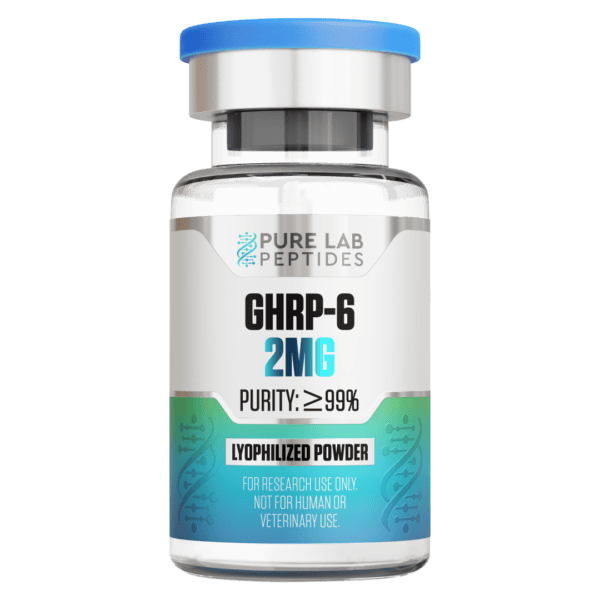
GHRP-6 5mg

$29.99

(5.0) (41 customer reviews)

Research Studies:

  • Selective GHS-R1a agonist for investigating calcium-mediated growth hormone secretagogue signaling
  • Facilitates analysis of ghrelin-mimetic modulation of hypothalamic hunger and satiety circuits
  • Supports research on phospholipase C activation and subsequent pulsatile somatotroph secretion
  • Enables evaluation of metabolic homeostasis and lipid metabolism in cellular models

Quantity:

Free Shipping
Buy Peptides with confidence: Stripe-powered secure checkout and major cards accepted.
Secure payment methods for buying peptides: Visa, MasterCard, AMEX, and more.
Buy Peptides with confidence: Stripe-powered secure checkout and major cards accepted.
Secure payment methods for buying peptides: Visa, MasterCard, AMEX, and more.

FREE Shipping on 

orders over $200

ALL ARTICLES AND PRODUCT INFORMATION PROVIDED ON THIS WEBSITE ARE FOR INFORMATIONAL AND EDUCATIONAL PURPOSES ONLY. The products offered on this website are intended solely for research and laboratory use. These products are not intended for human or animal consumption. They are not medicines or drugs and have not been evaluated or approved by the FDA to diagnose, treat, cure, or prevent any disease or medical condition. Any form of bodily introduction is strictly prohibited by law.

Description

GHRP-6 5mg is a research-use-only laboratory material supplied for controlled research workflows, compound characterization, and analytical documentation review. It is manufactured under rigorous quality standards to support consistency, traceability, and batch-specific verification for qualified laboratory settings.

Key Product Details

  • Manufactured in accordance with rigorous quality standards to support ≥99% purity, as reflected in batch-specific documentation where available.
  • Every batch is third-party analyzed for identity, assay/potency, and sterility documentation where applicable.
  • Supplied in lyophilized powder form to help preserve stability throughout transport and storage.
  • Produced with lot-level traceability to support research documentation and laboratory recordkeeping.

Research Documentation Context

  • Supports compound characterization in controlled laboratory settings.
  • Provides batch-specific identity and purity documentation for research review.
  • Allows lot-level traceability across laboratory documentation workflows.
  • Supports comparison of product labeling, analytical documentation, and storage information during research planning.
  • Supports analytical review of peptide research materials within a strictly laboratory-focused context.

Specifications and Documentation

  • Certificate of Analysis: Available with batch-specific documentation where applicable.
  • Material Safety Data Sheet: Coming Soon.
  • Handling and Storage Instructions: Coming Soon.
  • Product Form: Lyophilized powder.
  • Purity Specification: ≥99% purity.
  • Intended Use: Laboratory research use only.

GHRP-6 5mg is intended strictly for laboratory research use only. This product is not intended for human or animal consumption, therapeutic use, diagnostic use, clinical use, veterinary use, or as a food, drug, cosmetic, dietary supplement, or household product.

Additional information

CAS No.

87616-84-0

Purity

≥99%

Sequence

His-D-Trp-Ala-Trp-D-Phe-Lys-NH2

Molecular Formula

C46H56N12O6

Molecular Weight

873.01 g/mol

Applications

Growth hormone secretion studies, muscle growth research, tissue repair investigations, cardiovascular function analysis

Synthesis

Solid-phase synthesis

Format

Lyophilized powder

Solubility

Soluble in water or 1% acetic acid

Stability & Storage

Stable for up to 24 months at -20°C. After reconstitution, may be stored at 4°C for up to 4 weeks or at -20°C for up to 6 months.

Appearance

White lyophilized powder

Shipping Conditions

Shipped at ambient temperature; once received, store at -20°C

Regulatory/Compliance

Manufactured in a facility that adheres to cGMP guidelines

Safety Information

Refer to provided MSDS

There are no reviews yet.

We value your feedback. Please leave a review below:

Research Procurement Information

Buy GHRP-6 Online for Laboratory Research | COA Guide

Researchers searching for buy GHRP-6 online should evaluate GHRP-6 as a research-use-only laboratory material, not a consumer product. For laboratory buyers, the key considerations are compound identity, purity documentation, batch-specific COAs, lot traceability, product labeling, and storage information. This guide explains how to evaluate GHRP-6 for controlled research procurement through Pure Lab Peptides while keeping published literature separate from product-use claims.

Fast Answer: Buy GHRP-6 Online for Laboratory Research

Researchers can buy GHRP-6 online for laboratory research by reviewing RUO labeling, batch-specific COA documentation, purity data, identity information, storage guidance, and supplier transparency before selecting a source. Products discussed in this article are intended for laboratory research use only and are not intended for human or animal consumption.

What Does “Buy GHRP-6 Online” Mean in a Research Context?

The phrase “buy GHRP-6 online” is addressed here as laboratory research procurement intent, not personal-use intent. In an RUO context, the search is not about outcomes, protocols, or consumer use. It is about whether a supplier provides enough documentation for qualified researchers, laboratory buyers, research institutions, and technical procurement teams to evaluate a GHRP-6 research material before acquisition.

That review should begin with product labeling. A research-use-only product page should separate laboratory procurement from clinical, diagnostic, veterinary, or consumer positioning. Supplier language matters because research-only sourcing depends not only on the compound name but also on how the material is described, documented, and restricted.

Documentation review should include the GHRP-6 COA, stated purity, testing method, lot number, identity information, storage guidance, and product form. A transparent supplier should make it practical for the laboratory record to connect the ordered material, the product label, and the batch-specific certificate of analysis. In regulated laboratory environments, traceability and documentation consistency often matter as much as the headline purity value.

GHRP-6 Research Material Overview

GHRP-6 is commonly identified in scientific databases as growth hormone-releasing peptide-6, growth hormone-releasing hexapeptide, or SKF-110679. The IUPHAR/BPS Guide to Pharmacology lists GHRP-6 as a peptide ligand and provides synonyms and structural identifiers for the compound [1]. PubChem identifies GHRP-6 as a compound with molecular formula C46H56N12O6 and provides database-level chemical structure information [2]. GPCRdb lists the shorthand sequence HWAWFK and connects the ligand record to PubChem and Guide to Pharmacology resources [3].

Published research has characterized GHRP-6 in the broader class of synthetic growth-hormone-secretagogue research materials. Early literature described a synthetic hexapeptide framework in pituitary and related laboratory models, while later receptor literature identified the growth hormone secretagogue receptor, also called the ghrelin receptor, as a major receptor context for secretagogue research [4] [5]. The discovery of ghrelin as an endogenous acylated peptide ligand gave this pathway a broader biochemical context in receptor and endocrine research literature [6].

For procurement purposes, those publications do not convert GHRP-6 into a consumer-use, clinical-use, or veterinary-use material. They provide scientific context for compound identity and literature classification. The NCBI Gene record for GHSR identifies the growth hormone secretagogue receptor as a protein-coding gene and describes the receptor as part of the G-protein-coupled receptor family [7]. Receptor-focused reviews discuss intracellular signaling and regulation for the ghrelin receptor family, but those research discussions should remain separate from product-use claims for RUO materials [8].

Pathway relevance in published literature does not establish product-use guidance for RUO materials. Researchers evaluating GHRP-6 supplier documentation should therefore treat the compound as a laboratory research material requiring identity testing, purity documentation, COA review, and lot-level traceability rather than as a wellness, therapy, diagnostic, or consumer product.

Why Researchers Search “Buy GHRP-6 Online”

Researchers and procurement teams may search buy GHRP-6 when comparing RUO product availability, supplier transparency, and documentation quality. The search phrase is commercial, but the compliant interpretation is technical: laboratory buyers want to know whether the material is labeled for research use only, whether a batch-specific COA is available, whether the stated purity is supported by analytical documentation, and whether the product record can be matched to a lot number.

A qualified laboratory buyer may also compare whether the material is supplied as lyophilized powder, whether storage and handling documentation are visible, and whether supplier language avoids human-use or animal-use positioning. For GHRP-6 research-use-only procurement, the safer buying decision is not based on promotional claims. It is based on identity documentation, analytical testing, supplier documentation, and recordkeeping compatibility.

Because GHRP-6 appears in receptor and peptide literature, the procurement review should also separate literature context from sourcing claims. Reviews of growth hormone secretagogue and ghrelin receptor biology can help classify the research area, but they should not be used as instructions for an RUO material [9] [10].

Research Procurement Checklist for GHRP-6

  • Verify that GHRP-6 is labeled for research use only.
  • Review the batch-specific certificate of analysis before procurement.
  • Confirm that the COA includes GHRP-6 purity documentation and identity information.
  • Check whether HPLC, LC-MS, mass spectrometry, or another analytical method is listed.
  • Compare the product name, lot number, label, and documentation for consistency.
  • Assess whether the supplier avoids therapeutic, diagnostic, personal-use, or veterinary-use claims.
  • Document storage and handling information in laboratory records.
  • Evaluate whether the lyophilized powder form matches the needs of the research workflow.
  • Confirm that the product is not marketed for human or animal consumption.

GHRP-6 Quality Signals to Review Before Buying Online

Researchers searching to buy GHRP-6 online for laboratory research should give priority to documentation signals that can be checked before the material enters a controlled laboratory workflow. HPLC has long been used for peptide separation and purification, including reversed-phase, ion-exchange, and size-exclusion approaches [11]. Mass spectrometry is widely used for peptide and protein characterization, including molecular mass and structural confirmation workflows [12].

Evaluation Area What Researchers Should Review Why It Matters for RUO Procurement
RUO labeling Confirm the product is clearly labeled for research use only Helps separate research procurement from human-use positioning
COA availability Review batch-specific certificate of analysis Supports lot-level documentation and quality review
Purity data Look for analytical support for the stated purity Helps evaluate material consistency
Identity testing Review HPLC, LC-MS, mass spectrometry, or related identity data where available Helps confirm the material matches the listed compound
Lot traceability Match lot numbers across product and documentation Supports research recordkeeping
Product form Confirm whether the material is supplied as lyophilized powder or another documented form Supports laboratory planning
Storage information Review storage and handling documentation Helps maintain material integrity in laboratory settings
Supplier language Confirm the supplier avoids therapeutic, diagnostic, or personal-use claims Supports research-use-only positioning

COA, Purity, and Identity Documentation

A GHRP-6 COA should be reviewed as a batch-level document, not as generic marketing copy. Researchers should look for the compound name, lot number, test date, stated purity percentage, testing method, identity confirmation, molecular weight or molecular formula where relevant, chromatographic information where available, mass data where available, and product form. The COA should align with the label and the product page.

A purity percentage alone does not establish complete compound identity; researchers should evaluate purity, identity, method, lot number, and documentation together. Analytical literature on peptide impurities shows why this distinction matters: structurally related peptide impurities can arise in synthetic peptide materials, and closely related impurities may complicate interpretation when purity or identity is evaluated too narrowly [13]. A quality evaluation study of synthetic quorum-sensing peptides also reported discrepancies between supplier-stated purity values and independent quality-control findings, reinforcing the value of documentation review rather than reliance on a single headline value [14].

Researchers should also consider whether the method listed on the COA is fit for the stated purpose. Reference-standard literature for synthetic peptide materials describes the role of analytical testing, lyophilization, reference assignment, and stability studies in quality evaluation [15]. LC-HRMS literature further illustrates how high-resolution mass spectrometry can support identification and quantification of structurally related peptide impurities in controlled analytical workflows [16].

flowchart TD A[Receive product and COA] --> B{RUO labeling present?} B -- No --> C[Flag procurement gap] B -- Yes --> D{Lot number matches across label and COA?} D -- No --> E[Request batch-specific documentation] D -- Yes --> F{Identity supported by analytical method?} F -- No --> G[Request HPLC, LC-MS, or equivalent] F -- Yes --> H[Proceed to laboratory documentation and storage]

Documentation review also benefits from general analytical-method principles. FDA guidance on analytical procedures and methods validation describes the role of analytical procedures in documenting identity, strength, quality, purity, and potency for drug substances and drug products; while RUO peptide procurement is not a claim of drug status, the guidance is useful as a neutral reference for why identity and purity are separate analytical concepts [17]. ICH Q2(R2) provides a framework for validating analytical procedures, including characteristics used to evaluate whether a procedure is suitable for its intended analytical purpose [18]. ISO/IEC 17025:2017 is also relevant to laboratory competence and consistent operation of testing and calibration laboratories [19].

Research Literature Context

Published literature has examined GHRP-6 in the context of synthetic peptide, secretagogue receptor, and ghrelin receptor research. Early publications characterized the synthetic hexapeptide structure and laboratory-model activity of GHRP-6, while later receptor literature connected growth hormone secretagogues to receptor identification and pathway research [4] [5]. Additional research describes GHRP-6 sequence-related studies and receptor-associated models, including work involving His-D-Trp-Ala-Trp-D-Phe-Lys-NH2 as the GHRP-6 sequence in laboratory systems [20].

The evidence landscape includes database records, in vitro studies, preclinical models, review articles, receptor biology, and some human-study literature outside the scope of RUO product use. For example, published clinical literature has examined GHRP-6 in controlled research settings related to endocrine challenge models, but that literature should not be interpreted as use guidance for research-use-only materials [21]. Published clinical literature should not be interpreted as use guidance for RUO materials.

Reviews of growth hormone secretagogue receptor signaling describe GHSR as a receptor system with multiple intracellular signaling discussions across model contexts [8]. Literature on growth hormone secretagogues and calcium signaling provides additional pathway context, but pathway context is not the same as an RUO product claim [22]. For GHRP-6 research-use-only sourcing, the relevant procurement question remains documentation: what is the compound, what is the lot, what testing supports identity, and how is the material labeled?

Evidence Landscape

Research Area What Literature Examines Evidence Type RUO Interpretation
Compound identity Molecular structure, sequence, formula, synonyms, or classification Database / analytical Supports identification, not product-use claims
Pathway or category context Secretagogue receptor, ghrelin receptor, biochemical class, or model-specific research area Review / in vitro / preclinical Useful for research context, not therapeutic claims
Analytical testing Purity, identity, and batch verification HPLC / LC-MS / mass spectrometry / COA Supports documentation review
Storage and stability Material form and handling considerations Laboratory documentation Supports research workflow planning

Claim Boundary Table

Research-Safe Statement Why It Is Acceptable Non-Compliant Version to Avoid
“GHRP-6 is discussed in published research related to secretagogue receptor models.” Describes literature context without making a product claim “GHRP-6 helps with a human outcome.”
“Researchers should review COA and identity data before procurement.” Focuses on documentation and quality review “Users should buy GHRP-6 for results.”
“Pure Lab Peptides supplies GHRP-6 as a research-use-only material.” Clarifies intended use “Pure Lab Peptides supplies GHRP-6 for therapy.”
“The phrase buy GHRP-6 online is addressed as research procurement intent.” Qualifies commercial search intent “Buy GHRP-6 online for personal use.”
“GHRP-6 identity testing should be evaluated with the COA and lot record.” Connects analytical review to procurement documentation “Supplier claims can replace analytical documentation.”

How Pure Lab Peptides Presents GHRP-6

Pure Lab Peptides presents GHRP-6 5mg as a research-use-only material for laboratory procurement. The product is supplied as lyophilized powder, carries a ≥99% purity claim, and has a batch-specific COA available. Researchers should review the product page and batch-specific documentation to confirm the product name, lot-level traceability, purity information, identity documentation, and storage and handling information.

Review the Pure Lab Peptides GHRP-6 research-use-only product page for RUO labeling, product details, purity information, and batch-specific documentation. Research teams comparing broader peptide procurement options can also review the Pure Lab Peptides research peptide collection, the Pure Lab Peptides blogs, and the shipping and returns information for procurement planning.

Supplier transparency is especially important when a compound has an active literature record. FDA guidance on RUO and IUO labeling for in vitro diagnostic products explains that research-only labeling should be consistent with the intended use of the product; although that guidance is specific to IVDs, it is a useful regulatory-language reference for why RUO positioning must remain distinct from clinical or diagnostic use [23]. FDA IVD labeling information also gives the example phrase “For Research Use Only. Not for use in diagnostic procedures;” in the IVD context [24].

Common Misunderstandings About Buying GHRP-6 Online

Misunderstanding: “Buy GHRP-6 online” means personal use

Buy GHRP-6 online should not be interpreted as personal-use guidance on this page. The phrase is addressed as laboratory procurement intent for qualified researchers reviewing RUO labeling, documentation, purity data, identity information, and supplier transparency.

Misunderstanding: Published literature equals product-use guidance

Published literature related to GHRP-6 may discuss receptor models, pathway context, or controlled study settings. That literature does not create instructions for RUO materials, does not establish consumer suitability, and should not be converted into product-use claims.

Misunderstanding: Purity percentage alone proves identity

Purity is only one part of documentation review. GHRP-6 purity documentation should be evaluated alongside identity data, analytical method, lot number, label consistency, and product form. A single percentage cannot replace compound identity testing.

Misunderstanding: COA documentation does not need to be batch-specific

For research procurement, the COA should be connected to the actual lot under review. Batch-specific documentation supports traceability and helps the laboratory record connect the label, product page, test information, and received material.

Misunderstanding: RUO labeling supports human or animal use

RUO labeling does the opposite. It separates a laboratory research material from clinical, diagnostic, veterinary, consumer, or personal-use positioning. GHRP-6 research-use-only procurement should stay within controlled laboratory documentation and recordkeeping workflows.

Misunderstanding: Supplier claims can replace analytical documentation

Supplier transparency is valuable only when supported by documentation. Researchers should prioritize GHRP-6 supplier documentation, batch-specific COA access, identity testing information, purity data, lot traceability, and storage guidance over unsupported claims.

FAQs About Buying GHRP-6 Online for Research

Where can researchers buy GHRP-6 online for laboratory research?

Researchers can buy GHRP-6 online for laboratory research from an RUO supplier that provides clear research-use-only labeling, batch-specific COA documentation, purity information, identity data, product form, storage guidance, and lot-level traceability. Pure Lab Peptides provides a GHRP-6 5mg product page for qualified laboratory procurement review.

What should researchers check before buying GHRP-6 online?

Before buying GHRP-6 online, researchers should check RUO labeling, the GHRP-6 COA, purity documentation, identity testing information, lot number consistency, product form, supplier language, and storage documentation. The goal is to verify documentation suitability for laboratory records, not to evaluate personal-use outcomes.

Why does a COA matter when buying GHRP-6?

A COA matters when buying GHRP-6 because it links the material to batch-specific analytical documentation. Researchers should review whether the COA identifies the compound, lot number, purity result, testing method, and identity information. The COA should be assessed together with the label and product page.

Is GHRP-6 intended for human or animal consumption?

GHRP-6 discussed here is not intended for human or animal consumption. It is addressed only as a research-use-only laboratory material. Researchers should keep procurement, documentation review, storage records, and supplier evaluation within controlled laboratory research contexts and avoid consumer, clinical, veterinary, or personal-use interpretations.

What does research use only mean for GHRP-6?

Research use only means GHRP-6 is positioned for laboratory research workflows, not clinical, diagnostic, veterinary, consumer, or personal-use applications. For procurement teams, RUO review includes label language, batch-specific COA availability, purity documentation, identity testing, lot traceability, and supplier transparency.

How should published literature about GHRP-6 be interpreted?

Published literature about GHRP-6 should be interpreted as scientific context for compound classification, receptor models, analytical characterization, or controlled study settings. It should not be treated as product-use guidance for RUO materials. Pathway relevance in published literature does not establish product-use guidance for RUO materials.

Next Steps

Qualified researchers evaluating GHRP-6 should review product labeling, COA status, identity documentation, storage information, lot-level traceability, and supplier transparency. Review the GHRP-6 product page for RUO labeling, purity information, and available batch-specific documentation.

References

  1. IUPHAR/BPS Guide to Pharmacology. “GHRP-6 Ligand Page.” Guide to Pharmacology. Accessed 2026. guidetopharmacology.org/GRAC/LigandDisplayForward?ligandId=1093
  2. National Center for Biotechnology Information. “Ghrp-6.” PubChem Compound Summary. Accessed 2026. pubchem.ncbi.nlm.nih.gov/compound/Ghrp-6
  3. GPCRdb. “GHRP-6.” GPCRdb Ligand Record. Accessed 2026. gpcrdb.org/ligand/1093/gtp_info
  4. Bowers CY, Momany FA, Reynolds GA, Hong A. “On the in vitro and in vivo activity of a new synthetic hexapeptide that acts on the pituitary to specifically release growth hormone.” Endocrinology. 1984. pubmed.ncbi.nlm.nih.gov/6714155
  5. Howard AD, Feighner SD, Cully DF, et al. “A receptor in pituitary and hypothalamus that functions in growth hormone release.” Science. 1996. pubmed.ncbi.nlm.nih.gov/8688086
  6. Kojima M, Hosoda H, Date Y, Nakazato M, Matsuo H, Kangawa K. “Ghrelin is a growth-hormone-releasing acylated peptide from stomach.” Nature. 1999. pubmed.ncbi.nlm.nih.gov/10604470
  7. National Center for Biotechnology Information. “GHSR growth hormone secretagogue receptor.” NCBI Gene. Accessed 2026. ncbi.nlm.nih.gov/gene/2693
  8. Yin Y, Li Y, Zhang W. “The growth hormone secretagogue receptor: its intracellular signaling and regulation.” International Journal of Molecular Sciences. 2014. pubmed.ncbi.nlm.nih.gov/24651458
  9. Camanni F, Ghigo E, Arvat E. “Growth hormone-releasing peptides and their analogs.” Frontiers in Neuroendocrinology. 1998. pubmed.ncbi.nlm.nih.gov/9465289
  10. Bennett KA, Langmead CJ, Wise A, Milligan G. “Growth hormone secretagogues and growth hormone releasing peptides act as orthosteric super-agonists but not allosteric regulators of the ghrelin receptor.” Molecular Pharmacology. 2009. pubmed.ncbi.nlm.nih.gov/19625579
  11. Mant CT, Chen Y, Yan Z, Popa TV, Kovacs JM, Mills JB, Tripet BP, Hodges RS. “HPLC Analysis and Purification of Peptides.” Methods in Molecular Biology. 2007. pubmed.ncbi.nlm.nih.gov/18604941
  12. Jonsson AP. “Mass spectrometry for protein and peptide characterisation.” Cellular and Molecular Life Sciences. 2001. pubmed.ncbi.nlm.nih.gov/11497236
  13. D’Hondt M, Bracke N, Taevernier L, Gevaert B, Verbeke F, Wynendaele E, De Spiegeleer B. “Related impurities in peptide medicines.” Journal of Pharmaceutical and Biomedical Analysis. 2014. pubmed.ncbi.nlm.nih.gov/25044089
  14. Verbeke F, Wynendaele E, Braet S, D’Hondt M, De Spiegeleer B. “Quality evaluation of synthetic quorum sensing peptides used in R&D.” Journal of Pharmaceutical Analysis. 2015. pubmed.ncbi.nlm.nih.gov/29403929
  15. McCarthy D, Han Y, Carrick K, Schmidt D, Workman W, Matejtschuk P, Duru C, Atouf F. “Reference Standards to Support Quality of Synthetic Peptide Therapeutics.” Pharmaceutical Research. 2023. pubmed.ncbi.nlm.nih.gov/36949371
  16. Li M, Stoppacher N, Schiel JE. “Identification and accurate quantification of structurally related peptide impurities in synthetic human C-peptide by liquid chromatography-high resolution mass spectrometry.” Journal of Pharmaceutical and Biomedical Analysis. 2018. pubmed.ncbi.nlm.nih.gov/29862433
  17. U.S. Food and Drug Administration. “Analytical Procedures and Methods Validation for Drugs and Biologics.” FDA Guidance Document. 2015. fda.gov/regulatory-information/search-fda-guidance-documents/analytical-procedures-and-methods-validation-drugs-and-biologics
  18. International Council for Harmonisation. “ICH Q2(R2) Validation of Analytical Procedures.” ICH Guideline. 2023. database.ich.org/sites/default/files/ICH_Q2%28R2%29_Guideline_2023_1130.pdf
  19. International Organization for Standardization. “ISO/IEC 17025:2017 General requirements for the competence of testing and calibration laboratories.” ISO Standard. 2017. iso.org/standard/66912.html
  20. Cheng K, Chan WW, Barreto A Jr, Convey EM, Smith RG. “The synergistic effects of His-D-Trp-Ala-Trp-D-Phe-Lys-NH2 and growth hormone-releasing factor on growth hormone release in vitro.” Endocrinology. 1989. pubmed.ncbi.nlm.nih.gov/2541999
  21. Pandya N, DeMott-Friberg R, Bowers CY, Barkan AL, Jaffe CA. “Growth hormone (GH)-releasing peptide-6 requires endogenous hypothalamic GH-releasing hormone for maximal GH stimulation.” The Journal of Clinical Endocrinology & Metabolism. 1998. pubmed.ncbi.nlm.nih.gov/9543138
  22. Bresciani E, Rizzi L, Coco S, Molteni L, Meanti R, Locatelli V, Torsello A. “Growth Hormone Secretagogues and the Regulation of Calcium Signaling in Muscle.” International Journal of Molecular Sciences. 2019. pubmed.ncbi.nlm.nih.gov/31491959
  23. U.S. Food and Drug Administration. “Distribution of In Vitro Diagnostic Products Labeled for Research Use Only or Investigational Use Only.” FDA Guidance Document. 2013. fda.gov/regulatory-information/search-fda-guidance-documents/distribution-in-vitro-diagnostic-products-labeled-research-use-only-or-investigational-use-only
  24. U.S. Food and Drug Administration. “In Vitro Diagnostic Device Labeling Requirements.” FDA Medical Devices. 2023. fda.gov/medical-devices/device-labeling/in-vitro-diagnostic-device-labeling-requirements

Have Questions?

Our team is ready to assist you with any inquiries regarding our catalogue of peptides and their applications.

0