 Skip to content
Peptide Supplier Documentation Checklist for RUO Labs

A peptide supplier documentation checklist helps research teams decide whether an RUO peptide lot is traceable, analytically interpretable, and suitable for controlled laboratory workflows. Review batch-specific records, lot matching, method-backed identity and purity evidence, storage statements, and hazard documentation instead of relying on generic marketing language. In established quality systems, identity, impurities, assay/content, and release documentation are separate controls, not one interchangeable claim. [1] [2] [3]
Fast Answer
The right peptide supplier documentation checklist is a batch-review checklist, not a marketing checklist. Products discussed in this article are intended for laboratory research use only and are not intended for human or animal consumption. At minimum, qualified buyers should confirm a batch-specific COA, matching lot identifiers, method names, numerical results, storage statements where relevant, and an SDS or equivalent hazard document with labeling that matches the material supplied.[1][4][5]
What the checklist is actually verifying
A useful checklist answers five separate questions: What material is this? Which batch is it? What did the laboratory test? Which analytical method and acceptance criteria were used? Can the result be tied to the material received? Q7, ISO/IEC 17025 reporting principles, and the EMA synthetic peptide guideline all treat unique identification, explicit methods, dates, results, and authorization as core reporting elements.[1][6][7]
That separation matters because synthetic peptides can carry synthesis-related and degradation-related impurities that are not captured by a single headline purity percentage. Review literature describes deletion and insertion sequences, stereochemical variants, oxidation, deamidation, and higher-molecular-weight species as recurring peptide-quality issues, and published case studies have shown that supplier-stated quality and independent laboratory findings can diverge materially.[8][9][11]
The literature also warns against over-reading activity or a clean-looking chromatogram as proof of structural correctness. Boutin and colleagues argued that biological activity does not prove the purity or uniqueness of the desired peptide structure, especially for chemically synthesized longer peptides, which is exactly why documentation review has to be broader than one outcome-based claim.[10]
Even established API guidance does not treat a supplier certificate as self-authenticating. ICH Q7 allows supplier COAs to replace some incoming tests only when the receiving organization has a documented supplier-evaluation system and periodically compares certificate claims with full analyses, which is a strong benchmark for RUO buyer qualification as well.[1]
Core documents every qualified buyer should review
The checklist should center on documents that identify the batch, explain what was measured, and describe how the material should be handled in the laboratory. The COA is the core record, but it does not replace label review, SDS review, or storage and stability documentation when those attributes matter to the research plan.[1][4][5][12]
| Document | Minimum fields to verify | Why it belongs on the checklist |
| Batch-specific COA | Product or compound name, lot or batch number, release date, retest or expiry date when relevant, each test performed, acceptance limits, numerical results, signature or authorization, manufacturer or testing-lab identity.[1][6] | This is the primary lot-level evidence that the reported results belong to the material under review.[1] |
| Product label and lot match | Product identifier, batch or lot code, responsible party, and special storage or transport conditions if applicable, all matched against the COA and received container.[1][5] | Lot matching prevents the common failure mode where a valid-looking certificate cannot be tied to the exact material received.[1] |
| SDS | Section 1 identifier, supplier contact information, revision date, hazard information, handling and storage language, and transport or disposal information in the standard 16-section structure.[4][5] | The SDS is the hazard-communication document, not the analytical document, and it should still align with the labeled material.[4][5] |
| Product specification sheet or technical data sheet | Defined identity descriptor, sequence or expected mass where relevant, molecular weight, format, appearance, counterion if relevant, and other product-defining attributes used to interpret the COA.[3][7] | This document provides context for what the supplier says the material is supposed to be before batch-level testing is reviewed.[3][7] |
| Storage, stability, or retest support | Storage temperature or light conditions, retest or expiry basis where assigned, and any documentation that explains how the supplier handles excursion risk or shelf-life support.[1][12] | Release purity does not answer long-term stability, and temperature-sensitive or hygroscopic materials can require tighter review.[12][7] |
| Optional specialized reports | Residual solvents, elemental impurities, water content, endotoxin, microbiological purity, aggregation or other high-molecular-weight impurity data when justified by the peptide or research setting.[7] | These are targeted documentation requests, not universal replacements for identity, purity, and assay or content review.[7] |
A lean document set can still be strong, but it has to be internally consistent. If the label, COA, SDS, and product sheet disagree on identity, lot number, counterion, physical form, or storage conditions, the issue is not just formatting; it is traceability risk.[1][4][5][6][7]
How to read a peptide COA without over-reading it
A decision-grade peptide COA should be batch-specific and numerically informative. Q7 states that the certificate should include the intermediate or API name, batch number, release date, each test performed, acceptance limits, and the numerical results obtained when the result is numerical; it should also be dated, signed, and linked to the original manufacturer or testing laboratory.[1]
ISO/IEC 17025 reporting principles reinforce the same theme: clear title, laboratory identity, unique document identification, method identification, relevant dates, results with units where appropriate, and identification of the person authorizing the certificate. A peptide COA that cannot be uniquely tied to the tested lot is difficult to defend in an audit trail or publication record.[6]
Identity is not the same as purity
Identity and purity answer different analytical questions. ICH Q6A states that identification solely by a single chromatographic retention time is not regarded as specific, while EMA’s synthetic peptide guideline recommends at least two orthogonal methods for peptide identification at release, such as mass-based methods, LC-MS, peptide mapping, amino acid analysis, NMR, or other suitable combinations.[3][7]
Purity is not the same as assay or content
Purity is also not the same as assay or content. EMA treats purity, assay or content, counter-ion identity and content, residual ion content such as TFA, water content, residual solvents, and elemental impurities as distinct specification elements. In practical sourcing terms, that means a high-purity claim can still leave unanswered questions about how much actual peptide substance is present after non-peptide mass contributors are considered.[7]
Impurity language has to be interpretable
Impurity language should be specific enough to interpret. EMA explicitly rejects vague placeholders such as a generic “high molecular weight impurities” line and instead expects the impurity type to be specified, while FDA peptide guidance and OPQ training materials emphasize orthogonal methods, impurity identification, and characterization when meaningful peptide-related impurities are present.[7][13][14]
Which analytical signals make a COA decision-grade
The best peptide documentation shows not just that tests were run, but which analytical question each test answered. ICH Q2 frames validation around fit for intended purpose, including specificity or selectivity, accuracy, precision, and range, and it specifically notes that specificity can be shown through absence of interference or comparison to an orthogonal procedure.[2]
For peptide buyers, that usually means reading the COA as a small analytical package: an identity signal, a purity or related-substances signal, and enough method context to know what the method can and cannot distinguish. FDA and EMA peptide frameworks repeatedly point toward orthogonal chromatography and mass-spectrometric confirmation because co-elution, structural isomers, stereoisomers, and closely related truncation products are real peptide problems, not edge cases.[7][13][14][15]
Published peptide research supports that caution. The review by D’Hondt et al. catalogs common synthesis- and degradation-related impurities; Lian et al. review LC-MS strategies for structurally complex peptide impurities; and the obestatin case study demonstrates how combined chromatographic and mass-spectrometric QC can uncover unsuitable or even mixed-up peptide material from commercial sources.[8][9][15]
If the COA only shows a headline percentage, a qualified buyer should ask whether underlying chromatograms, spectra, or method summaries are available. ICH Q2 expects representative data such as chromatograms or spectra when demonstrating specificity, and FDA OPQ has highlighted deficiencies where peptide impurity studies lacked orthogonal separation principles, LC-HRMS/MS peak identification, or clear naming of impurities rather than relative retention times alone.[2][14]
That conservative reading style is justified by the literature. De Spiegeleer and colleagues showed in the obestatin case that supplier material could be unsuitable for research because of impurity and mix-up problems, while Verbeke et al. reported that only 44.0% of evaluated quorum-sensing peptides met the required purity in their QC workflow. Those findings do not prove that every supplier document is weak, but they strongly support lot-level verification over assumption.[9][11]
When additional documentation matters beyond the COA
A peptide COA is the anchor document, but some research settings need more than release testing. If the material is temperature-sensitive, hygroscopic, counterion-sensitive, or expected to remain in inventory for extended periods, storage statements, retest dating, and stability support become part of the sourcing decision, not an afterthought.[1][7][12]
ICH Q1A explains why: stress testing helps identify likely degradation products and supports stability-indicating methods, while stability programs also need to account for shipping excursions and long-term or freezer storage conditions. Q7 separately states that special transport or storage conditions should appear on the label and that distribution systems should allow each batch to be traced for recall.[12][1]
Hazard communication is a separate lane. OSHA requires a 16-section SDS and requires the product identifier on the label to match Section 1 of the SDS. For research buyers, that makes the SDS part of documentation control even when the COA itself looks analytically strong.[4][5]
Specialized tests such as bacterial endotoxin, microbiological purity, residual solvents, elemental-impurity review, or high-molecular-weight impurity analysis should be requested when the peptide format, manufacturing route, or laboratory context makes those attributes decision-relevant. EMA includes those items among peptide specification elements when applicable, but they should be treated as targeted requests rather than universal substitutes for identity, purity, and assay or content review.[7]
A practical qualification workflow for research teams
In practice, the checklist works best as a short qualification workflow: verify RUO-facing product identity and batch traceability first, then validate the COA against the label, then review whether the analytical package actually answers identity, purity, assay or content, impurity, and storage questions for the specific laboratory context. The point is not to demand every conceivable document; it is to remove avoidable ambiguity before the material enters a study record.[1][2][6][7][12]
Supplier qualification workflow
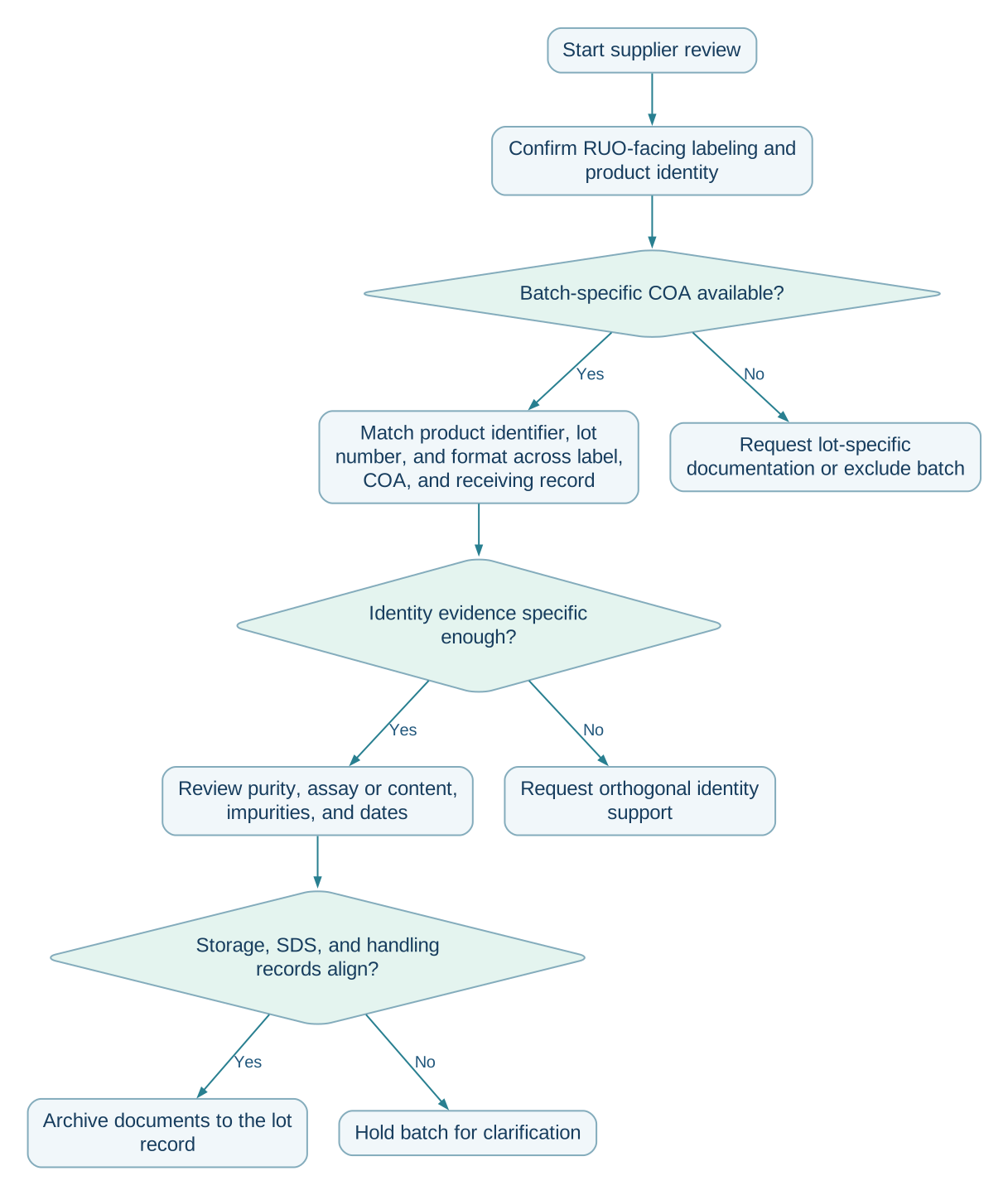
Text version of this diagram
- Start supplier review → Confirm RUO-facing labeling and product identity.
- Confirm RUO-facing labeling and product identity → Batch-specific COA available?.
- Batch-specific COA available? — Yes → Match product identifier, lot number, and format across label, COA, and receiving record.
- Batch-specific COA available? — No → Request lot-specific documentation or exclude batch.
- Match product identifier, lot number, and format across label, COA, and receiving record → Identity evidence specific enough?.
- Identity evidence specific enough? — Yes → Review purity, assay or content, impurities, and dates.
- Identity evidence specific enough? — No → Request orthogonal identity support.
- Review purity, assay or content, impurities, and dates → Storage, SDS, and handling records align?.
- Storage, SDS, and handling records align? — Yes → Archive documents to the lot record.
- Storage, SDS, and handling records align? — No → Hold batch for clarification.
This workflow is an original visual summary of the documentation principles discussed in this article, not a published quantitative model.
The most common red flags are straightforward: no lot-specific COA, label and COA mismatch, pass or fail reporting without numerical data, purity claims with no independent identity support, assay or content omitted for materials where water or counterion mass may matter, unclear testing-lab provenance, and no SDS or storage statement where handling risk is plausible. Case studies in peptide sourcing show that these are not administrative niceties; they are failure points that can distort downstream research interpretation.[1][4][5][6][7][9][10][11]
Research teams should archive the exact COA version, SDS revision, label image or container capture, and receiving record for the lot that entered the study. That archive makes troubleshooting easier later and aligns with the broader reporting principle that results should be uniquely identifiable and tied to the tested or received item.[1][6]
FAQs
What is a peptide supplier documentation checklist?
A peptide supplier documentation checklist is a lot-level review tool used to confirm that a research peptide can be traced from its label and shipment record to its batch-specific analytical data. In practice, it combines COA review, label matching, SDS review, method context, and storage or retest information so the batch can be interpreted conservatively in laboratory records.[1][4][5][6]
Is a peptide COA enough by itself?
A peptide COA is necessary but not always sufficient because the certificate reports analytical results for a batch, while the label, SDS, and storage documentation answer different questions. Q7, OSHA, and ISO-style reporting principles each make different pieces of information important, including batch identity, hazard communication, results, methods, dates, and authorization.[1][4][5][6]
What is the difference between peptide identity, purity, and assay or content?
Peptide identity asks whether the batch is the claimed peptide, purity asks how much of the sample appears to be the principal component under a stated method, and assay or content addresses how much actual peptide substance is present. EMA and ICH frameworks treat those as separate specification or validation questions, which is why one purity number should not be read as a complete quality summary.[2][3][7]
Why does lot-level traceability matter when comparing peptide suppliers?
Lot-level traceability matters because analytical results only have meaning when they can be tied to the exact material received, stored, and used in the laboratory. Q7 requires distinctive batch identification and traceable distribution controls, while ISO/IEC 17025 reporting principles emphasize unique report identification and results that relate only to the tested item.[1][6]
When should a laboratory request extra documentation such as endotoxin, residual solvent, or microbiological data?
A laboratory should request extra documentation when those attributes are relevant to the peptide format, manufacturing route, storage profile, or assay sensitivity rather than assuming every peptide COA will include them. EMA’s peptide guideline lists residual solvents, elemental impurities, bacterial endotoxins, microbiological purity, and high-molecular-weight impurities as specification elements that may need targeted control when applicable.[7]
What makes a pass or fail COA a red flag?
A pass or fail COA is a red flag when it omits the underlying measured value, acceptance limit, or method context, because the reviewer loses the ability to judge margin, trend, and interpretability. Q7 expects numerical results when results are numerical, and FDA OPQ has highlighted peptide-documentation deficiencies where impurity reporting and peak characterization were not specific enough for scientific review.[1][14]
Next Steps
Review batch-specific documentation before selecting any research-use-only peptide. Explore Pure Lab Peptides for RUO peptide compounds with clear labeling, research-focused product information, and available documentation. For research teams comparing peptide suppliers, prioritize COA availability, transparent labeling, and lot-level documentation.
References
- U.S. Food and Drug Administration. “Q7 Good Manufacturing Practice Guidance for Active Pharmaceutical Ingredients.” FDA Guidance for Industry. 2016. https://www.fda.gov/files/drugs/published/Q7-Good-Manufacturing-Practice-Guidance-for-Active-Pharmaceutical-Ingredients-Guidance-for-Industry.pdf
- International Council for Harmonisation. “Validation of Analytical Procedures Q2(R2).” ICH Harmonised Guideline. 2023. https://database.ich.org/sites/default/files/ICH_Q2%28R2%29_Guideline_2023_1130.pdf
- International Council for Harmonisation. “Q6A Specifications: Test Procedures and Acceptance Criteria for New Drug Substances and New Drug Products: Chemical Substances.” ICH Harmonised Guideline. 1999. https://database.ich.org/sites/default/files/Q6A%20Guideline.pdf
- U.S. Occupational Safety and Health Administration. “Hazard Communication Standard: Safety Data Sheets.” OSHA Brief. 2013. https://www.osha.gov/Publications/OSHA3514.html
- U.S. Occupational Safety and Health Administration. “Hazard Communication Standard: Labels and Pictograms.” OSHA Brief. 2013. https://www.osha.gov/sites/default/files/publications/OSHA3636.pdf
- National Institute of Standards and Technology. “SOP 1 – 2019 (Appendices B and C): ISO/IEC 17025:2017, Section 7.8 – Reporting of Results.” NIST Weights and Measures. 2019. https://www.nist.gov/document/sop-1-calibration-certificate-eval-app-b-c-20190506pdf
- European Medicines Agency. “Guideline on the Development and Manufacture of Synthetic Peptides.” EMA Scientific Guideline. 2025. https://www.ema.europa.eu/en/documents/scientific-guideline/guideline-development-manufacture-synthetic-peptides_en.pdf
- D’Hondt M, Bracke N, Taevernier L, Gevaert B, Verbeke F, Wynendaele E, et al. “Related impurities in peptide medicines.” Journal of Pharmaceutical and Biomedical Analysis. 2014. https://doi.org/10.1016/j.jpba.2014.06.012
- De Spiegeleer B, Vergote V, Pezeshki A, Peremans K, Burvenich C, Impens S, et al. “Impurity profiling quality control testing of synthetic peptides using liquid chromatography-photodiode array-fluorescence and liquid chromatography-electrospray ionization-mass spectrometry: The obestatin case.” Analytical Biochemistry. 2008. https://doi.org/10.1016/j.ab.2008.02.014
- Boutin JA, Tartar AL, Van Dorsselaer A, Vaudry H. “General lack of structural characterization of chemically synthesized long peptides.” Protein Science. 2019. https://doi.org/10.1002/pro.3601
- Verbeke F, Wynendaele E, Braet S, D’Hondt M, De Spiegeleer B. “Quality evaluation of synthetic quorum sensing peptides used in R&D.” Journal of Pharmaceutical Analysis. 2015. https://doi.org/10.1016/j.jpha.2014.12.002
- International Council for Harmonisation. “Q1A(R2) Stability Testing of New Drug Substances and Products.” ICH Harmonised Guideline. 2003. https://database.ich.org/sites/default/files/Q1A%28R2%29%20Guideline.pdf
- U.S. Food and Drug Administration. “ANDAs for Certain Highly Purified Synthetic Peptide Drug Products That Refer to Listed Drugs of rDNA Origin.” FDA Guidance for Industry. May 2021. FDA withdrawn-guidance record. Withdrawn July 28, 2026; cited for historical analytical context.
- Li Y. “Common Deficiencies Associated with Comparative Peptide Impurity Profile Studies and Qualification of Impurity Levels and Proposed Limits.” U.S. FDA Office of Pharmaceutical Quality Presentation. 2022. https://www.fda.gov/media/166572/download
- Lian Z, Wang N, Tian Y, Huang L. “Characterization of Synthetic Peptide Therapeutics Using Liquid Chromatography-Mass Spectrometry: Challenges, Solutions, Pitfalls, and Future Perspectives.” Journal of the American Society for Mass Spectrometry. 2021. https://doi.org/10.1021/jasms.0c00479