



Peptide Stability: Degradation, Storage and Evidence

TL;DR · The short version
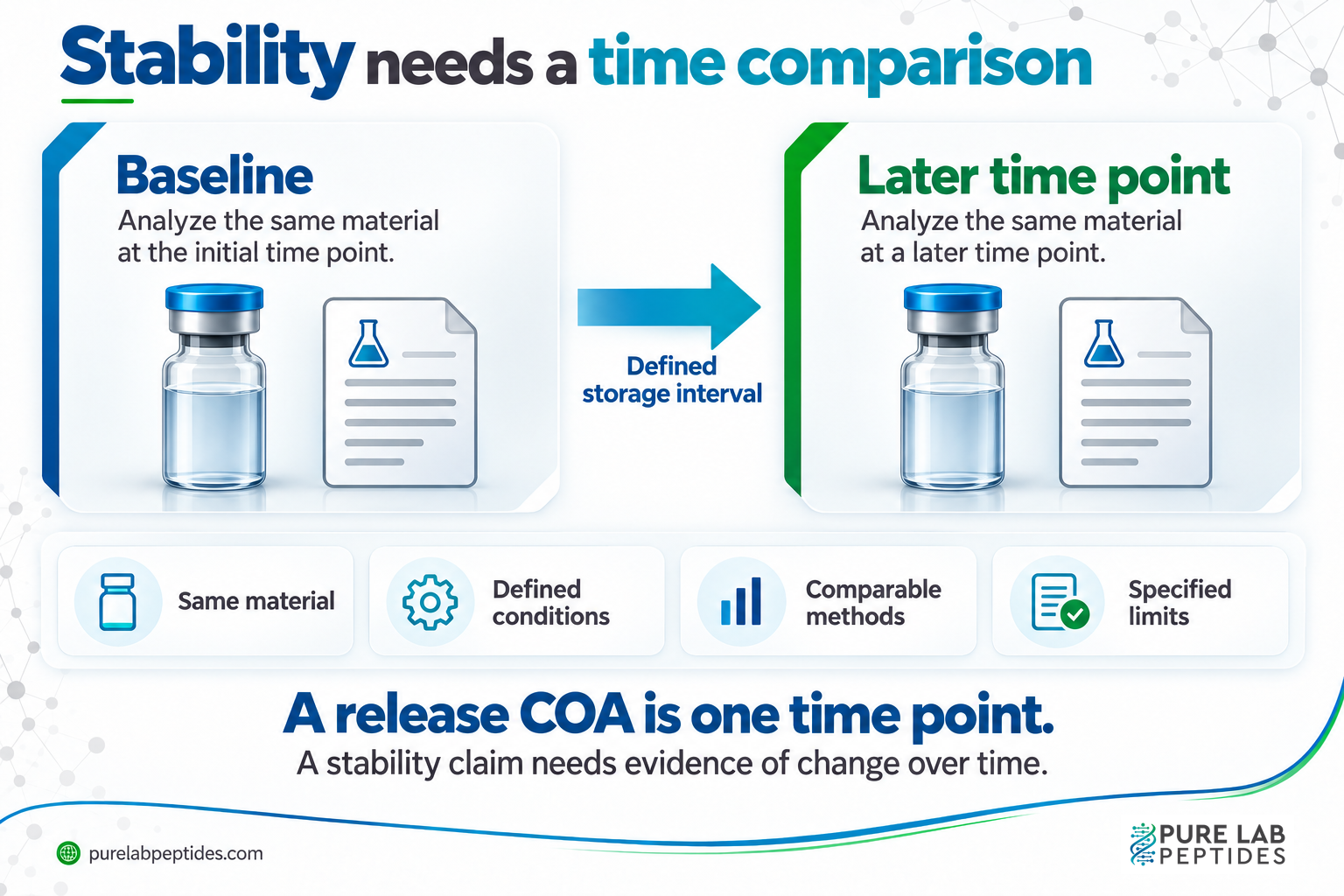
Peptide stability is a question about change over time in stated conditions. Read the material, state, container, interval and measurements together. A release COA gives one time point; it doesn’t assign a shelf life to every preparation made later.
A fresh COA tells you something useful about the tested sample. But if you’re planning to keep a preparation for the next few months, you need another kind of evidence. The release record alone doesn’t describe that later interval.
With peptide stability evidence, you follow a defined material through time and measure what changes under recorded conditions. Keep the sample state next to the dates. Otherwise, an unopened vial and a prepared solution can end up looking like the same storage case.
What can change in a peptide sample?
TL;DR: Separate chemical changes to the molecule from physical behavior and losses during handling.
Chemical degradation changes the molecule itself. Hydrolysis can cleave susceptible bonds; oxidation can modify residues such as methionine or cysteine; deamidation can alter susceptible asparagine or glutamine residues. The amino acid sequence and surrounding conditions determine which pathways matter. Sigma-Aldrich’s technical overview describes these sequence-dependent routes.
Physical behavior needs a separate explanation. Material may become harder to keep in solution, associate into aggregates or be lost during handling. If the analytical signal falls, that observation doesn’t identify the cause. Choose measurements that can distinguish chemical change from poor recovery or a different physical state.
Lyophilized powder and solutions need separate evidence
TL;DR: Freeze-dried material and dissolved preparations are different test cases, even when the compound name matches.
Lyophilized peptides are generally more stable than their dissolved counterparts, but freeze-drying does not make them indefinitely stable. Moisture exposure, container closure and the sequence still matter. Bachem’s handling guide also explains why solubility depends on composition and why there is no single dissolution protocol for every peptide.
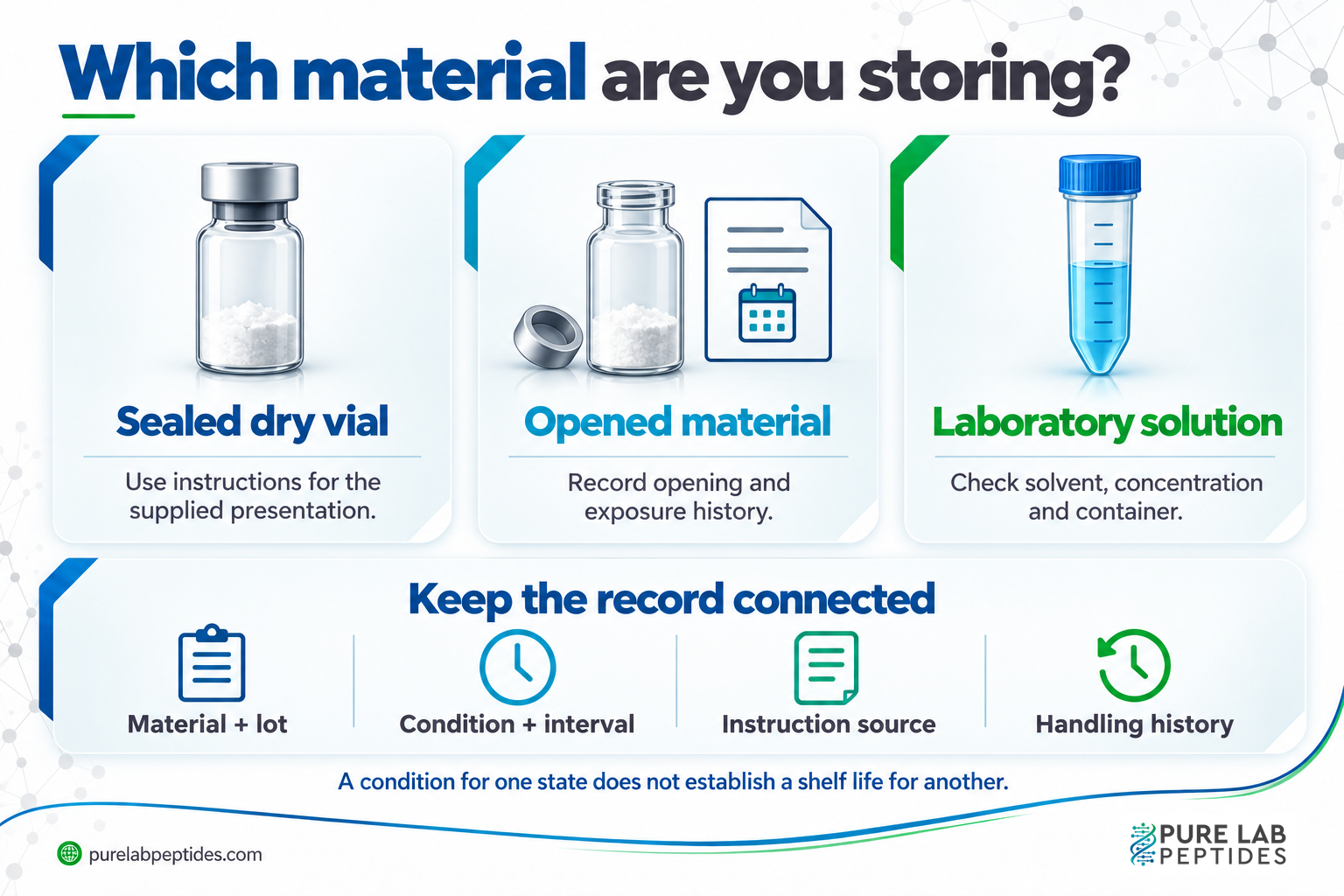
Adding solvent creates a different preparation to assess, with its own concentration, pH and other components. A result for dry, unopened material can’t determine that solution’s storage period. Use evidence and instructions for the preparation you actually have, rather than assigning it a generic number of days.
Define the stability claim in one complete sentence
TL;DR: A usable claim states what was tested, where and how it was kept, for how long, and against which limits.
If a record says “stable for months,” look for the details that make the statement usable. Which material and state, which container and conditions, and which measurements and limits? Without them, you can’t decide whether the claim applies to your sample.
Keep the states distinct when you read those records: unopened material, opened material, prepared solutions and biological samples. An instruction for one shouldn’t quietly become an instruction for the others.
Imagine a record for sealed dry powder beside one for a dilute solution that has been transferred several times. The compound name matches, but the histories don’t. Compare the conditions along with the dates before deciding what the storage periods tell you.
Choose endpoints that can detect the change
TL;DR: Choose measurements for the suspected change. An unchanged area percentage does not establish unchanged vial content.
| Question | Useful comparison | What not to infer |
|---|---|---|
| Did chemical composition change? | Comparable chromatograms, relevant peak assignments and complementary identity evidence. | A new signal’s identity from its presence alone. |
| Did recovery or content change? | A quantitative measurement with a defined reference and sample basis. | Unchanged amount from an unchanged area-purity percentage. |
| Did physical state change? | A suitable measurement of the suspected physical behavior. | One mechanism from appearance alone. |
| Did the analytical workflow change? | Preparation, container, processing and measurement records. | That every difference originated in the supplied lot. |
Temperature may be the first variable you notice. Matrix, relevant pH, moisture, light and interfaces can also affect the comparison. If several conditions changed together, don’t attribute the result to just one without evidence. Define the sample state and what you intend to measure before investigating a variable.
Keep the baseline and the comparisons
TL;DR: Compare time points on a consistent basis and retain the handling and analytical records between them.
A time trend needs comparable measurements. File each time point with its sample history and method so you can follow the series. If the method changes partway through, establish how the new results relate to the earlier ones before joining them into a trend.
In a 2025 LC–MS study of peptide libraries in cell culture, investigators compared storage treatments because degradation could continue after sample collection. Their measurements used an internal standard, and storage affected variability. This is a concrete example of why the interval between collection and analysis belongs in the record. It does not establish storage limits for unrelated catalog materials.
Stress studies and routine storage answer different questions
TL;DR: A deliberate stress study can reveal a vulnerability without establishing ordinary shelf life.
A deliberate stress experiment can expose a degradation pathway or challenge an analytical procedure. It doesn’t automatically predict ordinary shelf life. The same caution applies to extending a short observation indefinitely or carrying it over to a new formulation.
When reviewing a stability statement, ask which conditions were actually tested and which conclusions are inferred. Keep that distinction visible in internal records. The PLP material-handling guide supplies general context; the controlling conditions remain those supported for the exact material.
Can appearance or one COA confirm stability?
TL;DR: Appearance and a single COA cannot establish a time trend. Use comparable measurements of the properties that matter.
Unchanged appearance doesn’t establish unchanged chemical composition. Nor can one COA show a trend through time. If you suspect a change, compare suitable measurements with the starting sample and retain the conditions between those measurements.
A useful research record might state: “This defined preparation met the stated chromatographic and content criteria at the tested time points.” A reviewer can check the preparation and criteria behind that statement. “The peptide lasts for months” would remove the conditions they need to interpret it.