


Synthetic Peptides vs Recombinant Proteins: Choosing for an Assay

TL;DR · The short version
Synthetic peptides vs recombinant proteins starts with what the assay needs. Chemical synthesis can provide a defined peptide sequence or modification; recombinant expression can provide a domain or full-length construct. Check the actual specification, folding, host and activity rather than assuming either route guarantees suitability.
A short sequence may fit one assay precisely and omit the structure another depends on. Write down what must be recognized or measured before comparing purity and price.
“A defined linear binding site” and “an enzyme with demonstrated activity” describe different material briefs. That distinction guides the production comparison.
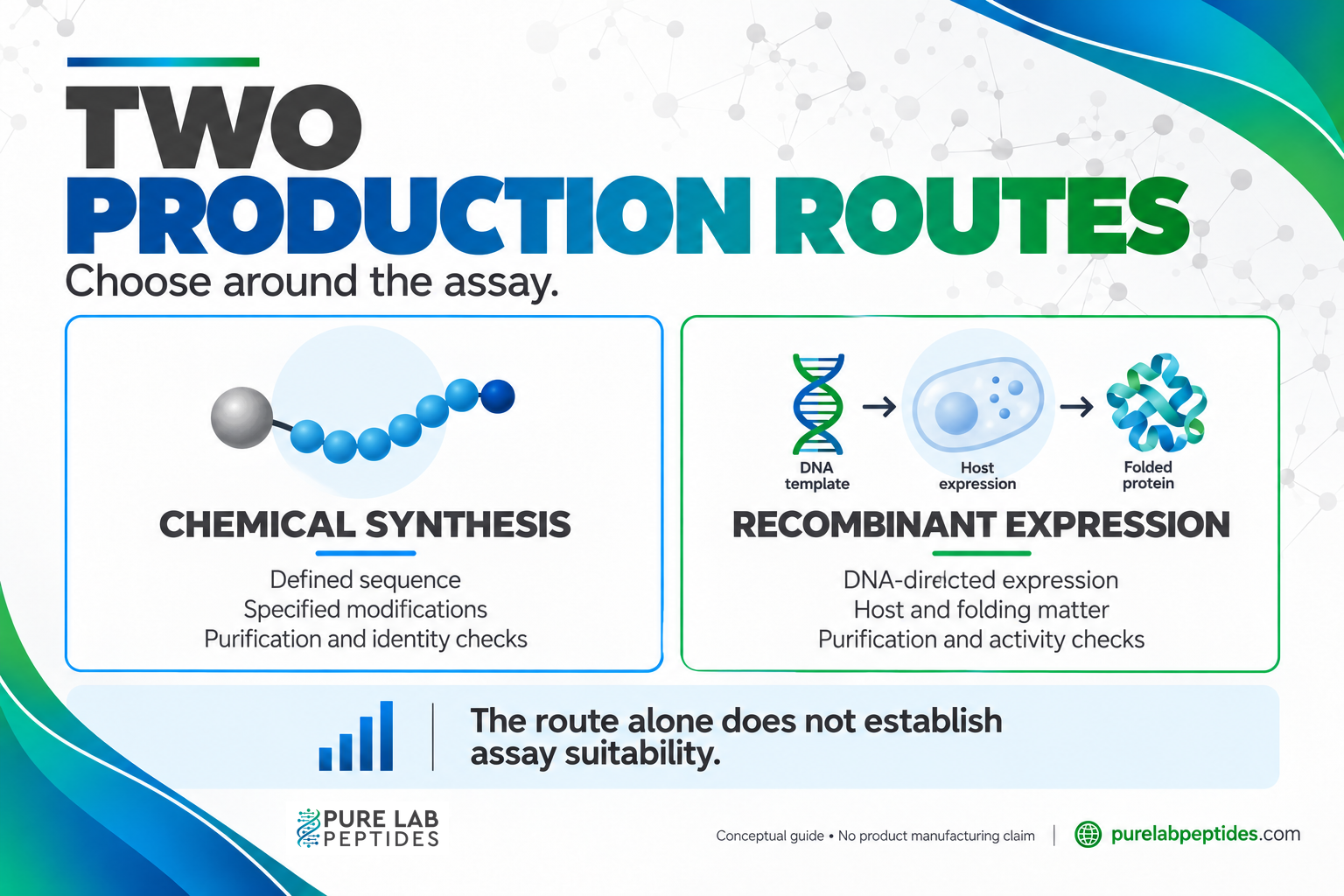
Chemical synthesis and recombinant expression
Key point: These terms describe how a chain is produced. They don’t, by themselves, describe its final structure or performance.
In chemical peptide synthesis, amino acids with protecting groups are coupled to build the peptide chain. Solid-phase peptide synthesis uses a resin support; the completed material is released and purified. Peptide design can include specified terminal groups or other chemical modifications. Incomplete reactions and side products are reasons that synthesis and purification belong together in the specification. Thermo Fisher’s synthesis explanation describes this process.
Recombinant protein expression starts with a DNA sequence encoding the desired product. An expression system produces the chain, which then needs downstream processing and purification. Bacterial, yeast, insect, mammalian and cell-free systems have different capabilities. Host choice matters when the experiment depends on folding or post-translational modifications, such as glycosylation. A host capable of a modification doesn’t guarantee the exact form you need. See the protein expression handbook.
Ask for the finished material’s specification. “Recombinant” tells you about production, but leaves properties your assay may depend on unresolved.
Compare the requirements before the production route
Start here: Define the sequence, structure and measurement your assay depends on.
| Your experimental need | Question for chemical synthesis | Question for recombinant expression |
|---|---|---|
| A defined short motif | Are the sequence, termini and any modification specified? | Does the recovered product have the intended sequence after any tag removal? |
| A folded domain or enzyme | What structural and activity evidence supports the final material? | What folding and activity evidence supports this construct and host? |
| A site-specific comparison | Can the supplier deliver the requested modified and control sequences? | Can the construct provide the required site and modification state? |
| Comparable experimental inputs | How are identity, content and purity measured? | How are identity, content, purity and relevant activity measured? |
| A practical supply decision | What yield, quantity, lead time and documentation are quoted for this sequence? | What yield, quantity, lead time and documentation are quoted for this construct? |
Use the worksheet to compare requirements, not to rank routes universally. Cost and feasibility depend on the sequence and project. Chemical synthesis isn’t always cheaper, nor does expression alone establish greater activity or a more suitable form.
Peptide length isn’t a hard dividing line
Worth checking: A simple length cutoff can hide methods that assemble larger chains.
“Short peptide means synthetic; protein means recombinant” is a convenient shortcut. It isn’t a rule of chemistry. In a 1999 experiment, Hackeng and colleagues assembled a 124-amino-acid human secretory phospholipase A2 from four synthetic segments using native chemical ligation, then refolded it into an active enzyme. Their comparison included enzymatic activity, not just a matching mass. The same work also examined a chemically altered variant with greatly reduced activity. Read the original experiment.
The reported synthesis shows what was possible in that experiment, not that every long chain is easy to make. Ask the supplier which approach can deliver your specified material and what evidence accompanies it.
A short fragment and a folded target can answer different questions
The distinction: Matching part of a sequence doesn’t automatically reproduce the whole protein’s binding surface.
For a hypothetical antibody assay targeting a selected linear region, a defined peptide and altered control sequence could support a focused comparison.
Recognition of the folded target is another assay question. A short-fragment result doesn’t establish it. Specify the folded protein or domain and the controls needed to test that recognition.
The target name stayed the same; the required experiment changed. Choose the material for that experiment.
For help recording the exact chain and terminal notation, use our peptide sequence guide.
Keep identity, purity and activity as separate checks
Don’t collapse the evidence: Knowing what a material is differs from knowing what it does in your assay.
Structural characterization and biological activity address different attributes. Expression-derived material can also require attention to process-related impurities, including host cell proteins or DNA. ICH Q6B explains these distinctions for biotechnological and biological drug products. Its scope does not regulate preclinical or clinical research material; it is cited here for analytical context, not as a claim that a research vial meets drug specifications. See the guideline’s scope and characterization sections.
When reviewing a report, keep its result attached to its method. A chromatographic purity figure shouldn’t be relabeled as an activity result. Our guides to purity versus identity and HPLC, LC-MS and NMR cover those distinctions.
What to put in the material request
A useful request: Give the supplier enough detail to propose a material that fits the measurement.
- Exact sequence or construct: Include terminal groups, tags, cleavage requirements and intended modifications.
- Required state: Specify whether the experiment depends on a linear chain, folded domain, assembly or measured activity.
- Analytical evidence: Ask which methods address identity, content, purity and any relevant activity.
- Experimental compatibility: Identify buffer, solvent or impurity constraints that matter to your assay.
- Supply details: Ask for the deliverable quantity, material form, documentation and lead time.
Keep the supplier’s answer with the assay record. It explains the choice of synthetic or recombinant material in terms someone else can check.