



Peptide Reference Standards: Choosing the Right Comparison

TL;DR · The short version
Peptide reference standards serve defined measurements. Identity comparison, content calibration and chromatographic performance checks don’t require identical evidence. Review intended use, assigned value, lot documents and handling before choosing the standard.
The sequence may match while the assigned quantity is missing. An instrument-check mixture may be suitable for a system test without calibrating your compound. A familiar vial name doesn’t settle the measurement question.
Decide what you’re measuring first. Then ask whether the proposed material has the documented properties to support it.
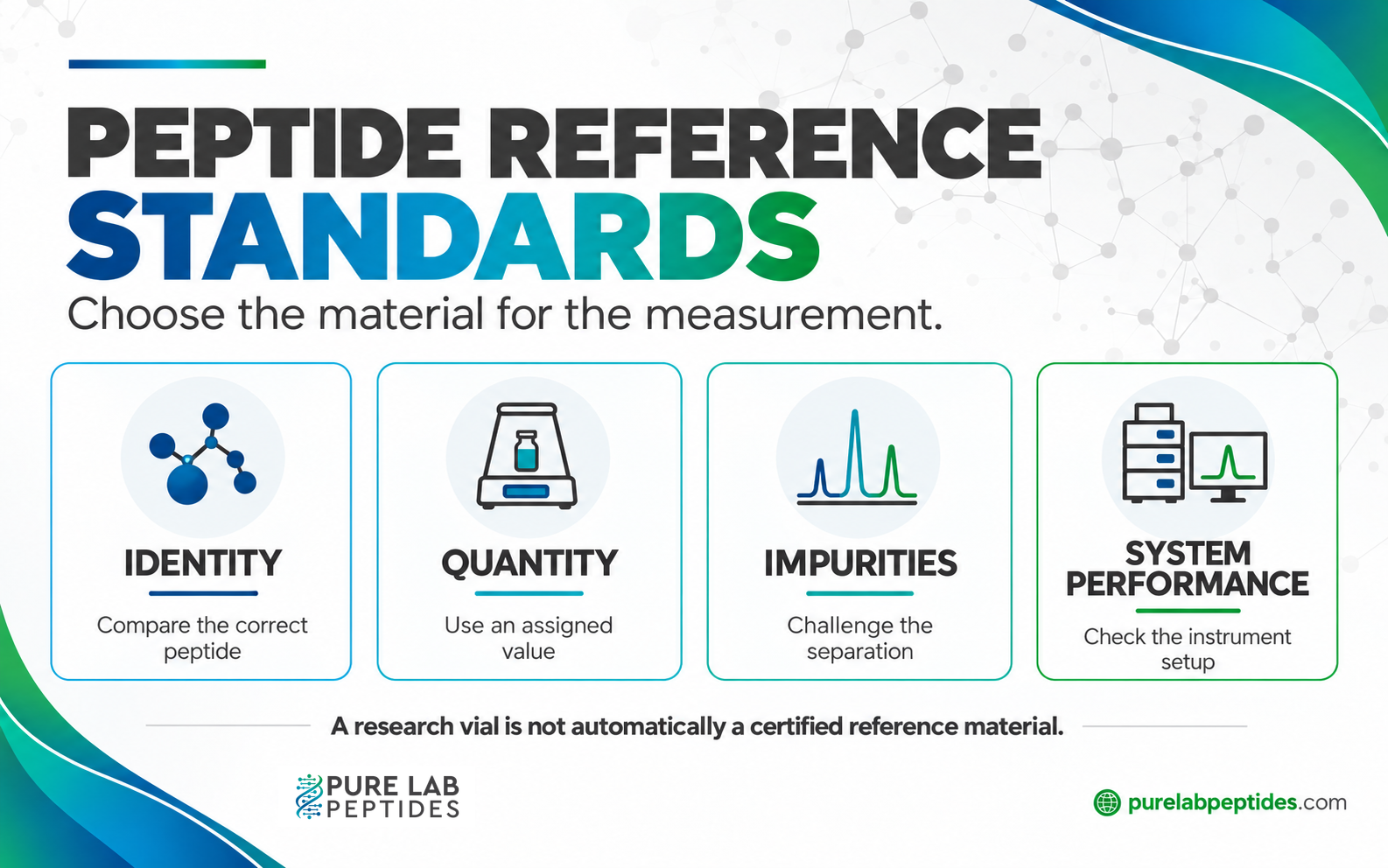
Match peptide reference standards to the job
Section takeaway: Write down the measurement first, then choose the comparison material that supports it.
A laboratory may need identity comparison, concentration calibration, an impurity challenge or a performance mixture. Read the specification for that job instead of treating reference materials as interchangeable accessories.
| Your question | Material to investigate | First documentation check |
|---|---|---|
| Is this the expected peptide? | An identity reference for that specific peptide | Sequence, modifications and supporting characterization |
| How much peptide is present? | A quantitative standard with an assigned value | What the value measures, its units and how it was assigned |
| Can the method distinguish a related impurity? | A characterized impurity reference | Its identity and role in the separation study |
| Is the chromatography system behaving as expected? | A system-performance standard or mixture | The specified application and expected system response |
This is a selection checklist, rather than a list of materials that every experiment needs. For example, a broad peptide mixture may be useful for an instrument check without being a calibrator for the compound you’re studying.
Reference material doesn’t always mean certified reference material
Section takeaway: Certification describes documented properties and values. It isn’t another way to say “high purity.”
NIST’s reference-material definitions center on fitness for an intended measurement, including sufficient homogeneity and stability for the relevant properties. A certified reference material adds values established through a valid procedure, with stated uncertainty and metrological traceability.
A research-use peptide and COA don’t automatically constitute a certified reference material. High HPLC area purity doesn’t establish every property required for a quantitative standard either.
Read the document for the proposed standard and lot. Does it assign the value your application needs, or establish identity and purity only? Both can be useful, but for different tasks.
Check identity and peptide content separately
Section takeaway: Correct identity and a defensible quantity are separate parts of the evidence.
In their original paper, McCarthy and colleagues describe how peptide reference standards are characterized and value-assigned. Their approach combines identity testing with a mass-balance assessment of the bulk material, followed by value assignment to the vialed material. Water, counterions and residual solvents can affect that accounting.
The paper also explains why some structures require additional techniques. A molecular mass result alone may not distinguish features such as chiral or isobaric amino acids. That’s a good reason to read the characterization behind the standard, rather than treating a single matching number as complete identity proof.
For quantity, establish the value basis: peptide mass, complete salt, specified solution concentration or another defined quantity. Don’t interchange them in calculations. The peptide purity and identity guide covers the related identity/purity distinction.
“99%” needs its method and denominator. By itself, it isn’t a concentration.
A practical example: two documents, two different uses
Section takeaway: Read the document for the job you need it to support.
Imagine a hypothetical laboratory comparing two materials with the same peptide name. The first document lists a matching identity result and an HPLC area-purity percentage. The second includes those records plus an assigned peptide concentration, its uncertainty and instructions for the specified analytical application.
The first hypothetical document leaves calibration quantity unresolved. That limits its use for the calculation, not every possible use of the material.
Keep identity, supplier, lot, application, value, units, value basis, document and handling conditions together. A blank field tells you what remains to be clarified; an assumed value hides it.
For the identity field, record terminal modifications and any labeling as well as the amino acid sequence. Our peptide sequence guide helps explain why a familiar name can still conceal a structural difference.
Working standards need their own records
Section takeaway: A prepared working solution needs a traceable link to its source material and preparation record.
In Hoofnagle and colleagues’ recommendations for peptide-based mass-spectrometry assays, well-characterized calibrators and internal standards are central to comparable quantitative results. Isotopically labeled peptides have a specific role in those workflows; a generic unlabeled research vial isn’t a substitute simply because the peptide name matches.
The authors also discuss solution losses and changes associated with adsorption, storage and chemical modification. This is why handling instructions belong beside the assigned value, not in a forgotten email.
Connect a working standard to its source lot, preparation date, diluent, dilution and applicable use period. Follow the supplier’s instructions and laboratory procedure rather than applying one storage recipe to every peptide.
A new lot is a new record. Even when the catalog number stays the same.
Questions to resolve before choosing a standard
Section takeaway: Resolve the material’s identity, value and application before relying on it as a comparison.
- Which measurement is this peptide standard intended to support?
- Does the documented identity match the exact sequence, modifications and chemical form required?
- Is a quantitative value assigned, and what does that value include?
- Which document applies to this lot, and is it current for the intended use?
- What preparation, storage and stability conditions apply?
- If a working standard is prepared, how will the source and calculation be recorded?
These questions make a supplier conversation more useful than asking for “the highest purity” alone. If you need help interpreting the methods listed in a report, continue with our guide to HPLC, LC-MS and NMR testing.
References
- NIST. SRM Definitions: reference materials and certified reference materials.
- McCarthy D, et al. Reference Standards to Support Quality of Synthetic Peptide Therapeutics. Pharmaceutical Research, 2023.
- Hoofnagle AN, et al. Recommendations for the Generation, Quantification, Storage, and Handling of Peptides Used for Mass Spectrometry-Based Assays. Clinical Chemistry, 2016.