



Peptide Fragment: Reading the Parent Sequence and Range

TL;DR · The short version
A peptide fragment selects a shorter part of a parent sequence. Its identity includes the parent, residue range and end chemistry; its activity needs separate evidence. A fragment ion produced during mass spectrometry is also a different thing from a shortened supplied material.
“Fragment” leaves several details unresolved. Which stretch was kept, where does the numbering start and what happened to the new ends? Two similar names may conceal different answers.
Start with the parent, then name the part
Quick takeaway: A range has meaning only beside its parent sequence. Keep the residue numbers and end groups together.
Cleavage can produce a fragment, but peptide synthesis can make it directly too. The relationship describes sequence ancestry rather than necessarily the production process. Even “synthetic fragment” needs the sequence to complete the identity.
Residue numbering usually follows the named parent. In partial-sequence nomenclature, a range such as (3–6) identifies the included positions. Changing or capping an end adds another piece of identity; it isn’t implied by the range alone. The IUPAC recommendations on partial sequences and modifications explain these distinctions.
The guide to reading peptide sequences explains the abbreviations. For this comparison, the next step is locating the stretch within its parent.
A four-residue example you can check by eye
Quick takeaway: Count both endpoints. Positions 3 through 6 include four residues, not three.
Imagine an eight-residue parent. Keep positions 3, 4, 5 and 6. That’s a four-residue fragment: 6 − 3 + 1 = 4. The subtraction alone measures the gaps between positions; the extra one counts the first position too.
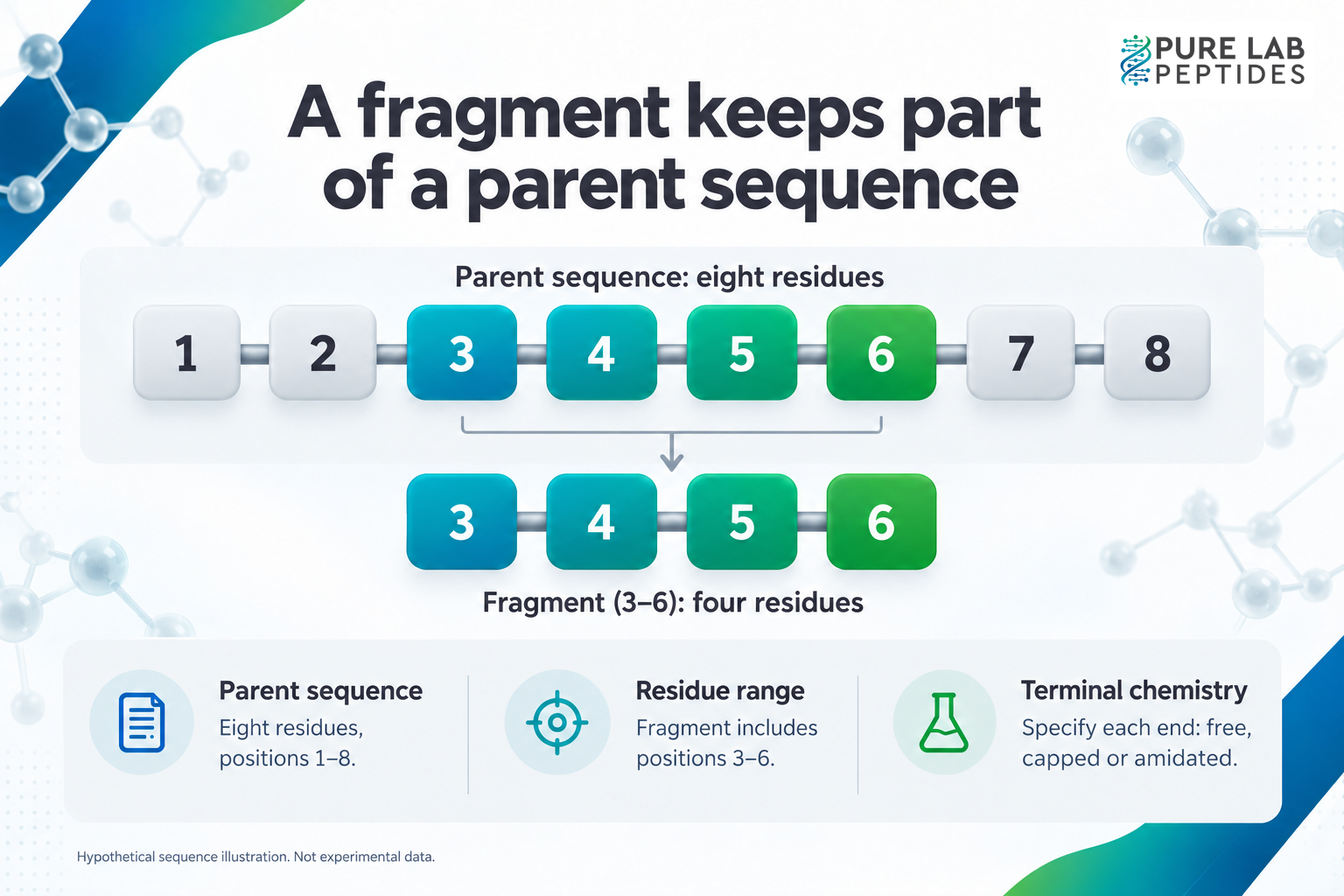
This is a hypothetical numbering exercise, not the sequence of a product. It also shows why “four residues” isn’t enough. Positions 1–4 and 3–6 have the same length but select different parts of the parent. For a document check, write the sequence letters beside the range rather than relying on length.
| Item to record | Example or question | What it resolves |
|---|---|---|
| Parent and version | Which exact parent sequence is being numbered? | A range without a reference can be ambiguous. |
| Included positions | Hypothetical parent positions 3–6 | Four included residues, counted inclusively. |
| Sequence letters | Do the stated letters match those positions? | Checks the selected stretch, not just its length. |
| Each end | Free, capped, amidated or otherwise specified? | Records chemistry the residue range doesn’t settle. |
A supplied fragment and a fragment ion are different
Quick takeaway: Read what the test measured. Instrument-generated ions don’t, by themselves, describe what was originally supplied.
In tandem mass spectrometry, a precursor ion can be fragmented to produce smaller ions. Those signals help analysts investigate a sequence or structure. This is the analytical process described in the IUPAC definition of mass spectrometric fragmentation.
Peptide fragmentation in an instrument doesn’t automatically mean the stock degraded or was deliberately shortened. Check the method, sample identity and analyst’s assignment before making that leap. The peptide-testing methods guide puts those measurements in context.
A peak is part of an assignment, not a complete identity record. Compare the report’s supported sequence and modifications with the material description. The purity-versus-identity guide explains why that check differs from purity.
Does a shorter sequence still do the same thing?
Quick takeaway: Length is not an activity scale. Check the particular fragment in the particular experiment.
A deletion study gives a better answer than a general rule. In a 1984 experiment, Ling and colleagues tested shortened growth-hormone-releasing-factor sequences in rat anterior-pituitary cell cultures. Some shortened, amidated sequences retained substantial activity. Further deletions produced lower potency, and the 1–19 amidated sequence lost bioactivity in that assay. The result was a pattern across tested sequences, not “shorter means weaker” at every step. See the original study abstract.
Fragments aren’t always unwanted breakdown products, either. Guerrero and colleagues used mass spectrometry to study naturally occurring peptides in human milk and found cleavage patterns associated with selected protein regions. Their 2014 peptidomics study shows why the parent and cleavage context matter. It doesn’t make every fragment biologically active.
The examples don’t establish results for another sequence, commercial lot or person. Retain the tested construct and model when summarizing the finding, as the research-literature reading guide demonstrates.
Leave yourself a usable comparison record
Quick takeaway: Save the identity first, then the result. A shorthand name shouldn’t have to carry both.
Save the parent and included sequence, then the end groups and modifications, then the test and result. Three short entries show what’s known and what’s missing when you return to the record.