



Peptide Degradation: Chemical Change and Sample Loss

TL;DR · The short version
Peptide degradation changes molecular chemistry. A smaller signal can instead reflect adsorption, precipitation, recovery or instrument response. Check the endpoint and controls before assigning a cause or calculating degradation from signal loss.
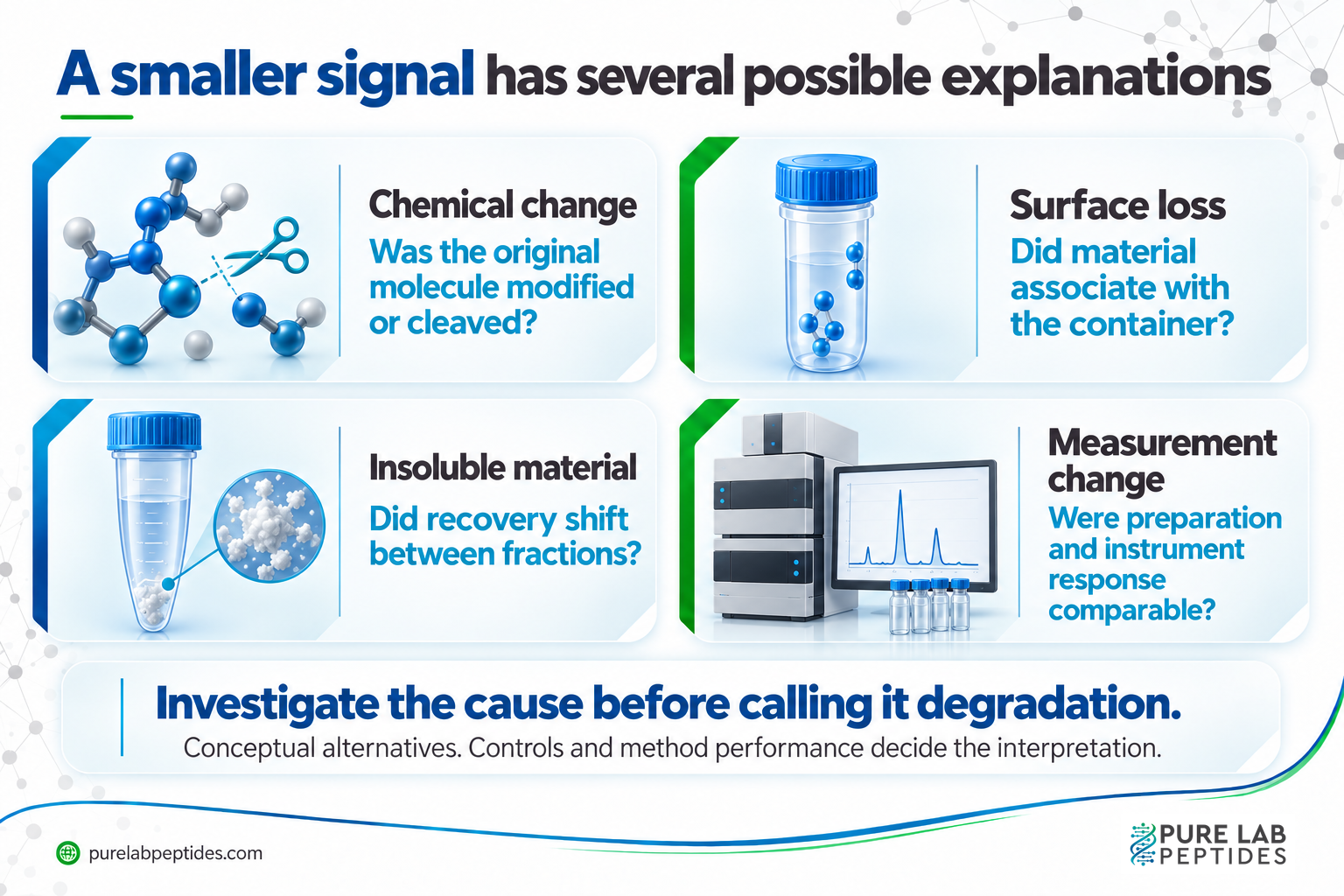
Today’s peak is smaller than yesterday’s. Degradation is one explanation; surface loss, precipitation and reduced recovery are others. The chromatogram gives you a change to investigate, not its cause.
Peptide degradation concerns a chemical change to the original molecule. Begin the investigation with the fraction sampled and method performance. They help distinguish molecular change from other reasons the measured signal fell.
Common peptide degradation pathways
TL;DR: Hydrolysis, oxidation, deamidation and proteolysis are possible pathways, not a diagnosis for every sample.
A peptide’s sequence and environment determine which reactions are plausible. The Sigma-Aldrich technical reference describes several pathways involving the backbone or amino acid side chains:
- Hydrolysis: cleavage involving water can break susceptible peptide bonds and produce smaller species.
- Oxidation: susceptible residues can change chemically. Methionine oxidation, for example, can produce methionine sulfoxide.
- Deamidation: side-chain amide groups, including those in asparagine, can change. Sequence context and conditions affect the reaction.
Proteases can cleave peptides in biological samples, but their presence isn’t a diagnosis for every lost signal. Use the possible pathways to frame tests, then look for evidence in the sample.
Physical loss is a different explanation
TL;DR: Adsorption, precipitation and aggregation can alter recovery without necessarily breaking peptide bonds.
Adsorption means material associates with a surface. Precipitation moves material into an insoluble fraction. Aggregation involves molecules associating into larger assemblies, which may affect recovery and measurement. These processes can accompany chemical changes, but they should not automatically be described as peptide-bond cleavage.
Warwood and colleagues investigated signal linearity using peptides from a standard six-protein digest. Many peptides did not show a proportional relationship between concentration and mass-spectrometry signal under the initial conditions. Changing the sample solvent improved linearity, supporting concentration-dependent surface adsorption as an explanation. The problem affected freshly prepared samples as well as the broader question of storage.
The solvent result belongs to the tested peptides and conditions. It isn’t a universal assay fix. Its broader lesson is to examine recovery and response before equating a smaller peak with less intact material.
What a cell-culture degradation assay actually measures
TL;DR: Disappearance from a sampled fraction can include uptake or other changes; read the study’s endpoint definition.
In an original LC-MS study by Rozans and colleagues, researchers followed peptide libraries in cell culture. They checked internal-standard behavior, concentration-response relationships, sample storage and chromatography performance. These checks helped distinguish changes in the sample from changes introduced by the measurement workflow.
Discarded fractions and changed column retention affected detected amounts in the study. Sample preparation and method performance therefore belonged in the interpretation of the loss.
The authors also stated a specific limitation: peptides taken into cells or modified through nonproteolytic processes counted as degraded in their calculation. Their measurement tracked disappearance of the monitored peptide from the sampled material; it did not uniquely quantify enzyme-mediated cleavage. This is why the definition of the endpoint belongs beside a degradation curve.
Build an interpretation around the evidence
TL;DR: Compare baseline, recovery, method performance and new signals before assigning a mechanism.
| Observation | Useful follow-up question |
|---|---|
| The original signal decreases | Are recovery, calibration and instrument response comparable with the baseline? |
| New chromatographic peaks appear | Have they been identified, or are they only additional detected signals? |
| Loss occurs in cell-containing samples | Can the experiment distinguish cleavage, uptake and other modifications? |
| The sample becomes cloudy | What is in the soluble and insoluble fractions? |
| The sample still looks clear | Which chemical or quantitative measurements establish whether it changed? |
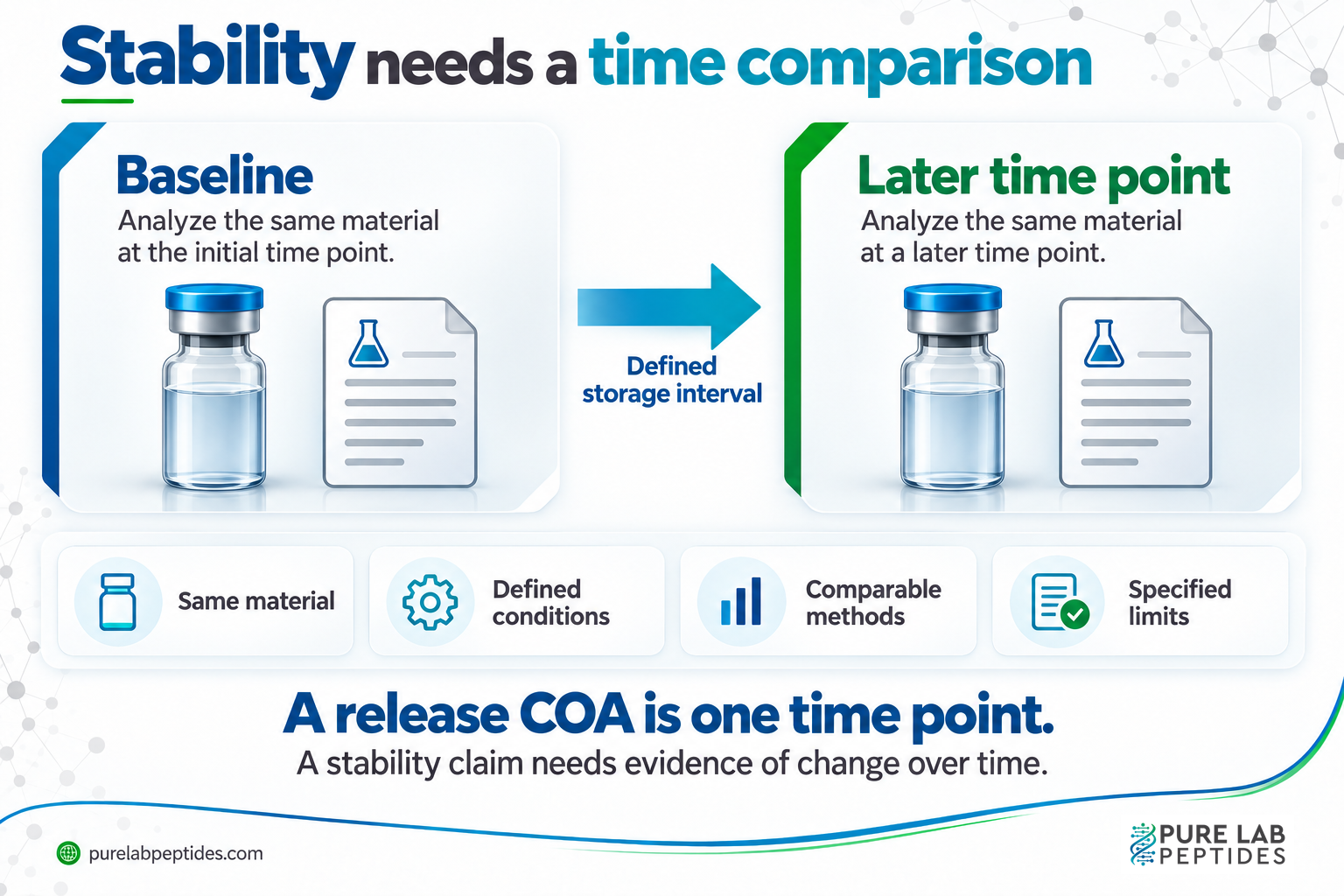
Compare a characterized starting sample with suitable time points. Retain lot, state, matrix, container, temperature and handling details, then choose controls for the proposed explanation. Appearance or one unchanged signal can’t resolve every stability question.
Define the denominator and normalization for percentage remaining. Baseline signal isn’t necessarily starting vial content, and disappearance from one fraction isn’t necessarily chemical degradation.
Keep degradation results tied to their conditions
TL;DR: Keep any rate or percentage tied to its denominator, material state and experimental conditions.
Dry powder, analytical solution and cell culture are different systems. A finding in one doesn’t set another’s expiry or rate. The peptide stability covers the time-based assessment, while the how to read a peptide HPLC chromatogram explains chromatographic changes.