
...
Documentation and Quality

Ipamorelin Research Peptide Overview | Pure Lab

In this “Ipamorelin Research Peptide Overview,” the starting point is narrow and evidence-based: ipamorelin is a synthetic pentapeptide studied as a selective ligand within ghrelin receptor and growth hormone secretagogue research. Public compound records list the sequence Aib-His-D-2-Nal-D-Phe-Lys-NH2, and the foundational literature places ipamorelin in receptor-pathway research rather than in broad consumer-style peptide language. [1][2]

Fast Answer

Ipamorelin is a synthetic pentapeptide research compound most often examined as a selective ghrelin receptor, or GHSR1a, agonist in endocrine signaling and gastrointestinal motility studies. Products discussed in this article are intended for laboratory research use only and are not intended for human or animal consumption. In published literature, the compound is discussed in receptor, PK/PD, and preclinical model contexts rather than consumer-use contexts. [1][2][3][4]

What Ipamorelin Is

Ipamorelin is a five-residue synthetic peptide with the molecular formula C38H49N9O5 and a reported molecular weight of about 711.9 g/mol. Public compound databases classify it as a pentapeptide and ghrelin mimetic, and they list the sequence Aib-His-D-2-Nal-D-Phe-Lys-NH2. Those identifiers matter because an ipamorelin overview should begin with compound identity before any discussion of pathway research or sourcing. [1]

In the endocrine research literature, ipamorelin belongs to the growth hormone secretagogue field rather than the GHRH-ligand field. The landmark 1998 paper described ipamorelin as a selective growth hormone secretagogue, while NCBI Gene and UniProt identify the functional ghrelin receptor pathway around GHSR1a as part of the broader neuroendocrine axis for growth hormone release. [2][3][4]

That classification is important for topical accuracy. Researchers do not treat ipamorelin as a generic “GH peptide” label; they study it as a defined synthetic ligand with a named receptor context, a known sequence, and a specific place in the literature. For qualified readers, that is the difference between a usable compound overview and a vague peptide summary. [1][2][4]

Structure and Receptor Pharmacology

Ipamorelin has a compact sequence that includes noncanonical and D-configured residues, and those sequence features are part of why it is discussed as a designed synthetic ligand rather than as an endogenous peptide hormone. Public records tie the compound directly to ghrelin-receptor research, and UniProt classifies the receptor target, GHSR, as a G protein-coupled receptor. [1][4]

GHSR1a signaling is commonly described in the receptor literature as involving G protein-coupled pathways that can engage phospholipase C, intracellular calcium mobilization, and downstream ERK signaling, depending on the assay system and cell type. Structural studies of the human ghrelin receptor have also clarified the activated receptor architecture that informs how researchers interpret ligand binding and receptor activation across the ghrelin-receptor agonist class. [5][6]

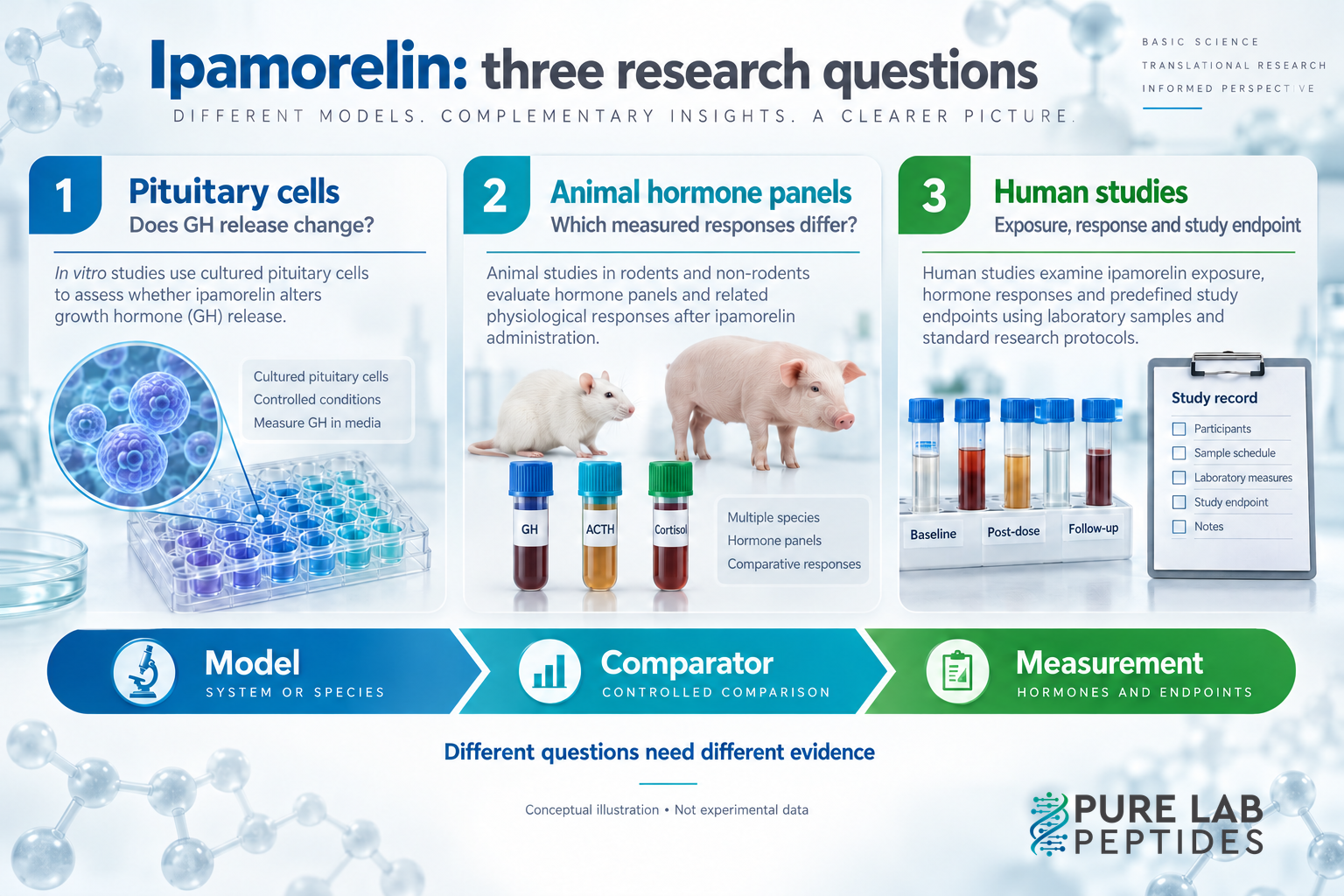
In the original ipamorelin characterization paper, investigators reported potent growth hormone-releasing activity in vitro and in vivo and described a selectivity pattern closer to GHRH than to older GHRPs under the tested conditions, with little ACTH or cortisol stimulation. That result does not make ipamorelin a general-purpose claim vehicle, but it does explain why the compound remains relevant in discussions of selective ghrelin-receptor signaling models. [2]

The diagram below is an editorial synthesis of the cited receptor and ipamorelin literature, not a reproduced figure from a single publication. [2][5][6]

flowchart TD A[Ipamorelin research peptide] --> B[GHSR1a binding] B --> C[GPCR signaling] C --> D[PLC and intracellular calcium pathways] C --> E[ERK-associated downstream signaling] B --> F[Endocrine selectivity studies] B --> G[PK and PD modeling] B --> H[GI motility research models]

The practical point is that ipamorelin is usually examined as a specific ghrelin-receptor research ligand with a narrower mechanistic identity than broad internet peptide language suggests. Good SEO on this topic therefore comes from precision: compound identity, receptor biology, evidence scope, and analytical documentation. [1][2][4]

Where Published Research Has Focused

Published ipamorelin literature is real, but it is relatively concentrated rather than broad. The record includes receptor-selectivity work, rat endocrine and skeletal studies, pharmacokinetic-pharmacodynamic modeling in volunteers, and gastrointestinal motility or postoperative ileus studies in rodents plus a phase 2 bowel-resection publication. That means the most defensible search intent for this topic is an evidence overview, not an extrapolated claim set. [2][7][8][9][10]

Research context Model or setting What the published literature examined Interpretation boundary
Receptor and endocrine selectivity In vitro pituitary and in vivo endocrine models Early work reported potent growth hormone-releasing activity and limited ACTH or cortisol stimulation under the experimental conditions described. [2] This supports selectivity in reported models, not blanket claims across all contexts.
Skeletal research Rat longitudinal bone model A published rat study examined longitudinal bone growth endpoints after repeated ipamorelin exposure. [7] This is a preclinical model and does not stand in for general outcome claims.
PK and PD characterization Controlled volunteer study Published PK/PD modeling literature characterized concentration-time and growth hormone-response relationships in a controlled research setting. [8] Modeling data inform pharmacology, but they are not a consumer protocol.
GI motility research Rodent postoperative ileus model The JPET study evaluated gastrointestinal transit-related endpoints in a rodent postoperative ileus model. [9] These findings are model-specific and should remain in their original experimental context.
Translational clinical literature Phase 2 bowel-resection cohort A published phase 2 article examined ipamorelin in a postoperative ileus research setting after bowel resection. [10] A limited clinical publication does not change RUO positioning for supplier content.

A pattern emerges from that table: most of the literature is narrow, model-driven, and older. Some studies are foundational and still worth citing, but the evidence base remains small enough that careful wording matters. Phrases such as “has been studied in,” “researchers examined,” and “published literature reported” are more accurate than sweeping verbs that imply settled conclusions. [2][8][9][10]

For search engines and qualified readers alike, that is the right framing: ipamorelin is best understood through the actual study record. The strongest content angle is not “what it does” in a generic sense, but what receptors it engages, which models it appears in, how selective the published literature describes it to be, and how a laboratory should verify the material it is evaluating. [2][7][8][9]

What Researchers Evaluate When Sourcing Ipamorelin

For an ipamorelin research peptide, the key question is not marketing language but characterization. FDA guidance on synthetic peptides states that modern technology can support assessment of peptide sameness through physicochemical characterization and biological evaluation, and it recommends sensitive, high-resolution analytical procedures for detecting and characterizing peptide-related impurities. ICH Q2(R2) frames validation around intended purpose and performance characteristics such as specificity or selectivity, accuracy, precision, range, and robustness. [11][12]

In peptide analytics, reversed-phase HPLC remains a core method for assessing chromatographic purity and related separation behavior. LC-MS and LC-HRMS are then used to confirm identity, investigate sequence-related variants, and characterize impurities with higher confidence. Review literature on synthetic peptide therapeutics makes the same broader point in different ways: chromatography and mass spectrometry work best as orthogonal tools, not as interchangeable one-number shortcuts. [13][14][15]

FDA also notes that peptide-related impurities can arise from insertion, deletion, oxidation, and other sequence-level modifications, and the guidance recommends high-resolution approaches to detect and compare those impurity profiles. For a RUO buyer or laboratory procurement team, that translates into a straightforward review framework: identity, purity, impurity visibility, method transparency, and lot traceability should all be visible at the batch level rather than implied by a marketing claim. [11][14][15]

  • Identity confirmation: a method such as LC-MS or HRMS that matches the expected mass and sequence-related pattern for ipamorelin. [1][11][14][15]
  • Purity readout: an HPLC or UHPLC chromatogram showing the principal peak and a reported area percentage or related release metric. [11][13]
  • Impurity context: a discussion of detectable peptide-related impurities, not only a single purity number. [11][14][15]
  • Method quality: procedures that are validated or otherwise shown to be fit for purpose with specificity or selectivity, precision, and robustness appropriate to release testing. [12]
  • Batch traceability: lot number, test date, and compound labeling that align with the COA and product record. [11][12]

When those elements are missing, an ipamorelin overview becomes less useful because receptor specificity and batch quality cannot be separated in serious laboratory work. A selective ligand is only as informative as the evidence that confirms the peptide in the vial is the peptide named on the label. [11][12][14][15]

Evidence Snapshot and Research Limits

The main takeaway is straightforward: ipamorelin is a defined ghrelin-receptor research peptide with a recognizable literature history, but that literature is not large enough to justify sweeping claims. The strongest public evidence describes receptor pharmacology, selective growth hormone-release patterns under specific test conditions, and several focused preclinical or clinical research settings. The evidence base is useful, but it is also bounded. [2][8][9][10]

That limit matters for both compliance and credibility. An evidence-based ipamorelin article should stay close to compound identity, GHSR biology, study design, and analytical verification. It should not drift into dosing, preparation, consumer outcomes, or speculative language that is not present in the source record and is incompatible with a research-use-only editorial standard. [1][2][11][12]

For qualified researchers and laboratory buyers, the useful questions are concrete: What is the peptide? Which receptor pathway is being modeled? What exactly did the published papers examine? And what lot-level documentation confirms the material being sourced? Those are the questions that keep an ipamorelin overview scientifically useful and RUO-compliant at the same time. [1][4][10][11][12]

FAQs

What is ipamorelin in research literature?

In research literature, ipamorelin is a synthetic pentapeptide ghrelin mimetic studied as a GHSR1a agonist. Papers and public databases describe a defined sequence and receptor context, not a generic peptide category. Most publications place it in endocrine signaling, PK/PD, or gastrointestinal motility research rather than in broad consumer-oriented peptide language. [1][2][4][8][9]

Is ipamorelin the same as ghrelin?

Ipamorelin is not the same molecule as endogenous ghrelin. Researchers group it with ghrelin-receptor agonists because it targets the same receptor family, but public compound records list a distinct synthetic pentapeptide sequence, and receptor reviews treat synthetic ligands and endogenous ghrelin as related but separate tools for studying GHSR biology. [1][4][5][6]

Why is ipamorelin often described as selective?

Ipamorelin is often described as selective because the original characterization study reported a growth hormone-release pattern that resembled GHRH more than older GHRPs under the tested conditions, particularly with limited ACTH and cortisol stimulation. In practice, that means the word “selective” is comparative and model-specific, not a license for broad unsupported claims. [2]

What should a COA include for an ipamorelin research peptide?

An ipamorelin COA should identify the compound and lot, show a fit-for-purpose identity method such as LC-MS or HRMS, report chromatographic purity, and give enough impurity detail for the batch to be interpreted. FDA and ICH materials support a release-testing mindset centered on identity, purity, impurity control, and validated analytical performance. [11][12][13][14][15]

Does published literature on ipamorelin remain limited?

Yes. Published literature on ipamorelin remains narrower than the literature for many larger peptide or GPCR research programs. The public record includes the foundational selectivity paper, a rat skeletal study, PK/PD modeling, rodent gastrointestinal motility work, and a phase 2 postoperative ileus publication, but the evidence base is still focused and context-specific. [2][7][8][9][10]

Next Steps

Review batch-specific documentation before selecting any research-use-only peptide. Explore Pure Lab Peptides for RUO peptide compounds with clear labeling, research-focused product information, and available documentation.

References

  1. National Center for Biotechnology Information. “Ipamorelin.” PubChem. 2026. https://pubchem.ncbi.nlm.nih.gov/compound/Ipamorelin
  2. Raun K, Hansen BS, Johansen NL, et al. “Ipamorelin, the first selective growth hormone secretagogue.” European Journal of Endocrinology. 1998. https://doi.org/10.1530/eje.0.1390552
  3. National Center for Biotechnology Information. “GHSR growth hormone secretagogue receptor [Homo sapiens].” NCBI Gene. 2026. https://www.ncbi.nlm.nih.gov/gene/2693
  4. UniProt Consortium. “GHSR – Growth hormone secretagogue receptor type 1.” UniProt. 2026. https://www.uniprot.org/uniprotkb/Q92847/entry
  5. Yin Y, Li Y, Zhang W. “The Growth Hormone Secretagogue Receptor: Its Intracellular Signaling and Regulation.” International Journal of Molecular Sciences. 2014. https://doi.org/10.3390/ijms15034837
  6. Liu H, Sun D, Myasnikov A, et al. “Structural basis of human ghrelin receptor signaling by ghrelin and the synthetic agonist ibutamoren.” Nature Communications. 2021. https://doi.org/10.1038/s41467-021-26735-5
  7. Johansen PB, Nowak J, Skjaerbaek C, et al. “Ipamorelin, a new growth-hormone-releasing peptide, induces longitudinal bone growth in rats.” Growth Hormone & IGF Research. 1999. https://doi.org/10.1054/ghir.1999.9998
  8. Gobburu JVS, Agerso H, Jusko WJ, Ynddal L. “Pharmacokinetic-Pharmacodynamic Modeling of Ipamorelin, a Growth Hormone Releasing Peptide, in Human Volunteers.” Pharmaceutical Research. 1999. https://doi.org/10.1023/A:1018955126402
  9. Venkova K, Mann W, Nelson R, Greenwood-Van Meerveld B. “Efficacy of Ipamorelin, a Novel Ghrelin Mimetic, in a Rodent Model of Postoperative Ileus.” Journal of Pharmacology and Experimental Therapeutics. 2009. https://doi.org/10.1124/jpet.108.149211
  10. Beck DE, Sweeney WB, McCarter MD, Ipamorelin 201 Study Group. “Prospective, randomized, controlled, proof-of-concept study of the Ghrelin mimetic ipamorelin for the management of postoperative ileus in bowel resection patients.” International Journal of Colorectal Disease. 2014. https://doi.org/10.1007/s00384-014-2030-8
  11. U.S. Food and Drug Administration. “ANDAs for Certain Highly Purified Synthetic Peptide Drug Products That Refer to Listed Drugs of rDNA Origin.” FDA Guidance for Industry. 2021. https://www.fda.gov/media/107622/download
  12. International Council for Harmonisation. “ICH Q2(R2) Guideline on Validation of Analytical Procedures.” ICH/EMA. 2023. https://www.ema.europa.eu/en/documents/scientific-guideline/ich-q2r2-guideline-validation-analytical-procedures-step-5-revision-2_en.pdf
  13. Mant CT, Chen Y, Yan Z, et al. “HPLC Analysis and Purification of Peptides.” Methods in Molecular Biology. 2007. https://doi.org/10.1007/978-1-59745-430-8_1
  14. Lian Z, Wang N, Tian Y, et al. “Characterization of Synthetic Peptide Therapeutics Using Liquid Chromatography-Mass Spectrometry: Challenges, Solutions, Pitfalls, and Future Perspectives.” Journal of the American Society for Mass Spectrometry. 2021. https://doi.org/10.1021/jasms.0c00479
  15. Zeng K, Geerlof A, Vidavsky I, et al. “Liquid Chromatography-High Resolution Mass Spectrometry for Peptide Drug Quality Control.” AAPS Journal. 2015. https://doi.org/10.1208/s12248-015-9730-z