
GHK-Cu, TB-500, and BPC-157 Blend Research Context
GHK-Cu, TB-500, and BPC-157 Blend Research Context refers to the laboratory literature and quality-control questions surrounding a three-component peptide mixture made from a copper-tripeptide complex, a thymosin beta-4-derived fragment, and a synthetic pentadecapeptide. For research teams, the central issue is not outcome-oriented blend branding, but whether each component is chemically defined, independently verifiable, and documented with fit-for-purpose analytical methods under a research-use-only framework. [1][2][3][4]
Fast Answer
GHK-Cu, TB-500, and BPC-157 blend research context is best understood as a component-by-component evidence review plus a blend-specific analytical question. Products discussed in this article are intended for laboratory research use only and are not intended for human or animal consumption. Recent review literature groups these compounds within broader reparative-peptide discussions, but the peer-reviewed evidence remains largely component-specific and predominantly preclinical rather than a mature standardized blend literature. [5][6]
What this keyword usually means in research
The keyword usually points to three distinct materials rather than one well-standardized entity. GHK-Cu is the copper-complex form of the tripeptide Gly-His-Lys, BPC-157 is commonly listed as a 15-amino-acid peptide with the sequence GEPPPGKPADDAGLV, and FDA currently refers to TB-500-related substances as “Thymosin beta-4, fragment (LKKTETQ),” which already signals a nomenclature and identity issue for any blend buyer or laboratory reviewer. [1][2][3][7]
That distinction matters because TB-500 is not the same thing as full-length thymosin beta-4. UniProt describes human thymosin beta-4 as an actin-monomer-binding protein involved in cytoskeletal organization, review literature describes the native molecule as a 43-amino-acid peptide, and analytical work on TB-500 identifies a short N-terminal acetylated fragment. Researchers therefore should not collapse the parent biology and the fragment chemistry into one label during literature review or COA assessment. [8][9][10]
| Component | Research identity | Primary literature emphasis | Blend-specific question |
| GHK-Cu | Copper complex of Gly-His-Lys [1][7] | Copper coordination, fibroblast matrix signaling, collagen-related readouts, and broader gene-expression studies [11][12][13] | Does the documentation verify the copper-bound state rather than only the peptide backbone? [1][3][11] |
| TB-500 | Thymosin beta-4 fragment, commonly described in LKKTETQ / Ac-LKKTETQ terms [3][10] | Fragment identity, actin-related rationale derived from thymosin beta-4 biology, and metabolism studies [8][9][14] | Is the labeled fragment clearly defined, and are metabolite questions addressed in study design? [10][14] |
| BPC-157 | Synthetic pentadecapeptide, commonly listed as GEPPPGKPADDAGLV [2][15] | Fibroblast migration, angiogenic signaling, and heterogeneous preclinical soft-tissue literature [15][16][17] | Is the exact peptide and salt form confirmed, with impurity profiling appropriate for a synthetic peptide? [2][3][18] |
How the mechanistic literature differs across the three components
The three components are often mentioned together in broader peptide discussions, but the mechanistic literature is not redundant. GHK-Cu studies center on copper handling and extracellular-matrix signaling, thymosin beta-4/TB-500 work centers on cytoskeletal and actin-associated biology, and BPC-157 papers have emphasized fibroblast migration, angiogenic signaling, and nitric-oxide-linked pathway work. Treating the blend as if all three compounds do the same scientific job creates a category error at the protocol-design stage. [5][8][9][11][13][16][17]
GHK-Cu literature
For GHK-Cu, the most durable research anchor is copper chemistry. Early biochemical work showed that glycyl-L-histidyl-L-lysine can compete with albumin for Cu(II) under physiologic conditions, and fibroblast studies reported collagen-synthesis effects for the copper complex. Later reviews expanded that literature into matrix-remodeling and gene-expression discussions. In a blend, that means the copper-coordinated form is part of the scientific identity, not a trivial label detail. [11][12][13]
TB-500 literature
For TB-500, the literature is more indirect and more fragile from a labeling standpoint. The parent protein thymosin beta-4 is linked to actin sequestration and cytoskeletal organization, but analytical studies identified TB-500 as a short acetylated fragment rather than the full 43-amino-acid peptide. A 2024 metabolism paper then reported that some observed in vitro assay activity was associated more strongly with a metabolite, Ac-LKKTE, than with the parent fragment itself. That finding makes identity, metabolite tracking, and assay context especially important. [8][9][10][14]
BPC-157 literature
For BPC-157, the experimental literature is broader in volume than it is in standardization. A critical review in Cell and Tissue Research described the field as promising but heterogeneous, while primary papers examined tendon fibroblast outgrowth and migration as well as VEGFR2-Akt-eNOS-associated angiogenic signaling. For a three-component blend, that means BPC-157 contributes a different hypothesis space from GHK-Cu and TB-500, rather than serving as a simple interchangeable pathway label. [15][16][17]
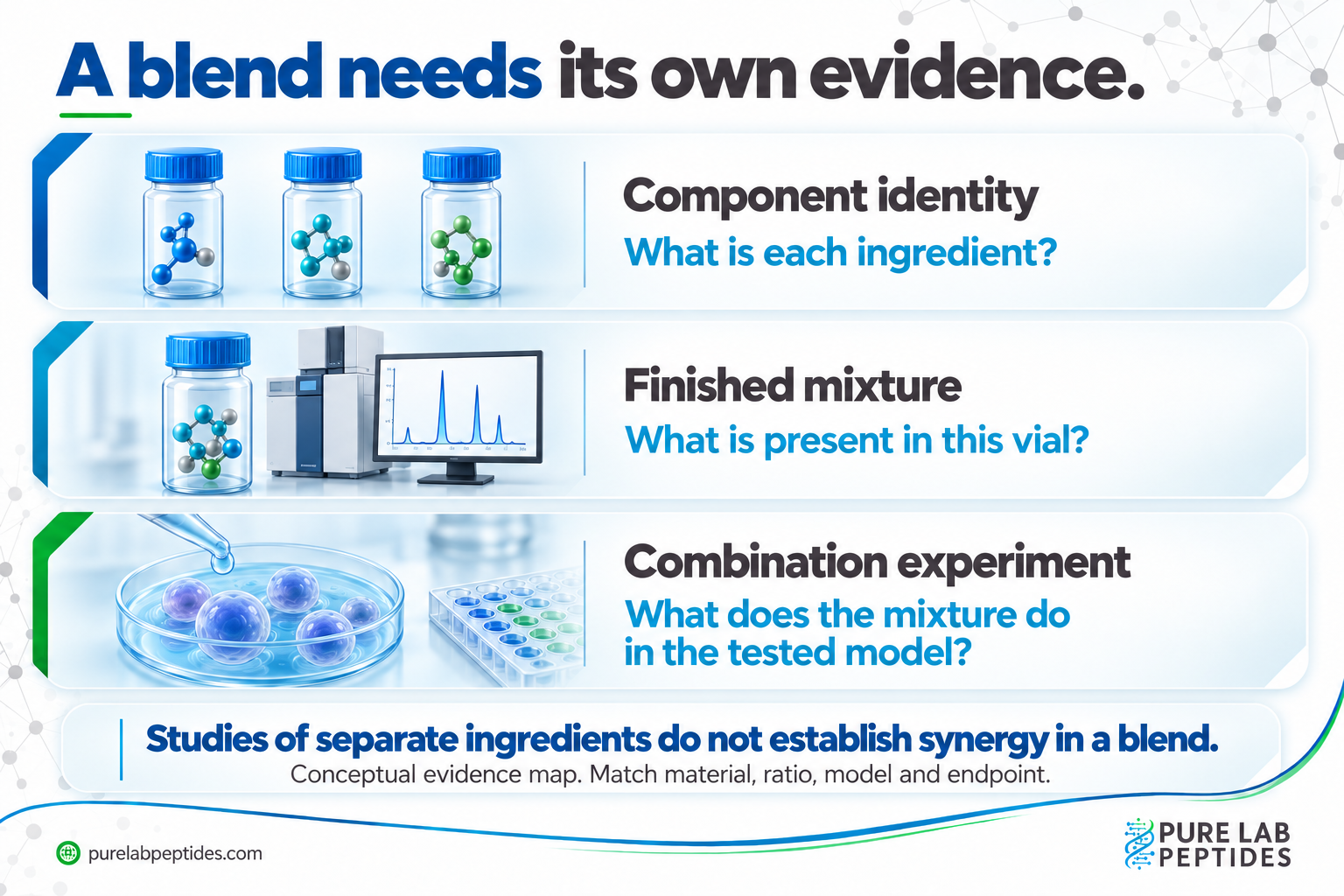
The following diagram is an editorial synthesis based on the cited literature and analytical guidance, not a published quantitative dataset. [3][4][18][19]
Why blend analytics are more complex than single-compound testing
The main analytical issue is straightforward: purity is not the same thing as identity. ICH Q2(R2) frames analytical validation around fit for intended purpose and emphasizes documented identity, purity, impurity assessment, specificity or selectivity, accuracy, precision, and suitable reference materials. In peptide analysis specifically, HPLC is foundational for separation, while LC-MS adds mass-based confirmation and impurity characterization that chromatographic area percentages alone cannot fully supply. [4][18][19]
That general rule becomes more important for this keyword because each component introduces a different analytical problem. GHK-Cu is a metal-peptide complex, TB-500 has fragment and metabolite issues documented in the analytical literature, and FDA’s current safety-risk page explicitly flags BPC-157, GHK-Cu, and TB-500-related substances for concerns tied to peptide-related impurities, aggregation, or active pharmaceutical ingredient characterization. Even in a strict RUO context, those are practical reasons to demand better documentation, not weaker documentation. [3][11][14][18]
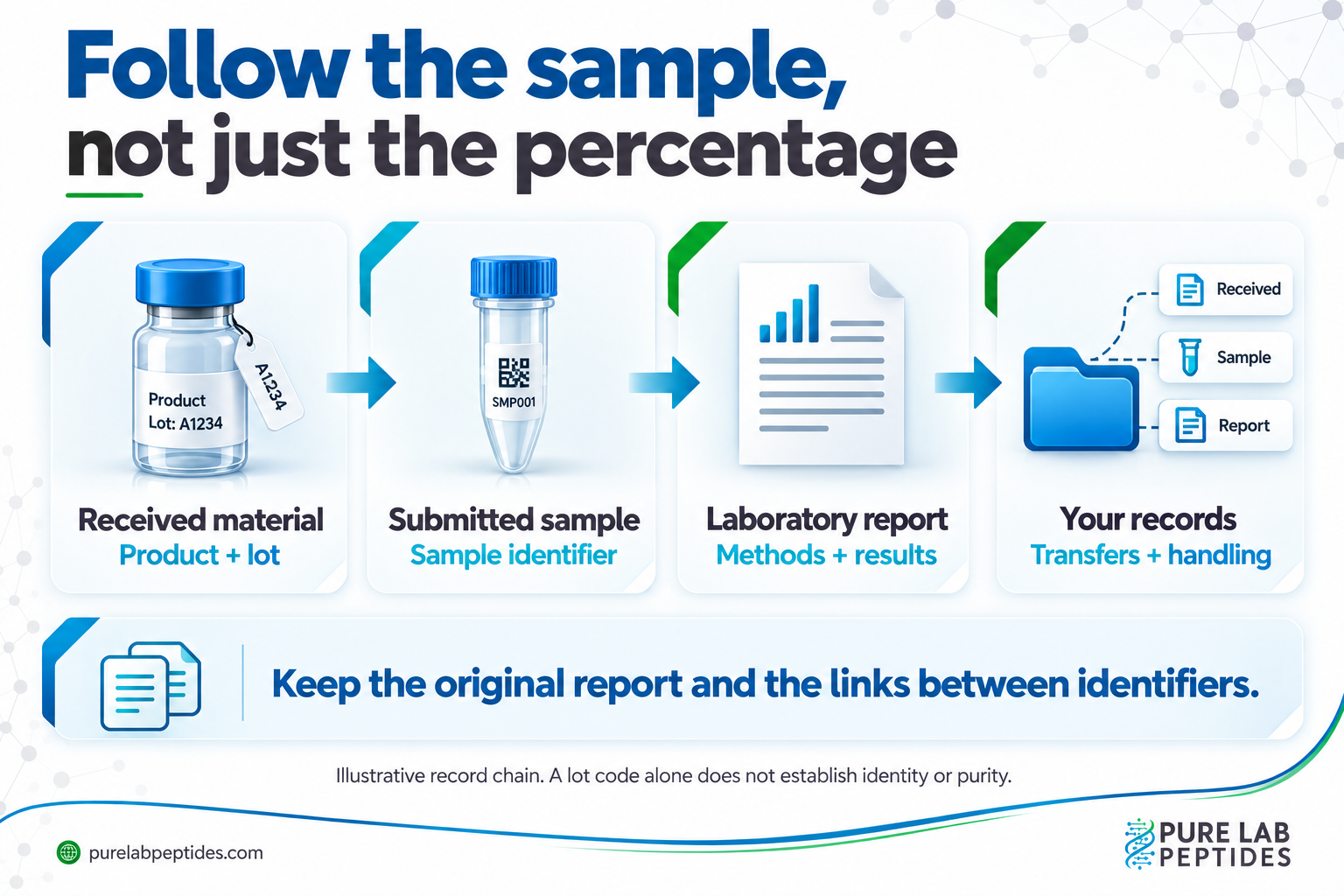
For that reason, a one-line certificate that reports only a single blend purity value is incomplete for serious laboratory procurement. A stronger documentation set separates component identity from blend purity, discloses the methods used, shows chromatographic and mass-spectrometric evidence where relevant, and makes clear whether the material tested was the individual component, the final combined blend, or both. [3][4][18][19]
- Component-resolved identity: evidence that each named analyte is present as labeled. [3][4][18]
- Blend-level purity: chromatographic data for the final combined material, not only for separate starting materials. [4][19]
- Related-substance reporting: disclosure of major impurities, if measured, and the method context used to detect them. [3][4][18]
- State clarification: confirmation of the copper-bound status for GHK-Cu and the exact fragment notation used for TB-500. [1][3][10][11]
What the evidence base actually supports
The evidence base supports component-level discussion much more clearly than exact-blend conclusions. Recent reviews that mention BPC-157, TB-500, and GHK-Cu place them in the same broad family of peptides studied in matrix-remodeling and preclinical orthopaedic-interest contexts, but those reviews also emphasize that the field remains dominated by preclinical evidence and has sparse high-level clinical validation. As a result, the phrase “GHK-Cu, TB-500, and BPC-157 blend research context” is scientifically strongest when it is interpreted as a literature-mapping and quality-control question, not as proof of a defined blend effect. [5][6]
Cross-study comparison is also limited by assay diversity. The reviews cited here aggregate cell-based migration readouts, endothelial signaling studies, extracellular-matrix endpoints, and broader preclinical model literature, which means the field does not yet operate around a single shared benchmark panel for all three components. That heterogeneity is one reason why blend-level extrapolation remains weaker than component-level interpretation. [5][6][15]
Published component studies also point to an attribution problem for any blend experiment. If a laboratory signal appears after exposure to a three-part mixture, researchers still need controls that distinguish copper-dependent effects, fragment-specific thymosin biology, BPC-157-linked fibroblast or VEGFR2 pathway effects, and possible metabolite contributions from TB-500. Without that separation, mechanistic conclusions can become descriptive rather than explanatory. [11][16][17][14]
In practical terms, that is why careful buyers and study designers ask documentation questions first. The narrower and better-defined the analytical dossier, the easier it becomes to connect a specific material to the correct body of literature and avoid importing claims from adjacent peptides or from the full-length parent protein. [3][4][8][10][18]
What researchers should review before selecting a blend
The most useful review standard is simple: confirm what the label means before interpreting what the literature means. For a three-component RUO blend, that means reviewing identity, purity, impurity methodology, and nomenclature at the component level before treating the mixture as a coherent research tool. [3][4][18][19]
- Confirm the exact names and forms. GHK-Cu, TB-500, and BPC-157 each carry naming conventions that can hide real chemical differences, including copper coordination, fragment notation, and salt-form description. [1][2][3][10]
- Look for orthogonal identity evidence. HPLC can separate peaks, but LC-MS or equivalent orthogonal data are more informative for confirming peptide identity and related impurities. [4][18][19]
- Check whether GHK remains copper-bound. Because copper coordination is central to the identity of GHK-Cu, the dossier should not treat the metal-complex state as an afterthought. [1][11]
- Check whether TB-500 is clearly defined. The literature distinguishes the thymosin beta-4 parent peptide from the short TB-500 fragment, and metabolite studies further complicate interpretation. [8][9][10][14]
- Match the literature to the actual material. BPC-157, TB-500, and GHK-Cu each have separate mechanistic papers and reviews; a blend label does not merge those literatures automatically. [5][6][15][13][17]
Lot comparability also matters more than it may appear. Analytical validation guidance is built around fit-for-purpose performance and documented reference materials, so a research team relying on component literature should not assume that one undocumented lot behaves like another solely because the vial label repeats the same three names. [4][18][19]
FAQs
Is there peer-reviewed literature on the exact GHK-Cu, TB-500, and BPC-157 blend?
The peer-reviewed literature cited here is mostly component-specific. Recent reviews discuss BPC-157, TB-500, and GHK-Cu in the same broad category, but they do not establish a standardized three-component blend literature with consistent composition, testing methods, and replicated endpoints. That is why blend interpretation usually starts with identity and documentation rather than with broad outcome claims. [5][6][18]
Is TB-500 the same as thymosin beta-4?
TB-500 is best treated as related to, but not identical with, full-length thymosin beta-4. UniProt and review literature describe thymosin beta-4 as the native actin-associated 43-amino-acid molecule, while FDA and analytical papers describe TB-500 in fragment terms centered on LKKTETQ or Ac-LKKTETQ. For literature review, those labels should not be treated as interchangeable. [3][8][9][10]
Why does GHK-Cu change how a blend should be tested?
GHK-Cu changes the testing discussion because it is not only a peptide sequence, but a copper-coordinated complex. Classical biochemical work and later reviews place copper binding at the center of its identity and signaling rationale, while FDA’s current safety-risk language also flags GHK-Cu for aggregation and peptide-related impurity concerns in regulatory review contexts. That makes state verification especially important in a blend. [1][3][11][13]
Why is LC-MS still useful if HPLC purity is already reported?
LC-MS remains useful because chromatographic purity percentages do not fully answer sequence identity, metal-complex state, or impurity-assignment questions. ICH validation guidance emphasizes fit-for-purpose methods and documented identity and purity, while peptide-analysis reviews describe HPLC and LC-MS as complementary rather than interchangeable tools. For a multi-component peptide blend, that distinction becomes more important, not less. [4][18][19]
What should a minimum COA package show for a peptide blend?
A minimum informative package for a peptide blend should show lot-level identification of each named component, the method used to assess purity or related substances, and enough supporting data to distinguish individual starting materials from the final combined blend. For this keyword, clear notation of GHK-Cu, TB-500 fragment identity, and BPC-157 sequence or salt form is especially important. [2][3][4][10][18]
Next Steps
Review batch-specific documentation before selecting any research-use-only peptide. Explore Pure Lab Peptides for RUO peptide compounds with clear labeling, research-focused product information, and available documentation. For research teams comparing suppliers, prioritize COA availability, transparent labeling, and lot-level documentation. [3][4][18]
References
- National Center for Biotechnology Information. “GHK-Cu.” PubChem Compound Summary. 2026. https://pubchem.ncbi.nlm.nih.gov/compound/133697840
- National Center for Biotechnology Information. “BPC-157 acetate.” PubChem Compound Summary. 2026. https://pubchem.ncbi.nlm.nih.gov/compound/BPC-157-acetate
- U.S. Food and Drug Administration. “Certain Bulk Drug Substances for Use in Compounding that May Present Significant Safety Risks.” FDA. 2026. https://www.fda.gov/drugs/human-drug-compounding/certain-bulk-drug-substances-use-compounding-may-present-significant-safety-risks
- International Council for Harmonisation. “ICH Q2(R2) Validation of Analytical Procedures.” ICH Guideline. 2023. https://database.ich.org/sites/default/files/ICH_Q2%28R2%29_Guideline_2023_1130.pdf
- Rahman OF, Lee SJ, Seeds WA. “Therapeutic Peptides in Orthopaedics: Applications, Challenges, and Future Directions.” JAAOS Global Research & Reviews. 2026. https://doi.org/10.5435/JAAOSGlobal-D-25-00236
- Mayfield CK, Bolia IK, Feingold CL, et al. “Injectable Peptide Therapy: A Primer for Orthopaedic and Sports Medicine Physicians.” The American Journal of Sports Medicine. 2026. https://doi.org/10.1177/03635465251357593
- National Center for Biotechnology Information. “glycyl-L-histidyl-L-lysine.” PubChem Compound Summary. 2026. https://pubchem.ncbi.nlm.nih.gov/compound/73587
- UniProt Consortium. “TMSB4X – Thymosin beta-4 – Homo sapiens.” UniProtKB. 2026. https://www.uniprot.org/uniprotkb/P62328/entry
- Maar K, Hetenyi R, Maar S, et al. “Utilizing Developmentally Essential Secreted Peptides Such as Thymosin Beta-4 to Remind the Adult Organs of Their Embryonic State.” Cells. 2021. https://doi.org/10.3390/cells10061343
- Esposito S, Deventer K, Goeman J, Van der Eycken J, Van Eenoo P. “Synthesis and Characterization of the N-Terminal Acetylated 17-23 Fragment of Thymosin Beta 4 Identified in TB-500, a Product Suspected to Possess Doping Potential.” Drug Testing and Analysis. 2012. https://doi.org/10.1002/dta.1402
- Lau SJ, Sarkar B. “The Interaction of Copper(II) and Glycyl-L-Histidyl-L-Lysine, a Growth-Modulating Tripeptide from Plasma.” Biochemical Journal. 1981. https://doi.org/10.1042/bj1990649
- Maquart FX, Pickart L, Laurent M, et al. “Stimulation of Collagen Synthesis in Fibroblast Cultures by the Tripeptide-Copper Complex Glycyl-L-Histidyl-L-Lysine-Cu2+.” FEBS Letters. 1988. https://doi.org/10.1016/0014-5793(88)80509-X
- Pickart L, Vasquez-Soltero JM, Margolina A. “GHK Peptide as a Natural Modulator of Multiple Cellular Pathways in Skin Regeneration.” BioMed Research International. 2015. https://doi.org/10.1155/2015/648108
- Rahaman KA, Muresan AR, Min H, et al. “Simultaneous Quantification of TB-500 and Its Metabolites in In Vitro Experiments and Rats by UHPLC-Q-Exactive Orbitrap MS/MS and Their Screening by Wound Healing Activities In Vitro.” Journal of Chromatography B. 2024. https://doi.org/10.1016/j.jchromb.2024.124033
- Gwyer D, Wragg NM, Wilson SL. “Gastric Pentadecapeptide Body Protection Compound BPC 157 and Its Role in Accelerating Musculoskeletal Soft Tissue Healing.” Cell and Tissue Research. 2019. https://doi.org/10.1007/s00441-019-03016-8
- Chang CH, et al. “The Promoting Effect of Pentadecapeptide BPC 157 on Tendon Healing Involves Tendon Outgrowth, Cell Survival, and Cell Migration.” Journal of Applied Physiology. 2011. https://doi.org/10.1152/japplphysiol.00945.2010
- Hsieh MJ, Liu HT, Wang CN, et al. “Therapeutic Potential of Pro-Angiogenic BPC157 Is Associated With VEGFR2 Activation and Up-Regulation.” Journal of Molecular Medicine. 2017. https://doi.org/10.1007/s00109-016-1488-y
- Lian Z, Ji W, Wang Y, et al. “Characterization of Synthetic Peptide Therapeutics Using LC-MS.” Journal of the American Society for Mass Spectrometry. 2021. https://doi.org/10.1021/jasms.0c00479
- Mant CT, Chen Y, Yan Z, et al. “HPLC Analysis and Purification of Peptides.” Methods in Molecular Biology. 2007. https://doi.org/10.1007/978-1-59745-430-8_1