



LC-MS Peptide Identity: What the Test Results Support

TL;DR: LC-MS peptide identity testing links a separated component with its measured mass. MS/MS may add fragment evidence for the proposed amino acid sequence. Find out which checks the report actually contains before treating a matching mass as a complete identity answer. It doesn’t establish every structural feature, the vial amount or a biological effect.
The molecular mass on the report looks right. So is this the compound named on the label? I’d look at how the laboratory reached the number before answering. The conclusion depends on the evidence behind it, not just how close the value looks.
Let’s follow that evidence from the separation to the assignment, then work out what to request when a report leaves a question open. If you need the wider measurement context first, see peptide purity versus peptide identity.
What happens during LC-MS peptide identity testing?
Quick take: Separation and mass measurement do different jobs. Read them together.
Liquid chromatography moves a prepared sample through a column using a solvent system. Components elute at different times when the method separates them successfully. The chromatogram shows signals over that run; retention time records when a component emerges under those conditions.
The mass spectrometer then measures ions. With electrospray ionization, a peptide can appear in several charge states, so the plotted mass-to-charge ratio isn’t necessarily its neutral molecular mass. If that axis is the sticking point, our mass-to-charge guide explains the calculation.
A laboratory can use the charge-state pattern and isotope information to assign a mass. The report should make clear whether it gives a monoisotopic mass or another mass convention, what the expected value is, and how the observed mass was compared with it. Otherwise, two numbers that look different may simply be expressed differently.
One peptide can produce several signals through charge states, isotopes or adducts. That makes counting peaks as though each were an impurity a poor shortcut. Ask the laboratory which signals it assigned to the target and which it could not explain.
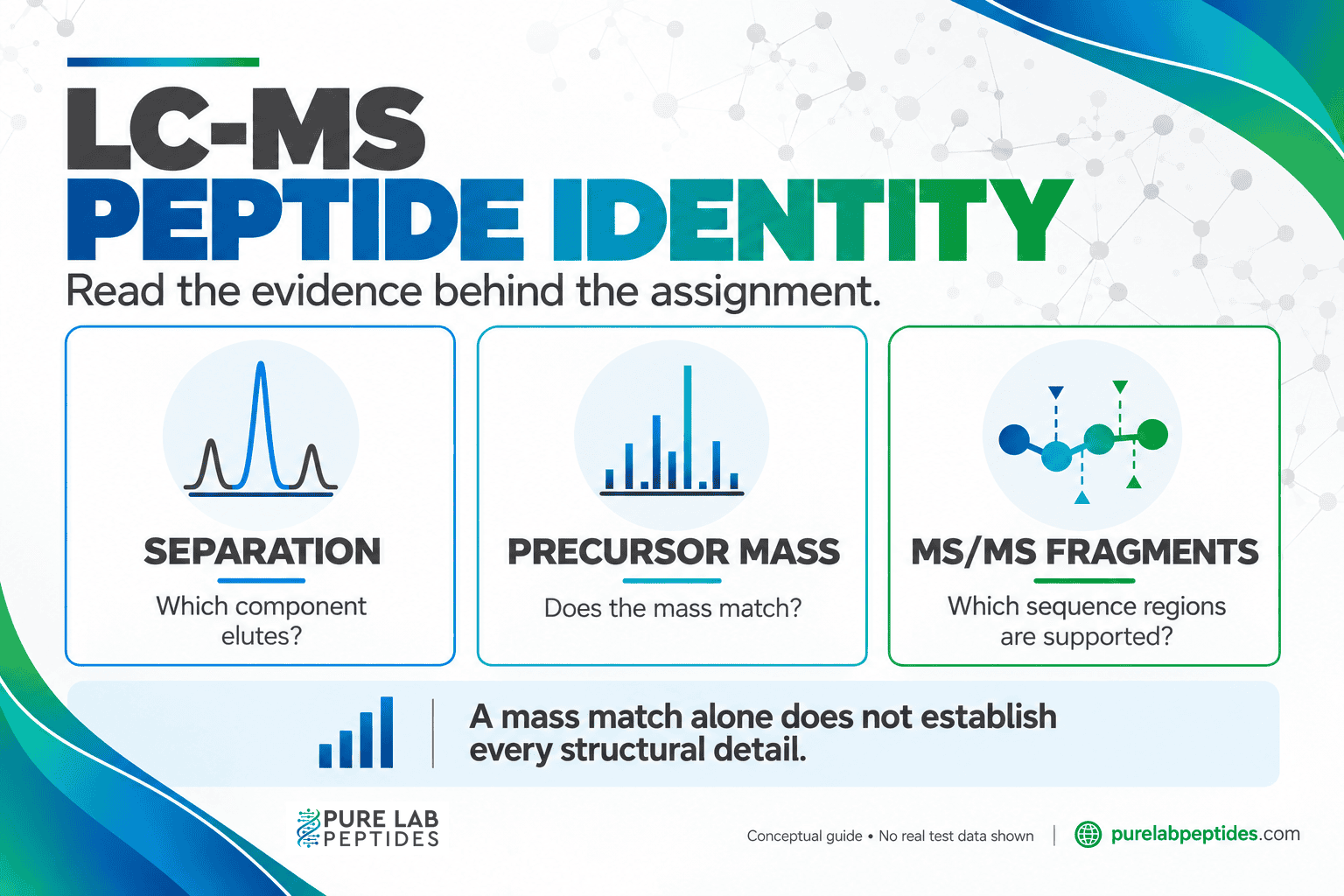
Precursor mass and MS/MS fragments answer different questions
Quick take: An intact-mass match supports a candidate. Fragment evidence can narrow the assignment further.
In tandem mass spectrometry, or MS/MS, an instrument selects a precursor ion and fragments it. The resulting spectrum can contain signals corresponding to portions of the peptide sequence. Matching those fragments with the proposed structure adds sequence information beyond the precursor mass.
For example, a high-resolution proteomics experiment by Boyne and colleagues used both precursor information and accurate fragment masses to assign peptides from protein digests. Its results illustrate why the combined evidence is useful. They don’t mean every routine LC-MS report contains the same experiment.
Look past the phrase “MS/MS performed.” Which regions of the proposed sequence have support, what criteria were used for the assignments, and which positions remain unresolved? Those answers tell you what the experiment adds to the identity assessment.
Keep the proposed sequence, allowed modifications and mass tolerance with a software or database assignment. They define the comparison the software made. A saved conclusion without those settings is much harder for another reviewer to interpret.
Peptide mapping is a related approach. For a larger peptide or protein, an enzyme may cleave the material into smaller pieces for analysis. The lab compares the resulting map with the expected fragments. An intact synthetic peptide doesn’t automatically need the same digestion workflow as a protein, and a mapping result should say what material and preparation it covers.
Where a matching mass can leave uncertainty
Quick take: Same mass does not always mean the same arrangement of amino acids.
Different sequences can have the same amino acid composition and total mass. In Hollebrands and colleagues’ study of short homologous peptides, the researchers combined spectral evidence with sequence-specific retention predictions to help distinguish peptides whose amino acids were arranged differently. That was a defined reversed-phase method and a particular short-peptide dataset, not a universal identification rule.
Leucine and isoleucine are another reason to avoid reading too much into mass alone: they have the same elemental composition. Whether a method distinguishes such alternatives depends on the separation and structural evidence it produces. A routine intact-mass result also doesn’t establish stereochemistry just because the reported mass is accurate.
Modifications need their own attention. Oxidation, terminal changes or another chemical form can alter the expected mass. Don’t compare a measured species with an unmodified sequence value unless that’s the intended comparison. Our peptide sequence guide covers how termini and modifications are written.
Read the report one claim at a time
Quick take: Ask for the evidence that supports the specific conclusion you need.
| Report item | What to check | What it doesn’t settle alone |
|---|---|---|
| Retention time | Method conditions and a suitable comparison | Identity across different methods or instruments |
| Precursor mass | Expected species, charge assignment, mass convention and tolerance | Every sequence position or structural alternative |
| MS/MS assignment | Fragment matches, sequence coverage and unresolved regions | Vial quantity or biological activity |
| Quantitative result | Calibrator, sample preparation, result basis and units | Identity simply because a number is reported |
Imagine comparing two reports. A lists an observed mass near the theoretical value. B identifies the measured species, explains the comparison and includes annotated MS/MS evidence. Either might help your review, but B contains evidence that A doesn’t show. Don’t fill in that missing work on A’s behalf.
You don’t have to call one report a blanket pass and the other a fail. Name the unresolved question instead, then ask the testing laboratory which evidence could answer it. That gives the request a useful scope.
Questions worth sending to the laboratory
Quick take: A few precise requests are more useful than asking for “more testing.”
- Which lot and sample does the result describe?
- What exact sequence, termini and chemical form were used to calculate the expected mass?
- Does the reported value refer to an ion, a deconvoluted neutral mass or another result?
- Was MS/MS acquired, and can you provide the annotated spectrum and coverage?
- Which alternatives or modifications can this method distinguish?
- Was the conclusion based on a reference comparison, a database match or both?
Also ask how the laboratory checked the system during the run. A manufacturer’s LC/MS suitability note describes a peptide mixture used to assess system performance and retention comparisons. Such a check helps establish that the system is behaving as intended; it doesn’t identify your sample by itself.
Keep identity, quantity and biological evidence separate
Quick take: One result can’t stand in for every other measurement.
A spectral match and a quantitative assay do different work. To turn a signal into milligrams per vial, you need an appropriate measurement procedure and calibration. A chromatographic purity percentage, meanwhile, still answers a different question from the structural assignment. Keep the conclusions beside the measurements that support them.
And neither of those results demonstrates that a research material has a particular effect in people. Keep the lot-level analytical record with the material, and keep claims from research papers tied to the actual experiments. For a practical document-reading workflow, see our peptide testing guide.
Leave the next reviewer something they can use: the conclusion the data support, the question they leave open and the record that would help answer it. A brief, specific note does more work than a broad “identity confirmed” copied out of context.