

...
Analytical Methods

Mass-to-Charge Ratio in LC-MS: Definition & Applications

The mass-to-charge ratio (m/z) is defined as the mass of an ion divided by its electric charge, and it is the fundamental parameter measured in mass spectrometry【21†L63-L66】【28†L36-L39】. In LC-MS (liquid chromatography–mass spectrometry), peptides or other analytes are separated by liquid chromatography and then ionized, with the resulting ions detected according to their m/z values. This ratio allows researchers to determine molecular weight and structural information from the measured spectrum. The discussion below is focused on laboratory research settings and does not involve any clinical or therapeutic context.

Fast Answer

The mass-to-charge ratio (m/z) is the basic quantity measured by LC-MS and equals an ion’s mass divided by its charge【5†L119-L124】【21†L63-L66】. In LC-MS, ions from a peptide are separated and detected according to their m/z, which enables identification and quantitation of the peptide. Products discussed in this article are intended for laboratory research use only and are not intended for human or animal consumption.

What Is Mass-to-Charge Ratio (m/z)?

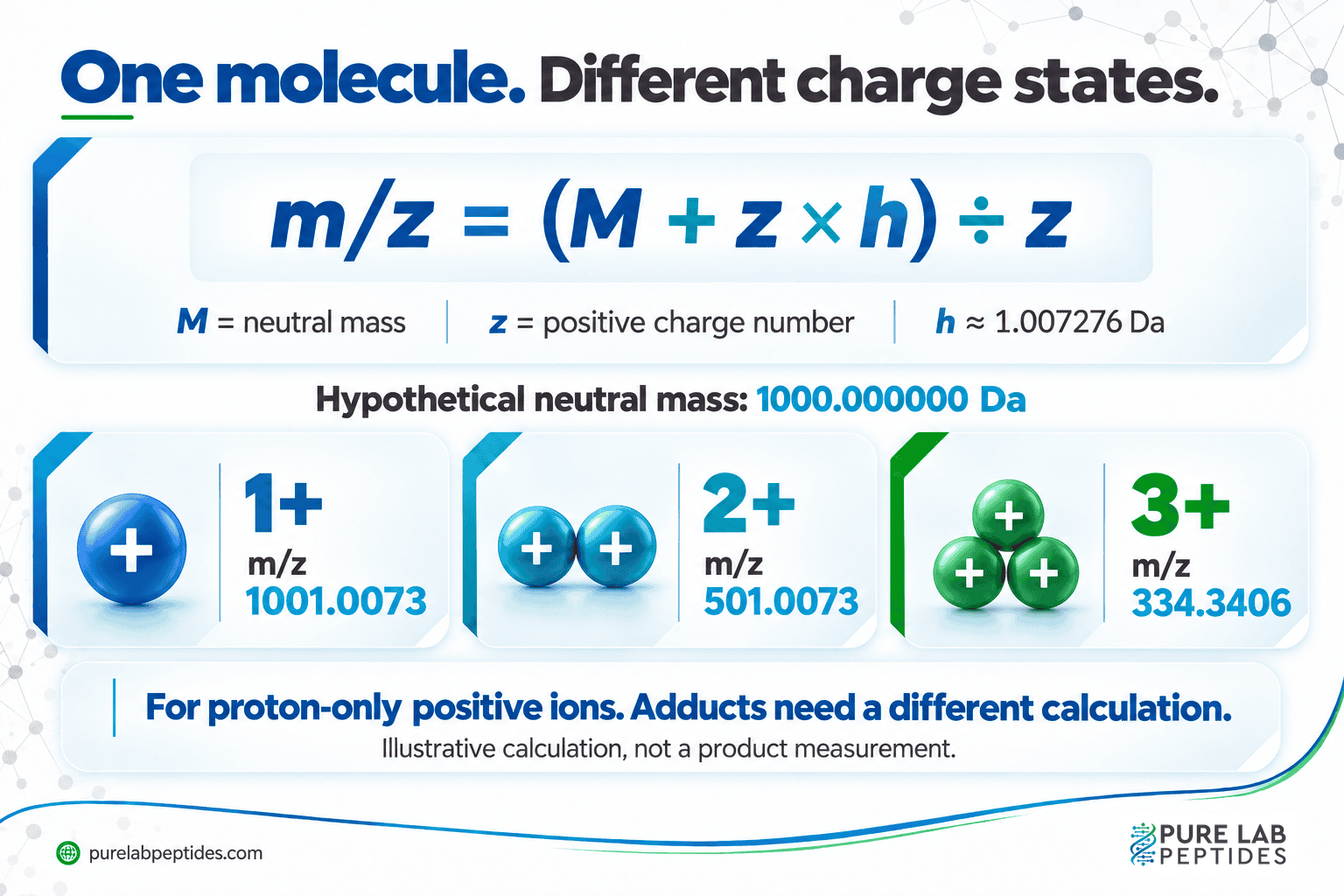
Mass spectrometry quantifies ions based on their mass-to-charge ratio (m/z). By definition, m is the ion’s mass (in atomic mass units) and z is its charge state (the net electric charge, e.g. +1, +2, etc.)【21†L63-L66】. An ion with a single positive charge (z=1) has m/z equal to its actual mass. Ions often carry multiple charges (especially in techniques like electrospray ionization), so their observed m/z is lower than the ion’s full mass. Mass-to-charge ratio is a dimensionless number (typically expressed in m/z units), and it is the value plotted on the x-axis of a mass spectrum【20†L759-L762】. Instruments called mass spectrometers are specifically designed to separate and measure ions by their m/z【20†L699-L704】【21†L75-L76】.

LC-MS Workflow: From Sample to m/z Data

In LC-MS analysis, the workflow begins with liquid chromatography separation of a sample (such as a peptide mixture), followed by ionization and mass analysis (see diagram below). The sample is ionized (commonly by electrospray ionization for peptides) into the gas phase. The ion source generates charged ions which enter the mass analyzer. Inside the mass analyzer, ions travel under electric/magnetic fields that cause them to separate by m/z. Finally, a detector records the number of ions at each m/z value, producing a mass spectrum【20†L699-L704】【5†L119-L124】.

flowchart TD Sample[Sample Injection] --> LC[Liquid Chromatography] LC --> Ion[Ionization (ESI/APCI)] Ion --> MS[Mass Analyzer] MS --> Detect[Detector records m/z spectrum]

Figure: Flowchart of an LC-MS analysis workflow (editorial schematic). Samples are injected and separated by LC, ionized (e.g. by electrospray), and the resulting ions are separated and detected by mass-to-charge ratio.

Different mass analyzers operate on the same principle of m/z separation. For example, a time-of-flight (TOF) analyzer accelerates ions so that lighter (lower m/z) ions reach the detector faster than heavier ones【20†L699-L704】. Quadrupole analyzers use oscillating electric fields to transmit ions of a specific m/z. Orbitrap or ion-trap systems trap ions and measure their frequencies to derive m/z. In all cases, the instrument output is a spectrum of intensity versus m/z, which is interpreted to identify the analytes.

Peptide Ions and Interpreting m/z Data

Peptides typically ionize with one or more proton additions (positive charges) under electrospray ionization. For a peptide of monoisotopic mass M, the most common ion species are [M+H]+ and [M+2H]2+ (and higher). Each ion’s m/z is calculated as (M + z×1H) / z, where 1H=1 Da is the mass of a proton. The table below shows example calculations for a hypothetical peptide with monoisotopic mass 1500 Da:

Ion Species Charge (z) m/z Calculation Example (M=1500 Da)
[M+H]+ +1 (1500 + 1)/1 1501
[M+2H]2+ +2 (1500 + 2)/2 751
[M+3H]3+ +3 (1500 + 3)/3 501

Each peak in the mass spectrum corresponds to a specific m/z. Software or manual calculation can convert that m/z back into the peptide’s mass by multiplying by the charge and subtracting added proton mass. For example, an observed peak at 751 m/z with z=2 indicates (751×2 – 2) = 1500 Da peptide mass. In practice, software tools consider isotopic patterns (the distribution of peaks from natural isotope variants) to assign charge states and deconvolute the true mass. The monoisotopic mass (the mass of the isotope with all 12C) is often used as the reference.

Mass Accuracy, Resolution, and Calibration

Mass-to-charge measurements have finite precision. Mass accuracy refers to how close the measured m/z is to the true value. Modern high-resolution analyzers (like Orbitraps or QTOFs) can achieve errors of only a few parts-per-million (ppm) in m/z【10†L889-L893】. For example, a QTOF may be accurate within ~5 ppm of the true monoisotopic mass. In contrast, lower-resolution analyzers (like simple quadrupoles) have broader peaks and larger uncertainty. Higher resolution means narrower peak widths (in m/z units), allowing closely spaced masses to be distinguished. In practice, instrument calibration with known standards is used to correct systematic m/z errors before sample analysis.

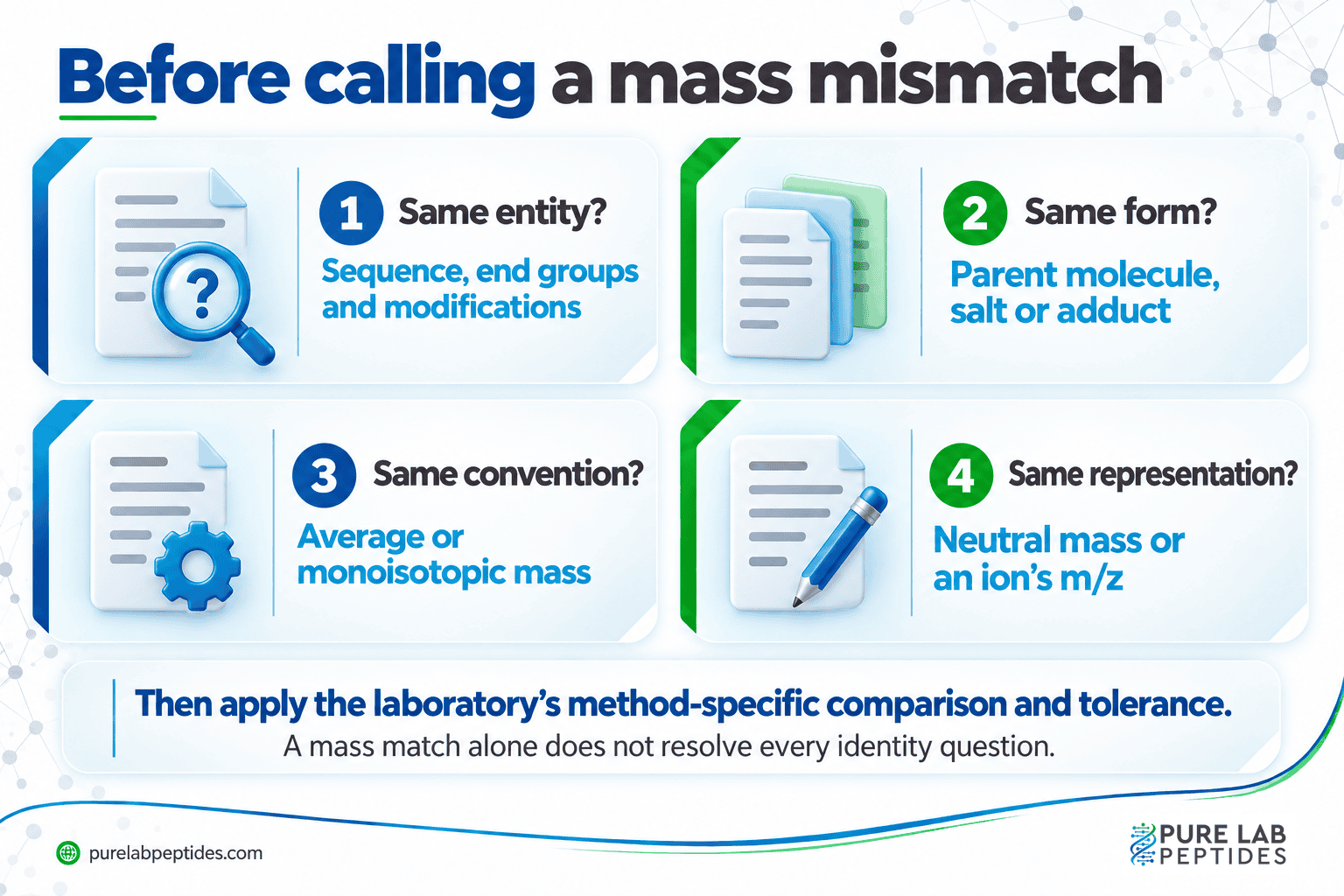
Researchers often specify acceptable mass error (for instance, ≤10 ppm) when confirming peptide identity. LC-MS data are interpreted in light of this accuracy. If an ion’s observed m/z matches the theoretical m/z of the expected peptide within tolerance, identity is confirmed. If not, it may indicate an unexpected modification or impurity. Maintaining high mass accuracy and resolution is therefore crucial for reliable peptide identification and for generating certificate-of-analysis reports in peptide QC.

Quality Control: Reporting m/z in Peptide Documentation

In peptide research supply, a Certificate of Analysis (COA) typically includes the theoretical mass and the observed MS data. The observed m/z values of the peptide’s charge states should match the expected mass within a small tolerance. For example, if a peptide’s monoisotopic mass is 1500 Da, the COA might report observing peaks at 1501 m/z ([M+H]+) and 751 m/z ([M+2H]2+). These confirm the peptide’s identity by matching its theoretical mass. Researchers should review the COA to ensure the reported m/z matches the target molecule’s calculated mass, and that resolution and calibration information are documented. Robust QC practices often involve third-party mass spectrometry labs and standardized formats for reporting m/z data in RUO materials.

FAQs

What does “mass-to-charge ratio” mean in an LC-MS experiment?

The mass-to-charge ratio (m/z) is the measured value obtained by dividing an ion’s mass by its charge. In LC-MS, each ionized analyte (such as a peptide) is assigned an m/z value, which determines where its peak appears on the mass spectrum. A singly charged ion has m/z equal to its mass, while multiply charged ions have proportionally lower m/z values for the same peptide mass【21†L63-L66】【20†L759-L762】.

How do multiple charges on a peptide affect its m/z value?

If a peptide carries more than one proton (or other charge), its m/z value decreases accordingly. For instance, a doubly charged ion [M+2H]2+ will have roughly half the m/z of the same peptide in the [M+H]+ form. In practice, multiply-charged peptide ions produce multiple peaks in the spectrum. The charge state is determined by comparing the m/z differences between isotopic peaks or using deconvolution software, allowing calculation of the peptide’s actual mass【10†L921-L924】.

What is the difference between m/z and molecular weight?

Mass-to-charge ratio (m/z) is not the same as molecular weight unless the charge (z) is known. For a singly charged ion (z=1), m/z equals the molecular mass. For higher charges, the molecular weight must be reconstructed as (m/z × z) minus the mass of added protons. For example, an observed m/z of 500 with z=2 corresponds to a molecule of (500×2–2)=998 Da (minus two protons). Analysts use the m/z and charge state together to determine the true mass of the peptide【21†L63-L66】【10†L921-L924】.

Why are resolution and calibration important for m/z measurements?

High resolution and proper calibration ensure that measured m/z values are precise. Better resolution yields sharper peaks, making it easier to distinguish close masses. Calibration with known standards corrects systematic shifts in m/z, so that the instrument reports accurate masses (often within a few ppm). Accurate, high-resolution m/z data are necessary for confidently matching observed peaks to the correct peptide, especially in complex samples【10†L889-L893】. Without these, identification could be ambiguous.

How do researchers use m/z values to verify a peptide’s identity?

Researchers compare observed m/z peaks to the peptide’s theoretical masses. A correct identity is confirmed when the major peaks (e.g. [M+H]+, [M+2H]2+) match calculated values within the instrument’s mass error tolerance. For example, if the theoretical monoisotopic mass is 1500 Da, seeing peaks at ~1501 and ~751 m/z supports the expected peptide. This match is typically reported in the certificate of analysis, and it must be within a small deviation (often <5–10 ppm) to verify the compound’s identity.

Next Steps

Always review batch-specific LC-MS documentation when working with research peptides. Ensure that the reported m/z values and calibration details match the expected peptide formulas. Prioritize suppliers like Pure Lab Peptides that provide transparent COAs with detailed mass spectrometry data. For reliable research results, choose RUO peptides from vendors offering full analytical reports and clear labeling of mass-to-charge ratio measurements.

References

  1. Wysocki VH, Resing KA, Zhang Q, Cheng G. “Mass spectrometry of peptides and proteins.” Methods. 2005. doi:10.1016/j.ymeth.2004.08.013
  2. Auburn University Department of Chemistry & Biochemistry. “Basics of Mass Spectrometers.” 2020. auburn.edu
  3. Thermo Fisher Scientific. “Overview of Mass Spectrometry for Protein Analysis.” Pierce Protein Methods. 2018. thermofisher.com
  4. Waters Corporation. “Mass Accuracy & Resolution.” 2024. waters.com
  5. JEOL USA. “Mass Spectrometry Basics.” 2019. jeolusa.com
Pure Lab Peptides Logo with Black Letters