



Peptide Purity Testing: HPLC, Identity and Vial Content

TL;DR · The short version
Peptide purity testing doesn’t give you one number that answers everything. HPLC area purity concerns detected peaks, identity testing concerns the material’s identity, and a content assay concerns the measured amount. Before comparing reports, check what each method measures and how the result is expressed.
You’re looking at 99% purity on a report and 10 mg on a vial. Can you say the laboratory found 9.9 mg of the right peptide? It sounds like a straightforward calculation, but the two figures haven’t established that measurement.
The trouble starts when the label amount and the percentage look like parts of the same answer. With peptide purity testing, they may belong to different questions. Ask what the instrument detected, how the lab assessed identity and whether it measured content. Then read each result in that context.
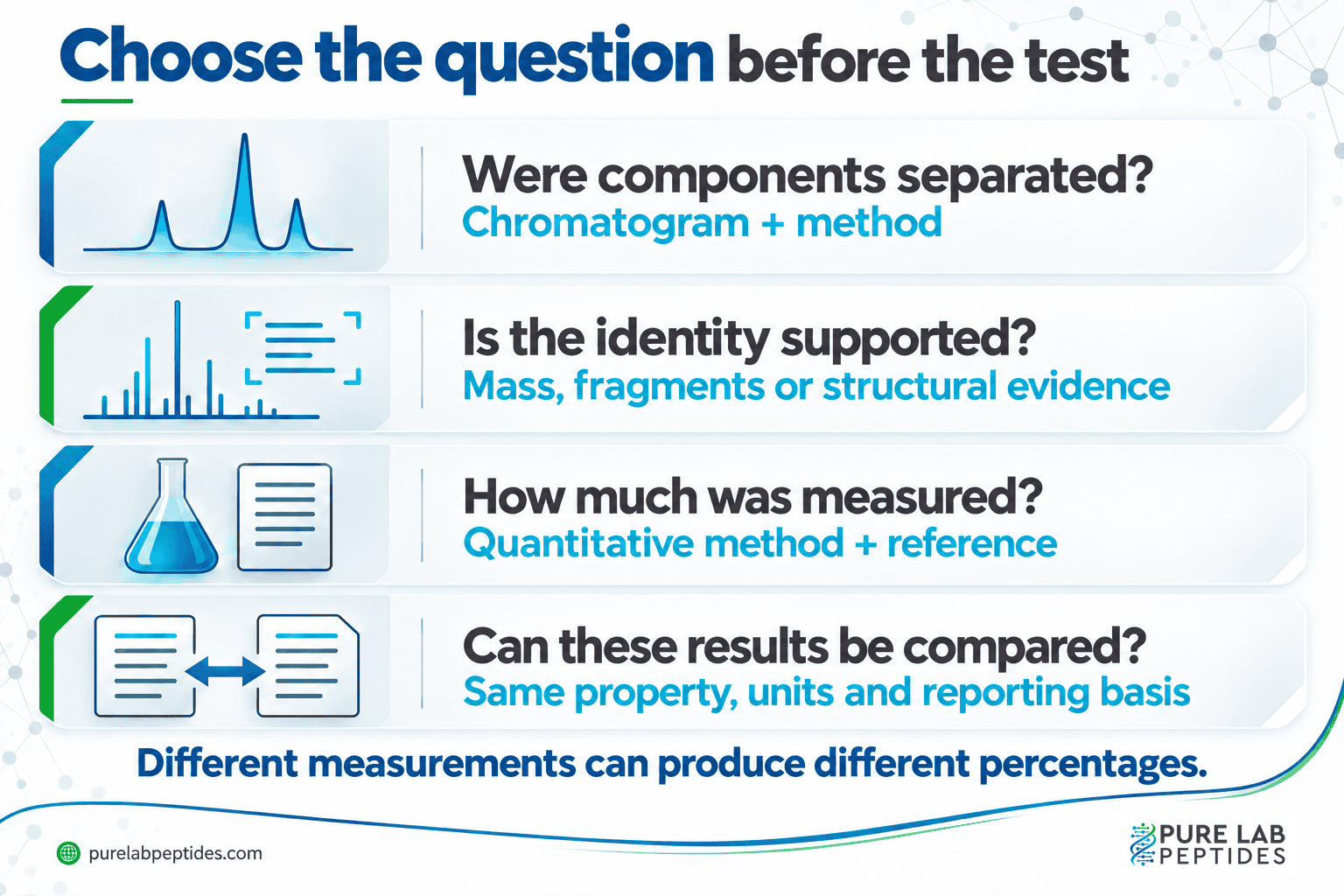
Start with the property you need to establish
TL;DR: Choose the question first: identity, separated components, measured content or another specified property.
What do you need to find out? If you’re asking whether the main detected component dominates the chromatogram, look at chromatographic purity. For the material’s identity, read the identity assessment. For a measured amount, find the content assay and keep its units and calculation basis beside the result. Deciding that first saves a lot of confusion later.
| Question | Evidence to look for | Important boundary |
|---|---|---|
| What material was detected? | Identity method and conclusion | A matching intact mass may not establish every structural feature. |
| What related components were separated? | Chromatogram, method and integration result | Undetected or coeluting components are not resolved by a single area percentage. |
| How much peptide is present? | Quantitative assay or content result | The reporting basis may differ from total powder mass. |
| Were other properties tested? | Named tests with actual results | Do not infer sterility, endotoxin or residual-solvent results from unrelated tests. |
What an HPLC purity percentage means
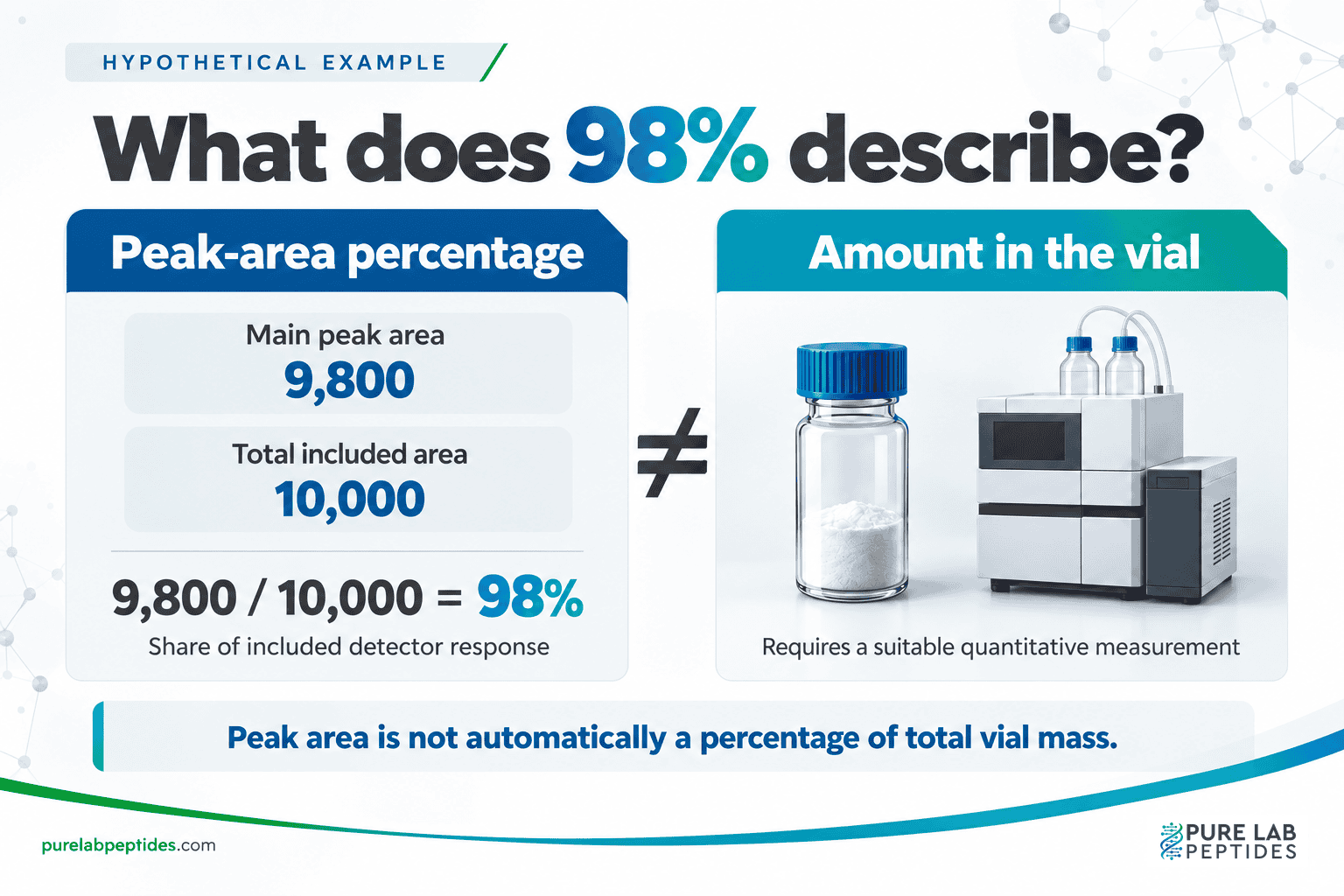
High-performance liquid chromatography separates components as a sample travels through a column. A detector records the material leaving the column, producing a chromatogram. In an area-normalized result, the assigned peak area is divided by the total area included under the reporting rules.
Pay attention to what enters the denominator. Material that isn’t detected or included in integration won’t necessarily appear as a separate impurity peak. Nor will material that travels together with another component. Detector responses can also differ between compounds. The percentage describes the method’s calculation; it isn’t automatically the fraction of the entire powder mass made up by the target.
Waters explains the distinction between identifying and quantifying chromatographic components. For a closer look at the axes, peaks and integration, see our HPLC chromatogram guide.
Why methods can disagree without contradicting one another
TL;DR: Compare the same measurement and reporting basis. Different tests can legitimately produce different numbers.
Before treating two laboratory results as conflicting, check whether they answer the same question. A UV chromatographic area result describes the responses included in integration. A mass-fraction assignment concerns the amount of defined peptide in the material. If the entity or denominator differs, the comparison needs that difference spelled out.
A primary angiotensin II reference-material study combined corrected amino acid analysis, quantitative NMR and mass-balance evidence. That example shows why a reference material’s assigned peptide content can require more than an HPLC area calculation. It does not establish the composition of another supplier’s lot.
A percentage does not measure the vial amount
TL;DR: A label amount multiplied by an HPLC percentage is not a laboratory measurement of vial content.
Take a listing labeled 10 mg and a report showing 99% chromatographic purity. Multiplying 10 by 0.99 gives 9.9. Easy arithmetic. Different measurement. That calculation hasn’t turned the label into an assay, or detector area into a mass fraction. To say the lab measured 9.9 mg, you need an actual content result with its unit and reference basis.
That is why similar chromatographic purity percentages can sit beside different measured vial contents. If the combination looks odd, read the definitions first. You may be comparing different properties rather than finding a disagreement between laboratories.
Read the method alongside the result
TL;DR: The method, sample identifier and supporting trace explain what the result can establish.
Look for the submitted sample, method and measured result in the report. The supporting record can tell you more: a chromatogram shows separation and integration, while a mass spectrum helps explain ion assignments. If you’re given only a summary and need that missing context for the study, ask for the original laboratory record.
An instrument name doesn’t choose your acceptance threshold. Your material, the impurities you’re investigating and the purpose of the experiment determine what you need to establish. Also, don’t confuse an absent test with a failed test. An unlisted property remains unreported.
Connect the test to the vial you received
TL;DR: Match the report to the lot on the received material, not just the product name.
File the lot identifier, report and receiving record together, and check that connection again when batches change. The current page may feature a different lot from the one in an earlier order. Use the PLP COA reading guide to follow the document relationship, then return to the laboratory report for its actual findings.