
How to Interpret HPLC Chromatograms for Research
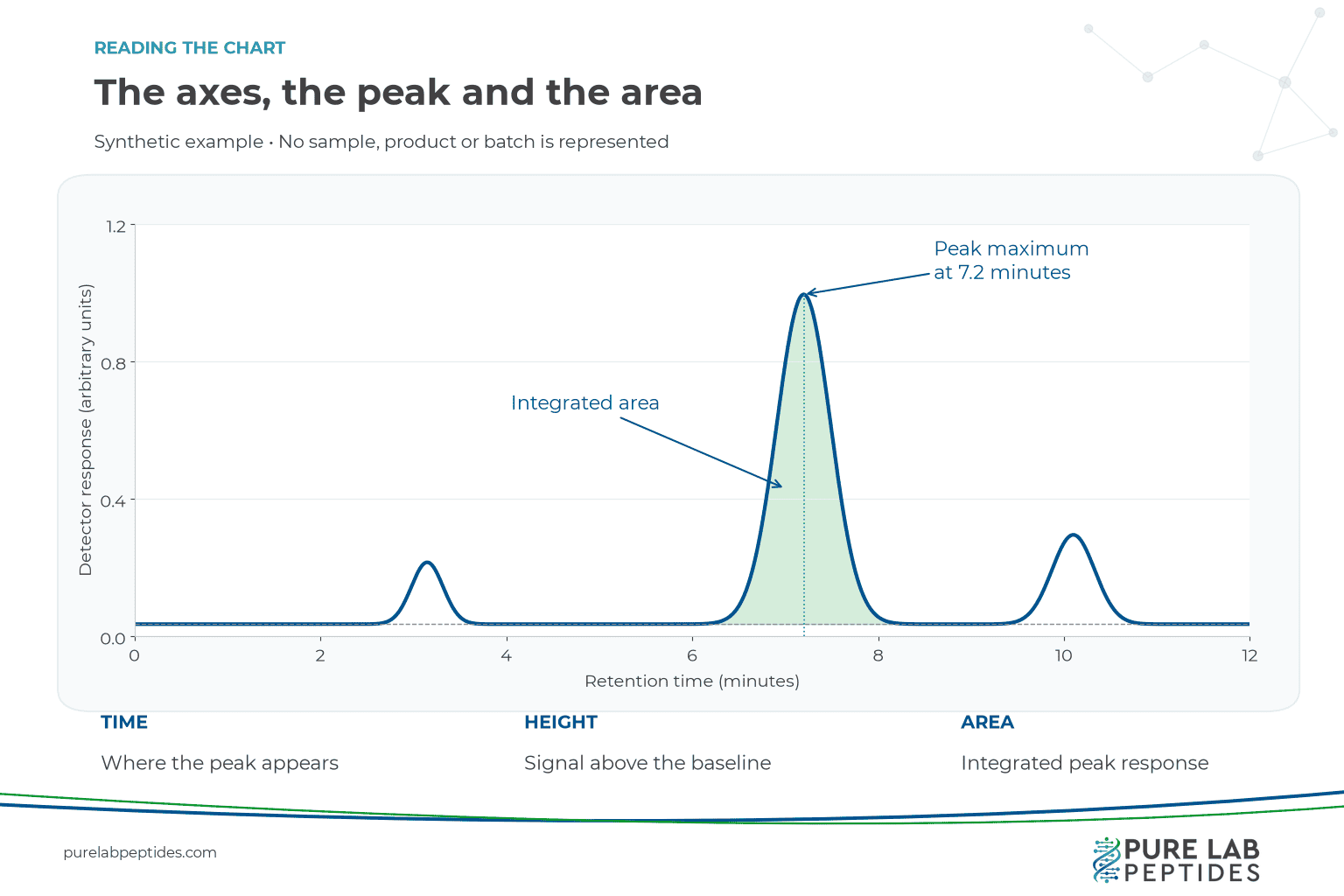
High-performance liquid chromatography (HPLC) produces chromatograms that display a series of peaks, each corresponding to a chemical component in a sample. Interpreting HPLC chromatograms involves reading these peaks — examining their retention times (when they appear), areas (how large they are), and shapes — to identify compounds and assess sample composition【24†L458-L467】【24†L490-L498】. In research settings, this analysis helps confirm peptide identity and estimate purity without implying any therapeutic use.
Fast Answer
Interpreting an HPLC chromatogram means analyzing each peak’s retention time (time from injection to peak apex) and peak area (proportional to the compound’s amount) to identify and quantify sample components【24†L458-L467】【24†L490-L498】. Products discussed in this article are intended for laboratory research use only and are not intended for human or animal consumption. Key considerations include matching peaks to reference standards by retention time, calculating relative peak area percentages for purity, and checking peak shape for symmetry or tailing as indicators of column or sample issues.
HPLC Chromatogram Basics
An HPLC chromatogram plots detector response (often UV absorbance) versus time. Each peak represents one analyte eluting from the column under the chosen mobile phase conditions. By comparing a peak’s retention time (tR) to that of known standards under the same conditions, researchers can tentatively identify the compound【24†L458-L467】. For example, if a reference peptide elutes at 5.0 minutes, a peak at 5.0 minutes in an unknown sample suggests the same peptide is present. The detector response (height or area of the peak) is proportional to the quantity of that analyte in the sample【24†L490-L498】.
Key Chromatogram Features
When interpreting peaks, important features include:
- Retention Time (tR): The time from injection to peak apex. Consistent retention times under fixed conditions indicate the same compound; shifts may indicate system variability or mobile phase changes【24†L458-L467】.
- Peak Area: The integrated area under a peak. Larger area corresponds to more analyte (assuming linear detector response), so researchers use this to calculate relative concentration or purity【24†L490-L498】.
- Peak Shape and Width: Ideally peaks are symmetrical and narrow. Broad or tailing peaks (long trailing edge) suggest column issues (e.g. active sites) or sample overload【22†L203-L210】. Peak width also relates to column efficiency (theoretical plates).
- Baseline Stability: A flat, stable baseline without drift or noise is essential. Excessive noise or drifting baseline can obscure small peaks and affect integration accuracy.
- Resolution (Rs): The degree of separation between adjacent peaks. Good resolution (Rs ≥ 1.5) ensures peaks do not overlap significantly. For instance, Rs of 1.50 gives only ~0.13% overlap between equal-area peaks【31†L433-L442】, enabling confident quantitation of each component.
| Parameter | Description / Indicator | Typical Expectation |
| Retention Time (tR) | Time to peak apex; used to identify compounds against standards【24†L458-L467】 | Consistent under set conditions; matches reference |
| Peak Area | Integrated area under peak; proportional to analyte concentration【24†L490-L498】 | Used to calculate percent composition or concentration |
| Resolution (Rs) | Separation quality between adjacent peaks【31†L433-L442】 | > 1.5 for baseline separation |
| Theoretical Plates (N) | Column efficiency metric (higher N = narrower peaks) | Dependent on column; typically thousands or more |
| Tailing Factor / Symmetry | Peak symmetry measure; tailing (As >1) indicates column or adsorption issues【22†L203-L210】 | Ideal ~1; USP recommends 0.8–1.8 for quantitation |
| Baseline Noise / Drift | Random fluctuations or trends in detector signal | Should be minimal and stable |
Identifying Peaks and Quantifying Analytes
Once peaks are visible in a chromatogram, the first step is identification. Each peak’s retention time is compared to that of known standards or reference materials under identical HPLC conditions【24†L458-L467】. A match suggests the peak corresponds to the same compound. Additional confirmation may use detector spectral data (e.g. diode-array UV spectra) or orthogonal methods (like LC-MS) in rigorous research contexts.
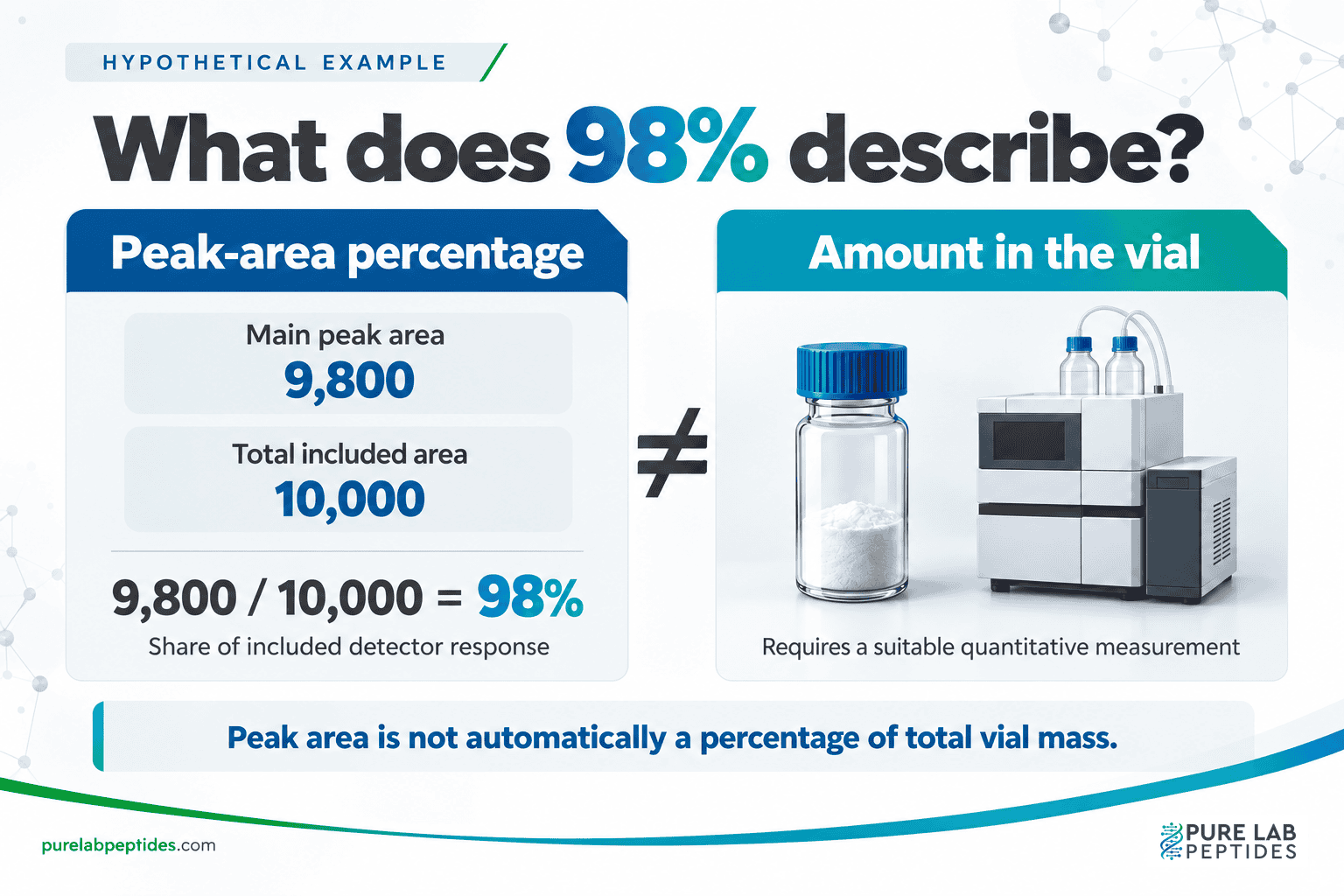
After identification, peak area is used for quantification. Under fixed detector conditions, the area under each peak is proportional to the analyte amount【24†L490-L498】. In practice, researchers create calibration curves (known concentration vs area) or report relative purity. For a research peptide, purity is often estimated by dividing the area of the main peptide peak by the total area of all peaks (main plus impurities) and multiplying by 100%. For example, if the main peak area is 95% of the sum of all peak areas, the peptide has ~95% purity by that assay (assuming similar UV response for all peaks). These calculations assume linear detector response and consistent injection volume.
Assessing Peak Quality and Purity
Inspecting peak shape and separation informs on chromatography quality. Sharp, symmetrical peaks indicate efficient column performance. Peak tailing (asymmetry) or fronting suggests interactions with column active sites or overloaded injection【22†L203-L210】. If major peaks are poorly resolved or merged, it may be impossible to quantify components separately. A resolution ≥1.5 is generally required for baseline separation (see table above).
For peptide analysis, labs often include a chromatogram image on the Certificate of Analysis (COA). A single sharp peak with minimal other peaks indicates high purity. However, some small secondary peaks (impurities or side-products) are typical; these are noted as minor percentages. Any unknown peaks should be interpreted as impurities. In research context, analysts may use additional tests (e.g. mass spectrometry) to characterize unknown peaks, but a clean HPLC profile is a first-line indicator of purity.
Quality Controls and Troubleshooting
System Suitability parameters are checked before interpreting sample data. These include injecting standards or system suitability mixtures to verify that theoretical plates (efficiency) and tailing factors meet criteria. Typical acceptance criteria (e.g. USP) are specified in method protocols. If system suitability fails (e.g. low plates, high tailing), the run is invalid and method conditions must be adjusted.
If chromatograms show unexpected issues (such as irregular peaks or drifting baseline), common troubleshooting steps include checking the HPLC pump and solvent degassing, ensuring the column is not overloaded, and verifying that sample solvents and buffers are freshly prepared. These factors affect peak quality and thus interpretation. Good laboratory practice emphasizes documenting any anomalies in chromatograms and re-running or investigating anomalous results.
Below is a flowchart summarizing a typical workflow for interpreting HPLC chromatograms in a research lab setting:
flowchart TD A[Inject sample into HPLC system] --> B[Run chromatography and collect detector signal] B --> C{Is baseline stable?} C -- Yes --> D[Identify peaks by retention time vs reference] C -- No --> E[Adjust conditions (degass, clean, etc.) and repeat] D --> F[Measure peak areas and heights] F --> G{Peaks symmetric and resolved?} G -- Yes --> H[Calculate relative purity and document results] G -- No --> E E --> B FAQs
What does each peak in an HPLC chromatogram represent?
Each peak corresponds to a different compound in the injected sample. The peak’s position (retention time) and shape tell us about that compound. Under fixed conditions, a compound will appear at a specific retention time【24†L458-L467】. By comparing peaks to standards (known compounds run under the same conditions), researchers can identify what each peak likely is.
How are peak retention time and area used in analysis?
Retention time is used for identification: each substance has a characteristic time it emerges from the column under set conditions【24†L458-L467】. Peak area (or height) is used for quantification: it is proportional to the amount of analyte. In practice, the area under a peak is integrated and compared to calibration curves or expressed as a percentage of total area【24†L490-L498】.
Why might a peak be broad, tailing, or fronting?
Peak broadening, tailing, or fronting indicate issues with the chromatographic system or sample. Common causes include column overloading, interactions with active sites in the column packing, or extra-column effects. For example, peak tailing (a sloped trailing edge) often arises when a compound sticks transiently to the column support【22†L203-L210】. Such shapes make quantitation less accurate and usually prompt a method check.
What does it mean if the chromatogram shows only one main peak?
If a sample’s HPLC chromatogram shows one dominant peak and no other significant peaks, it suggests the sample is highly pure (with the main compound making up nearly all detected content). Researchers often calculate purity by dividing the main peak’s area by the total area of all peaks. For research peptides, this indicates good synthetic purity, though very small undetected impurities could still be present.
How do researchers confirm that a peak is the expected compound?
Besides matching retention time to a known standard, researchers can use additional evidence. For example, UV diode-array detectors can provide a spectrum for each peak; matching spectra supports identity. In rigorous research, liquid chromatography-mass spectrometry (LC-MS) is used: the mass of the eluting compound is checked against the expected peptide mass. But even without MS, consistency of retention time and spectral data under the same LC conditions is used for identification.
Next Steps
When working with research peptides, always review batch-specific documentation such as the Certificate of Analysis and chromatographic profiles. For reliable results, choose suppliers who provide full HPLC data and lot-level quality information. Prioritize transparent labeling and available COAs when selecting research-use-only peptide materials.
References
- Beginner’s Guide to High-Performance Liquid Chromatography (HPLC). Waters Corporation. “Identifying and Quantitating Compounds Using HPLC.” (n.d.) [Online Primer] waters.com
- J. R. Hayes. “Principles of Chromatography.” In *Analytical Chemistry* (Open Textbook), 2021. (Section on column chromatography; definition of resolution) chem.libretexts.org【31†L433-L442】
- MilliporeSigma (Sigma-Aldrich). “Factors Affecting Resolution in HPLC.” *Technical Article* (n.d.) sigmaaldrich.com【22†L139-L147】【22†L203-L210】