



Peptide Analog: Identify the Change Before the Claim

TL;DR · The short version
A peptide analog differs from a reference peptide in a defined way: a residue, end group, attachment or backbone may change. The relationship doesn’t establish better potency, stability or a matching biological response. Locate the alteration before interpreting the test.
An “analog” may contain one substitution or extensive redesign. The label alone can’t distinguish them. Start by identifying the reference and the exact chemical difference.
Describe the change, not just the name
Quick takeaway: You should be able to point to the changed position or chemical group. Similar names aren’t a substitute for that record.
In research writing, you’ll see both “peptide analog” and “peptide analogue.” Usage can be broad. Formal chemical nomenclature is more specific, so the sequence and modification description remain the safer basis for comparison. The IUPAC recommendations distinguish residue replacements, end-group changes and alterations to peptide bonds.
Mark the change on the reference sequence, including stereochemistry where it matters. Record what replaced a residue rather than merely noting replacement. A capped N-terminus and a modified C-terminus also need separate descriptions.
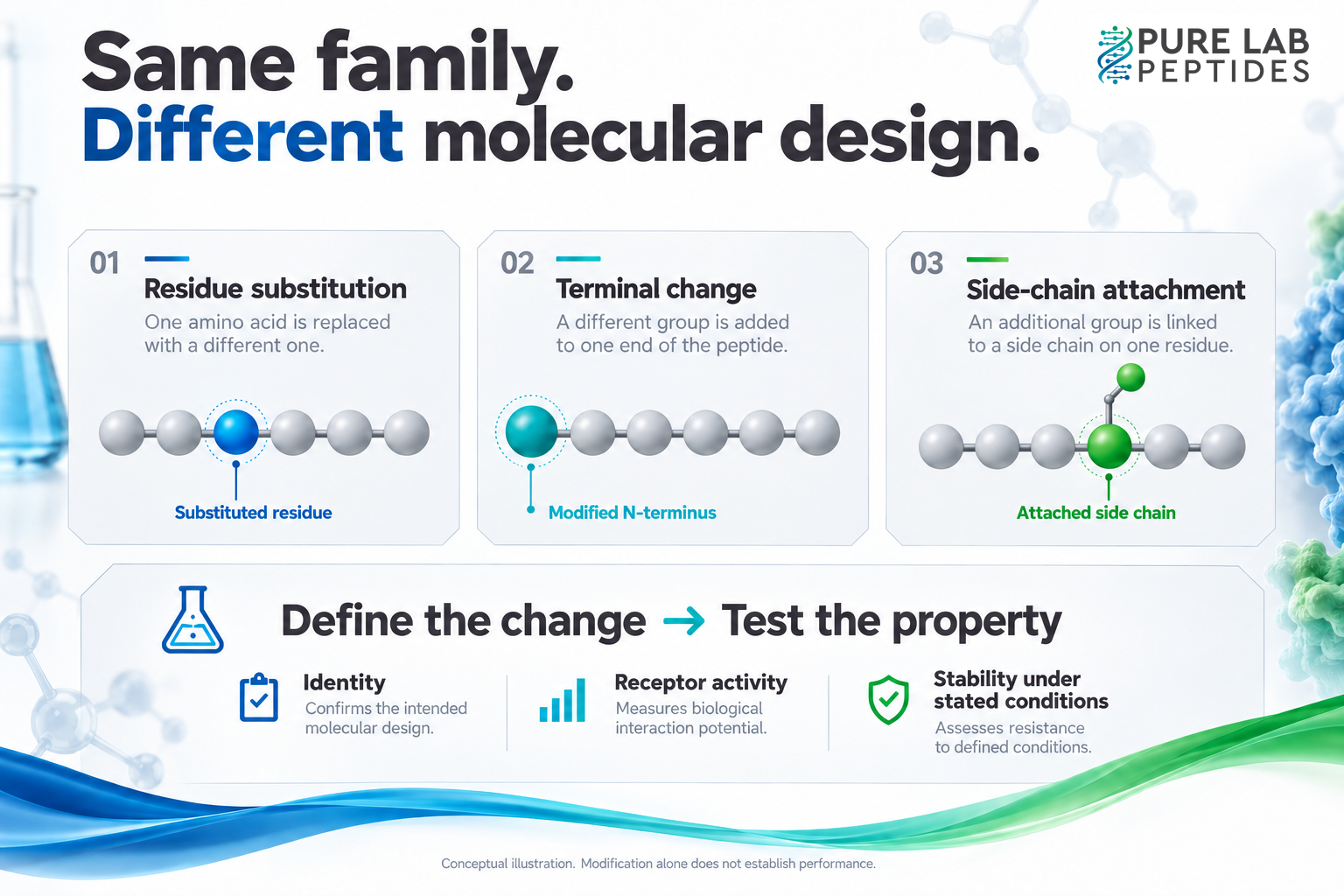
The diagram groups common descriptions into three visible changes. Its shapes are abstract symbols, not actual chemical structures. Backbone engineering needs its own notation too; a sequence-letter list may not show the whole chemical difference. Our sequence notation guide is a useful starting point for reading those records.
| Description | What to identify | What still needs evidence |
|---|---|---|
| Residue substitution | Position, replacement residue and stereochemistry | Whether the substitution changes the measured response. |
| Terminal modification | Which end and its exact chemical group | Its effect under the tested conditions. |
| Side-chain attachment | Attachment site, attached group and linkage | Any claimed change in behavior or stability. |
| Backbone modification | The altered backbone unit or bond | Whether the new design preserves the relevant activity. |
Where does a fragment fit?
Quick takeaway: Shortening and modifying are different descriptions. A material can involve both.
A fragment identifies a stretch of a parent; an analog identifies a chemical change relative to a reference. A shortened, substituted peptide can be both. Record both features instead of assuming either label tells you the whole structure.
Ask which residues remain and which chemistry changed. Those answers resolve the material question more usefully than debating a broad label.
A modification can help one design and hurt another
Quick takeaway: A design rationale is a hypothesis. The assay tells you whether that design worked for the measured property.
Johnson and colleagues’ 2014 GLP-1 study makes this distinction concrete. They examined analogues with selected alpha-amino-acid backbone units replaced by beta units. One design had greatly reduced potency at the tested GLP-1 receptor system. A design using constrained beta residues restored activity. The chemical strategy mattered, but so did the particular implementation. See the original JACS study.
A stability claim needs its modification, stability test and activity measurement. Experimental proteolytic degradation and persistence in a person are different questions. Neither “modified” nor a design rationale bridges them.
For receptor findings specifically, our GLP-1 receptor research guide covers the wider literature. This article is about interpreting the analog’s change, not repeating a treatment guide.
Keep the property beside the result
Quick takeaway: Identity, binding and biological response are separate measurements. “Improved” needs a named endpoint.
Even within one research project, different tests can answer different questions. Tangri and colleagues studied modified peptide epitopes using HLA binding and T-cell responses. Their original epitope-analog study is a reminder to keep the binding result and the cellular response distinct.
Compare a synthetic peptide with its reference under matched conditions and a named endpoint. Altered receptor activation doesn’t establish every downstream response; a stability result isn’t a potency result. A family name also doesn’t establish identical chemistry.
A test report therefore needs to be read for the claim it supports. Our purity and identity guide explains why a clean analytical result and a functional result shouldn’t be treated as the same evidence.
A five-field record for the next paper
Quick takeaway: Save the reference, change, material, test and outcome. That makes the comparison repeatable without overloading the prose.
Keep the reference, alteration, tested material, assay conditions and comparative result in your record. For complicated changes, retain the authors’ notation rather than reducing it to a nickname.
The ProForma 2.0 specification provides a standard way to describe modified peptide sequences, including end groups and ambiguous assignments. You don’t have to master the syntax to spot missing information. If the alteration can’t be located or the endpoint isn’t named, those are the next details to find.