

GLP-1 Receptor Agonism: How to Read Activity Data

TL;DR · The short version
GLP-1 receptor agonism requires activation of GLP-1R in a stated system. Binding isn’t enough. Keep the pathway, concentration-response result, reference ligand and conditions together when interpreting potency or bias.
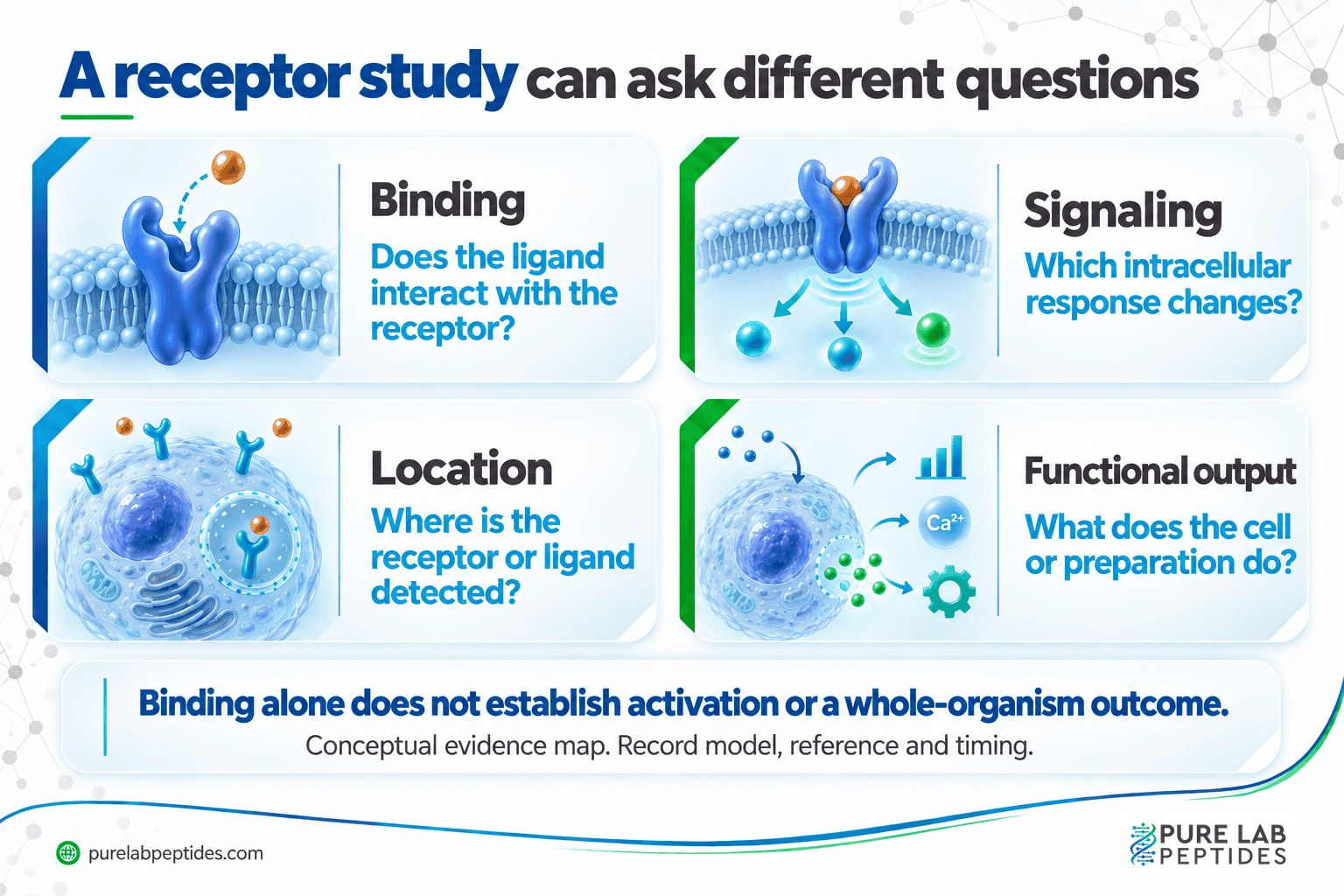
Two peptides can interact with a receptor while one activates it and the other blocks activation. Reading only affinity would miss the distinction the functional experiment tests.
For GLP-1 receptor agonism, find the response and reference behind the label. Affinity, potency, maximum response and pathway preference are distinct measurements, so compare them in separate entries.
GLP-1 stands for glucagon-like peptide-1. Its receptor is a cell-surface protein; a GLP-1 receptor agonist is a molecule that activates that receptor. In the original human-receptor experiments, activation was detected through increased production of the intracellular messenger cAMP. That gives the term a measurable meaning rather than treating it as a general description of metabolic effects.
GLP-1 receptor binding does not establish activation
TL;DR: A ligand can bind GLP-1R without acting as an agonist; the functional experiment makes the distinction.
A 1993 human receptor study compared exendin-4 with exendin-(9–39). Both interacted with GLP-1R, while their functional roles differed: agonist and antagonist. This is a direct experimental example of why receptor affinity alone does not establish agonism.
An antagonist can help investigate a mechanism precisely because it doesn’t reproduce the agonist’s response. Describing both binding ligands as activating would erase that experimental distinction.
Potency and maximum response answer different questions
TL;DR: Potency and maximum response describe different features of a concentration-response relationship.
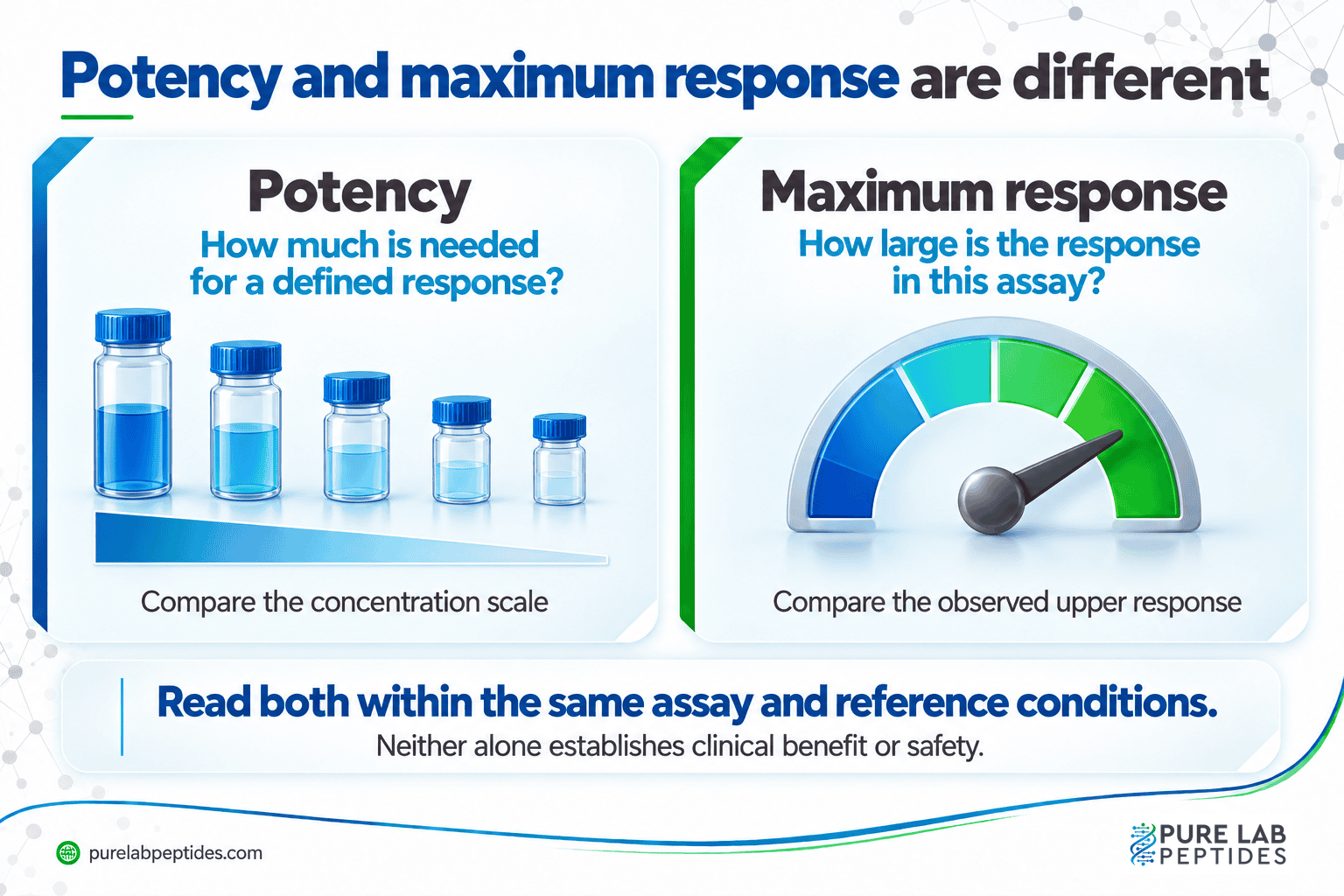
Potency describes concentration for a defined response. Maximum response describes its measured extent. A compound may differ in one without differing similarly in the other.
Keep expression, amplification, exposure time and reference with the numbers. Removing those fields makes the table shorter but can remove the basis for comparison too.
GLP-1 receptor signaling has more than one readout
TL;DR: cAMP, calcium and trafficking are distinct readouts; compare pathways within a suitable framework.
Human GLP-1R expression experiments measured both cAMP and intracellular calcium responses. Later pharmacology also examines recruitment of signaling partners and receptor trafficking. These measurements describe different parts of receptor behavior.
Bias compares pathways relative to a reference. A larger numerical axis in one graph doesn’t establish it. Use the analytical framework and comparable reference conditions behind the claim.
A concrete example of signaling bias
TL;DR: The reported tirzepatide bias profile belongs to the tested systems and does not establish a universal advantage.
In tirzepatide experiments, investigators reported a GLP-1R profile favoring cAMP relative to beta-arrestin recruitment compared with GLP-1. That finding belongs to the tested ligand and experimental systems. It does not establish that bias is always beneficial or that every dual agonist shares the same profile.
Compare four measures of receptor activity
TL;DR: Keep receptor species, expression, reference, pathway and time beside the numerical result.
| Parameter | Record from the assay | Interpretation |
|---|---|---|
| Affinity or binding result | Binding method and reference ligand | Interaction with the receptor, not necessarily activation. |
| Potency | Concentration-response measure and measured pathway | Where the response occurs on that assay’s concentration scale. |
| Maximum response | Observed upper response relative to the reference | The response extent, not its duration. |
| Pathway preference | Comparable pathway assays and reference conditions | A basis for examining bias rather than comparing unrelated axis values. |
Receptor species, expression system and timing help explain apparent disagreements. The in vitro and in vivo comparison shows why the experimental setting remains part of the result.
If two apparent potencies came from different expression levels or incubation times, selecting the lower number won’t settle the difference. Align the methods and reference responses or retain separate findings.
For the broader distinction between a mechanism and an outcome, see mechanism of action vs efficacy. The dual-incretin guide adds the separate problem of comparing activity across two receptors.