
Third-Party Peptide Testing Explained for Labs
Third-Party Peptide Testing Explained starts with a practical procurement question: what does an external lab report actually verify for a research peptide lot? In an RUO setting, third-party testing generally means an independent laboratory outside the original manufacturing workflow examines a sample with fit-for-purpose analytical methods and issues reportable results tied to that measured item. For qualified researchers and laboratory buyers, the value is analytical clarity around identity, purity, content, and documentation quality rather than marketing language alone. [1][2][3]
Fast Answer
Third-party peptide testing is external analytical verification of a peptide sample by a laboratory that is separate from the supplier’s production process. A strong third-party package links each result to a specific lot or sample ID, uses methods appropriate to the attribute being measured, and preserves the underlying evidence needed to interpret the result. Products discussed in this article are intended for laboratory research use only and are not intended for human or animal consumption. [1][2][3][4][5]
What Third-Party Peptide Testing Actually Means
At its core, third-party testing is about independence and laboratory competence. ISO defines certification as written assurance by an independent body, and ISO/IEC 17025 is the principal international standard used to assess the competence, impartiality, and consistent operation of testing laboratories. In peptide sourcing, that means the analytical work is performed outside the supplier’s original manufacturing workflow rather than being only an internal quality summary. [1][2]
That independence matters, but it is not enough by itself. A credible third-party result still depends on whether the laboratory used a method suited to the question being asked, whether performance expectations were clear, and whether the report preserves enough detail to interpret the measurement. ICH Q2(R2) frames validation around demonstrating that a procedure is fit for its intended purpose, especially for attributes such as identity, purity, impurities, and assay. FDA guidance on laboratory data integrity and out-of-specification investigations likewise emphasizes complete data retention, including chromatograms, spectra, calculations, instrument outputs, and scientifically sound review of unexpected results. [3][5][6]
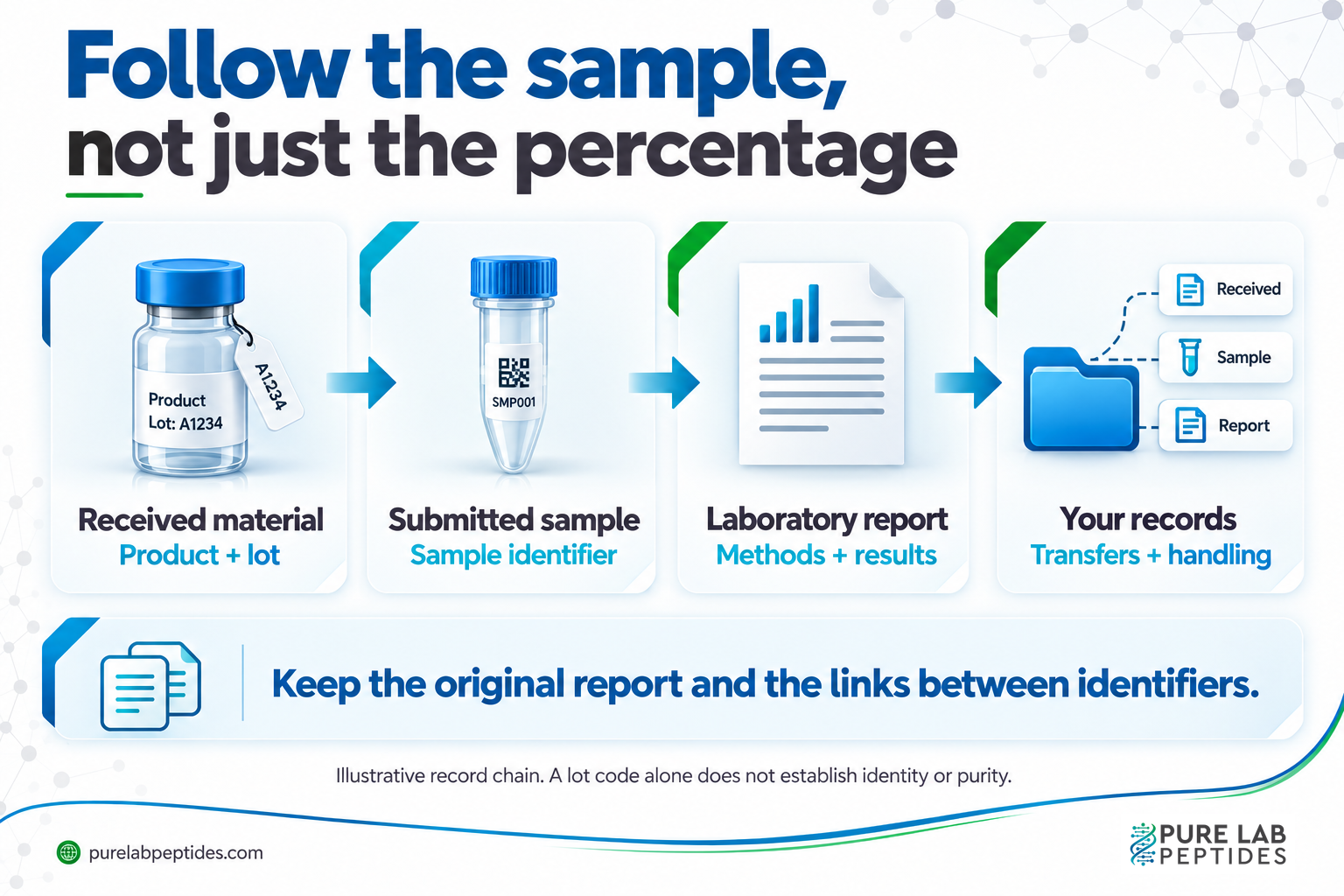
The most overlooked limitation is sampling scope. Under ISO/IEC 17025 reporting principles, results relate to the measured item, and the report should clearly identify the sample, method, relevant dates, and authorized signatory. In practical RUO procurement terms, a clean third-party result is strongest when the tested sample can be traced to the same lot, labeling, and packaging context that the research team is actually evaluating. [4][5]
Which Analytical Questions Independent Labs Answer
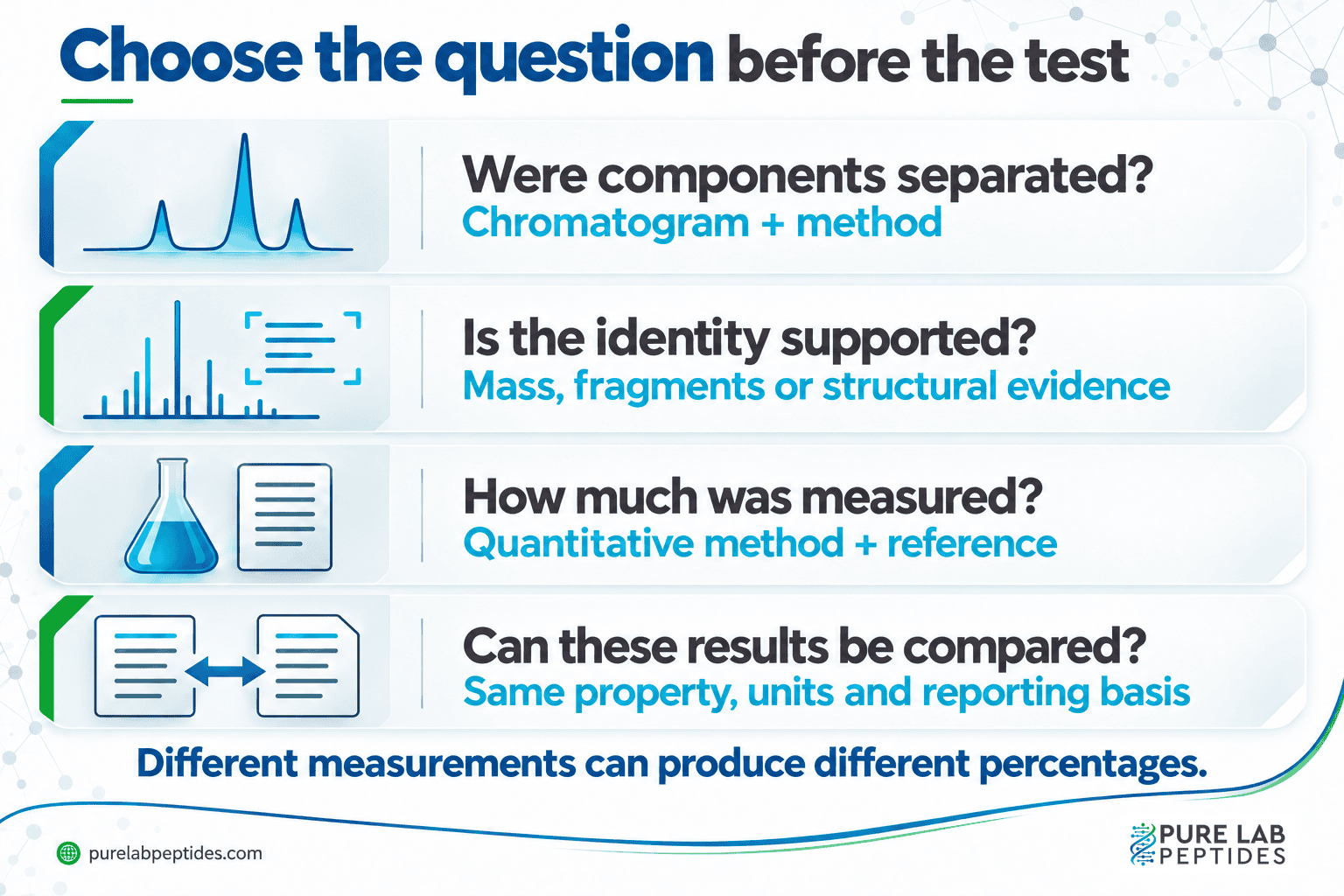
Independent peptide testing is useful because different methods answer different analytical questions. A chromatogram can estimate chromatographic purity, a mass spectrum can support identity confirmation and impurity mapping, and amino acid analysis can support absolute content estimation. Counter-ion, moisture, and stereochemical questions often require additional orthogonal methods rather than a single headline percentage on a certificate. [7][8][9][10][11]
| Analytical question | Common method | What the result can show | Main limitation |
| How many peptide-related species are resolved under one separation? | RP-HPLC or UHPLC [7] | Main peak area and visible impurity profile for that specific chromatographic setup [11] | Peak-area purity is method-dependent and can miss coeluting or unresolved species [8] |
| Does the measured mass align with the expected peptide? | LC-MS, HRMS, or MS/MS [8] | Expected molecular mass and, in stronger workflows, structural clues for impurities [12] | Identity support is strong, but some structural isomers or stereochemical changes may still require specialized methods [15] |
| How much actual peptide is present in the lyophilized material? | Quantitative amino acid analysis or mass-balance approaches [9][10] | Absolute or near-absolute peptide content rather than only chromatographic purity [11] | Content and purity are different measurements and should not be treated as interchangeable [11] |
| What peptide-related impurities may arise from synthesis and processing? | Orthogonal chromatography with MS-based characterization [12] | Deletion sequences, truncations, oxidized or deamidated forms, aggregates, and other related impurities [12] | The impurity profile can be chemistry-specific and may need more than one method to characterize confidently [16] |
| Which salt form or counter-ion is present? | Ion chromatography, capillary methods, or related ion analysis [13][14] | Acetate, trifluoroacetate, chloride, and related counter-ion composition [14] | Counter-ion data are often omitted from simplified certificates even when analytically relevant [13] |
| Is stereochemical purity being checked? | Direct chiral LC-MS or specialized chiral methods [15] | Presence or absence of D/L stereochemical impurities in susceptible sequences [15] | A standard non-chiral purity chromatogram usually does not answer this question [15] |
For many short synthetic peptides, a practical baseline is orthogonal identity plus chromatographic purity plus some form of content assessment. More complex or longer peptides may justify broader characterization, because FDA’s 2021 synthetic peptide guidance for regulated products highlights the importance of orthogonal methods for impurity profiles and, where relevant, secondary structure or aggregation-related attributes. That guidance was written for approved synthetic peptide products rather than RUO catalog materials, but it remains analytically useful as a benchmark for what “characterized” can mean in peptide science. [11][16]
This workflow is an editorial synthesis of common independent peptide testing steps and is not a direct reproduction of a single published standard.
Seen this way, third-party testing is not one test. It is a structured analytical package in which methods are selected according to the property being questioned, then reported in a way that allows another laboratory or procurement reviewer to understand exactly what was measured and how. [3][4]
How Core Peptide Test Methods Work
RP-HPLC and UHPLC
Reversed-phase HPLC is one of the main workhorse techniques in peptide analysis because it separates peptide species according to how they interact with the chromatographic stationary phase under a changing mobile-phase gradient. In third-party reports, the output is often summarized as a main-peak purity figure, but the fuller analytical value lies in the entire chromatogram, integration method, wavelength choice, and the lab’s ability to separate closely related impurities rather than just report a single percentage. [7][17]
LC-MS and HRMS
Mass spectrometry complements chromatography by testing whether the detected mass aligns with the expected peptide and by helping characterize impurity peaks that appear near the main component. In stronger workflows, LC-MS or HRMS is used not only for mass confirmation but also for mapping structurally related impurities and assessing where a simple UV chromatogram may be ambiguous. Published reviews of synthetic peptide characterization note that LC-MS is especially valuable when peptide-related impurities must be identified rather than merely counted. [8][17][18]
Amino Acid Analysis and Quantitative Content
Amino acid analysis matters because chromatographic purity and actual peptide content are not the same thing. A lyophilized vial can contain the target peptide plus water, counter-ions, residual solvents, or other non-peptide components. AAA approaches the question differently by hydrolyzing the peptide and quantifying amino acid composition, making it useful for absolute content or value assignment. That is why peptide reference-standard work often relies on mass-balance and amino acid analysis rather than a purity trace alone. [9][10][11]
Counter-Ions, Moisture, and Other Optional Tests
Optional tests often become important when a research team needs a more complete compositional picture of a peptide lot. Counter-ion analysis can distinguish acetate, trifluoroacetate, chloride, or related forms, and published reviews note that counter-ions materially affect peptide composition and documentation. Moisture and other process-related residues can also affect mass balance and labeled content. For high-scrutiny work, stereochemical purity may need its own dedicated method because a standard non-chiral chromatogram does not usually exclude D-amino-acid related impurities. [13][14][15][16]
How to Audit a Third-Party Peptide Report
The most reliable way to read a third-party peptide report is to start with document architecture before interpreting the purity number. ISO/IEC 17025 reporting guidance and FDA data-integrity guidance both point toward the same principle: if the sample identity, method, raw evidence, calculation path, and authorization trail are weak, the summary result is weak too. [4][5][6]
- Confirm the sample identity fields. A defensible report should show a unique lot or sample identifier, a clear description of the material, relevant dates, and the issuing laboratory’s identifying information. If those fields do not align with the supplier’s lot-level documentation, the report is not yet analytically anchored. [4]
- Check whether the method is named, not implied. “Purity 99%” is incomplete without a method designation. A useful report states whether the result came from RP-HPLC, UHPLC, LC-MS, AAA, ion chromatography, or another procedure, because different methods answer different questions. [3][4]
- Separate specification from measured result. Strong reports show the actual result and its unit, not only a pass-fail summary. This matters because comparison against a limit without the underlying number obscures how close the result sits to the acceptance criterion. [3][4]
- Ask for raw evidence when the project is high-stakes. FDA guidance repeatedly treats chromatograms, spectra, worksheets, and calculation pathways as part of the complete analytical record, not optional decoration. For procurement review, that means the summary table should be expandable into underlying evidence when required by a laboratory quality system. [5][6]
- Check who authorized the report and when. ISO-oriented reporting guidance expects report authorization and identifiable issue dates. A certificate without clear authorization is harder to audit, especially if multiple versions circulate. [4]
- Remember that the result applies to the measured sample. The formal wording in ISO-style result reporting is important: results relate to the measured item. That is why retained-sample provenance, sampling plan, and lot traceability still matter even after a third-party test is complete. [4]
When an internal supplier COA and an independent report appear to disagree, the next step is usually not to jump straight to misconduct. More often, the discrepancy arises from differences in sample provenance, chromatographic conditions, integration rules, or the presence of impurities that one method resolves better than another. FDA guidance recommends raw-data review, calculation review, and verification of standards and instrument performance before interpretation. Published peptide quality case studies show why that discipline matters. [6][19][20]
What Third-Party Testing Can and Cannot Prove
Third-party testing can materially improve confidence in a peptide sample, but it cannot turn a single purity percentage into complete characterization. ICH Q2(R2), peptide reference-standard work, and modern LC-MS reviews all point in the same direction: analytical strength comes from matching the method to the attribute and combining orthogonal evidence when the chemistry or research context demands it. [3][11][18]
What it can support with high value
A well-designed independent testing package can support lot-level identity confirmation, estimate chromatographic purity, characterize certain peptide-related impurities, distinguish content from purity, and document optional attributes such as counter-ion composition when analytically relevant. For many RUO procurement decisions, that is exactly the information needed to compare lots, vendors, or documentation standards under a laboratory’s internal acceptance criteria. [7][8][9][11][13]
What it cannot prove by itself
A headline HPLC purity value does not prove full identity, full impurity resolution, or absence of stereochemical variants. Published case studies in synthetic peptide quality control found substantial discrepancies between supplier certificates and independent quality-control results, including examples in which the major detected compound differed from the intended structure or where the majority of samples failed the claimed quality threshold. Those findings are exactly why orthogonal testing and raw-data review matter. [19][20]
Third-party testing also does not automatically answer long-sequence or conformational questions. Published literature on chemically synthesized long peptides notes that sequences in the roughly 20 to 100 amino acid range are often undercharacterized with respect to folding and three-dimensional structure. Regulatory peptide guidance for approved products similarly points beyond sequence alone to physicochemical properties, aggregation states, and related higher-order attributes when complexity increases. In other words, the more complex the peptide, the less persuasive a one-line purity statement becomes. [21][16]
Finally, even rigorous third-party results remain sample-specific. ISO-oriented reporting makes this explicit, and that principle is critical in RUO procurement: a result belongs to the measured item, under the documented method, on the documented date. It does not erase the need for lot-level traceability, version control, or consistent sampling practices within a research purchasing workflow. [4]
FAQs
Is third-party testing the same as a COA?
No. A COA is the document package that summarizes specifications and results, while third-party testing is the external analytical work performed by a laboratory outside the supplier’s production workflow. A COA can be internal, external, or mixed, so the report should be checked for laboratory identity, method details, lot or sample ID, and authorization before treating it as independent evidence. [1][2][4]
Does a 99% HPLC purity result confirm that a peptide is correct?
No. A 99% HPLC purity result usually means the main chromatographic peak represented about 99% of the detected peak area under one method, not that every structural question has been closed. Identity still benefits from LC-MS, and unresolved impurities, coelutions, or stereochemical variants may require additional orthogonal methods beyond a single non-chiral HPLC run. [7][8][15][18]
Why do some peptide reports list acetate, TFA, chloride, water, or related values?
Those values appear because peptide lots are often more than just the target sequence in isolation. Counter-ions, residual moisture, and other non-peptide components can contribute to the final lyophilized mass, which is why content and purity are separate analytical concepts. Reviews and analytical studies show that counter-ion composition and mass-balance considerations can materially affect how a peptide lot is interpreted. [11][13][14]
What should a research buyer request beyond the summary table?
A research buyer should request the method ID, sample or lot identifier, relevant dates, actual measured results with units, report authorization, and raw chromatograms or spectra when the project requires closer review. NIST’s ISO/IEC 17025 reporting crosswalk and FDA guidance both support the idea that summary outputs are only part of the record; the underlying analytical evidence matters for interpretation. [4][5][6]
Can third-party testing eliminate all sourcing risk for RUO peptides?
No. Third-party testing reduces uncertainty, but it does not eliminate every sourcing variable. Results remain specific to the measured sample, methods have known blind spots, and more complex peptides may require added work on impurities, stereochemistry, aggregation, or higher-order structure. The strongest procurement decisions therefore combine independent testing with lot traceability and disciplined documentation review. [4][16][21]
Next Steps
Review batch-specific documentation before selecting any research-use-only peptide. Explore Pure Lab Peptides, browse the RUO catalog, and use the resource center to compare lot-level labeling and documentation against the analytical principles summarized above.
References
- International Organization for Standardization. “Certification.” ISO. Accessed 2026. https://www.iso.org/certification.html
- International Organization for Standardization. “ISO/IEC 17025:2017 General requirements for the competence of testing and calibration laboratories.” ISO. 2017, confirmed 2023. https://www.iso.org/standard/66912.html
- International Council for Harmonisation. “Q2(R2) Validation of Analytical Procedures.” ICH Guideline. 2023. https://database.ich.org/sites/default/files/ICH_Q2%28R2%29_Guideline_2023_1130.pdf
- NIST Weights and Measures. “ISO\IEC 17025 Crosswalk – Reporting the Results.” National Institute of Standards and Technology. 2018. https://www.nist.gov/document/7-8-17025-crosswalk-reporting-results-20180201pdf
- U.S. Food and Drug Administration. “Data Integrity and Compliance With Drug CGMP: Questions and Answers.” Guidance for Industry. 2018. https://www.fda.gov/media/119267/download
- U.S. Food and Drug Administration. “Investigating Out-of-Specification (OOS) Test Results for Pharmaceutical Production.” Guidance for Industry. 2022. https://www.fda.gov/media/158416/download
- Mant CT, Chen Y, Yan Z, et al. “HPLC analysis and purification of peptides.” Methods in Molecular Biology. 2007. https://doi.org/10.1007/978-1-59745-430-8_1
- Prabhala BK, Mirza O, Hojrup P, Hansen PR. “Characterization of Synthetic Peptides by Mass Spectrometry.” Methods in Molecular Biology. 2015. https://doi.org/10.1007/978-1-4939-2999-3_9
- Rutherfurd SM, Dunn BM. “Quantitative amino acid analysis.” Current Protocols in Protein Science. 2011. https://doi.org/10.1002/0471140864.ps0302s63
- Hojrup P. “Analysis of Peptides and Conjugates by Amino Acid Analysis.” Methods in Molecular Biology. 2015. https://doi.org/10.1007/978-1-4939-2999-3_8
- McCarthy D, Han Y, Carrick K, et al. “Reference Standards to Support Quality of Synthetic Peptide Therapeutics.” Pharmaceutical Research. 2023. https://doi.org/10.1007/s11095-023-03493-1
- D’Hondt M, Bracke N, Taevernier L, et al. “Related impurities in peptide medicines.” Journal of Pharmaceutical and Biomedical Analysis. 2014. https://doi.org/10.1016/j.jpba.2014.06.012
- Sikora K, Jaskiewicz M, Neubauer D, et al. “The Role of Counter-Ions in Peptides-An Overview.” Pharmaceuticals. 2020. https://doi.org/10.3390/ph13120442
- Mrozik W, Markowska A, Guzik L, Kraska B, Kamysz W. “Determination of counter-ions in synthetic peptides by ion chromatography, capillary isotachophoresis and capillary electrophoresis.” Journal of Peptide Science. 2012. https://doi.org/10.1002/psc.1436
- Badgujar D, et al. “Enantiomeric purity of synthetic therapeutic peptides: A review.” Chirality. 2024. https://doi.org/10.1002/chir.23652
- U.S. Food and Drug Administration. “ANDAs for Certain Highly Purified Synthetic Peptide Drug Products That Refer to Listed Drugs of rDNA Origin.” Guidance for Industry. 2021. https://www.fda.gov/media/107622/download
- Zeng K, Geerlof-Vidavisky I, Gucinski A, Jiang X, Boyne MT 2nd. “Liquid Chromatography-High Resolution Mass Spectrometry for Peptide Drug Quality Control.” AAPS Journal. 2015. https://doi.org/10.1208/s12248-015-9730-z
- Lian Z, Wang N, Tian Y, Huang L. “Characterization of Synthetic Peptide Therapeutics Using Liquid Chromatography-Mass Spectrometry: Challenges, Solutions, Pitfalls, and Future Perspectives.” Journal of the American Society for Mass Spectrometry. 2021. https://doi.org/10.1021/jasms.0c00479
- De Spiegeleer B, Vergote V, Pezeshki A, et al. “Impurity profiling quality control testing of synthetic peptides using liquid chromatography-photodiode array-fluorescence and liquid chromatography-electrospray ionization-mass spectrometry: The obestatin case.” Analytical Biochemistry. 2008. https://doi.org/10.1016/j.ab.2008.02.014
- Verbeke F, Wynendaele E, Braet S, D’Hondt M, De Spiegeleer B. “Quality evaluation of synthetic quorum sensing peptides used in R&D.” Journal of Pharmaceutical Analysis. 2015. https://doi.org/10.1016/j.jpha.2014.12.002
- Boutin JA, et al. “General lack of structural characterization of chemically synthesized long peptides.” Protein Science. 2019. https://doi.org/10.1002/pro.3601