

...
Analytical Methods

GLP-1 vs GIP vs Glucagon Pathway Research Guide

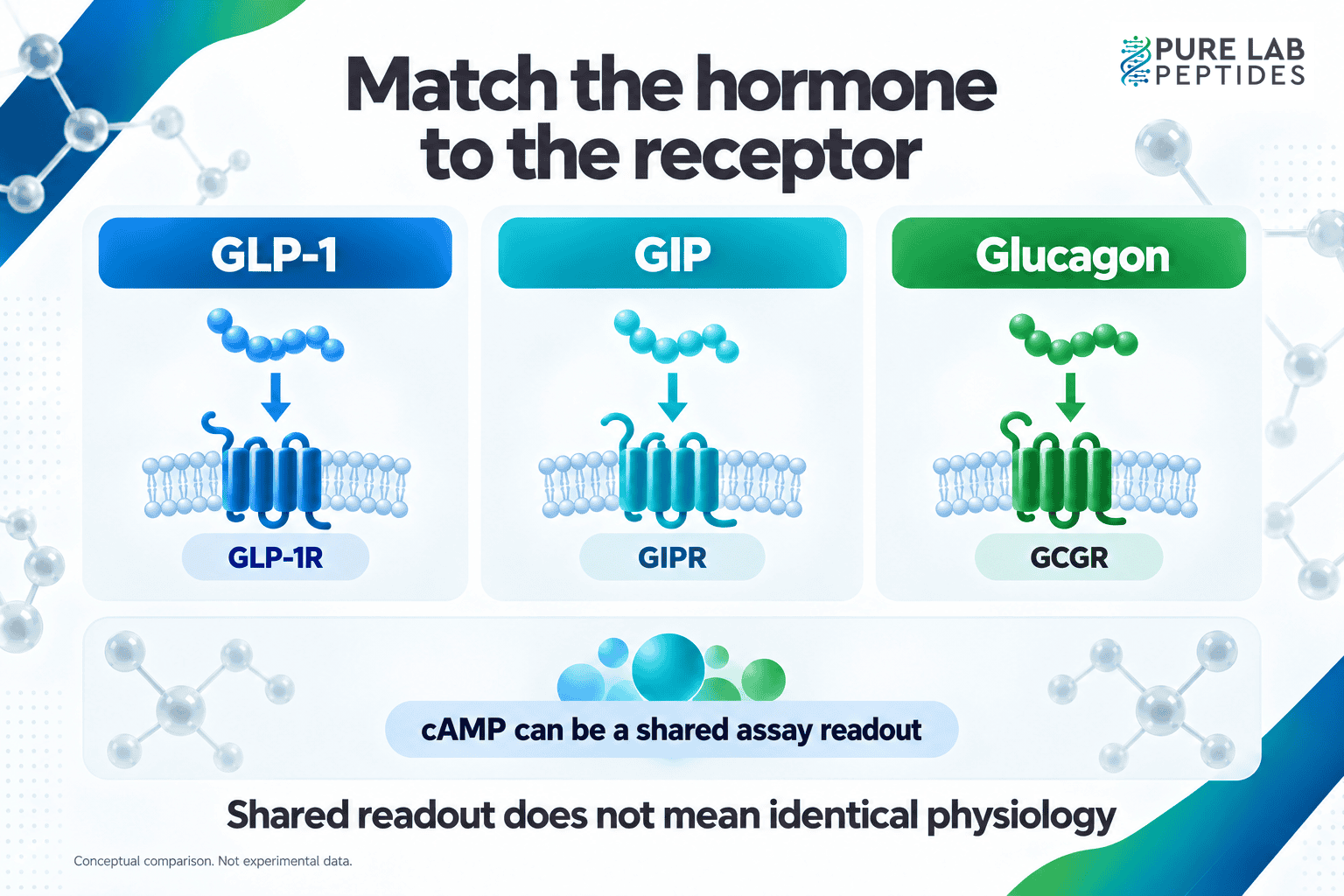
GLP-1 vs GIP vs Glucagon Pathway Research compares three related peptide hormone systems within one receptor superfamily, but the comparison only becomes useful when it is framed around receptor pharmacology, assay context, and analytical documentation. GLP-1 and GIP define the canonical incretin axis, while glucagon anchors a more liver-weighted counter-regulatory axis, yet all three converge on class B1 G protein-coupled receptor signaling questions that matter in laboratory research.[1][2][3]

Fast Answer

GLP-1, GIP, and glucagon pathway research compares three class B1 GPCR signaling systems whose shared cAMP-first pharmacology masks important differences in peptide origin, tissue emphasis, receptor trafficking, and downstream pathway interpretation. Products discussed in this article are intended for laboratory research use only and are not intended for human or animal consumption. In practice, GLP-1 and GIP studies usually center on incretin biology, while glucagon studies more often prioritize hepatic signaling and counter-regulatory pathway mapping.[1][2][3]

What each pathway represents in laboratory research

The first thing to clarify is that this is not a comparison of three unrelated peptides. GLP-1 and glucagon are both derived from proglucagon, but tissue-specific processing generates different peptide outputs in different endocrine settings, while GIP is a separate incretin peptide produced by enteroendocrine K cells. That shared lineage for GLP-1 and glucagon, combined with the parallel incretin role of GIP, is why these pathways are often studied together in receptor and ligand research.[1][4]

The second clarification is that the comparison spans different biological frames. GLP-1 and GIP are usually studied in meal-linked incretin settings, whereas glucagon research often begins with fasting hepatocyte signaling and then extends into broader amino acid and metabolic network questions. That difference changes experimental design, including cell model selection, glucose conditions, assay timing, and the choice between secretion-focused, trafficking-focused, or transcription-focused endpoints.[1][5][6]

Pathway Peptide origin Primary receptor focus Common laboratory readouts Main interpretation caution
GLP-1 Proglucagon-derived signal, generally associated with intestinal L-cell processing in nutrient-responsive incretin biology.[1][4] GLP1R, a class B1 GPCR commonly profiled for Gs-cAMP signaling plus follow-up trafficking and scaffolded signaling studies.[3] cAMP accumulation, secretion-coupled signaling assays, receptor trafficking studies, and downstream signaling follow-up.[3] Strong proximal signaling does not automatically establish equivalence across every downstream assay layer.[3]
GIP Classical incretin peptide secreted from enteroendocrine K cells.[1] GIPR, another class B1 GPCR in the same glucagon receptor family.[3] cAMP-centered incretin assays, glucose-context studies, and receptor selectivity comparisons against GLP1R and GCGR panels.[1][5] Results can shift with glucose conditions and cell background, so direct one-to-one comparison with GLP-1 requires matched assay settings.[5]
Glucagon Pancreatic alpha-cell proglucagon product, generated through a distinct processing route from intestinal GLP-1.[2][4] GCGR, a class B1 GPCR with a strong hepatic emphasis in pathway literature and tissue-mapping studies.[2][6][7] Hepatocyte cAMP/PKA/CREB signaling, glycogenolytic and amino acid flux readouts, and transcriptional pathway mapping.[2][6] Liver-weighted expression can dominate the dataset, so extrahepatic generalization should be made cautiously.[6][7]

The practical takeaway from the table is that “GLP-1 vs GIP vs glucagon” is not just a ligand ranking exercise. It is a comparison of precursor biology, receptor distribution, and endpoint selection. A peptide can look similar at the family level but still produce materially different datasets once the experiment is anchored to a specific receptor, a specific cell background, and a specific output layer.[1][2][3][4]

Where the pathways overlap and where they diverge

The central overlap is receptor class and proximal coupling. GLP1R, GIPR, and GCGR are class B1 GPCRs, and they are commonly introduced as Gs-linked receptors that elevate intracellular cAMP. The central divergence is that this common upstream architecture does not guarantee identical signal duration, scaffold use, receptor trafficking, or downstream transcriptional behavior after ligand binding. Comparative pharmacology studies on the glucagon receptor family repeatedly show that pathway identity becomes clearer, not less important, as the assay panel expands beyond a single cAMP measurement.[3][8]

GLP-1 and GIP sit closest together in incretin research, but published literature does not treat them as interchangeable. Reviews of incretin physiology describe both as glucose-dependent insulinotropic signals, yet they also note that GLP-1 tends to suppress glucagon secretion whereas GIP can raise glucagon secretion in a glucose-dependent manner. More recent beta-cell work adds a signaling explanation by showing that GLP1R and GIPR can recruit beta-arrestin 2 into distinct functional programs rather than a single shared incretin pathway.[1][5][9]

Glucagon research diverges even more strongly because the pathway is usually interpreted through liver-weighted biology. Classic tissue-mapping work found the highest glucagon receptor mRNA abundance in liver, and newer reviews extend glucagon pathway questions into amino acid metabolism, hepatocyte transcriptional control, and broader metabolic regulation beyond simple glucose mobilization. As a result, a GCGR dataset is often asking a different biological question from a matched GLP1R or GIPR dataset even before ligand bias enters the picture.[2][6][7]

The editorial map below summarizes how researchers commonly move from endogenous peptide origin to receptor-level readouts and then to multi-receptor design questions when comparing these pathways.[3][6][8][9]

flowchart LR A[Enteroendocrine nutrient signaling] --> B[GLP-1 pathway research] A --> C[GIP pathway research] D[Pancreatic alpha-cell signaling] --> E[Glucagon pathway research] B --> F[GLP1R: cAMP, trafficking, beta-arrestin] C --> G[GIPR: cAMP, glucose-context signaling, actin remodeling] E --> H[GCGR: hepatic cAMP, PKA, CREB, amino acid flux] F --> I[Comparative receptor profiling] G --> I H --> I I --> J[Dual and tri-agonist design questions]

Diagram note: This is an editorial synthesis of commonly studied pathway relationships and is not a quantitative map of pathway flux.

Why this comparison matters in modern peptide pathway research

Modern interest in GLP-1, GIP, and glucagon comparison did not emerge from physiology alone. It expanded rapidly when peptide design moved from single-receptor ligands toward intentional multi-receptor pharmacology. Reviews of dual and triple incretin-based agonism describe the GLP1R-GIPR-GCGR axis as a tunable design space in which relative potency, efficacy, receptor occupancy, and tissue weighting can be redistributed rather than assumed to be fixed.[10][11][3]

This shift matters for laboratory research because closely related peptides can display deliberately imbalanced profiles. Campbell and colleagues describe the chemical and physiological logic behind dual GIPR/GLP1R agonism, while Gutgesell and coauthors place dual and triple agonists within the broader incretin family landscape. In both cases, the relevant research question is not whether pathways overlap, because they clearly do, but how much overlap can be engineered without collapsing receptor selectivity into a single indistinct signal.[10][11]

Mechanistic papers make that point even more clearly. Willard and colleagues showed that tirzepatide behaves as an imbalanced and biased dual GIP and GLP-1 receptor agonist, while structural studies from Zhao and Sun clarified how residue-level interaction patterns change receptor engagement across GLP1R, GIPR, and GCGR family members. Those papers helped establish that sequence similarity is only the beginning of the analysis; receptor-specific binding geometry and downstream coupling determine how a peptide is ultimately classified in pathway research.[12][13][14]

For research teams, the implication is straightforward. A peptide cannot be labeled “GLP-1-like,” “GIP-like,” or “glucagon-like” on sequence resemblance alone. It has to be profiled against each receptor under matched conditions, because family-level resemblance often conceals exactly the sort of partial agonism, signaling imbalance, and receptor bias that make glucagon-family peptide research scientifically interesting.[3][10][11][12][13][14]

How researchers evaluate GLP-1, GIP, and glucagon pathways

In laboratory practice, comparison usually begins with receptor-matched cAMP testing and then moves into orthogonal assays. Published pharmacology studies on mono-, dual-, and tri-agonists evaluate cAMP accumulation, beta-arrestin recruitment, ERK activation, and related pathway outputs because one potency value rarely captures the full signaling profile of a glucagon-family peptide. The more closely related the ligands are, the more important it becomes to compare them across the same receptor panel instead of across separate studies with different assay architectures.[15][16]

Assay layer What it clarifies Why it matters in comparison work
cAMP accumulation Initial receptor activation and relative potency across matched GLP1R, GIPR, and GCGR panels.[15][16] Useful as a first screen, but incomplete if pathway identity is inferred from it alone.[8][16]
beta-arrestin and trafficking Signal duration, desensitization tendency, scaffold use, and receptor internalization patterns.[8][9][12] Explains why ligands with similar cAMP output can diverge in downstream behavior.[8][9]
ERK, CREB, and transcriptional follow-up Whether proximal receptor activation propagates into pathway-specific cellular outputs.[8][9][6] Important when comparing incretin-focused cell systems with liver-weighted glucagon programs.[6]
Material identity and purity review Whether observed differences may reflect peptide composition rather than receptor pharmacology.[17][18] Adds analytical confidence when ranking closely related peptides or comparing lots.[17][18]

Two papers are especially useful when interpreting the table. Jones and colleagues showed that reduced beta-arrestin recruitment can prolong cAMP signaling across glucagon family receptors, while Zaïmia and colleagues demonstrated that GLP-1R and GIPR can route beta-arrestin 2 into distinct functional programs in pancreatic beta cells. Together, they explain why assay layering is essential in GLP-1 vs GIP vs glucagon pathway research.[8][9]

Documentation should also be treated as part of the experiment, not as a separate purchasing formality. If a project compares closely related pathway-active peptides, lot-level identity and purity records help distinguish receptor pharmacology from sample heterogeneity. Analytical guidance such as ICH Q2(R2) defines the core validation language for specificity, accuracy, precision, and range of analytical procedures, while LC-MS reviews on synthetic peptide characterization explain why impurity profiling matters when interpreting comparative peptide datasets.[17][18]

From an RUO sourcing perspective, that means a batch-specific certificate of analysis is most useful when it can be connected back to an identity method, a purity method, and a clearly described analytical framework. In pathway comparison work, especially where ligands differ only subtly, missing analytical detail can create interpretive noise that looks like biology but may instead reflect composition.[17][18]

Common interpretation errors in comparative pathway work

First, do not equate cAMP potency with full pathway identity. Glucagon-family ligands can separate across beta-arrestin recruitment, receptor internalization, and downstream signaling even when proximal activation looks similar. Comparative studies on dual and tri-agonists repeatedly show that pathway ranking changes once the assay panel broadens beyond one readout.[8][12][15][16]

Second, do not infer selectivity from sequence alone. Multi-receptor design literature and structural studies show that small residue changes can redistribute signaling across GLP1R, GIPR, and GCGR. Family resemblance is therefore a reason to measure cross-reactivity explicitly, not a reason to assume selective behavior from sequence homology alone.[3][10][11][13][14]

Third, keep tissue context in view. A glucagon-dominant hepatocyte dataset answers a different question from an incretin-focused beta-cell dataset, and GIP-versus-GLP-1 effects can shift with glucose conditions and cellular background. Comparative interpretation is strongest when receptor expression context, glucose conditions, and endpoint timing are matched as closely as possible.[5][6][7][9]

Fourth, review documentation before comparing conclusions. When two lots look different in pathway assays, the cause may be pharmacology, composition, or both. Batch-specific certificate of analysis review, alongside identity and purity methods, is therefore part of sound RUO interpretation rather than a separate administrative step.[17][18]

FAQs

What is the core difference between GLP-1, GIP, and glucagon pathway research?

The core difference between GLP-1, GIP, and glucagon pathway research is the biological frame of the experiment. GLP-1 and GIP usually anchor incretin-focused signaling questions, whereas glucagon studies more often emphasize liver-weighted and counter-regulatory biology. The three still belong to one receptor family, so comparison requires matched receptor and assay context rather than sequence comparison alone.[1][2][3][4]

Why is glucagon included in incretin-related comparisons?

Glucagon is included in incretin-related comparisons because GCGR sits in the same class B1 receptor family as GLP1R and GIPR, and modern ligand-design literature treats the three receptors as a connected pharmacology space. In comparative pathway research, glucagon adds the liver-weighted dimension that distinguishes family overlap from true pathway equivalence.[2][3][10][11][13]

Do GLP-1 and GIP trigger the same downstream signals?

GLP-1 and GIP do not trigger the same downstream signals in a simple one-to-one way. Both are commonly profiled through cAMP-centered incretin signaling, but published work shows differences in glucagon regulation, beta-arrestin 2 dependence, and downstream cellular programs. That is why matched assay architecture matters in GLP1R versus GIPR pathway comparisons.[5][8][9]

Which assays are most useful for GLP-1 vs GIP vs glucagon pathway research?

The most useful assays for GLP-1 vs GIP vs glucagon pathway research usually begin with receptor-matched cAMP measurements and then expand into beta-arrestin, trafficking, ERK or CREB follow-up, and tissue-relevant functional readouts. If material quality is part of the question, identity and purity documentation should also be reviewed because analytical uncertainty can distort pathway interpretation.[15][16][6][17][18]

What documentation should a laboratory review before comparing pathway-active peptides?

The documentation a laboratory should review before comparing pathway-active peptides includes lot identity data, purity results, impurity-related analytical detail, and a batch-specific certificate of analysis that maps back to described methods. LC-MS and chromatographic characterization are especially useful when closely related peptides are being compared across receptor panels.[17][18]

Next Steps

Review batch-specific documentation before selecting any research-use-only peptide. Explore Pure Lab Peptides for RUO peptide compounds with clear labeling, research-focused product information, and available documentation. For research teams comparing peptide suppliers, prioritize COA availability, transparent labeling, and lot-level documentation.

References

  1. Baggio LL, Drucker DJ. “Biology of incretins: GLP-1 and GIP.” Gastroenterology. 2007. https://doi.org/10.1053/j.gastro.2007.03.054
  2. Capozzi ME, D’Alessio DA, Campbell JE. “The past, present, and future physiology and pharmacology of glucagon.” Cell Metabolism. 2022. https://doi.org/10.1016/j.cmet.2022.10.001
  3. Sangwung P, Ho JD, Siddall T, et al. “Class B1 GPCRs: insights into multireceptor pharmacology for the treatment of metabolic disease.” American Journal of Physiology-Endocrinology and Metabolism. 2024. https://doi.org/10.1152/ajpendo.00371.2023
  4. Lafferty RA, O’Harte FPM, Irwin N, Gault VA, Flatt PR. “Proglucagon-Derived Peptides as Therapeutics.” Frontiers in Endocrinology. 2021. https://doi.org/10.3389/fendo.2021.689678
  5. Nauck MA, Quast DR, Wefers J, Pfeiffer AFH. “The evolving story of incretins (GIP and GLP-1) in metabolic and cardiovascular disease: A pathophysiological update.” Diabetes, Obesity and Metabolism. 2021. https://doi.org/10.1111/dom.14496
  6. Kajani S, Laker RC, Ratkova E, Will S, Rhodes CJ. “Hepatic glucagon action: beyond glucose mobilization.” Physiological Reviews. 2024. https://doi.org/10.1152/physrev.00028.2023
  7. Hansen LH, Abrahamsen N, Nishimura E. “Glucagon receptor mRNA distribution in rat tissues.” Peptides. 1995. https://doi.org/10.1016/0196-9781(95)00078-X
  8. Jones B, McGlone ER, Fang Z, et al. “Genetic and biased agonist-mediated reductions in beta-arrestin recruitment prolong cAMP signaling at glucagon family receptors.” Journal of Biological Chemistry. 2021. https://doi.org/10.1074/jbc.RA120.016334
  9. Zaïmia N, Obeid J, Varrault A, et al. “GLP-1 and GIP receptors signal through distinct beta-arrestin 2-dependent pathways to regulate pancreatic beta cell function.” Cell Reports. 2023. https://doi.org/10.1016/j.celrep.2023.113326
  10. Campbell JE, Muller TD, Finan B, DiMarchi RD, Tschop MH, D’Alessio DA. “GIPR/GLP-1R dual agonist therapies for diabetes and weight loss-chemistry, physiology, and clinical applications.” Cell Metabolism. 2023. https://doi.org/10.1016/j.cmet.2023.07.010
  11. Gutgesell RM, Nogueiras R, Tschop MH, Muller TD. “Dual and Triple Incretin-Based Co-agonists: Novel Therapeutics for Obesity and Diabetes.” Diabetes Therapy. 2024. https://doi.org/10.1007/s13300-024-01566-x
  12. Willard FS, Douros JD, Gabe MBN, et al. “Tirzepatide is an imbalanced and biased dual GIP and GLP-1 receptor agonist.” JCI Insight. 2020. https://doi.org/10.1172/jci.insight.140532
  13. Zhao F, Zhou Q, Cong Z, et al. “Structural insights into multiplexed pharmacological actions of tirzepatide and peptide 20 at the GIP, GLP-1 or glucagon receptors.” Nature Communications. 2022. https://doi.org/10.1038/s41467-022-28683-0
  14. Sun B, Willard FS, Feng D, et al. “Structural determinants of dual incretin receptor agonism by tirzepatide.” Proceedings of the National Academy of Sciences of the United States of America. 2022. https://doi.org/10.1073/pnas.2116506119
  15. Yuliantie E, Darbalaei S, Dai A, et al. “Pharmacological characterization of mono-, dual- and tri-peptidic agonists at GIP and GLP-1 receptors.” Biochemical Pharmacology. 2020. https://doi.org/10.1016/j.bcp.2020.114001
  16. Darbalaei S, Yuliantie E, Dai A, et al. “Evaluation of biased agonism mediated by dual agonists of the GLP-1 and glucagon receptors.” Biochemical Pharmacology. 2020. https://doi.org/10.1016/j.bcp.2020.114150
  17. International Council for Harmonisation. “Validation of Analytical Procedures Q2(R2).” ICH Guideline. 2023. https://database.ich.org/sites/default/files/ICH_Q2%28R2%29_Guideline_2023_1130.pdf
  18. Lian Z, Wang N, Tian Y, Huang L. “Characterization of Synthetic Peptide Therapeutics Using Liquid Chromatography-Mass Spectrometry: Challenges, Solutions, Pitfalls, and Future Perspectives.” Journal of the American Society for Mass Spectrometry. 2021. https://doi.org/10.1021/jasms.0c00479
Pure Lab Peptides Logo with Black Letters