

Copper Peptides in Laboratory Research Guide
Copper Peptides in Laboratory Research most often refers to copper-coordinated peptide systems built around glycyl-L-histidyl-L-lysine, or GHK, and its copper complex Cu-GHK/GHK-Cu. In the published literature, researchers treat the free tripeptide and the copper complex as distinct analytes with different coordination and transport behavior, not as interchangeable labels. This overview is written as research-use-only educational content focused on chemistry, assay context, and documentation review. [1][2][3][4][5]
Fast Answer
Copper peptides in laboratory research are best understood as metal-peptide systems whose experimental behavior depends on sequence, copper-binding geometry, and assay conditions, with GHK-Cu as the best-known example. Products discussed in this article are intended for laboratory research use only and are not intended for human or animal consumption. The strongest literature base covers solution structure, redox behavior, fibroblast culture findings, and analytical stability rather than a single uniform mechanism. [5][6][7][8][9]
What copper peptides usually mean in research
For most research readers, “copper peptide” points first to GHK-Cu: the copper complex of the tripeptide GHK. That distinction matters immediately at the documentation level, because PubChem lists GHK and Cu-GHK as separate compound records with different molecular formulas, even though they are chemically related. A supplier, purchasing team, or lab notebook that labels both materials only as “copper peptide” can therefore blur an important analytical difference before any assay begins. [1][2]
The early literature established why this pairing became scientifically interesting. Pickart and colleagues reported in 1980 that the plasma tripeptide readily formed complexes with copper(II) and facilitated copper uptake into cultured cells. Lau and Sarkar then showed that GHK could compete with albumin for Cu(II) at physiological pH conditions, reinforcing the idea that GHK is not merely a short peptide sequence, but a copper-binding ligand with specific chemical behavior in solution. [3][4]
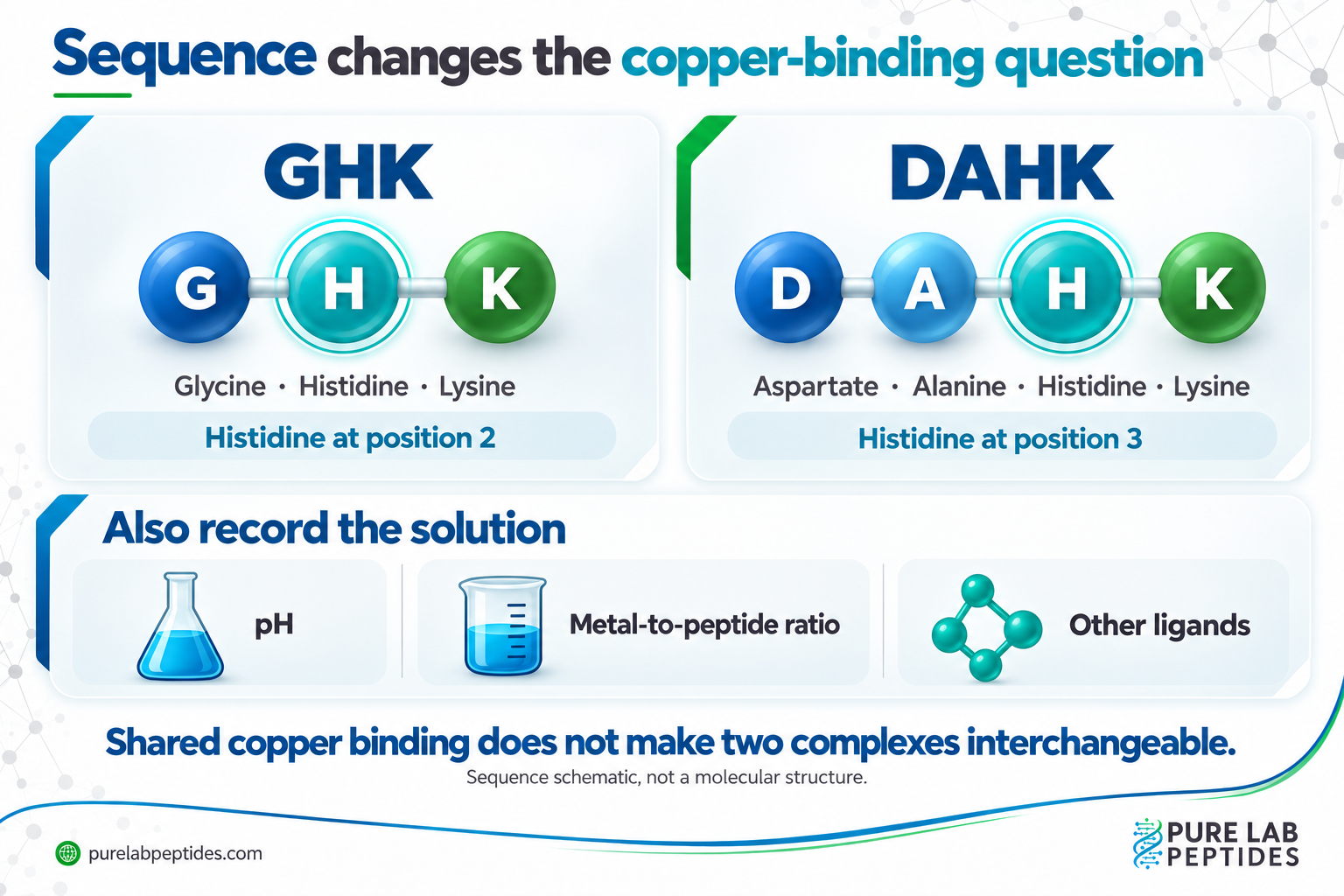
At the same time, “copper peptides” is broader than one molecule. Structural and analytical reviews show that peptide-copper systems behave differently when the sequence changes, especially when the free N terminus, amide nitrogens, and histidine placement change the coordination environment. In other words, GHK-Cu should not be treated as interchangeable with other copper-binding motifs such as ATCUN peptides, nor with simple copper salts used as comparator controls. The sequence defines the complex; the complex defines much of the assay behavior. [6][10]
Why copper coordination changes the readout
Copper coordination changes more than a label. Lau and Sarkar described GHK as a ligand that interacts meaningfully with Cu(II) in solution, while Freedman and colleagues later characterized the structure of the GHK-copper(II) complex in solution. Those studies are important because they frame Cu-GHK as a defined coordination complex rather than as a casual mixture of peptide plus metal added to the same vial. [4][5]
That distinction becomes even more important when redox chemistry enters the experiment. Hureau and colleagues compared Cu(II)GHK with Cu(II)DAHK and showed that these complexes differ in structure and redox properties. The broader peptide-copper literature likewise notes that histidine position and coordination mode can alter binding affinity, redox potential, catalytic behavior, and signal output in analytical systems. For laboratory design, that means “same copper concentration” does not imply “same chemical environment” or “same biological readout.” [6][10]
Recent in vitro work adds another layer. Min and colleagues reported that free GHK reduced copper redox activity and altered copper- and zinc-driven protein aggregation and cell-death readouts in vitro. Whether a study starts from free GHK, precomplexed Cu-GHK, or a separate copper salt can therefore change the speciation landscape of the medium itself, which is one reason experimental methods need to describe the analyte precisely. [11]
Illustrative analytical logic for copper peptide batch review
Caption: This Mermaid flowchart is an editorial synthesis of a common research workflow for copper peptide review and does not reproduce a single published protocol.
Where published laboratory work concentrates
The copper peptide literature is not evenly distributed across all possible research settings. It clusters around a few recurring areas: coordination chemistry, extracellular matrix and fibroblast models, aggregation and redox studies, and engineered analytical systems such as biosensors. That concentration is useful for search intent because it tells qualified readers where the evidence is strongest and where extrapolation becomes less secure. [3][4][5][7][8][11][10]
| Research context | What researchers examine | Representative literature signal | Key boundary |
| Coordination chemistry | Cu(II) binding, ligand competition, solution geometry, redox profile | GHK forms a defined copper complex, and later structural work showed that related peptide-copper systems can differ significantly in redox behavior. [3][4][5][6] | Results depend strongly on pH, competing ligands, and whether the analyte is free peptide or precomplexed metal-peptide. |
| Fibroblast and matrix-associated models | Collagen-related output, matrix metalloproteinases, remodeling-associated signals | Published fibroblast studies reported increased collagen synthesis and modulation of MMP-2 and TIMP secretion under specific culture conditions. [7][8] | These are model-specific findings and not a universal rule for every cell system, matrix, or medium composition. |
| Aggregation and redox assays | Copper-driven aggregation, protein solubility, oxidative behavior in vitro | Recent in vitro work found that GHK altered copper redox activity and changed copper- and zinc-induced aggregation outcomes. [11] | Findings are highly context-dependent and tied to the chosen aggregation model and metal conditions. |
| Engineered analytical systems | Biosensors, colorimetric readouts, electrochemical and fluorescent designs | Review literature shows peptide-copper coordination has also been developed as a functional design element in biosensing platforms. [10] | This work broadens the category beyond GHK-Cu, so not every peptide-copper paper maps to the same sourcing question. |
| Stability and formulation-oriented characterization | Hydrophilicity, degradants, stress behavior, method suitability | GHK-Cu has been described as highly hydrophilic and susceptible to basic and oxidative degradation under stress, with HPLC-MS used to identify major degradants. [9] | Analytical findings are method- and matrix-dependent, so one stability report does not replace lot-specific QC. |
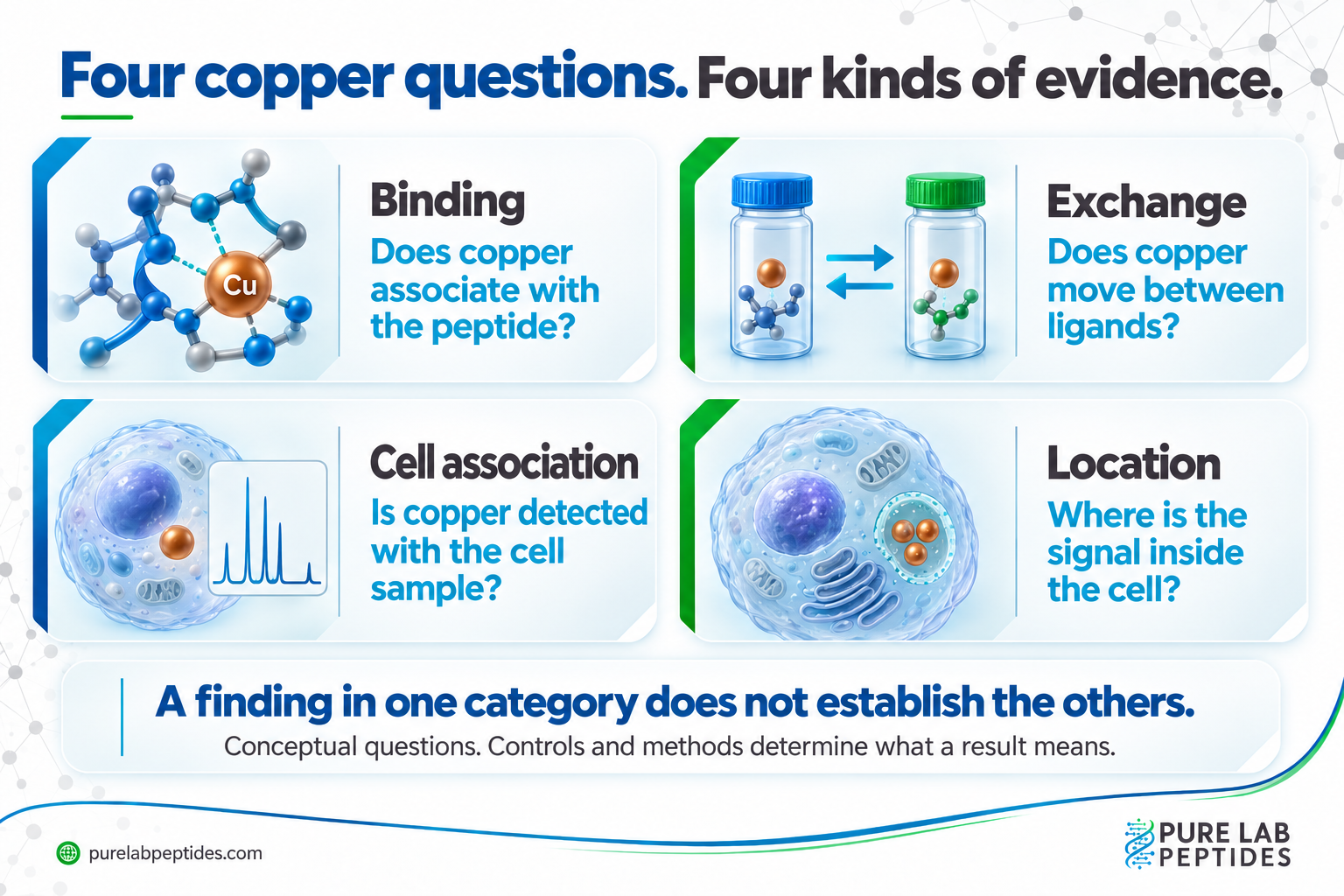
The practical takeaway is that there is no single catch-all “copper peptide effect.” Published findings vary by ligand state, copper source, medium composition, cell model, and analytical method. For qualified researchers, that means the most defensible interpretation is narrow: identify the exact copper peptide species under study, then interpret its data only within the assay conditions that generated it. [7][8][9][11]
How copper peptides are characterized analytically
For batch review, the first analytical distinction is identity versus purity. HPLC is a core peptide tool for separation and purity assessment, while mass spectrometry is particularly useful for confirming peptide authenticity and integrity. ICH Q2(R2) and Q14 frame the broader principle: analytical procedures should be fit for intended purpose, supported by appropriate performance characteristics, and grounded in documented reference materials and development knowledge. That logic applies directly when a research team is deciding whether a copper peptide COA is informative enough for laboratory work. [12][13][14][15]
For copper peptides specifically, purity alone is incomplete. A chromatographic purity value can indicate how dominant the principal peak is under stated conditions, but it does not by itself confirm the copper coordination state, oxidation state, or whether the analyte is free GHK versus precomplexed Cu-GHK. Badenhorst and colleagues also reported that GHK-Cu is strongly hydrophilic and shows stress-dependent degradation behavior, which means method selection and storage- or matrix-related interpretation need real analytical context rather than a headline percentage alone. [9][12][13]
Official peptide-drug guidance is not the same thing as RUO supplier regulation, but it is still a useful analytical benchmark. FDA’s synthetic peptide guidance recommends sensitive, high-resolution procedures such as UHPLC-HRMS for impurity characterization and describes identification of peptide-related impurities at 0.10% of drug substance or greater in the covered context. The LC-HRMS literature cited by FDA likewise shows why orthogonal testing is valuable when closely related peptide impurities may co-travel or be missed by a single readout. Research buyers do not need to collapse RUO materials into a pharmaceutical framework, but they can still borrow the analytical discipline. [16][17]
What researchers should review before sourcing a copper peptide
A copper peptide COA is most useful when it answers five practical questions at once: what exact analyte was tested, which lot was tested, how identity was confirmed, how purity was measured, and whether copper coordination was directly demonstrated or only assumed. For copper peptide research, naming precision is the starting point because the free ligand and the copper complex are not the same record, not the same formula, and not necessarily the same assay input. [1][2][12][13][14][15]
- Exact analyte name: A useful COA should distinguish GHK from Cu-GHK rather than collapsing both into a generic “copper peptide” label. [1][2]
- Lot number and test date: Documentation should be traceable to the specific batch under review, not to a generic method sheet. [14][15]
- Identity evidence: Intact-mass confirmation and, where relevant, sequence-consistent MS data are more informative than a product name alone. [13]
- Purity method context: A percent purity value is most meaningful when paired with the chromatographic method and chromatogram used to generate it. [12][14]
- Copper-state documentation: If the material is sold as a precomplexed copper peptide, the record should clarify whether the copper-bound state was actually verified or simply inferred from synthesis. [9][13]
- RUO positioning: Labeling and documentation should remain consistent with research-use-only handling and evaluation. [16]
This level of review matters because peptide QC literature has shown that closely related impurities can alter experimental interpretation in research settings. Verbeke and colleagues, studying synthetic peptides used in R&D, reported that inherent synthesis-related impurities may mask biomedical experimental results. For copper peptide work, that warning is especially relevant because both peptide impurities and metal speciation can shift assay behavior. A supplier headline such as “high purity” is therefore only the beginning of the review, not the end of it. [18][16][17]
FAQs
What is the main copper peptide discussed in laboratory literature?
The main copper peptide discussed in laboratory literature is usually GHK-Cu, the copper(II) complex of glycyl-L-histidyl-L-lysine. Broader copper-binding peptide systems also exist in metallopeptide chemistry and biosensor design, but most research-intent searches for “copper peptides” map to the GHK/Cu-GHK pair rather than to every copper-coordinating peptide motif in the literature. [1][2][3][10]
Are GHK and GHK-Cu the same material?
GHK and GHK-Cu are related but not identical materials. GHK is the free tripeptide ligand, while GHK-Cu or Cu-GHK refers to the copper-coordinated complex. Because the free peptide and the metal complex differ in formula, speciation, and potentially in assay behavior, they should be listed, stored in records, and interpreted as distinct analytes during laboratory review. [1][2][4][5]
Does HPLC purity alone confirm a copper peptide batch?
No, HPLC purity alone does not fully confirm a copper peptide batch. HPLC can show the dominance of the principal chromatographic peak under stated conditions, but identity, integrity, and copper coordination status generally require orthogonal evidence such as mass spectrometry and method-appropriate validation logic. That is why strong batch review separates identity testing from purity testing instead of treating them as the same question. [12][13][14][15]
Why does copper coordination matter in assay design?
Copper coordination matters in assay design because the peptide sequence and the resulting metal-binding geometry influence structure, competition with other ligands, and redox behavior. Published studies show that Cu-GHK does not behave like every other copper-binding peptide, and neither copper peptides nor copper salts should be assumed to generate identical chemical environments in medium or buffer. [4][5][6][11]
What should a copper peptide COA include?
A copper peptide COA is most informative when it includes the exact analyte name, lot identifier, test date, identity data, purity method details, and any direct evidence supporting the copper-bound state if the batch is sold as a precomplexed copper peptide. Research teams also benefit from actual chromatograms or spectra rather than summary percentages alone, because impurity context can affect interpretation. [14][15][16][17][18]
Are all copper peptides interchangeable in research?
No, all copper peptides are not interchangeable in research. The literature on peptide-copper coordination shows that sequence-level changes, especially around the N terminus and histidine placement, can alter affinity, coordination mode, redox potential, and downstream analytical performance. A research protocol built around GHK-Cu therefore should not automatically be generalized to other copper-binding peptide systems. [6][10]
Next Steps
Review batch-specific documentation before selecting any research-use-only peptide. Explore Pure Lab Peptides for RUO peptide compounds, and prioritize suppliers that present clear labeling, research-focused product information, and lot-level documentation.
References
- National Center for Biotechnology Information. “glycyl-L-histidyl-L-lysine.” PubChem. 2026. https://pubchem.ncbi.nlm.nih.gov/compound/glycyl-L-histidyl-L-lysine
- National Center for Biotechnology Information. “Cu-GHK.” PubChem. 2026. https://pubchem.ncbi.nlm.nih.gov/compound/Cu-GHK
- Pickart L, Freedman JH, Loker WJ, Peisach J, Perkins CM, Stenkamp RE, Weinstein B. “Growth-modulating plasma tripeptide may function by facilitating copper uptake into cells.” Nature. 1980. https://doi.org/10.1038/288715a0
- Lau SJ, Sarkar B. “The interaction of copper(II) and glycyl-L-histidyl-L-lysine, a growth-modulating tripeptide from plasma.” Biochemical Journal. 1981. https://doi.org/10.1042/bj1990649
- Freedman JH, Pickart L, Weinstein B, Mims WB, Peisach J. “Structure of the glycyl-L-histidyl-L-lysine-copper(II) complex in solution.” Biochemistry. 1982. https://doi.org/10.1021/bi00262a004
- Hureau C, Eury H, Guillot R, Bijani C, Sayen S, Solari PL, Guillon E, Faller P, Dorlet P. “X-ray and solution structures of Cu(II) GHK and Cu(II) DAHK complexes: influence on their redox properties.” Chemistry – A European Journal. 2011. https://doi.org/10.1002/chem.201100751
- Maquart FX, Pickart L, Laurent M, Gillery P, Monboisse JC, Borel JP. “Stimulation of collagen synthesis in fibroblast cultures by the tripeptide-copper complex glycyl-L-histidyl-L-lysine-Cu2+.” FEBS Letters. 1988. https://doi.org/10.1016/0014-5793(88)80509-X
- Simeon A, Emonard H, Hornebeck W, Maquart FX. “The tripeptide-copper complex glycyl-L-histidyl-L-lysine-Cu2+ stimulates matrix metalloproteinase-2 expression by fibroblast cultures.” Life Sciences. 2000. https://doi.org/10.1016/S0024-3205(00)00803-1
- Badenhorst T, Svirskis D, Wu Z. “Physicochemical characterization of native glycyl-L-histidyl-L-lysine tripeptide for wound healing and anti-aging: a preformulation study for dermal delivery.” Pharmaceutical Development and Technology. 2016. https://doi.org/10.3109/10837450.2014.979944
- Liu G, Xia N, Tian L, Sun Z, Liu L. “Progress in the Development of Biosensors Based on Peptide-Copper Coordination Interaction.” Biosensors. 2022. https://doi.org/10.3390/bios12100809
- Min JH, Sarlus H, Harris RA. “Glycyl-L-histidyl-L-lysine prevents copper- and zinc-induced protein aggregation and central nervous system cell death in vitro.” Metallomics. 2024. https://doi.org/10.1093/mtomcs/mfae019
- Mant CT, Chen Y, Yan Z, Popa TV, Kovacs JM, Mills JB, Tripet BP, Hodges RS. “HPLC Analysis and Purification of Peptides.” Methods in Molecular Biology. 2007. https://doi.org/10.1007/978-1-59745-430-8_1
- Chrone VG, Lorentzen A, Hojrup P. “Characterization of Synthetic Peptides by Mass Spectrometry.” Methods in Molecular Biology. 2024. https://doi.org/10.1007/978-1-0716-3914-6_7
- International Council for Harmonisation. “ICH Q2(R2) Validation of Analytical Procedures.” ICH Guideline. 2023. https://database.ich.org/sites/default/files/ICH_Q2%28R2%29_Guideline_2023_1130.pdf
- International Council for Harmonisation. “ICH Q14 Analytical Procedure Development.” ICH Guideline. 2023. https://database.ich.org/sites/default/files/ICH_Q14_Guideline_2023_1116.pdf
- U.S. Food and Drug Administration. “Guidance for Industry: Synthetic Peptides.” FDA Guidance Document. 2021. https://www.fda.gov/media/107622/download
- Zeng K, Geerlof-Vidavisky I, Gucinski A, Jiang X, Boyne MT 2nd. “Liquid Chromatography-High Resolution Mass Spectrometry for Peptide Drug Quality Control.” The AAPS Journal. 2015. https://doi.org/10.1208/s12248-015-9730-z
- Verbeke F, Wynendaele E, Braet S, D’Hondt M, De Spiegeleer B. “Quality evaluation of synthetic quorum sensing peptides used in R&D.” Journal of Pharmaceutical Analysis. 2015. https://doi.org/10.1016/j.jpha.2014.12.002