

...
Documentation and Quality

CJC-1295 Research Peptide Overview for RUO Labs

CJC-1295 Research Peptide Overview begins with a naming and classification issue: published literature describes CJC-1295 as a synthetic growth hormone-releasing hormone-derived analog, while later databases and detection papers make clear that DAC-conjugated and non-DAC records should not be treated as interchangeable by default. This article explains the compound, the pathway context, the evidence base, and the documentation standards that matter when reviewing research-use-only material. [1] [2] [3] [4] [5]

Fast Answer

CJC-1295 is a GHRH-derived research peptide term most often associated with a DAC-conjugated analog designed for prolonged signaling exposure, but careful review is essential because some databases and discussions also reference a distinct “without DAC” record. Products discussed in this article are intended for laboratory research use only and are not intended for human or animal consumption. [1] [3] [4] [5]

What CJC-1295 Is

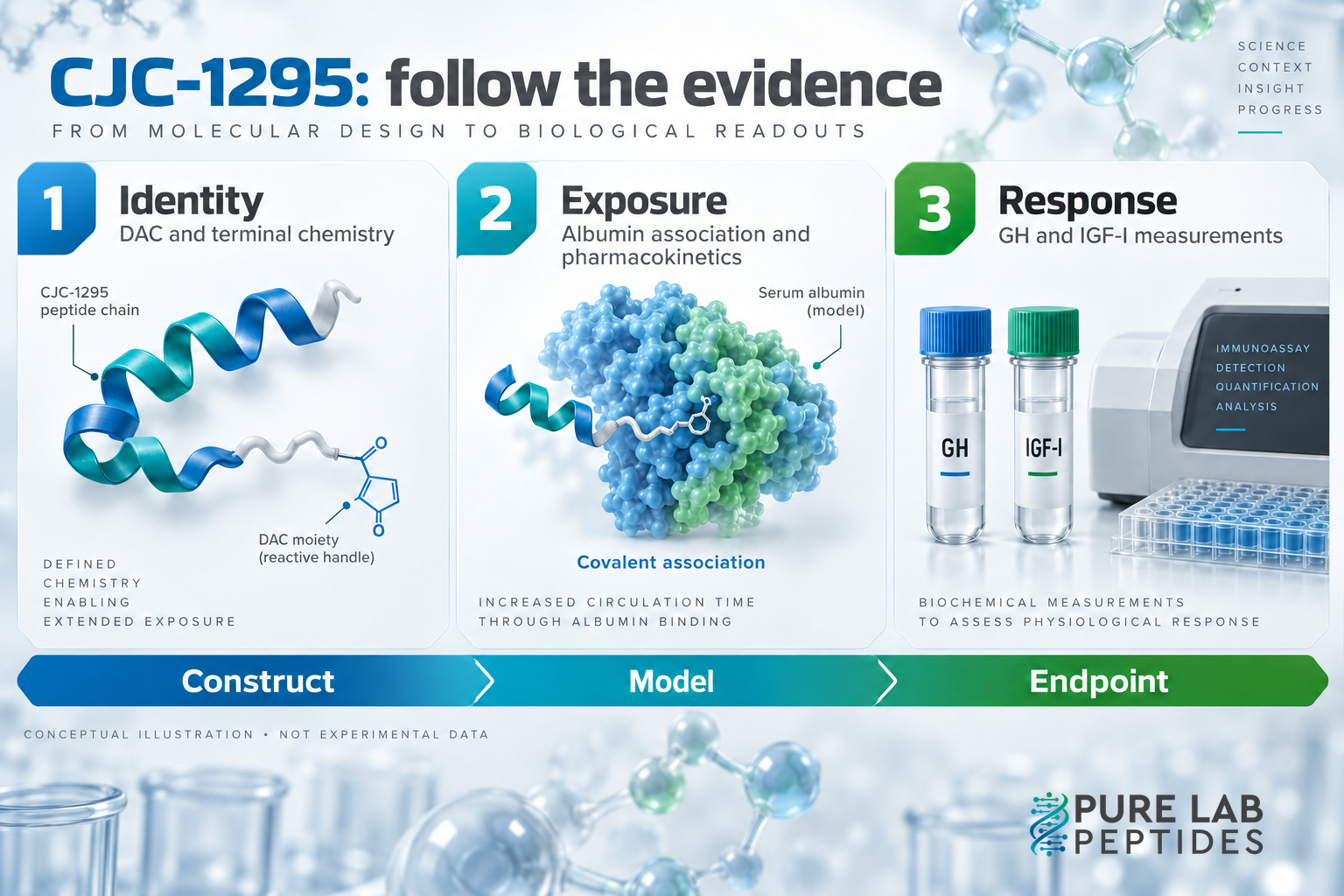
In the foundational development paper, CJC-1295 was identified as a tetrasubstituted hGRF(1-29)-based analog carrying an added C-terminal maleimidopropionamide derivative of lysine. That design was used to enable albumin bioconjugation and extend circulating persistence relative to the parent hGRF(1-29) framework. In the same paper, the authors reported enhanced in vitro stability against dipeptidylpeptidase-IV and continued plasma detectability beyond 72 hours in rat pharmacokinetic evaluation. [1]

Later academic literature commonly described CJC-1295 as a long-acting analog of GH-releasing hormone in controlled endocrine research settings. That framing is important because it tells laboratory readers what the peptide is designed to model: a modified ligand in the GHRH signaling space, not a generic “growth peptide” label detached from receptor biology. [2]

For research procurement and literature review, the most practical point is that the name is not always used with perfect precision. PubChem maintains separate compound summaries for “Cjc 1295” and “CJC1295 Without DAC,” which is a strong signal that researchers should verify exactly which molecular form is being referenced in a paper, catalog, or certificate of analysis. [3] [4]

Why the Name Can Be Confusing

The naming issue matters because “CJC-1295” is sometimes used as a broad shorthand even though the scientific and database record is more specific. Detection literature on GHRH synthetic analogs explicitly distinguishes CJC-1295 from CJC-1295 with drug affinity complex, while PubChem separately indexes a no-DAC record. Taken together, those sources indicate that the label alone is not enough for a high-confidence identification decision. [5] [3] [4]

For qualified researchers, this is more than a naming nuance. DAC status changes the structural designation, expected mass, conjugation chemistry, and the analytical control strategy that should accompany the material. A supplier page or COA that omits DAC status leaves an avoidable gap in identity documentation. [1] [5]

Term seen in literature or databases What is being described Why it matters for RUO review Representative sources
CJC-1295 A GHRH-derived analog label that is often used as a primary compound name, but may still require structural clarification in practice. The generic label should be matched to sequence-level or mass-level documentation before interpretation of purity, stability, or literature relevance. [3] [5]
CJC-1295 with DAC The DAC-conjugated form associated with the albumin-binding strategy described in the original development work. Conjugation changes the characterization problem because both the peptide and conjugation-related species may need to be controlled analytically. [1] [3] [5]
CJC1295 Without DAC A separate non-conjugated compound record indexed independently in PubChem. A no-DAC record should not be assumed to be analytically identical to the DAC-conjugated form, even when informal discussions blur the distinction. [4] [5]

Mechanistic Context in GHRH Receptor Research

CJC-1295 belongs in the GHRH receptor research category. Structural work on the human GHRH receptor describes GHRHR as a class B G protein-coupled receptor, and UniProt summarizes the receptor as being coupled to G proteins that activate adenylyl cyclase. That places CJC-1295 research squarely in ligand-receptor interaction, cAMP-linked signaling, and somatotroph-axis biology rather than in broad consumer-style outcome language. [6] [7]

The receptor context also explains why CJC-1295 papers so often discuss GH and IGF-1 as readouts. Those biomarkers appear in the literature because they are downstream endocrine outputs of GHRH receptor signaling, not because they provide a complete description of peptide identity, purity, or fitness for a given laboratory application. Biological readouts and analytical quality readouts answer different questions and should not be conflated. [2] [8] [14]

Early development work reinforces this point. The original CJC-1295 paper used cultured rat anterior pituitary cells and GH secretion assays to test receptor-linked activity, which means the mechanistic foundation is receptor pharmacology and peptide chemistry, followed by downstream biomarker observation. That is the correct frame for an RUO overview. [1]

What Published Literature Actually Shows

The most-cited early paper established CJC-1295 as a modified hGRF(1-29) analog with prolonged persistence and retained bioactivity in receptor-linked testing. That work is especially important because it explains the design logic behind the compound rather than treating the name as a black-box marketing label. [1]

In later adult endocrine literature, CJC-1295 was examined in controlled study settings where investigators measured GH- and IGF-1-related biomarkers over time. Those data are often cited because they suggest sustained pathway engagement, but the proper RUO takeaway is narrow: the papers describe study-specific biomarker behavior under defined research conditions, not a general-purpose shortcut for evaluating present-day batch quality. [2]

A second academic study reported that GH pulsatility persisted during continuous stimulation by CJC-1295, with increased trough and mean GH secretion and increased IGF-1 production in that research context. This is useful for understanding how investigators interpreted prolonged GHRH analog signaling, especially when comparing tonic exposure with pulsatile endocrine readouts. [8]

Additional literature has examined downstream serum-protein profile changes associated with GH/IGF-1-axis activation after CJC-1295 exposure. That adds another layer of published pathway-related observation, but it still does not replace lot-level identity confirmation, impurity review, or stability documentation. Published biological literature and batch release documentation serve different purposes and should be reviewed separately. [9] [14] [15]

How CJC-1295 Materials Are Evaluated Analytically

For synthetic peptides broadly, reversed-phase HPLC remains one of the core tools for separation, analysis, and purification. In practical CJC-1295 review, chromatographic data help characterize peak profile, main-component purity, and potential related-species burden, but HPLC alone does not fully solve identity questions when closely related impurities or variant forms are possible. [10]

Mass spectrometry adds the orthogonal confirmation that peptide buyers and research teams usually need. Reviews of peptide LC-MS and LC-HRMS workflows emphasize their value for confirming molecular identity and for investigating structurally related impurities, including isomers, stereochemical variants, truncations, and degradation products. For a compound family where DAC status changes the chemistry, orthogonal confirmation becomes especially important. [11] [12]

Analytical validation guidance also helps clarify what should appear on documentation. ICH Q2(R2) treats identity, impurity or purity, and assay as distinct measured quality attributes, and it states that suitably characterized reference materials with documented identity and purity should be used in validation studies. Reference standard literature for synthetic peptides similarly discusses analytical testing, lyophilization, and stability studies as part of building reliable peptide standards. [14] [13]

Conjugated peptides add another layer of complexity. EMA’s synthetic peptide guideline notes that conjugation can alter peptide properties, increase characterization and control complexity, and make the amount of free unconjugated peptide and free conjugate moiety additional quality attributes. In the same guidance, EMA also emphasizes justified storage conditions, discussion of degradation pathways, and use of stability-indicating analytical procedures. That framework is highly relevant to DAC-associated CJC-1295 review even when the material is positioned strictly as research-use-only. [15] [16]

What Researchers Should Review Before Sourcing

For CJC-1295, researchers should review the exact structural designation before they look at the purity percentage. If DAC status is unclear, the batch record is incomplete for meaningful comparison with the published literature and with appropriate analytical expectations. [3] [4] [5]

  • Exact name and structural form. Documentation should state whether the material is CJC-1295 with DAC or a separate no-DAC form, rather than relying on shorthand alone. [3] [4] [5]
  • Orthogonal identity evidence. A useful package pairs chromatographic information with mass-based confirmation rather than using a single method as the entire identity case. [10] [11] [14]
  • Purity and impurity context. The main reported purity number should be accompanied by the analytical method and, when available, information about related impurities or unresolved peaks. [12] [14]
  • Batch-specific documentation. Lot number, batch analysis, and method-linked records matter because peptide quality is assessed batch by batch, not by label language alone. [13] [15]
  • Storage and stability statements. Peptide documentation should include justified storage conditions and enough stability information to support the stated handling window or retest logic. [16] [15]
  • Reference-standard awareness. For critical analytical methods, it is helpful to know whether a characterized reference material underpins identity or purity assignments. [13] [14]

The workflow below is an editorial synthesis of common review steps for CJC-1295 documentation rather than a direct figure from a single published source.

flowchart TD A[Start with batch label] --> B{Does the record specify DAC status?} B -- "Yes" --> C[Match the label to the correct literature and database record] B -- "No" --> D[Request structural clarification before comparing results] C --> E[Review orthogonal identity data such as HPLC and mass confirmation] D --> E E --> F[Review purity result and related impurity context] F --> G[Review storage, stability, and lot-level COA details] G --> H[Decide whether the documentation is sufficient for the planned laboratory context]

A final caution is warranted. In a published peptide quality-control study from a different research area, investigators documented meaningful discrepancies between supplier-reported certificates and in-house analysis. That paper was not about CJC-1295 specifically, but it is a useful reminder that COA review is a starting point, not a substitute for critical evaluation. [17]

FAQs

What is CJC-1295 in academic literature?

CJC-1295 in academic literature is generally described as a modified hGRF(1-29)-based analog studied in GHRH receptor research. The literature most often connects the term to a long-acting design strategy, but database records and later detection papers show that readers should still confirm whether the cited material is the DAC-conjugated form or a separate no-DAC record. [1] [3] [4] [5]

Is CJC-1295 the same as CJC-1295 without DAC?

CJC-1295 is not automatically the same as CJC-1295 without DAC. PubChem maintains separate compound records, and analytical-detection literature distinguishes CJC-1295 from CJC-1295 with drug affinity complex as separate analytes in GHRH analog workflows. For RUO review, that means the exact structural form should be named explicitly on the batch documentation. [3] [4] [5]

Why does DAC status matter on a CJC-1295 COA?

DAC status matters on a CJC-1295 COA because the DAC-conjugated form was developed around an albumin-binding strategy, and peptide conjugation changes the characterization problem. EMA’s synthetic peptide guidance notes that conjugated peptides introduce added control complexity, including attention to unconjugated peptide and conjugate-related species, so DAC status is a material part of identity, impurity, and stability review. [1] [15]

Which analytical tests are most informative when evaluating a CJC-1295 batch?

The most informative tests for evaluating a CJC-1295 batch are usually orthogonal identity and purity methods rather than a single headline value. HPLC is central for peptide separation and purity profiling, while LC-MS or LC-HRMS strengthens molecular identity confirmation and impurity investigation. ICH Q2(R2) is useful here because it treats identity, purity, and assay as distinct analytical objectives. [10] [11] [14]

Can a high purity number by itself validate a research peptide?

A high purity number by itself does not validate a research peptide because purity does not fully answer identity, impurity characterization, or stability questions. Peptide impurity literature shows that structurally related variants can complicate interpretation, and published quality-control work has documented mismatches between supplier certificates and independent laboratory findings. For that reason, batch-specific COA review should be broader than a single purity figure. [12] [17]

Next Steps

Review batch-specific documentation before selecting any research-use-only peptide. Explore Pure Lab Peptides for RUO peptide compounds with clear labeling, research-focused product information, and available documentation.

References

  1. Jette L, Leger R, Thibaudeau K, Benquet C, Robitaille M, Pellerin I, Paradis V, van Wyk P, Pham K, Bridon DP. “Human growth hormone-releasing factor (hGRF)1-29-albumin bioconjugates activate the GRF receptor on the anterior pituitary in rats: identification of CJC-1295 as a long-lasting GRF analog.” Endocrinology. 2005. https://doi.org/10.1210/en.2004-1286
  2. Teichman SL, Neale A, Lawrence B, Gagnon C, Castaigne JP, Frohman LA. “Prolonged stimulation of growth hormone (GH) and insulin-like growth factor I secretion by CJC-1295, a long-acting analog of GH-releasing hormone, in healthy adults.” J Clin Endocrinol Metab. 2006. https://doi.org/10.1210/jc.2005-1536
  3. National Center for Biotechnology Information. “Cjc 1295.” PubChem Compound Summary. Accessed 2026. https://pubchem.ncbi.nlm.nih.gov/compound/Cjc-1295
  4. National Center for Biotechnology Information. “CJC1295 Without DAC.” PubChem Compound Summary. Accessed 2026. https://pubchem.ncbi.nlm.nih.gov/compound/CJC1295-Without-DAC
  5. Memdouh S, Gavrilovic I, Ng K, Cowan D, Abbate V. “Advances in the Detection of Growth Hormone Releasing Hormone Synthetic Analogs.” Drug Testing and Analysis. 2021. https://doi.org/10.1002/dta.3183
  6. Zhou F, Zhang D, et al. “Structural basis for activation of the growth hormone-releasing hormone receptor.” Nature Communications. 2020. https://doi.org/10.1038/s41467-020-18945-0
  7. UniProt Consortium. “GHRHR_HUMAN Q02643: Growth hormone-releasing hormone receptor.” UniProtKB. Accessed 2026. https://www.uniprot.org/uniprotkb/Q02643/entry
  8. Ionescu M, et al. “Pulsatile Secretion of Growth Hormone (GH) Persists during Continuous Stimulation by CJC-1295, a Long-Acting GH-Releasing Hormone Analog.” J Clin Endocrinol Metab. 2006. https://doi.org/10.1210/jc.2006-1702
  9. Sackmann-Sala L, Ding J, Frohman LA, Kopchick JJ. “Activation of the GH/IGF-1 axis by CJC-1295, a long-acting GHRH analog, results in serum protein profile changes in normal adult subjects.” Growth Hormone and IGF Research. 2009. https://doi.org/10.1016/j.ghir.2009.03.001
  10. Mant CT, Chen Y, Yan Z, et al. “HPLC Analysis and Purification of Peptides.” Methods in Molecular Biology. 2007. https://doi.org/10.1007/978-1-59745-430-8_1
  11. Lian Z, Wang N, Tian Y, Huang L. “Characterization of Synthetic Peptide Therapeutics Using Liquid Chromatography-Mass Spectrometry: Challenges, Solutions, Pitfalls, and Future Perspectives.” Journal of the American Society for Mass Spectrometry. 2021. https://doi.org/10.1021/jasms.0c00479
  12. D’Hondt M, Bracke N, Taevernier L, Gevaert B, Verbeke F, Wynendaele E, De Spiegeleer B. “Related impurities in peptide medicines.” Journal of Pharmaceutical and Biomedical Analysis. 2014. https://doi.org/10.1016/j.jpba.2014.06.012
  13. McCarthy D, Han Y, Carrick K, Schmidt D, Workman W, Matejtschuk P, Duru C, Atouf F. “Reference Standards to Support Quality of Synthetic Peptide Therapeutics.” Pharmaceutical Research. 2023. https://doi.org/10.1007/s11095-023-03493-1
  14. International Council for Harmonisation. “Validation of Analytical Procedures Q2(R2).” ICH Guideline. 2023. https://database.ich.org/sites/default/files/ICH_Q2%28R2%29_Guideline_2023_1130.pdf
  15. European Medicines Agency. “Guideline on the Development and Manufacture of Synthetic Peptides.” EMA Scientific Guideline. 2023. https://www.ema.europa.eu/en/documents/scientific-guideline/draft-guideline-development-manufacture-synthetic-peptides_en.pdf
  16. International Council for Harmonisation. “Q1A(R2) Stability Testing of New Drug Substances and Products.” ICH Guideline. 2003. https://database.ich.org/sites/default/files/Q1A%28R2%29%20Guideline.pdf
  17. Verbeke F, Wynendaele E, Braet S, D’Hondt M, De Spiegeleer B. “Quality evaluation of synthetic quorum sensing peptides used in R&D.” Journal of Pharmaceutical Analysis. 2015. https://doi.org/10.1016/j.jpha.2014.12.002