



Growth Hormone Secretagogues: Two Receptor Routes Explained

TL;DR · The short version
Growth hormone secretagogues are studied for stimulating growth hormone release, but that shared response doesn’t put them in one chemical family. Find the receptor route before comparing compounds, then keep the experimental model and endpoint beside the finding.
A paper reports a higher growth hormone measurement after adding a compound. What produced the response? I’d answer that before comparing it with another paper. A GHRH analog and a ghrelin-receptor agonist may sit in the same discussion while acting through different receptors.
Which receptors do growth hormone secretagogues act on?
Quick takeaway: GHRH acts through GHRHR. Ghrelin-related secretagogue research centers on GHSR. Keep the target names separate when making a comparison.
The growth hormone-releasing hormone receptor, abbreviated GHRHR, responds to GHRH. The NCBI human GHRHR record identifies this receptor and its role in hormone-triggered growth hormone (GH) synthesis and release.
A different receptor entered the picture through synthetic secretagogue research. Howard and colleagues’ 1996 cloning study identified a G protein-coupled receptor for these compounds in pituitary and hypothalamic tissue. It’s the growth hormone secretagogue receptor, or GHSR.
Later, Kojima and colleagues identified ghrelin as an endogenous ligand for that receptor. In plain language, a naturally occurring molecule could activate the target first investigated using synthetic compounds.
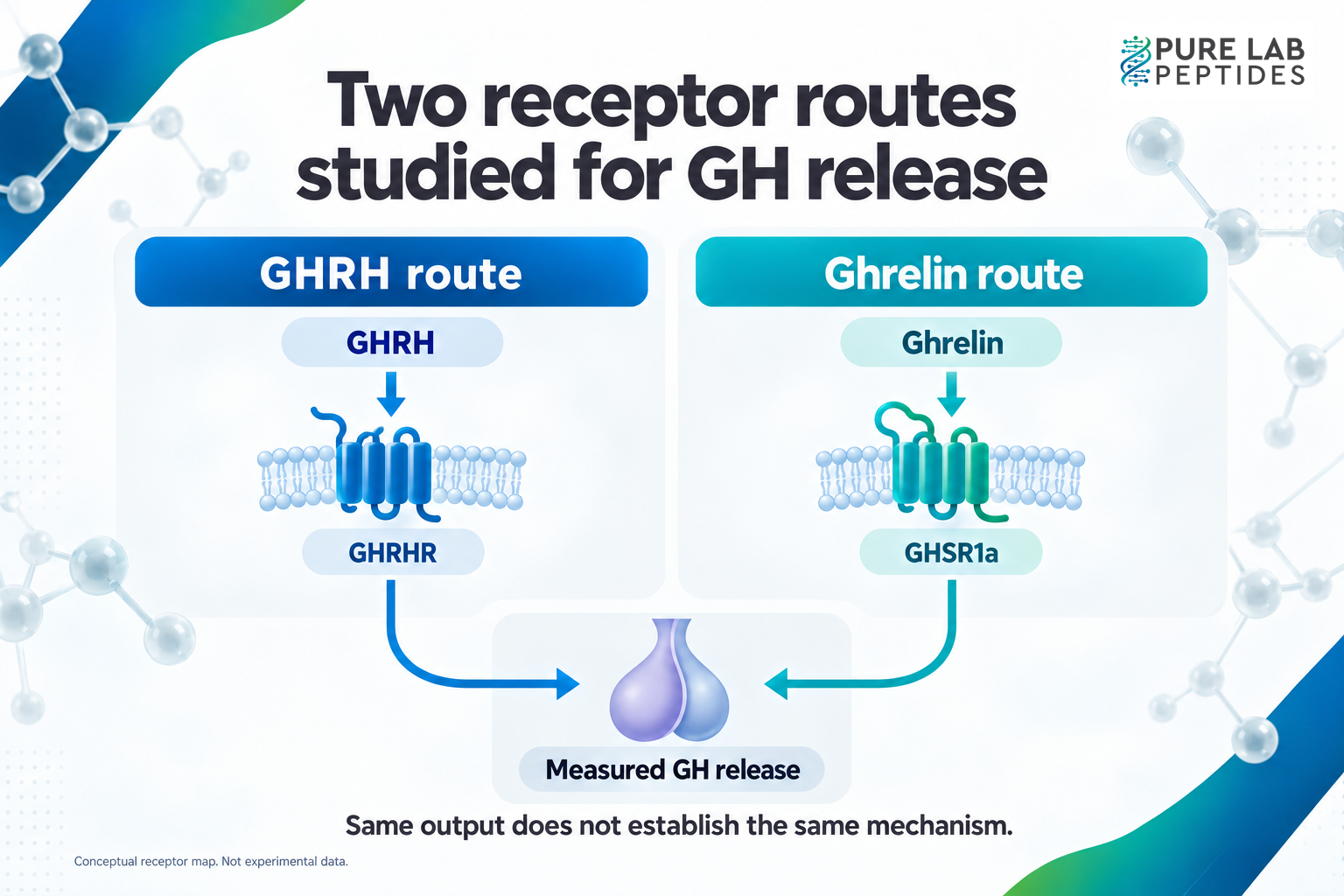
Use the diagram to locate the receptor route, while remembering that the routes belong to an interconnected endocrine system. Put the receptor name beside the compound in your reading notes. An increase in GH alone doesn’t tell you that two experiments tested the same mechanism.
GHRH analogs and growth hormone-releasing peptides
Quick takeaway: A receptor family, a chemical identity and a measured response are three different pieces of information.
| Research label | Example in the literature | What to check next |
|---|---|---|
| GHRH analog | CJC-1295 | The precise modification and material used in that study |
| Growth hormone-releasing peptide | GHRP-2 or GHRP-6 | The receptor evidence, model and endpoints |
| Another peptide secretagogue | Ipamorelin | Which response was measured and against what comparator |
| Nonpeptide secretagogue | MK-0677, also called ibutamoren | The tested molecule, target and experimental conditions |
Read the table as a comparison aid rather than a ranking. The Teichman and colleagues’ CJC-1295 study reports a long-acting GHRH analog in healthy adults. Its findings stay with the material tested there; they can’t be attached automatically to every listing with “CJC” in its name.
“Selective” is easier to interpret once you know the comparator, model and hormone endpoint. The ipamorelin study by Raun and colleagues examined rat pituitary cells, rats and swine with comparator compounds and multiple hormone measurements. Ask which response was selective under those conditions before broadening the conclusion.
For compound-specific reading, use our GHRP-2 research overview and GHRP-6 research overview. For a two-ingredient listing, the CJC-1295 and ipamorelin blend guide explains the documentation question. A blend name doesn’t turn its ingredients into a single receptor mechanism.
A receptor-control experiment makes the distinction clearer
Quick takeaway: A missing response can be informative when the experiment includes a control that still responds.
In Sun and colleagues’ 2004 mouse study, ghrelin and MK-0677 did not produce an acute GH response in mice lacking Ghsr. GHRH still produced a response in both the knockout and wild-type animals.
The comparison makes that experiment useful. The animals still responded through GHRH when the GHSR-dependent response was absent. That supports the receptor distinction in the tested setting. It doesn’t establish a supplied vial’s performance or the full consequences of repeated exposure in humans.
If a broad title makes the result hard to place, look for the narrower question in the experiment. The in vitro versus in vivo guide helps you distinguish cell-based, animal and human evidence before carrying a conclusion between them.
Make a comparison you can actually use
Quick takeaway: Record the route, material, model and endpoint before deciding whether two papers answer the same question.
You can begin with a short reading record. Give the comparison enough context for another person to follow it:
- Compound: the exact molecule, including any stated modification.
- Target: GHRHR, GHSR or a target not established by that experiment.
- Model: cells, species or the population studied.
- Endpoint: receptor activity, GH release or another named measurement.
- Comparator: vehicle, a reference compound or a receptor-control condition.
If two papers use different models or endpoints, separate their results before judging their size or meaning. Statistical significance doesn’t make them directly comparable, and a mechanism experiment doesn’t become a use recommendation. The mechanisms and consumer claims guide addresses that next interpretive step.