

GHRP-2 Research: Receptor Context and Release Assays

TL;DR · The short version
GHRP-2 research includes receptor and secretion experiments with contrasting pituitary-cell antagonist findings. Keep species and preparation beside each result. Binding, signaling and release aren’t interchangeable potency or benefit measurements.
An antagonist blocks a GHRP-2 response in one paper but not another. Check the preparations before deciding which result to use. The contrast needs explanation, not removal of the inconvenient finding.
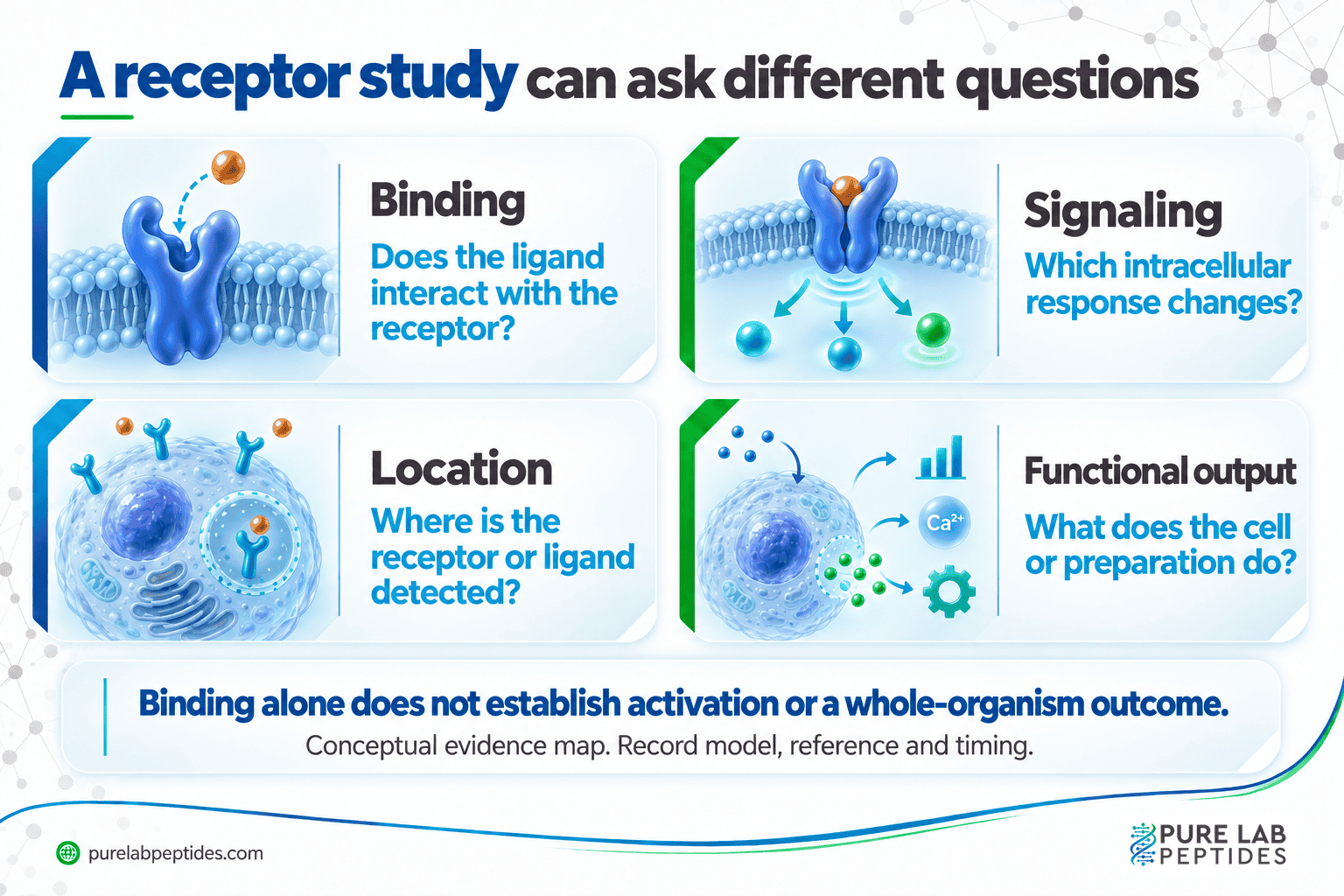
GHRP-2 research provides that example. GHRP-2, also called pralmorelin or KP-102, is a synthetic growth hormone secretagogue receptor agonist. Cayman Chemical’s reference sheet records those names. The pituitary-cell studies below show why receptor activity, intracellular signals and hormone release need separate descriptions.
The expanded name is growth hormone-releasing peptide-2. It belongs to the growth hormone secretagogues, compounds investigated for their effects on GH secretion. That classification names a research context. It does not make a GH-release measurement interchangeable with a receptor-binding result.
GHRP-2 mechanism of action: rat pituitary findings
TL;DR: Rat pituitary findings supported shared GHRP mechanisms under the tested conditions, not universal equivalence.
In a 1997 study by Cheng and colleagues, researchers compared GHRP-2 and GHRP-6 in primary rat pituitary cells. Both stimulated growth hormone (GH) release. Combining them at maximal concentrations did not increase release beyond either peptide alone.
Prior exposure to one peptide reduced the cells’ response to the other, a finding called cross-desensitization. This did not occur for growth hormone-releasing factor (GRF). A peptide antagonist inhibited the GHRP-2 response, whereas a GRF antagonist did not.
The shared mechanism finding belongs to that preparation. It doesn’t make the molecules identical or establish responses in other systems. A lack of extra release at maximal concentrations also leaves lower-concentration combinations unresolved.
GHRP-2 research in bovine pituitary cells
TL;DR: The bovine-cell antagonist result differed. The abstracts do not resolve which experimental differences explain it.
Roh and colleagues’ bovine-cell study, also published in 1997, measured GH in culture medium using an enzyme immunoassay. GHRP-2 increased secretion, and combining it with GRF produced an additive response under the tested conditions.
Here, a GRF-receptor antagonist blocked the GHRP-2 response. That differs from the rat-cell result. The calcium-channel blocker nifedipine also inhibited release, supporting a role for calcium entry in this preparation. The authors proposed contributions from GRF-receptor, protein kinase C and cAMP pathways.
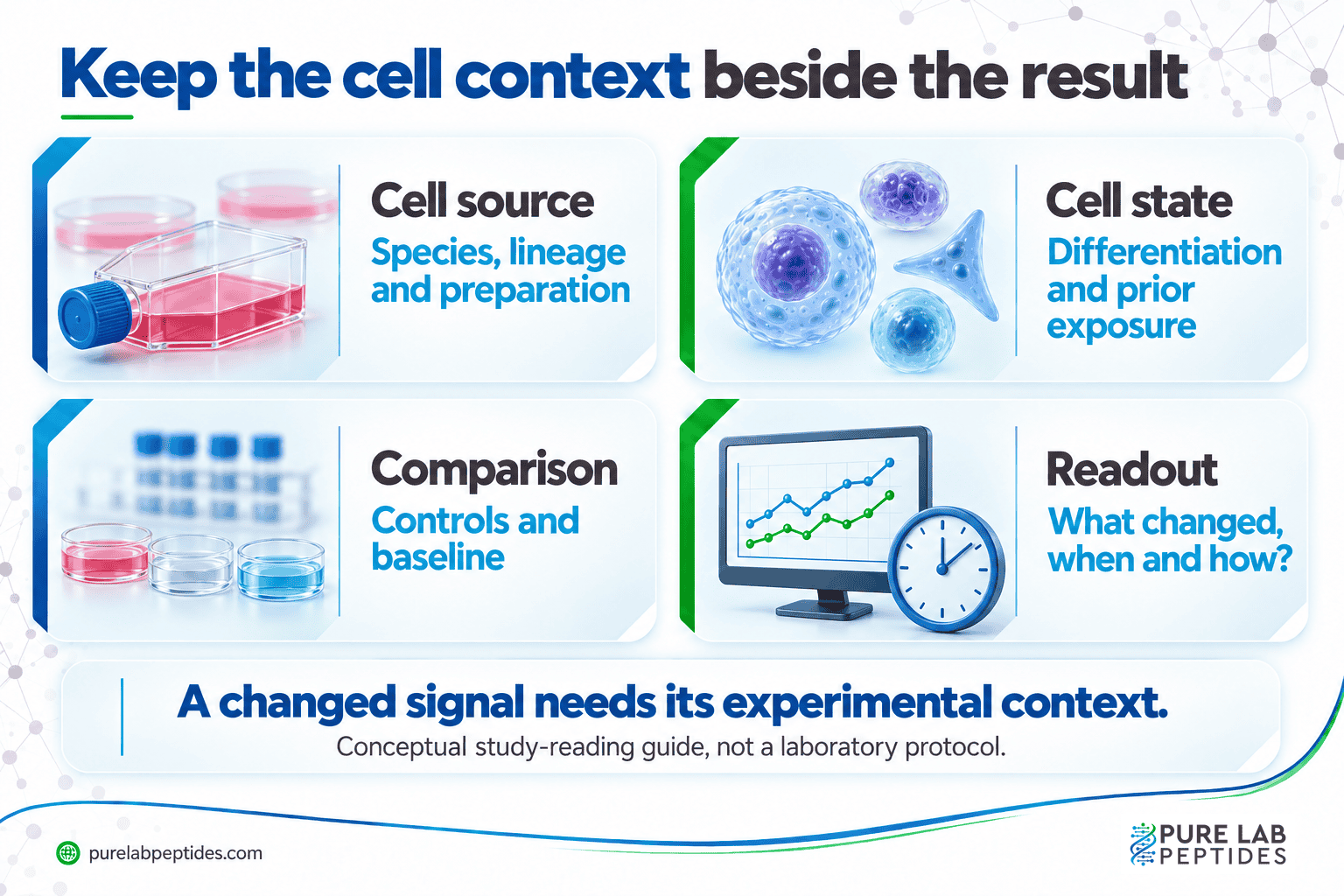
Retain the species and preparations for both findings. The abstracts don’t establish which experimental differences caused the contrast, so don’t assign one explanation from those records alone.
Keep receptor identity separate from pathway interaction
TL;DR: Ghrelin-receptor and GHRH-receptor contexts are distinct even when both studies measure GH release.
GHRP-2’s ghrelin-receptor context differs from GHRH, also called GRF in these papers. Both may lead to a GH-release measurement without being the same input.
Antagonist responses help investigate a pathway but don’t identify every binding event or merge receptor systems. The CJC-1295 and ipamorelin research guide discusses that distinction in another combination context.
How to read a GHRP-2 research result
TL;DR: Record model, endpoint, controls, timing and material basis before comparing response numbers.
| Check | What to identify |
|---|---|
| Experimental model | Species, tissue or cell system, and whether the receptor is naturally present or introduced. |
| Measured endpoint | Binding, intracellular signaling or GH secretion; identify the method and observation period. |
| Comparison | Baseline, reference ligand, antagonist controls and any prior exposure. |
| Reported response | Concentration-response relationship, maximum response and variability. |
| Test material | Exact peptide, supplied chemical form, lot and amount basis used in the experiment. |
Potency concerns concentration for a specified response; maximum response concerns the largest observed effect. Keep the endpoint and conditions with any claim that one peptide is more potent.
Check chemical form before comparing concentration. Equal mass needn’t mean equal molar concentration. Literature activity also doesn’t verify the content or identity of a newly supplied vial.
The GHRP-6 research adds structural and signaling evidence. Use a defined endpoint for the comparison rather than treating a shared research context as an equivalent result.