 Skip to content
Peptide Purity Percentage: What It Does and Does Not Prove

Understanding what a peptide purity percentage proves is important in research-use-only peptide sourcing. In most laboratory documentation, the reported percentage is not a universal proof of composition. It usually describes how a stated analytical method separated the target peptide from detectable related components under defined conditions. That makes it useful for research evaluation, but narrower than many buyers assume. [1] [2] [3]
Fast Answer
A peptide purity percentage generally indicates relative purity within the specific analytical method that produced the number, often a chromatographic area-percent calculation, and it should be read as method-scoped evidence rather than stand-alone proof of identity, absolute peptide content, or overall lot quality. Products discussed in this article are intended for laboratory research use only and are not intended for human or animal consumption. [1][2][3]
What peptide purity percentage usually means on a COA
On many peptide certificates of analysis, “purity %” is derived from a chromatographic run such as RP-HPLC or UPLC. In that setting, the value is commonly calculated from the area assigned to the main peptide peak relative to the summed area of all detected peaks under the chosen conditions. Waters illustrates this directly for synthetic peptide analysis by defining percent peptide purity from main-peak area divided by total peak area, and the same workflow shows that relative quantification may be reported from either UV or total ion chromatogram data depending on the method design. [2]
That definition is narrower than “how much peptide is truly present.” Chromatographic purity is a detector-dependent and method-dependent estimate. It depends on sample preparation, column chemistry, gradient, pH, ion-pairing conditions, wavelength or MS channel, and the method’s ability to separate the target from closely related species. ICH Q14 is relevant here because it defines analytical procedures in terms of fitness for purpose, including specificity or selectivity, accuracy, precision, and robustness for the attribute being measured. [1][3]
For peptide materials, that distinction matters even more because method development is analytically challenging. Sharma and colleagues note that peptide chromatographic methods must account for variables that affect separation, recovery, and molecular stability. In practical terms, a reported purity percentage is best understood as an answer to a narrower question: “What proportion of the measured analytical response belongs to the main peptide under this method?” not “What does this number prove about every relevant quality attribute of the lot?” [3]
What a high purity percentage can support
A high purity percentage can support one useful conclusion: under the stated analytical conditions, the main detectable peptide-related component represented most of the measured response. That makes the number valuable for lot screening, purification assessment, and estimating whether related byproducts are likely to interfere with a sensitive laboratory workflow. In research settings, this is meaningful because peptide-related impurities are not just paperwork problems. They can alter assay interpretation if they are present at meaningful levels or if they co-elute with the target compound. [5][6]
D’Hondt and co-authors review peptide impurities in detail and note that synthesis-related and degradation-related impurities can influence early functionality studies and even lead to erroneous conclusions. That review is one reason purity percentage remains a legitimate research buying metric. A cleaner chromatographic profile usually means fewer obvious related contaminants competing for interpretation. What it does not mean is that every other analytically relevant question has already been answered. [6]
Purity percentage can also support lot-to-lot comparison, but only when the same or demonstrably comparable method is used. If the method changes, the number may move partly because the chemistry moved and partly because the analytical window moved. For qualified laboratory buyers, comparability is strongest when the same method, reporting thresholds, detector, and documentation standard are used across lots. [1][4]
What peptide purity percentage does not prove
The most common buying mistake is to read one purity number as a universal proof of quality. The analytical and regulatory literature does not support that interpretation. Instead, it treats purity as one attribute inside a broader characterization package that also addresses identity, impurity type, physicochemical properties, and fit-for-purpose method performance. [1][5]
| Question a buyer is really asking | Does purity % prove it? | Why not | What is stronger evidence |
| Is this definitively the intended peptide sequence? | No | FDA treats active ingredient sameness and impurity profiling as separate issues and lists primary sequence, physicochemical properties, secondary structure, aggregation state, and related data as distinct characterization elements. [5] | LC-MS identity confirmation, sequence-focused characterization, and lot-specific analytical documentation. [5] |
| How much actual peptide is present per milligram of material? | No | Lyophilized mass can include associated water and other non-peptide components, so area-based purity is not the same thing as net peptide content. [7] | Validated peptide content determination, including amino acid analysis where appropriate. [8] |
| What counter-ion or salt form is present, and in what amount? | No | Counter-ion type and quantity are separate analytical questions and may require ion chromatography, capillary electrophoresis, titration, IR, or NMR. [9] | Explicit salt-form statement and counter-ion testing in the lot file. [9] |
| Are residual solvents controlled? | No | Residual solvents are governed by a separate ICH framework with its own limits, scope, and testing logic. [10] | Residual solvent review and testing tied to the manufacturing and purification route. [10] |
| Are elemental impurities controlled? | No | Elemental impurities are assessed through a separate risk-based framework that considers catalysts, water, equipment, and container systems. [11] | Elemental impurity risk assessment and, when needed, targeted testing. [11] |
| Is water content already accounted for? | No | ICH Q6A treats water content as a separate specification item and prefers water-specific procedures such as Karl Fischer where appropriate. [12] | Water-content testing reported separately from chromatographic purity. [12] |
| Is stereochemical or enantiomeric purity established? | No | D/L isomeric impurities are analytically challenging and require dedicated approaches; they are not automatically resolved by a routine purity claim. [13] | Chiral or otherwise dedicated stereochemical testing when relevant to the sequence and synthesis route. [13] |
Identity is the clearest example of over-interpretation. FDA’s peptide guidance does not treat impurity profiling as a substitute for identity characterization. It specifies that sameness assessment can involve primary sequence and physicochemical properties, and may also consider secondary structure, oligomer or aggregation states, and function-related evidence. A clean chromatogram can therefore coexist with incomplete identity evidence if the lot file does not include orthogonal confirmation. [5]
Net peptide content is also separate from chromatographic purity. Peer-reviewed guidance for peptide standards notes that relying on the weight of lyophilized peptide alone can misstate actual concentration because associated non-peptide mass can contribute to the total material weight, while amino acid analysis is explicitly used to determine amino acid content in peptide-containing samples. For research teams building molar comparisons across lots or suppliers, that difference can be more important than a one-point change in HPLC area percent. [7][8]
Counter-ion profile is another frequent blind spot. Sikora and colleagues note that hard evidence of purity, identity, and batch-to-batch consistency are all important analytical parameters, and they emphasize that determination of counter-ion type and quantity may require dedicated analytical techniques. That is why a COA that only reports chromatographic purity can still leave unanswered questions about acetate, trifluoroacetate, chloride, or other ionic content relevant to research material characterization. [9]
Chromatographic purity also does not replace separate impurity programs for residual solvents and elemental impurities. ICH Q3C addresses acceptable amounts and testing logic for residual solvents, while ICH Q3D sets out a distinct risk-based framework for elemental impurities introduced from catalysts, reagents, water, equipment, and packaging. Likewise, Badgujar and co-authors show that enantiomeric purity is its own analytical problem for synthetic peptides because D/L isomers are difficult to distinguish without dedicated methods. [10][11][13]
Why the analytical method changes the number
Peptides are unusually sensitive to analytical method design because their chromatographic behavior depends on charge state, hydrophobicity, secondary interactions, pH, salt, and ion-pairing conditions. Sharma et al. review how method variables can affect separation, recovery, and stability. Field et al. then show experimentally that screening different mobile phases, pH values, ion-pair reagents, ionic strengths, and stationary phases changes selectivity and the probability of resolving impurities in peptide mixtures. [3][4]
That creates a practical sourcing consequence: the same material can look cleaner or less clean depending on the analytical window used to observe it. A number without method disclosure therefore has less scientific value than a slightly lower number attached to a transparent, lot-specific, fit-for-purpose analytical package. ICH Q14’s emphasis on specificity, robustness, and lifecycle control is directly relevant to that interpretation. [1][4]
How to interpret a reported purity percentage
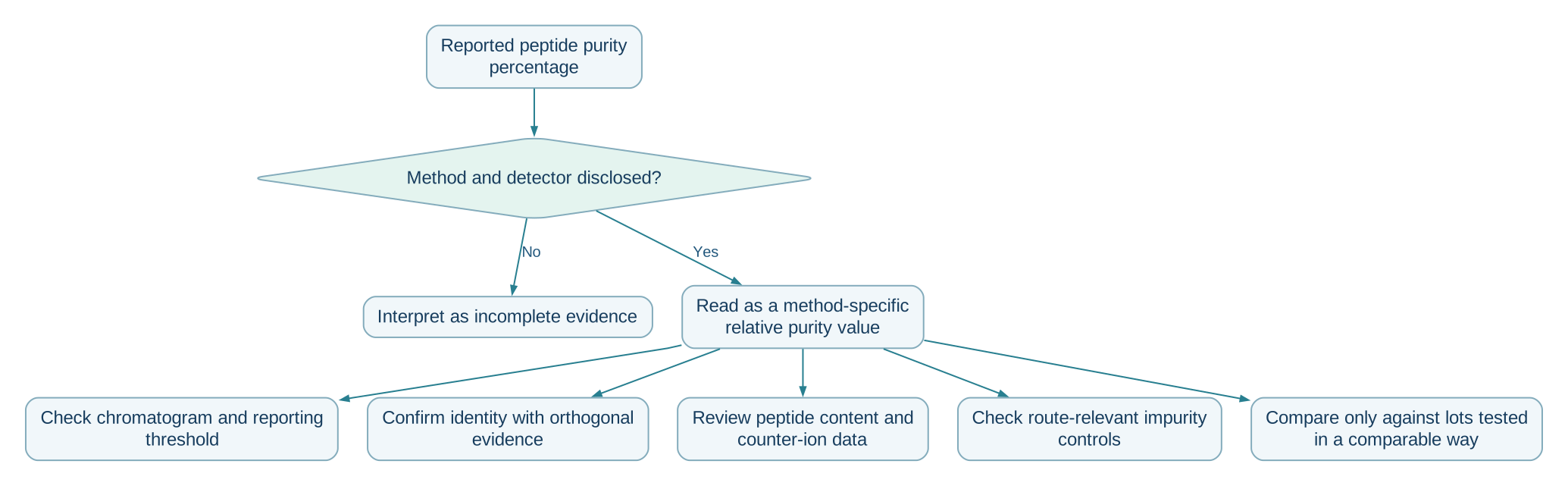
Text version of this diagram
- Reported peptide purity percentage → Method and detector disclosed?.
- Method and detector disclosed? — No → Interpret as incomplete evidence.
- Method and detector disclosed? — Yes → Read as a method-specific relative purity value.
- Read as a method-specific relative purity value → Check chromatogram and reporting threshold.
- Read as a method-specific relative purity value → Confirm identity with orthogonal evidence.
- Read as a method-specific relative purity value → Review peptide content and counter-ion data.
- Read as a method-specific relative purity value → Check route-relevant impurity controls.
- Read as a method-specific relative purity value → Compare only against lots tested in a comparable way.
This diagram is an original visual summary based on the cited analytical and regulatory literature. [1][2][5][12]
How to evaluate peptide documentation before lot selection
ICH Q6A defines a specification as a list of tests, references to analytical procedures, and acceptance criteria. That framing is useful in RUO peptide buying as well. A credible batch file is not a single purity number. It is a small evidence stack that answers different questions with different methods. [12]
- Read the analytical label, not just the percentage. Look for method type, detector, chromatogram, retention time, and any reporting threshold because interpretability depends on analytical context. [1][2][4]
- U.S. Food and Drug Administration. “ANDAs for Certain Highly Purified Synthetic Peptide Drug Products That Refer to Listed Drugs of rDNA Origin.” FDA Guidance for Industry. May 2021. FDA withdrawn-guidance record. Withdrawn July 28, 2026; cited for historical analytical context.
- Ask whether peptide content was addressed. If the research design depends on molar input, documentation that distinguishes peptide content from associated water or other non-peptide mass is more informative than material weight alone. [7][8]
- Review salt or counter-ion information. Counter-ion type and quantity can be analytically relevant and may require dedicated measurement rather than inference from purity percentage. [9]
- Match additional testing to plausible process risk. Residual solvents, elemental impurities, and water content are specification-style questions with separate frameworks and methods. [10][11][12]
- Compare like with like across lots. Lot comparison is strongest when the same analytical methods and reporting rules are used consistently over time. [1][12]
For laboratory buyers, the most useful question is therefore not simply “What is the purity?” but “What exactly was measured, by which method, and what complementary tests close the remaining gaps?” If the documentation provides only a percentage and no analytical context, the most scientifically honest conclusion is not that the lot is necessarily poor – only that the claim is incomplete. [1][5][12]
FAQs
Is 99% peptide purity automatically better than 95% for every research workflow?
Not automatically. A higher number can indicate a lower relative burden of detectable related impurities under the stated method, which is often useful, but method comparability still matters. A 99% result from one analytical setup is not always directly more informative than a 95% result from a better disclosed or more selective method package. [1][2][4]
Does HPLC purity prove peptide identity?
No. HPLC purity usually supports a statement about chromatographic composition under defined conditions, not a complete statement of identity. FDA’s peptide guidance treats identity and impurity profiling as related but distinct analytical tasks, so sequence-confirming or orthogonal identity evidence remains important even when the chromatogram shows one dominant peak. [5][2]
Can two lots both report 98% purity and still differ in analytically important ways?
Yes. Two lots can both report 98% purity and still differ in impurity type, counter-ion profile, net peptide content, or the analytical methods used to generate the result. Because specifications are made up of multiple tests rather than one number, equal purity percentages do not automatically mean analytical sameness. [9][12]
Why can the labeled mass of a lyophilized peptide material overstate actual peptide amount?
The labeled mass of a lyophilized material can overstate actual peptide amount because total weight may include associated water and other non-peptide mass. That is why peptide content should not be inferred from weight alone when precise molar comparison matters. Amino acid analysis and related content-focused methods answer a different question from chromatographic purity. [7][8]
What documents should a research team review alongside purity percentage?
A research team should review the chromatogram, method disclosure, detector context, orthogonal identity data such as LC-MS, any peptide content or counter-ion information, and any additional impurity controls that are relevant to the manufacturing route. Read together, those documents provide a much stronger basis for lot qualification than the purity percentage alone. [1][5][9][12]
Next Steps
Review batch-specific documentation before selecting any research-use-only peptide. Explore Pure Lab Peptides for RUO peptide compounds with clear labeling, research-focused product information, and available documentation, and prioritize suppliers that pair purity reporting with lot-level analytical context.
References
- International Council for Harmonisation. “Q14: Analytical Procedure Development.” ICH Guideline. 2023. https://database.ich.org/sites/default/files/ICH_Q14_Guideline_2023_1116_1.pdf
- Waters Corporation. “Streamlined LC-MS Analysis of Stress Induced Impurities of a Synthetic Peptide using the BioAccord System and the waters_connect Intact Mass Application.” Waters Application Note. 2022. https://www.waters.com/content/dam/waters/en/app-notes/2022/720007752/720007752-en.pdf
- Sharma N, Kukreja D, Giri T, Kumar S, Shah RP. “Synthetic pharmaceutical peptides characterization by chromatography principles and method development.” Journal of Separation Science. 2022. https://doi.org/10.1002/jssc.202101034
- Field JK, Euerby MR, Haselmann KF, Petersson P. “Investigation into reversed-phase chromatography peptide separation systems Part IV: Characterisation of mobile phase selectivity differences.” Journal of Chromatography A. 2021. https://doi.org/10.1016/j.chroma.2021.461986
- U.S. Food and Drug Administration. “ANDAs for Certain Highly Purified Synthetic Peptide Drug Products That Refer to Listed Drugs of rDNA Origin.” FDA Guidance for Industry. May 2021. FDA withdrawn-guidance record. Withdrawn July 28, 2026; cited for historical analytical context.
- D’Hondt M, Bracke N, Taevernier L, et al. “Related impurities in peptide medicines.” Journal of Pharmaceutical and Biomedical Analysis. 2014. https://doi.org/10.1016/j.jpba.2014.06.012
- Hoofnagle AN, Whiteaker JR, Carr SA, et al. “Recommendations for the Generation, Quantification, Storage, and Handling of Peptides Used for Mass Spectrometry-Based Assays.” Clinical Chemistry. 2016. https://doi.org/10.1373/clinchem.2015.250563
- Rutherfurd SM, Gilani GS. “Amino acid analysis.” Current Protocols in Protein Science. 2009. https://pubmed.ncbi.nlm.nih.gov/19937719/
- Sikora K, Jaskiewicz M, Neubauer D, Migon D, Kamysz W. “The Role of Counter-Ions in Peptides – An Overview.” Pharmaceuticals. 2020. https://doi.org/10.3390/ph13120442
- International Council for Harmonisation. “Q3C(R8): Impurities: Guideline for Residual Solvents.” ICH Guideline. 2021. https://database.ich.org/sites/default/files/ICH_Q3C-R8_Guideline_Step4_2021_0422_1.pdf
- International Council for Harmonisation. “Q3D(R2): Guideline for Elemental Impurities.” ICH Guideline. 2022. https://database.ich.org/sites/default/files/Q3D-R2_Guideline_Step4_2022_0308.pdf
- International Council for Harmonisation. “Q6A: Specifications: Test Procedures and Acceptance Criteria for New Drug Substances and New Drug Products: Chemical Substances.” ICH Guideline. 2000. https://database.ich.org/sites/default/files/Q6A%20Guideline.pdf
- Badgujar D, Paritala ST, Matre S, Sharma N. “Enantiomeric purity of synthetic therapeutic peptides: A review.” Chirality. 2024. https://doi.org/10.1002/chir.23652