



Ghrelin Receptor: Baseline Activity, Controls and Evidence

TL;DR · The short version
The ghrelin receptor, often designated GHSR1a, is a G protein-coupled receptor studied with ghrelin and synthetic agonists. Check the receptor construct, baseline, controls and endpoint. An assay without added ligand may still have signaling to account for.
A control well has a signal before the agonist arrives. That needn’t mean the assay failed: some receptor systems have measurable activity without added ligand. Check how baseline was measured and which controls support the response comparison.
What is the ghrelin receptor, or GHSR?
Quick takeaway: Identify the receptor and the ligand separately. “Ghrelin,” “GHSR” and “GH release” don’t name the same thing.
GHSR stands for growth hormone secretagogue receptor. The original 1996 cloning study identified a receptor responsive to synthetic growth hormone secretagogues. The receptor’s name preceded the discovery of its endogenous ligand.
In 1999, Kojima and colleagues reported ghrelin, a peptide isolated from rat stomach. Its octanoyl modification at serine 3 mattered to activity in the tested systems. “Ghrelin” therefore isn’t enough detail for every material comparison; the chemical form matters too.
GHSR1a names the receptor in these studies, but the methods should identify species and construct. Those details matter when comparing engineered human-receptor cells with an intact-animal finding.
Why baseline activity matters in a ghrelin receptor assay
Quick takeaway: An agonist increases the measured response; an inverse agonist can reduce constitutive activity. An antagonist label alone doesn’t tell you what happens to the baseline.
Holst and colleagues’ 2003 study found strong ligand-independent signaling in transfected cell systems expressing the ghrelin receptor. A modified substance P compound reduced that activity toward the untransfected-cell baseline, supporting its classification as an inverse agonist in those assays.
Blocking an added agonist and reducing an existing baseline are different effects. Basal activity can vary between preparations, so retain expression and assay conditions.
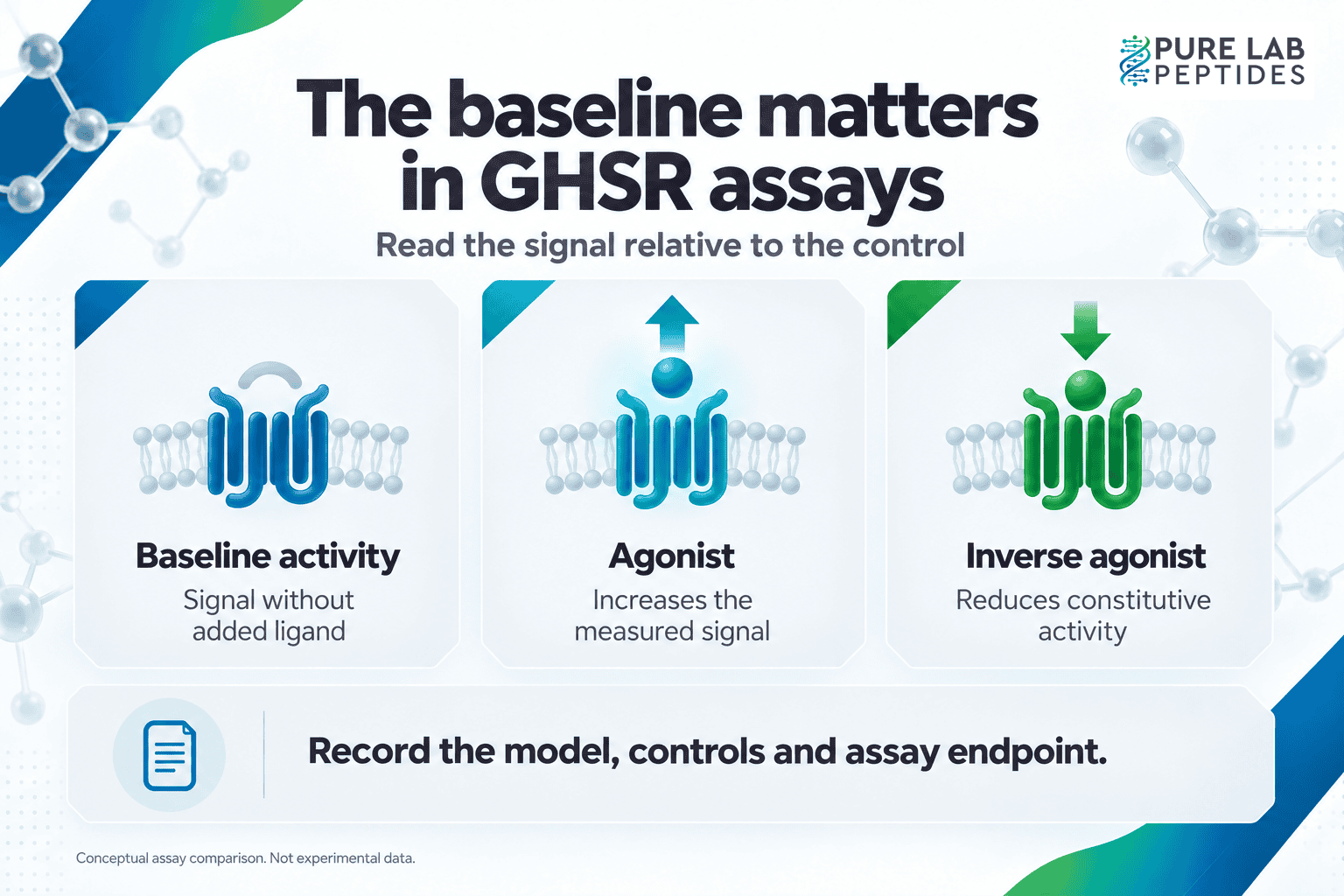
Imagine two laboratories reporting the same ligand, one as raw signal and the other after vehicle subtraction. Their charts may differ before any biological difference is considered. Note the calculation before comparing the response sizes.
Binding, signaling and hormone release answer different questions
Quick takeaway: Name the endpoint beside the result. A binding observation isn’t a direct measurement of hormone release.
| Measurement | Question it helps answer | What it doesn’t establish by itself |
|---|---|---|
| Ligand binding | Does the ligand interact with the studied receptor preparation? | The full cellular or physiological response |
| Signaling assay | What happens to a defined readout, such as calcium mobilization? | Every signaling pathway or a clinical outcome |
| Hormone-release measurement | Does GH change in the tested model and time window? | Which receptor caused the change without additional evidence |
| Structural analysis | How are the ligand and receptor arranged in the resolved complex? | The complete behavior of the system over time |
A 2021 structural study of the human ghrelin receptor examined complexes with ghrelin and the nonpeptide agonist ibutamoren. It combined cryo-electron microscopy with mutations and functional testing. The resolved complexes included Gi protein; calcium-mobilization experiments supplied a different functional readout. These are complementary observations, not interchangeable measurements.
A structure helps explain proposed contacts; the accompanying assay tests their consequences. Read both before carrying the mechanism into a summary. The how to read peptide research literature covers that process.
Which controls make a GHSR result useful?
Quick takeaway: Look for controls that distinguish receptor-dependent activity from background or a different route.
A Ghsr-null mouse experiment separated the acute GH responses to ghrelin-related stimulation and GHRH. It’s a reminder that a shared output can have more than one route. A hormone result needs target-specific evidence if the claim is about a particular receptor.
In a cell assay, the practical reading questions are straightforward:
- Receptor: Which species and construct were expressed?
- Baseline: Was vehicle activity recorded, and how was it handled?
- Background: Were cells without the introduced receptor compared?
- Ligand: What exact chemical form and concentration were tested?
- Endpoint: Which signal was measured, at what time?
- Reference: Was a known comparator tested under the same conditions?
Keep the controls and endpoint beside the result when sharing a chart. The experimental model guide explains the additional questions raised beyond cells.
Keep material identity separate from receptor evidence
Quick takeaway: Documentation about a sample’s identity and purity doesn’t replace a functional assay.
Sequence, purity and analytical identity don’t independently establish agonism, selectivity or hormone release. The purity versus identity separates those material questions from functional evidence.
State what preparation changed which endpoint against which control in which model. That sentence is more useful than “activates GHSR” alone. The mechanism and claims guide explains the boundary between that observation and broader claims.