



Formulation Stability Testing for Peptide Research

TL;DR · The short version
Formulation stability testing follows a specified preparation over time. Record composition, container, conditions and time-zero evidence, then choose chemical, physical and functional measurements for the question. A finding belongs to that formulation, not every product containing the peptide.
“Stayed stable” leaves the endpoint unclear. Unchanged appearance, chromatographic signal and biological response are separate observations, even when the same preparation is being studied.
Plan those measurements before storage begins. This guide follows that planning task; the peptide stability overview covers general handling and degradation context.
Define the formulation before choosing the schedule
Takeaway: Record exactly what is being tested, including its container. A compound name does not define a formulation.
Write the study question as a sentence you can actually answer. For example: “Does the intact-peptide measurement change over the selected interval in this defined preparation and container?” That is a planning example, not a validated protocol or an instruction to prepare a solution.
Buffers, concentrations and accompanying ingredients can differ behind the same peptide name. If composition changes, the earlier results remain results for the earlier preparation.
| Study record | What to capture | Why it belongs in the record |
|---|---|---|
| Material and composition | Identity, lot, concentration and relevant formulation ingredients | Defines which preparation the result describes |
| Container and handling | Container/closure, sample configuration and handling history | Keeps the test setup reproducible |
| Conditions and time points | Recorded exposure conditions, start time and planned collection times | Defines the comparison over time |
| Measurements and controls | Assay purpose, time-zero reference, appropriate controls and replicates | Makes changes and uncertainty interpretable |
This is a working checklist. The exact measurements and controls still need to fit the research question and analytical method.
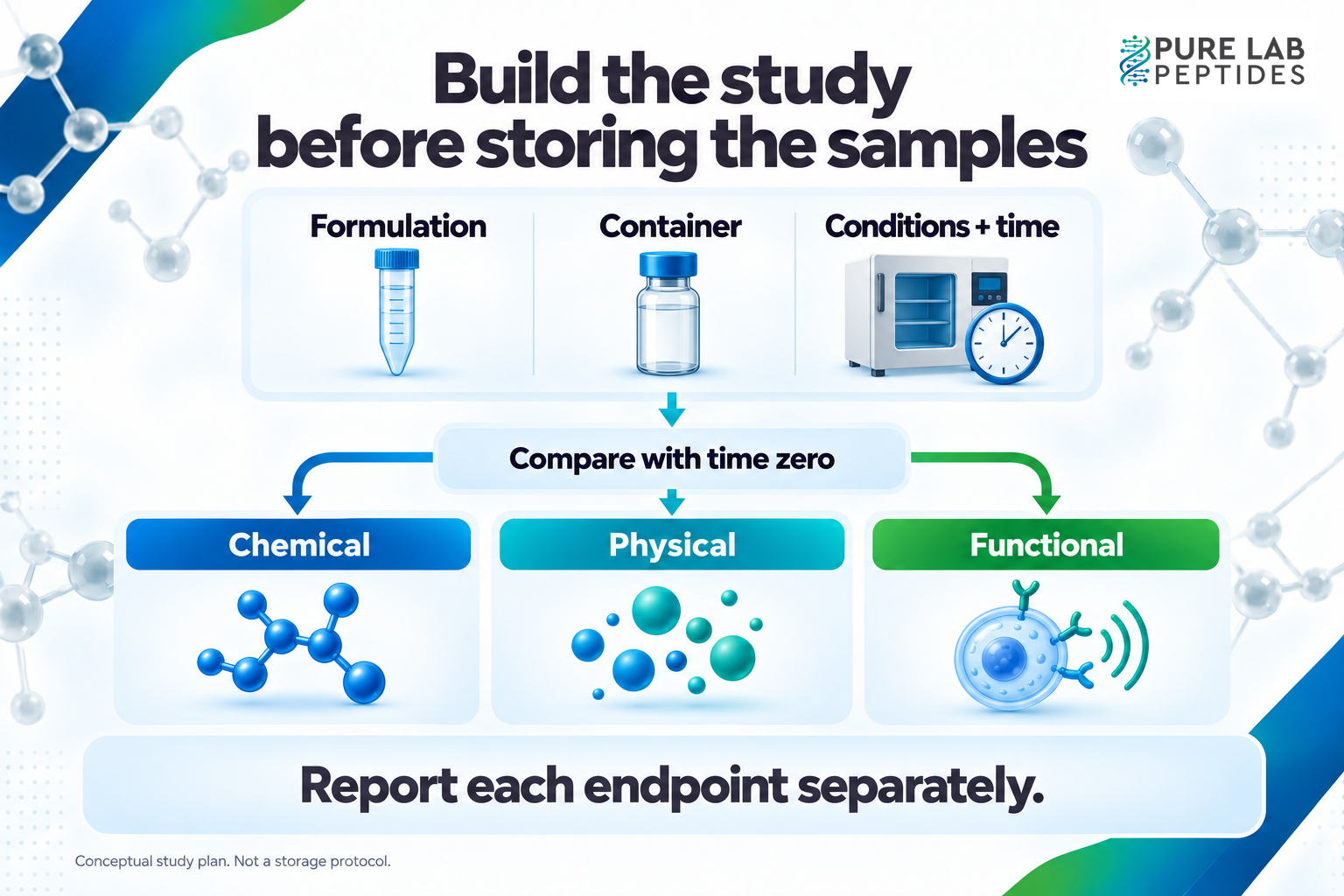
Separate chemical, physical and functional measurements
Takeaway: Choose methods for the question being asked. No single result answers every stability question.
Appearance can remain unchanged while chemistry changes, or a chemical signal can remain while activity changes. Reporting the endpoint makes that distinction visible rather than hiding it under “stable.”
In Taleb and colleagues’ 2017 glucagon study, researchers examined a specified commercial formulation under controlled pump conditions. They assessed chemical integrity with LC-MS/MS, fibrillation with a fluorescence measurement and biological activity with a cell-based assay. Freshly prepared material provided a comparator. The study’s strength here is the separate questions, not a universal handling rule for other glucagon preparations.
- Chemical: does the chosen method distinguish the intended material from relevant chemical changes?
- Physical: what happens to the physical condition being measured, such as aggregation or particulates?
- Functional: does the defined response remain comparable in the selected assay?
Give each endpoint a separate result. If activity wasn’t measured, don’t imply that chemical testing established it. The testing-method comparison explains the different contributions of analytical methods.
The formulation can change the result
Takeaway: Treat published results as evidence about the tested preparation and conditions.
Avanti and colleagues’ 2011 oxytocin experiments compared defined aqueous preparations with different buffer and metal-ion conditions. They followed recovery using reversed-phase chromatography and size-exclusion chromatography. The results depended on the tested preparation and conditions, and the methods provided different views of the material.
The paper isn’t a recipe for another peptide. Retain its composition and measured endpoint when describing the finding so the stability claim remains tied to its preparation.
List the differences between formulations A and B. Several simultaneous ingredient, container and exposure changes won’t identify a single cause cleanly. A focused comparison is easier to interpret.
Start with a real time-zero reference
Takeaway: Compare later measurements with a documented starting point using methods suited to detecting change.
Document the starting measurement and later sampling so the time comparison has a basis. Plan the variability assessment before interpreting small fluctuations as losses.
Illustrative example: a later result is lower than the first measurement, but the variation among replicate measurements is of similar size. That observation calls for a look at precision, sampling and controls before a confident degradation conclusion. The example contains no product data or pass/fail threshold.
For the method side of that review, see how to read an HPLC chromatogram. For the record trail, keep the study samples connected to their material and lot records.
Stress testing is useful, but it is not a shelf-life shortcut
Takeaway: Stress results can help reveal change. They do not automatically establish a real-world expiry.
The pharmaceutical-development guideline ICH Q5C, published in 1995, distinguishes real-time stability data from accelerated or stress evidence and describes the need for a stability-indicating profile. It is a framework for specified biological products, not certification of research-use materials.
State conditions, interval, endpoints, method limits and changes. Leave untested storage conditions out of the conclusion. Stress testing can reveal degradation while leaving ordinary storage life unresolved.
End with the preparation, container, conditions, interval and measurements actually studied. That gives another researcher a finding they can use instead of a broad stability promise.