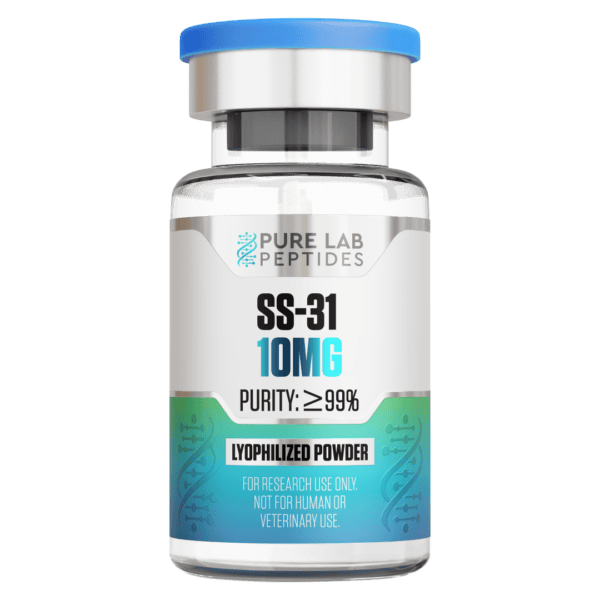

Researchers searching for buy SS-31 online should evaluate SS-31 as a research-use-only laboratory material, not a consumer product. For laboratory buyers, the key considerations are compound identity, SS-31 COA review, purity documentation, identity testing, lot traceability, product labeling, storage information, and supplier evaluation. This guide explains how to evaluate SS-31 30mg for controlled research procurement through Pure Lab Peptides while keeping all buying intent limited to laboratory research.
Fast Answer: buy SS-31 online for laboratory research
Researchers can buy SS-31 online for laboratory research by reviewing RUO labeling, batch-specific COA documentation, purity data, identity information, storage guidance, and supplier transparency before selecting a source. Products discussed in this article are intended for laboratory research use only and are not intended for human or animal consumption.
What Does “Buy SS-31 Online” Mean in a Research Context?
The phrase “buy SS-31 online” is addressed here as laboratory research procurement intent, not personal-use intent. In a research context, the phrase points to documentation review, supplier screening, lot-level recordkeeping, and confirmation that the material is positioned only for qualified laboratory research workflows.
Research-use-only sourcing is different from consumer buying. A laboratory buyer should evaluate whether the supplier clearly separates RUO materials from clinical, diagnostic, veterinary, or personal-use positioning. FDA RUO guidance discusses how research-use-only labeling is used for materials that are not represented for diagnostic use, and federal labeling language for certain laboratory research contexts includes the phrase “For Research Use Only. Not for use in diagnostic procedures.” [1] [2]
For SS-31 research procurement, qualified researchers should focus on the SS-31 COA, lot number, product label, purity documentation, identity testing, product form, and storage information. FDA labeling materials also emphasize elements such as lot or control numbers, storage instructions, and material identification in relevant laboratory reagent and IVD labeling contexts, which supports the broader procurement principle that documentation must be traceable and reviewable. [3]
SS-31 Research Material Overview
SS-31 is commonly discussed in scientific literature under the name elamipretide and related identifiers. Analytical database records identify elamipretide with the molecular formula C32H49N9O5 and PubChem CID 11764719, while ChEMBL includes a related elamipretide hydrochloride record. [4] [5] In laboratory procurement language, these database records are useful for compound identity review, name matching, and documentation consistency.
Published literature describes SS-31 as a synthetic tetrapeptide in the Szeto-Schiller peptide family and discusses it in mitochondrial membrane and cardiolipin research contexts. [6] Reviews and mechanistic papers have described its sequence, mitochondrial targeting literature, and cardiolipin-related model systems. [7] This research context should be treated as background literature, not as instructions for using any RUO material.
SS-31 research material is generally evaluated through laboratory documentation rather than outcome claims. Researchers may compare the product name against database names, confirm whether documentation includes peptide identity information, and review whether analytical testing supports the listed material. Publications on SS-31 have examined cardiolipin interaction, lipid bilayer behavior, and mitochondrial protein interaction landscapes in model systems. [8] [9] [10] [11]
Metabolic pathway literature should not be translated into weight-loss, performance, or wellness claims for RUO materials. For SS-31 research-use-only procurement, the practical review point is not whether a publication discusses mitochondrial biology. The practical review point is whether the material being procured has clear RUO labeling, batch-specific documentation, identity testing, purity support, and supplier transparency.
Why Researchers Search “Buy SS-31 Online”
Researchers search “buy SS-31 online” when they need to compare research suppliers, confirm product availability, and evaluate whether a listed SS-31 research material has appropriate documentation for a controlled laboratory environment. The commercial phrase does not change the intended-use boundary. On this page, buy SS-31 means evaluate SS-31 procurement for laboratory research use only.
For technical procurement teams, the search often begins with basic product matching. The team may need to confirm that the listed compound is SS-31 30mg, that the supplier identifies the product as research-use-only, that a batch-specific certificate of analysis is available, and that the product page does not rely on unsupported claims. The team may also check whether the material is supplied as lyophilized powder, whether storage information is documented, and whether the supplier makes lot-level traceability practical.
A research institution may also need supplier documentation for internal records. That review may include SS-31 purity documentation, SS-31 identity testing, SS-31 supplier documentation, product-label review, and a comparison between the COA and the physical label. The purpose is to support transparent laboratory procurement, not to guide personal use or expected outcomes.
Research Procurement Checklist for SS-31
- Verify that SS-31 is labeled for research use only.
- Review the available batch-specific certificate of analysis before procurement.
- Confirm that the SS-31 COA includes purity documentation and identity information.
- Check whether HPLC, LC-MS, mass spectrometry, or another analytical method is listed.
- Compare the product name, lot number, and documentation for consistency.
- Assess whether the supplier avoids dosing, therapeutic, diagnostic, veterinary, or personal-use claims.
- Document storage and handling information in laboratory records.
- Evaluate whether the lyophilized powder form matches the needs of the laboratory workflow.
- Confirm that the product is not marketed for human or animal consumption.
SS-31 Quality Signals to Review Before Buying Online
Researchers planning to buy SS-31 online for laboratory research should evaluate quality signals before selecting a source. The most useful signals are documentation-based: RUO labeling, batch-specific COA availability, purity data, identity testing, lot traceability, product form, storage information, and supplier language. These signals help laboratories distinguish research procurement from consumer-style positioning.
| Evaluation Area | What Researchers Should Review | Why It Matters for RUO Procurement |
| RUO labeling | Confirm the product is clearly labeled for research use only | Helps separate research procurement from human-use positioning |
| COA availability | Review the available batch-specific certificate of analysis | Supports lot-level documentation and quality review |
| Purity data | Look for analytical support for the stated purity | Helps evaluate material consistency |
| Identity testing | Review HPLC, LC-MS, mass spectrometry, or related identity data | Helps confirm the material matches the listed compound |
| Lot traceability | Match lot numbers across product and documentation | Supports research recordkeeping |
| Product form | Confirm whether the material is supplied as lyophilized powder or another documented form | Supports laboratory planning |
| Storage information | Review storage and handling documentation | Helps maintain material integrity in laboratory settings |
| Supplier language | Confirm the supplier avoids dosing, therapeutic, or personal-use claims | Supports research-use-only positioning |
COA, Purity, and Identity Documentation
A certificate of analysis is a central procurement document for SS-31 research material. Laboratory buyers should review the compound name, lot number, test date, purity percentage, analytical method, identity confirmation, product form, and storage information. For peptide materials, HPLC is commonly used for separation and purity-related review, while mass spectrometry and LC-MS approaches can support molecular identity and impurity evaluation. [12] [13] [14]
A purity percentage alone does not establish complete compound identity; researchers should evaluate purity, identity, method, lot number, and documentation together. Peptide quality review may also require attention to method suitability, impurity profile, chiral or sequence-related considerations, reference standards, and whether the COA connects directly to the lot being procured. [15] [16]
Specifications, test procedures, and acceptance criteria are a core part of quality documentation in regulated chemical-substance contexts, and GMP guidance for active pharmaceutical ingredients describes COA elements such as batch number, test results, acceptance limits, and authorized release documentation. [17] [18] RUO procurement teams can apply the same documentation mindset without converting the material into a clinical, diagnostic, veterinary, or personal-use product.
flowchart TD
A[Receive product and COA] --> B{RUO labeling present?}
B -- No --> C[Flag procurement gap]
B -- Yes --> D{Lot number matches across label and COA?}
D -- No --> E[Request batch-specific documentation]
D -- Yes --> F{Identity supported by analytical method?}
F -- No --> G[Request HPLC, LC-MS, or equivalent]
F -- Yes --> H[Proceed to laboratory documentation and storage]
After COA review, the laboratory record should connect the SS-31 research material to its product page, supplier, lot number, documented purity, identity testing method, storage information, and internal receipt records. That recordkeeping approach helps maintain traceability throughout the research procurement process.
Research Literature Context
Published SS-31 literature includes database records, mechanistic studies, preclinical model work, biophysical studies, reviews, and clinical literature outside the scope of RUO product use. Database records identify the compound and related names, while peer-reviewed literature discusses SS-31 in mitochondrial membrane, cardiolipin, lipid bilayer, and protein-interaction research contexts. [4] [6] [10] [11]
Research teams should distinguish published literature from product-use guidance. A paper may describe a model system, a molecular interaction, or an analytical method. That does not mean an RUO material is intended for clinical, diagnostic, veterinary, or personal use. Published clinical literature should not be interpreted as use guidance for RUO materials.
Clinical literature has examined elamipretide in specific research settings outside the scope of this procurement guide. For example, published trials have evaluated elamipretide in defined clinical study populations, including Barth syndrome and primary mitochondrial myopathy study settings. [19] [20] Later open-label literature and FDA communications also discuss regulated elamipretide contexts. [21] [22]
Regulated medicines and RUO research materials are not interchangeable. A regulated product discussed by a regulator, a database, or a clinical journal is not the same procurement category as an RUO laboratory material. For SS-31 research-use-only sourcing, literature should inform background understanding, nomenclature, and identity review. It should not be converted into human-use claims, animal-use claims, expected outcomes, or procedural instructions.
Evidence Landscape
| Research Area | What Literature Examines | Evidence Type | RUO Interpretation |
| Compound identity | Molecular structure, sequence, formula, synonyms, and classification | Database / analytical | Supports identification, not product-use claims |
| Mitochondrial and cardiolipin context | Mitochondrial membrane, cardiolipin, lipid bilayer, and model-specific interaction research | Review / in vitro / preclinical / biophysical | Useful for research context, not therapeutic claims |
| Analytical testing | Purity, identity, impurity profile, and batch verification | HPLC / LC-MS / mass spectrometry / COA | Supports documentation review |
| Storage and stability | Material form, lyophilized presentation, and handling documentation | Laboratory documentation | Supports research workflow planning |
Claim Boundary Table
| Research-Safe Statement | Why It Is Acceptable | Non-Compliant Version to Avoid |
| “SS-31 is discussed in published research related to mitochondrial membrane and cardiolipin research.” | Describes literature context without making a product claim | “SS-31 helps with a human outcome.” |
| “Researchers should review COA and identity data before procurement.” | Focuses on documentation and quality review | “Users should buy SS-31 for results.” |
| “Pure Lab Peptides supplies SS-31 as a research-use-only material.” | Clarifies intended use | “Pure Lab Peptides supplies SS-31 for therapy.” |
| “The phrase buy SS-31 online is addressed as research procurement intent.” | Qualifies commercial search intent | “Buy SS-31 online for personal use.” |
| “SS-31 purity documentation should be reviewed alongside identity testing and lot traceability.” | Connects procurement review to analytical documentation | “A purity number alone proves everything needed for use.” |
How Pure Lab Peptides Presents SS-31
Pure Lab Peptides presents SS-31 30mg as a research-use-only material for qualified laboratory settings. The product is listed with a ≥99% purity claim, supplied as lyophilized powder, and supported by available batch-specific COA documentation. Researchers should review the Pure Lab Peptides SS-31 research-use-only product page for RUO labeling, product details, purity information, and batch-specific documentation.
For procurement review, the product page should be evaluated together with the SS-31 COA, product label, lot number, storage and handling documentation, and internal laboratory records. Lot-level traceability matters because the material received by the laboratory should match the documentation used for purchasing and recordkeeping. Supplier transparency matters because a research-focused supplier should provide product documentation without relying on dosing, clinical, diagnostic, veterinary, or personal-use positioning.
Laboratory buyers comparing SS-31 research material can also review the broader Pure Lab Peptides research peptide collection, supporting educational materials in the Pure Lab Peptides blogs, and procurement logistics information on the shipping and returns page. These internal resources should be used for research procurement planning and documentation review only.
Common Misunderstandings About Buying SS-31 Online
Misunderstanding: “Buy SS-31 online” means personal use
Buy SS-31 online should not be interpreted as personal-use guidance on this page. The phrase is addressed as laboratory procurement intent for qualified researchers reviewing RUO labeling, documentation, purity data, identity information, lot traceability, and supplier transparency.
Misunderstanding: published literature equals product-use guidance
Published SS-31 literature may describe model systems, databases, analytical characterization, or clinical study settings outside the scope of RUO product use. That literature should not be converted into instructions, expected outcomes, or claims for research-use-only materials. Literature context supports background review, not product-use guidance.
Misunderstanding: purity percentage alone proves identity
SS-31 purity documentation is important, but a purity percentage alone does not prove complete compound identity. Researchers should review purity, identity testing, analytical method, product name, lot number, molecular information, and supplier documentation together before adding the material to laboratory procurement records.
Misunderstanding: COA documentation does not need to be batch-specific
For SS-31 research procurement, the COA should be batch-specific and should connect to the lot number on the product label or receipt record. A generic document is less useful for lot-level traceability because it may not describe the exact material received by the laboratory.
Misunderstanding: RUO labeling supports human or animal use
Research-use-only labeling does not support human or animal consumption. RUO labeling separates laboratory materials from clinical, diagnostic, veterinary, and consumer-use categories. Qualified researchers should maintain that boundary when reviewing supplier language, product documentation, and internal laboratory records.
Misunderstanding: pathway relevance equals a product claim
SS-31 may appear in literature related to mitochondrial pathway and cardiolipin research, but pathway relevance is not a product claim. A pathway discussion belongs in scientific context. It should not be reframed as a claim about outcomes, wellness, clinical use, animal use, or personal use.
FAQs About Buying SS-31 Online for Research
Where can researchers buy SS-31 online for laboratory research?
Researchers can buy SS-31 online for laboratory research by selecting an RUO supplier that provides clear labeling, available batch-specific COA documentation, purity information, identity testing support, storage guidance, and lot-level traceability. Pure Lab Peptides lists SS-31 30mg as a research-use-only material with product documentation for qualified laboratory buyers.
What should researchers check before buying SS-31 online?
Before buying SS-31 online, researchers should check RUO labeling, the SS-31 COA, the stated purity, analytical method, product form, storage information, lot number, and supplier language. The product listing and COA should match, and the supplier should avoid clinical, diagnostic, veterinary, consumer-use, or outcome-based positioning.
Why does a COA matter when buying SS-31?
A COA matters when buying SS-31 because it gives researchers a batch-specific document to review during procurement. The COA should support identity and purity review, connect to the lot number, list analytical method information, and fit with product labeling and internal laboratory recordkeeping.
Is SS-31 intended for human or animal consumption?
SS-31 discussed on this page is intended for laboratory research use only and is not intended for human or animal consumption. RUO materials should not be evaluated as consumer products, veterinary materials, clinical products, or diagnostic products. Procurement review should remain limited to qualified laboratory research settings.
What does research use only mean for SS-31?
Research use only for SS-31 means the material is positioned for controlled laboratory research procurement and documentation review. Researchers should evaluate labeling, COA availability, identity documentation, purity documentation, storage information, and lot traceability. RUO positioning does not provide instructions for human, animal, clinical, diagnostic, or consumer use.
How should published literature about SS-31 be interpreted?
Published literature about SS-31 should be interpreted as scientific background, not as product-use guidance for RUO materials. Papers may discuss database identity, mitochondrial membrane research, cardiolipin-related models, analytical methods, or clinical study settings. Those discussions do not change the intended-use boundary for SS-31 research material.
Next Steps
Qualified researchers evaluating SS-31 should review product labeling, COA status, identity documentation, purity information, storage guidance, lot-level traceability, and supplier transparency before selecting any research-use-only material. Review the SS-31 product page for RUO labeling, product details, purity information, and available batch-specific documentation.
References
- U.S. Food and Drug Administration. “Distribution of In Vitro Diagnostic Products Labeled for Research Use Only or Investigational Use Only.” FDA Guidance Document. 2013. fda.gov
- Electronic Code of Federal Regulations. “21 CFR 809.10 – Labeling for in vitro diagnostic products.” eCFR. Current. ecfr.gov
- U.S. Food and Drug Administration. “In Vitro Diagnostic Device Labeling Requirements.” FDA Medical Devices. 2023. fda.gov
- National Center for Biotechnology Information. “PubChem Compound Summary for CID 11764719, Elamipretide.” PubChem. Current. pubchem.ncbi.nlm.nih.gov
- European Bioinformatics Institute. “Elamipretide hydrochloride (CHEMBL4298161).” ChEMBL. Current. ebi.ac.uk
- Szeto HH. “First-in-class cardiolipin-protective compound as a therapeutic agent to restore mitochondrial bioenergetics.” British Journal of Pharmacology. 2014;171(8):2029-2050. pubmed.ncbi.nlm.nih.gov/24117165
- Tung C, Varzideh F, Farroni E, Mone P, Kansakar U, Jankauskas SS, Santulli G. “Elamipretide: A Review of Its Structure, Mechanism of Action, and Therapeutic Potential.” International Journal of Molecular Sciences. 2025;26(3):944. pubmed.ncbi.nlm.nih.gov/39940712
- Birk AV, Liu S, Soong Y, Mills W, Singh P, Warren JD, Seshan SV, Pardee JD, Szeto HH. “The mitochondrial-targeted compound SS-31 re-energizes ischemic mitochondria by interacting with cardiolipin.” Journal of the American Society of Nephrology. 2013;24(8):1250-1261. pubmed.ncbi.nlm.nih.gov/23813215
- Birk AV, Chao WM, Bracken C, Warren JD, Szeto HH. “Targeting mitochondrial cardiolipin and the cytochrome c/cardiolipin complex to promote electron transport and optimize mitochondrial ATP synthesis.” British Journal of Pharmacology. 2014;171(8):2017-2028. pubmed.ncbi.nlm.nih.gov/24134698
- Mitchell W, Ng EA, Tamucci JD, Boyd KJ, Sathappa M, Coscia A, Pan M, Han X, Eddy NA, May ER, Szeto HH, Alder NN. “The mitochondria-targeted peptide SS-31 binds lipid bilayers and modulates surface electrostatics as a key component of its mechanism of action.” Journal of Biological Chemistry. 2020;295(21):7452-7469. pubmed.ncbi.nlm.nih.gov/32273339
- Chavez JD, Tang X, Campbell MD, Reyes G, Kramer PA, Stuppard R, Keller A, Zhang H, Rabinovitch PS, Marcinek DJ, Bruce JE. “Mitochondrial protein interaction landscape of SS-31.” Proceedings of the National Academy of Sciences of the United States of America. 2020;117(26):15363-15373. pubmed.ncbi.nlm.nih.gov/32554501
- Mant CT, Chen Y, Yan Z, Popa TV, Kovacs JM, Mills JB, Tripet B, Hodges RS. “HPLC analysis and purification of peptides.” Methods in Molecular Biology. 2007;386:3-55. pubmed.ncbi.nlm.nih.gov/18604941
- Zeng K, Geerlof-Vidavisky I, Gucinski A, Jiang X, Boyne MT II. “Liquid Chromatography-High Resolution Mass Spectrometry for Peptide Drug Quality Control.” AAPS Journal. 2015;17(3):643-651. pubmed.ncbi.nlm.nih.gov/25716148
- Lian Z, et al. “Characterization of Synthetic Peptide Therapeutics Using Liquid Chromatography-Mass Spectrometry: Challenges, Solutions, Pitfalls, and Future Perspectives.” Journal of the American Society for Mass Spectrometry. 2021. doi.org/10.1021/jasms.0c00479
- Strege MA, Oman TJ, Risley DS, Muehlbauer LK, Jalan A, Lian ZJ. “Enantiomeric purity analysis of synthetic peptide therapeutics by direct chiral high-performance liquid chromatography-electrospray ionization tandem mass spectrometry.” Journal of Chromatography B. 2023;1219:123638. pubmed.ncbi.nlm.nih.gov/36857849
- McCarthy D, Han Y, Carrick K, Schmidt D, Workman W, Matejtschuk P, Duru C, Atouf F. “Reference Standards to Support Quality of Synthetic Peptide Therapeutics.” Pharmaceutical Research. 2023;40(6):1317-1328. pubmed.ncbi.nlm.nih.gov/36949371
- European Medicines Agency. “ICH Q6A specifications: test procedures and acceptance criteria for new drug substances and new drug products: chemical substances.” EMA Scientific Guideline. 2000. ema.europa.eu
- U.S. Food and Drug Administration. “Q7 Good Manufacturing Practice Guidance for Active Pharmaceutical Ingredients.” FDA Guidance for Industry. 2016. fda.gov
- Thompson WR, Hornby B, Manuel R, Bradley E, Laux J, Carr J, Vernon HJ. “A phase 2/3 randomized clinical trial followed by an open-label extension to evaluate the effectiveness of elamipretide in Barth syndrome, a genetic disorder of mitochondrial cardiolipin metabolism.” Genetics in Medicine. 2021;23(3):471-478. pubmed.ncbi.nlm.nih.gov/33077895
- Karaa A, Bertini E, Carelli V, Cohen BH, Enns GM, Falk MJ, et al. “Efficacy and Safety of Elamipretide in Individuals With Primary Mitochondrial Myopathy: The MMPOWER-3 Randomized Clinical Trial.” Neurology. 2023;101:e238-e252. pubmed.ncbi.nlm.nih.gov/37268435
- Thompson WR, Manuel R, Abbruscato A, Carr J, Campbell J, Hornby B, Vaz FM, Vernon HJ. “Long-term efficacy and safety of elamipretide in patients with Barth syndrome: 168-week open-label extension results of TAZPOWER.” Genetics in Medicine. 2024;26(7):101138. pubmed.ncbi.nlm.nih.gov/38602181
- U.S. Food and Drug Administration. “FDA Grants Accelerated Approval to First Treatment for Barth Syndrome.” FDA Press Announcement. 2025. fda.gov
There are no reviews yet.