






Peptide Storage and Handling for Laboratory Research
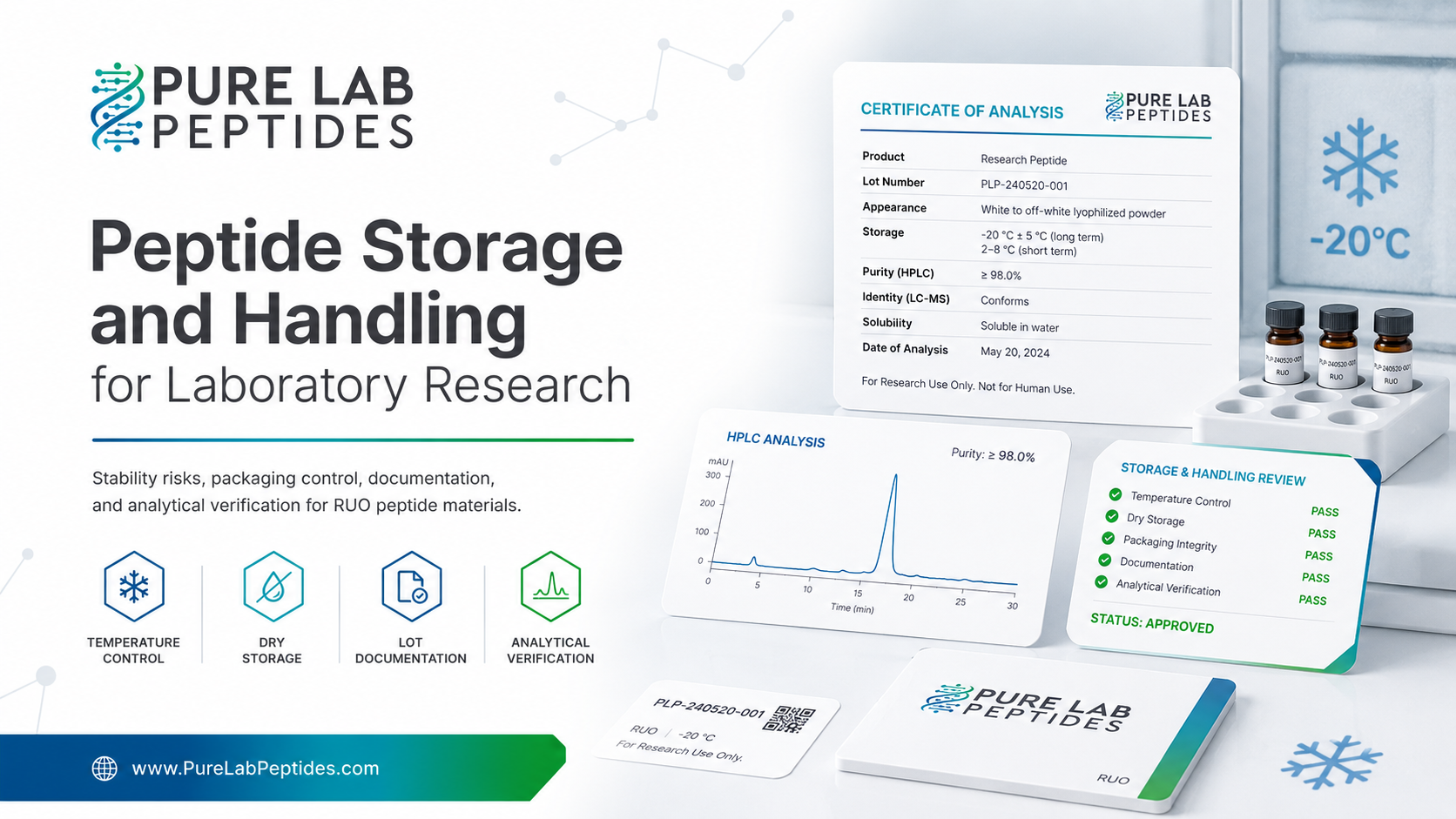
Peptide Storage and Handling for Laboratory Research is a stability-control topic, not a generic storage rule. Published peptide and polypeptide stability literature shows that temperature, moisture, light, oxidation, solution chemistry, and surface interactions can all alter molecular integrity over time, while aggregation risk depends on both sequence-related and external stresses. For research-use-only material, the practical objective is preserving lot integrity, analytical clarity, and experimental interpretability. [1][2][3][4]
Fast Answer
Peptide storage and handling for laboratory research should be driven by the batch label, the material state, and the peptide’s known stability liabilities. In practice, researchers try to limit nonvalidated exposure to heat, moisture, light, oxidative conditions, and unnecessary thermal cycling, then verify integrity analytically when extended holds or excursions could affect identity or purity. Products discussed in this article are intended for laboratory research use only and are not intended for human or animal consumption. [1][2][5]
What peptide storage and handling means in laboratory research
At a scientific level, “storage” is not just where a vial sits. ICH Q1A defines stability around how quality changes over time under environmental factors such as temperature, humidity, and light, while ICH Q5C notes that proteins and polypeptides can be especially sensitive to temperature change, oxidation, light, ionic content, and shear. Those principles are highly relevant to research peptides because the same degradation drivers can change the material a laboratory later evaluates by chromatography, spectroscopy, or bioassay. [1][2]
That is why peptide handling is best understood as a fit-for-purpose quality problem. Reviews of peptide instability describe both intrinsic factors, such as sequence, hydrophobicity, charge distribution, and self-association tendency, and external factors, such as pH, concentration, interfaces, container choice, and storage history, as important determinants of whether a peptide remains analytically consistent over time. A batch that has not obviously changed in appearance can still show altered impurity patterns, reduced recovery, oxidation products, or aggregation behavior. [3][4]
For laboratory teams, the implication is straightforward: there is no universal “best” storage condition that applies equally to every research peptide. Instead, a sound handling program anchors decisions to the lot-specific label, physical state, packaging, and any available stability documentation. Compendial chapter <659> exists to standardize packaging and storage-condition terminology, but the actual batch statement remains the primary reference point for day-to-day control. [1][5]
Which variables most often drive peptide instability
Chemical degradation is often the first concern when a peptide is held in solution or exposed to stress. ICH Q1A explicitly treats hydrolysis across a wide pH range as a relevant stress-testing consideration for substances in solution or suspension, and contemporary reviews of peptide formulation science identify hydrolysis, deamidation, and oxidation as recurring aqueous-solution liabilities for many peptide systems. In other words, once a peptide is no longer in a dry state, solution chemistry usually becomes more important, not less. [1][4]
Light and oxidative exposure are similarly important. ICH Q1B states that light testing should be an integral part of stress testing, and ICH Q5C places oxidation and light among the environmental variables to which proteins and polypeptides are particularly sensitive. For research settings, that means light protection is not just a shipping concern. It is part of preserving a peptide’s documented identity through receiving, storage, and bench handling. [2][6]
Physical instability can be just as consequential as chemical change. Reviews of peptide aggregation make clear that physical stability is affected by concentration, interfaces, temperature history, and molecular design, while broader protein and peptide stability reviews warn that repeated freeze-thaw exposure can promote adsorption at air-water, ice-water, and container interfaces. Earlier container-surface work also found measurable adsorption across pharmaceutical storage materials, with glass showing greater binding under the experimental conditions examined. [3][7][8]
Dry solids are not exempt from instability. Solid-state protein and peptide literature shows that dried systems still depend on residual moisture, glass transition behavior, and storage temperature, and classic lyophilized antibody work demonstrated that moisture content can materially influence long-term stability outcomes. For research peptides supplied as dry solids, moisture control and container integrity therefore remain central, even before any later analytical workflow begins. [9][10]
The table below summarizes the main stability drivers that laboratories usually evaluate when building a storage and handling framework for RUO peptides. [1][3][4]
| Risk factor | Common failure mode | Why it matters in laboratory research | Typical documentation or review point |
| Temperature excursion | Accelerated chemical degradation or aggregation [1][2] | Rates of change can shift during transport or out-of-range storage, complicating lot comparability. | Batch label, hold-time record, and excursion log [1] |
| Light exposure | Photodegradation or photo-oxidation [1][6] | Light-sensitive material can drift outside expected impurity or identity profiles without obvious visible change. | Light-protective packaging and handling notes [6] |
| Moisture ingress in dry solid | Higher molecular mobility and weaker solid-state stability [9][10] | Residual or absorbed moisture can alter long-term stability of dried peptide or protein systems. | Container closure integrity and dry-state storage statement [10] |
| Solution-state hold | Hydrolysis, deamidation, and oxidation [1][4] | Aqueous environments usually increase exposure to chemically relevant stresses. | Documented solution hold time and any stability rationale [1] |
| Freeze-thaw cycling | Interface stress, adsorption, and aggregation [7] | Repeated cycling can change recovery and physical stability even when nominal storage temperature appears acceptable. | Cycle count and post-event analytical review when justified [7] |
| Container and surface interaction | Adsorptive loss or destabilization [8] | Surface chemistry can influence recovery, particularly when exposure area is high relative to sample volume. | Container compatibility review and packaging controls [11] |
Why material state and packaging matter so much
For many research programs, the most important distinction is whether a peptide is being managed as a dry solid or as a solution. Drying and lyophilization are widely used in pharmaceutical protein science precisely because they can improve stability relative to aqueous systems, but solid-state stability is still conditional on moisture content, temperature, and the physical properties of the dried matrix. A lyophilized peptide is therefore often more manageable from a storage perspective than a solution, but it is not inherently immune to degradation. [4][9][10]
Once a peptide is in solution, the handling window usually becomes narrower. Q1A explicitly includes hydrolysis testing for solution and suspension states, and broader peptide instability reviews describe repeat freeze-thaw exposure as a relevant physical stress because interfaces formed during freezing and thawing can promote adsorption and aggregation. In practical research terms, material state changes the dominant risk profile, so handling records should track not only storage condition but also whether the batch remained dry or spent time in solution. [1][7]
Packaging is equally important. Q1A states that stability studies should be conducted in the same container closure system, or one that simulates the proposed packaging, and FDA guidance on container closure systems states that packaging should provide adequate protection from external factors such as temperature and light and should not be reactive, additive, or absorptive in a way that alters product quality. In short, the container is part of the stability system, not an afterthought. [1][11]
That is why a scientifically defensible peptide handling program considers both molecule and container together. A laboratory may have appropriate refrigeration or freezing capacity, but if the packaging offers poor light protection, allows moisture ingress, or increases surface interaction risk, the storage environment alone does not solve the problem. USP chapter <659> provides the compendial framework for packaging and storage terminology, while FDA guidance adds the compatibility and protective expectations that researchers can adapt into supplier review and receiving practices. [5][11]
The workflow below is an editorial synthesis of the cited stability, packaging, and analytical literature rather than a single published dataset.
How researchers verify integrity after storage and handling
After a peptide has been stored, shipped, or handled, the key question is not whether the vial “looks fine.” The real question is whether identity, purity, and related-substance profiles still support the intended laboratory work. ICH Q6A states that identification testing should discriminate between closely related structures and explicitly notes that identification based only on a single chromatographic retention time is not sufficiently specific. The same guideline recognizes combined orthogonal approaches such as HPLC with diode array detection or HPLC/MS as generally acceptable. [12]
In practice, RP-HPLC remains one of the foundational tools for peptide quality review because it is widely used to assess purity and related substances in peptide analysis. However, chromatography is strongest when it is interpreted alongside a second identity-oriented technique. Peptide analytical literature and current regulatory reviews therefore place chromatography in a broader framework that can include mass spectrometry, NMR, and other orthogonal methods matched to the peptide’s critical attributes. [13][14][15]
The FDA’s 2021 synthetic peptide guidance is especially useful here because it reflects the modern view that advances in high-resolution mass spectrometry, liquid chromatography, and multidimensional NMR now make far more thorough peptide characterization possible than was previously routine. For research teams, that does not mean every stored batch requires full characterization every time. It means any meaningful storage event, such as an unexplained excursion, prolonged transit, or repeated thawing, should be interpreted through an analytical lens rather than by assumption alone. [15]
As a result, post-storage review is usually most defensible when it is comparative. Laboratories often review the latest chromatogram against prior lot data, inspect intact-mass or LC-MS identity results when available, note visible changes, confirm packaging condition, and reconcile the full handling record. The purpose is not consumer-facing “safety” messaging or use guidance. It is protecting data quality by confirming that the research material still matches the analytical understanding on which the experiment depends. [11][12][14][15]
What to review before selecting an RUO peptide supplier
Storage success begins before a vial reaches the laboratory. From a procurement standpoint, the most useful peptide pages and batch documents are the ones that tell a research buyer exactly what is being stored, in what state, under what condition, with what analytical basis. That logic follows directly from stability and specification guidance, which ties interpretation to the documented storage condition, container closure context, and validated analytical procedures. [1][5][12][11]
Documentation fields that are especially useful
- A clear lot or batch identifier and explicit research-use-only labeling.
- A stated physical form, such as dry solid or solution, because handling risk changes with material state. [1][4]
- A certificate of analysis that links purity or impurity observations to an actual method, not just a standalone percentage. [12][13]
- An identity result supported by orthogonal or otherwise specific methodology when appropriate. [12][15]
- Storage language that is tied to the packaging context rather than presented as vague marketing copy. [5][11]
- Shipping, receiving, or excursion-related notes when the supplier provides them, because transport history can influence later interpretation. [1][11]
For research buyers, that means documentation quality is often more informative than headline purity alone. A peptide described as “99% pure” without method detail, identity support, or storage context gives a laboratory less decision value than a slightly more modest specification backed by a clear chromatographic method, identity confirmation, lot traceability, and packaging-aware handling statement. That is the difference between a marketing claim and an analytically interpretable batch record. [12][14][15]
FAQs
Is there one storage rule that works for every research peptide?
No. Storage expectations are not universal because peptide stability depends on the molecule, its physical state, the container, and the stresses it encounters over time. Regulatory and review literature consistently frames stability around environmental exposure and peptide-specific liabilities, so the safest research approach is to follow the batch documentation rather than relying on a one-rule-fits-all assumption. [1][2][3][4][5]
Is a lyophilized peptide automatically stable for long-term laboratory storage?
Not automatically. A lyophilized peptide is often easier to manage than a peptide kept in solution because it avoids many aqueous degradation pathways, but dry-state stability still depends on moisture control, temperature, and the physical properties of the dried material. Published solid-state work shows that residual moisture can materially affect long-term stability behavior. [4][9][10]
Why are repeated freeze-thaw events treated as a handling risk?
Repeated freeze-thaw exposure is treated cautiously because interface formation during freezing and thawing can promote adsorption and aggregation, especially for sensitive peptide or polypeptide systems. That does not mean every cycle produces the same level of change, but it does mean repeated cycling should be documented and considered when interpreting later analytical results. [3][7]
Is RP-HPLC alone enough to confirm that a stored peptide is still the same material?
RP-HPLC is extremely useful, but RP-HPLC alone is often not the strongest stand-alone identity tool. ICH Q6A notes that a single chromatographic retention time is not considered sufficiently specific for identification by itself, which is why peptide characterization programs commonly combine chromatographic purity review with LC-MS or another orthogonal method when identity confidence matters. [12][13][14]
What should a laboratory buyer request before purchasing an RUO peptide batch?
A laboratory buyer should request the lot identifier, RUO labeling, storage statement, material state, and a COA that ties identity and purity results to specific analytical methods. Those items matter because modern peptide guidance emphasizes orthogonal characterization, explicit specifications, and packaging-aware quality controls rather than relying on a purity percentage without method context. [11][12][15]
Next Steps
Review batch-specific documentation before selecting any research-use-only peptide. Explore Pure Lab Peptides for RUO peptide compounds with clear labeling, research-focused product information, and available documentation. For research teams comparing peptide suppliers, prioritize COA availability, transparent labeling, and lot-level documentation. [12][15]
References
- International Council for Harmonisation. “Q1A(R2) Stability Testing of New Drug Substances and Products.” ICH Guideline. 2003. ich.org/Q1A(R2)
- International Council for Harmonisation. “Q5C Quality of Biotechnological Products: Stability Testing of Biotechnological/Biological Products.” ICH Guideline. 1995. ich.org/Q5C
- Zapadka KL, Becher FJ, Gomes dos Santos AL, Jackson SE. “Factors affecting the physical stability (aggregation) of peptide therapeutics.” Interface Focus. 2017. doi.org/10.1098/rsfs.2017.0030
- Nugrahadi PP, Hinrichs WLJ, Frijlink HW, Schoneich C, Avanti C. “Designing Formulation Strategies for Enhanced Stability of Therapeutic Peptides in Aqueous Solutions: A Review.” Pharmaceutics. 2023. doi.org/10.3390/pharmaceutics15030935
- United States Pharmacopeia. “General Chapter <659> Packaging and Storage Requirements.” USP-NF. 2021. doi.org/10.31003/USPNF_M2773_06_01
- International Council for Harmonisation. “Q1B Photostability Testing of New Drug Substances and Products.” ICH Guideline. 1996. ich.org/Q1B
- Shi M, McHugh KJ. “Strategies for overcoming protein and peptide instability in biodegradable drug delivery systems.” Advanced Drug Delivery Reviews. 2023. doi.org/10.1016/j.addr.2023.114904
- Burke CJ, Steadman BL, Volkin DB, Tsai PK, Bruner MW, Middaugh CR. “The adsorption of proteins to pharmaceutical container surfaces.” International Journal of Pharmaceutics. 1992. doi.org/10.1016/0378-5173(92)90034-Y
- Chen Y, Mutukuri TT, Wilson NE, Zhou QT. “Pharmaceutical protein solids: drying technology, solid-state characterization and stability.” Advanced Drug Delivery Reviews. 2021. doi.org/10.1016/j.addr.2021.02.016
- Breen ED, Curley JG, Overcashier DE, Hsu CC, Shire SJ. “Effect of Moisture on the Stability of a Lyophilized Humanized Monoclonal Antibody Formulation.” Pharmaceutical Research. 2001. doi.org/10.1023/A:1013054431517
- U.S. Food and Drug Administration. “Container Closure Systems for Packaging Human Drugs and Biologics: Chemistry, Manufacturing, and Controls Documentation.” FDA Guidance for Industry. 1999. fda.gov/media/70788/download
- International Council for Harmonisation. “Q6A Specifications: Test Procedures and Acceptance Criteria for New Drug Substances and New Drug Products: Chemical Substances.” ICH Guideline. 2000. ich.org/Q6A
- Mant CT, Chen Y, Yan Z, Popa TV, Kovacs JM, Mills JB, Tripet BP, Hodges RS. “HPLC Analysis and Purification of Peptides.” In Peptide Characterization and Application Protocols. Methods in Molecular Biology. 2007. doi.org/10.1007/978-1-59745-430-8_1
- Lian Z, Wang Y, Tian Y, et al. “Characterization of Synthetic Peptide Therapeutics Using Liquid Chromatography-Mass Spectrometry: Challenges, Solutions, Pitfalls, and Future Perspectives.” Journal of the American Society for Mass Spectrometry. 2021. doi.org/10.1021/jasms.0c00479
- U.S. Food and Drug Administration. “ANDAs for Certain Highly Purified Synthetic Peptide Drug Products That Refer to Listed Drugs of rDNA Origin.” FDA Guidance for Industry. 2021. fda.gov/media/107622/download