

Researchers evaluating where to buy MOTS-c for research should start with compound identity, COA availability, analytical testing, lot traceability, and clear RUO labeling rather than consumer-facing claims. MOTS-c is described in research databases and literature as a 16-amino acid mitochondrial-derived peptide associated with the MT-RNR1, or 12S rRNA, region of mitochondrial DNA [1] [2] [3]. This product-page guide frames MOTS-c as a laboratory research peptide within metabolic and mitochondrial research, with published pathway context kept separate from product positioning.
Researchers looking to buy MOTS-c for research should prioritize identity documentation, batch-specific COA review, HPLC purity data, LC-MS or mass spectrometry identity support, lot traceability, and RUO labeling. Products discussed in this article are intended for laboratory research use only and are not intended for human or animal consumption. The safest commercial research path is documentation-first review.
Start with the basics: compound name, lot number, product label, COA, purity method, identity method, storage documentation, and supplier documentation. These records should tell one consistent story across the product listing and batch-specific materials.
A COA is most useful when it is tied to a defined lot rather than presented as a generic quality statement. ATCC’s COA retrieval process, for example, relies on an item number and lot number to retrieve lot-specific documentation [25].
RUO labeling sets the intended research context before procurement review begins. FDA guidance for IVD products labeled RUO is not a peptide-specific standard, but it is a useful official source for the broader principle that research-only labeling and product representations must align [26].
For a Pure Lab Peptides product page, that means the page should focus on identity, analytical testing, literature context, and documentation. It should not translate academic findings into consumer-facing claims.
MOTS-c is commonly expanded as mitochondrial open reading frame of the 12S rRNA-c. PubChem lists MOTS-c with molecular formula C101H152N28O22S2 and molecular weight 2174.6 g/mol [1]. UniProt identifies the human entry as “mitochondrial-derived peptide MOTS-c,” associated with MT-RNR1 and a 16-amino acid length [2].

In research classification, MOTS-c belongs in the metabolic and mitochondrial research lane. NCBI Gene identifies MT-RNR1 as mitochondrially encoded 12S RNA, an rRNA gene on mitochondrial chromosome MT [3].
The compound is best framed as a research peptide and mitochondrial-derived peptide. That framing keeps product-page language focused on identity, documentation, and literature context.
PubChem lists the condensed peptide sequence as H-Met-Arg-Trp-Gln-Glu-Met-Gly-Tyr-Ile-Phe-Tyr-Pro-Arg-Lys-Leu-Arg-OH [1]. UniProt also identifies MOTS-c as a 16 amino acid peptide associated with the human MT-RNR1 gene entry [2].
Sequence and molecular-weight data matter because they help research buyers compare the product page, label, COA, and analytical report. A purity percentage alone does not replace identity review.
Mitochondrial-derived peptides are described as peptides encoded by short open reading frames in mitochondrial DNA. A review by Fuku and colleagues describes MOTS-c as a mitochondrial open reading frame of the 12S rRNA-c and places it within the broader mitochondrial-derived peptide category [7].
That context matters for MOTS-c research because it connects the peptide to mitochondrial signaling, gene regulation, and metabolic model literature. It does not create a product claim.
A product-page article should target the canonical compound, not a product variant. MOTS-c peptide research can include identity, analytical testing, literature review, and documentation standards while avoiding separate SEO targeting for catalog amounts.
For search intent, “buy MOTS-c peptide for research” is safer than a standalone commercial phrase because it keeps the intent inside an RUO procurement frame. The phrase buy MOTS-c should not appear by itself as a consumer-facing prompt.
The safe primary phrase is buy MOTS-c for research. It serves commercial research intent while making the research-use-only boundary visible.
Canonical targeting also avoids unnecessary variant pages. The main entity is MOTS-c, not a strength-specific or amount-specific page.
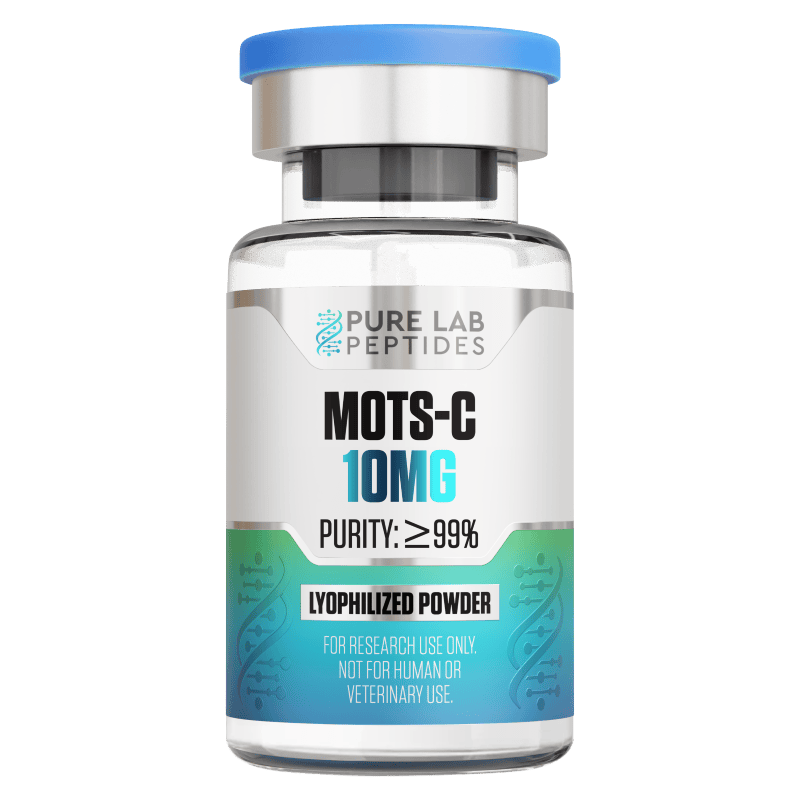
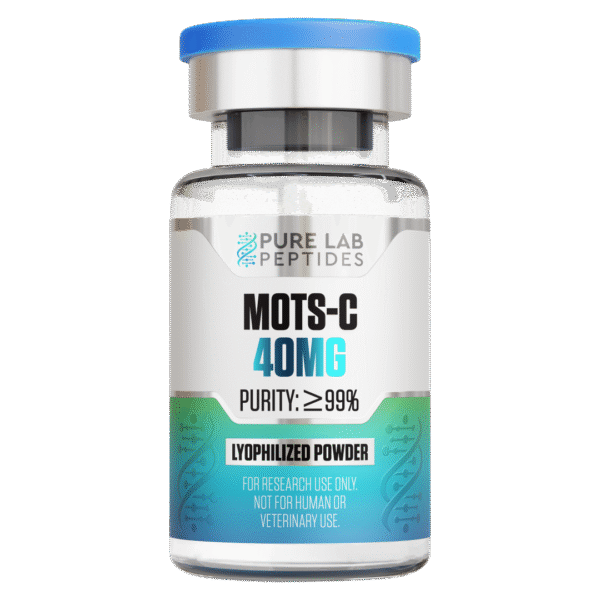
A 10mg listing can be referenced as a catalog amount when it appears in a product listing or inventory context. It should not be framed as a research-method quantity or outcome-related specification.
Neutral catalog language helps keep the product page aligned with technical procurement. The useful question is whether the listing, label, COA, and lot details match.
Research buyers should compare the compound name, lot number, molecular weight, sequence information, stated purity method, identity method, and COA date. ICH Q2(R2) describes analytical procedure validation around performance characteristics such as specificity, accuracy, precision, and range for identity, impurity, purity, and assay-related measurements [17].
The review should be documentation-led. If a page emphasizes language beyond identity, literature, and analytical support, that language should be separated from product positioning.
Published MOTS-c research often examines mitochondrial signaling, metabolic stress, and cell-to-nucleus communication. Kim and colleagues reported that MOTS-c can translocate to the nucleus in response to metabolic stress and regulate nuclear gene expression in a model-specific research setting [5].
This is a research-literature point. It should be used to explain why MOTS-c appears in metabolic and mitochondrial research, not to imply a product function.
Mitochondrial signaling describes how mitochondria contribute to cellular communication and adaptive responses. Reviews on MOTS-c describe it as a mitochondrial-encoded or mitochondria-derived signaling peptide within stress, metabolism, and gene-expression literature [8] [10].
For product-page writing, the safer phrasing is “mitochondrial signaling research.” It avoids turning pathway context into product claims.
Foundational MOTS-c literature describes links among cellular glucose handling, mitochondrial pathways, and fatty acid metabolism in experimental models [4]. AMPK literature separately describes AMP-activated protein kinase as a cellular energy sensor involved in energy homeostasis [13].
The research interpretation is narrow. Metabolism and energy homeostasis are pathway topics, not consumer-facing promises.
Cellular energy language should stay attached to model systems, study endpoints, and pathway interpretation. Ross and colleagues describe AMPK as a cellular energy-status sensor expressed broadly across eukaryotic cells [14].
On an RUO page, “cellular energy” is acceptable when it describes literature context. It should not become a product-performance statement.

AMPK activation is a recurring theme in MOTS-c research literature. Lee and colleagues described MOTS-c in connection with the folate-purine-AMPK pathway in metabolic-homeostasis research models [4].
The product-page task is to explain the pathway at a high level. It should not convert pathway findings into practical use claims.
AMPK is studied as a kinase complex that senses cellular energy status and participates in metabolic regulation [13] [14]. In MOTS-c literature, AMPK pathway discussion appears alongside purine metabolism, glucose metabolism, and mitochondrial signaling [4].
A useful article should explain where AMPK fits, then stop at the RUO boundary. The product page should not imply product-directed pathway activity.
Glucose uptake appears in skeletal muscle and cell-model literature. Kurth-Kraczek and colleagues studied AMPK activation and GLUT4 translocation in skeletal muscle, while Richter and Hargreaves reviewed skeletal muscle GLUT4 and glucose uptake mechanisms [15] [16].
MOTS-c research may reference glucose uptake as a model-specific endpoint. That endpoint belongs to literature interpretation, not product positioning.
Pathway relevance means a compound appears in a research model connected to a biochemical pathway. It does not mean a research material is positioned for outcomes outside laboratory research.
This distinction is central for buy MOTS-c for research intent. Commercial research pages should answer procurement and documentation questions, not consumer-outcome questions.
Skeletal muscle appears in MOTS-c literature because it is an important tissue context for glucose and metabolic pathway research. Lee and colleagues reported skeletal muscle-related findings in their foundational MOTS-c study [4].
Research-page copy should treat skeletal muscle as a model context. It should not turn tissue-specific literature into product claims.
Mechanistic context helps explain why MOTS-c appears alongside AMPK activation, glucose metabolism, and GLUT4-related literature. Bhullar and colleagues studied MOTS-c-related GLUT4 translocation in cellular research involving mitochondrial dynamics [12].
The right framing is narrow and technical. A product page can describe what literature examines without implying outcomes from the product.
Insulin sensitivity appears in MOTS-c literature as a research-model topic. Lee and colleagues described MOTS-c in metabolic-homeostasis research that included insulin sensitivity endpoints [4].
This phrase requires careful handling. On an RUO product page, it should appear only as literature context and should not be presented as a product effect.
Lab teams should avoid overstating model-specific findings, especially when a study examines cells, tissues, or preclinical systems. A study endpoint is not the same as a product-page claim.
A safer sentence is: “Published literature has examined MOTS-c in metabolic pathway models.” A less safe sentence would present pathway activity as something a research material is meant to deliver.
Published literature helps identify what research areas exist, what models have been used, and what limitations should guide interpretation. It does not replace COA review, analytical testing, supplier documentation, or lot traceability.
| Research Area | What Literature Examines | Evidence Type | RUO Interpretation |
|---|---|---|---|
| Compound identity | MOTS-c as a 16-amino acid mitochondrial-derived peptide associated with MT-RNR1/12S rRNA-C [1] [2] [3] | Database and literature | Supports identity review, not product claims |
| Metabolic pathway context | Folate-purine-AMPK pathway and glucose metabolism in model-specific research [4] | Mechanistic literature | Useful for literature framing only |
| Gene expression context | MOTS-c translocation and nuclear gene expression under metabolic stress [5] [6] | Mechanistic and review literature | Supports pathway discussion with limits |
| Review-level context | MOTS-c research across mitochondrial signaling and metabolism [8] [9] [10] | Review literature | Helps map research areas without product positioning |
| Analytical verification | HPLC, LC-MS, mass spectrometry, and reference-material concepts [19] [20] [22] | Analytical literature and official reference materials | Supports documentation review |
Preclinical MOTS-c literature often focuses on metabolic pathway models, mitochondrial signaling, glucose metabolism, and stress-response biology. Reviews by Zheng, Wan, and Gao summarize a broader MOTS-c research landscape while noting that evidence remains model-specific [9] [10] [11].
That evidence category is useful for research context. It should not be carried into product copy as a direct claim.
In vitro laboratory research can clarify cell signaling, gene expression, glucose uptake, and pathway-specific endpoints under controlled conditions. Kim and colleagues reported metabolic-stress-linked nuclear translocation and gene expression findings in experimental models [5].
In vitro data can help researchers understand mechanistic hypotheses. It cannot, by itself, define product purpose.
Translational limits protect the difference between research literature and product positioning. Some published literature outside the scope of RUO product use has examined this compound class in human study settings. That literature should not be interpreted as a use claim for research-use-only materials.
A product page should therefore treat literature as background. The procurement decision should focus on identity, COA, analytical methods, and supplier documentation.

A safer way to interpret the literature is to separate study findings from product-page statements. Literature can examine mechanisms, but a product page should emphasize documentation, analytical testing, and RUO status.
Product performance language can drift into claim territory when separated from model-specific context. That is why RUO content should make the boundary visible.
Study findings depend on model type, study design, assay conditions, and the research question being asked. Even when a study examines AMPK activation or glucose metabolism, the finding remains tied to its experimental context [4] [13].
A Pure Lab Peptides product page should not imply that a research material produces the same findings described in literature. It should explain what the literature discusses and what the documentation shows.
Claim boundaries mean the product page should avoid product-outcome statements and focus on research procurement. The strongest RUO framing is documentation-first: identity, purity, lot traceability, label clarity, and analytical support.
This approach also helps search intent. Researchers evaluating where to buy MOTS-c for research need a page that answers technical procurement questions.
Documentation gives the page a practical center. COA review, HPLC data, LC-MS identity support, and lot-specific records are concrete research procurement topics.
That focus keeps MOTS-c research context from drifting into unsupported claims. It also gives lab teams a consistent way to evaluate research materials.

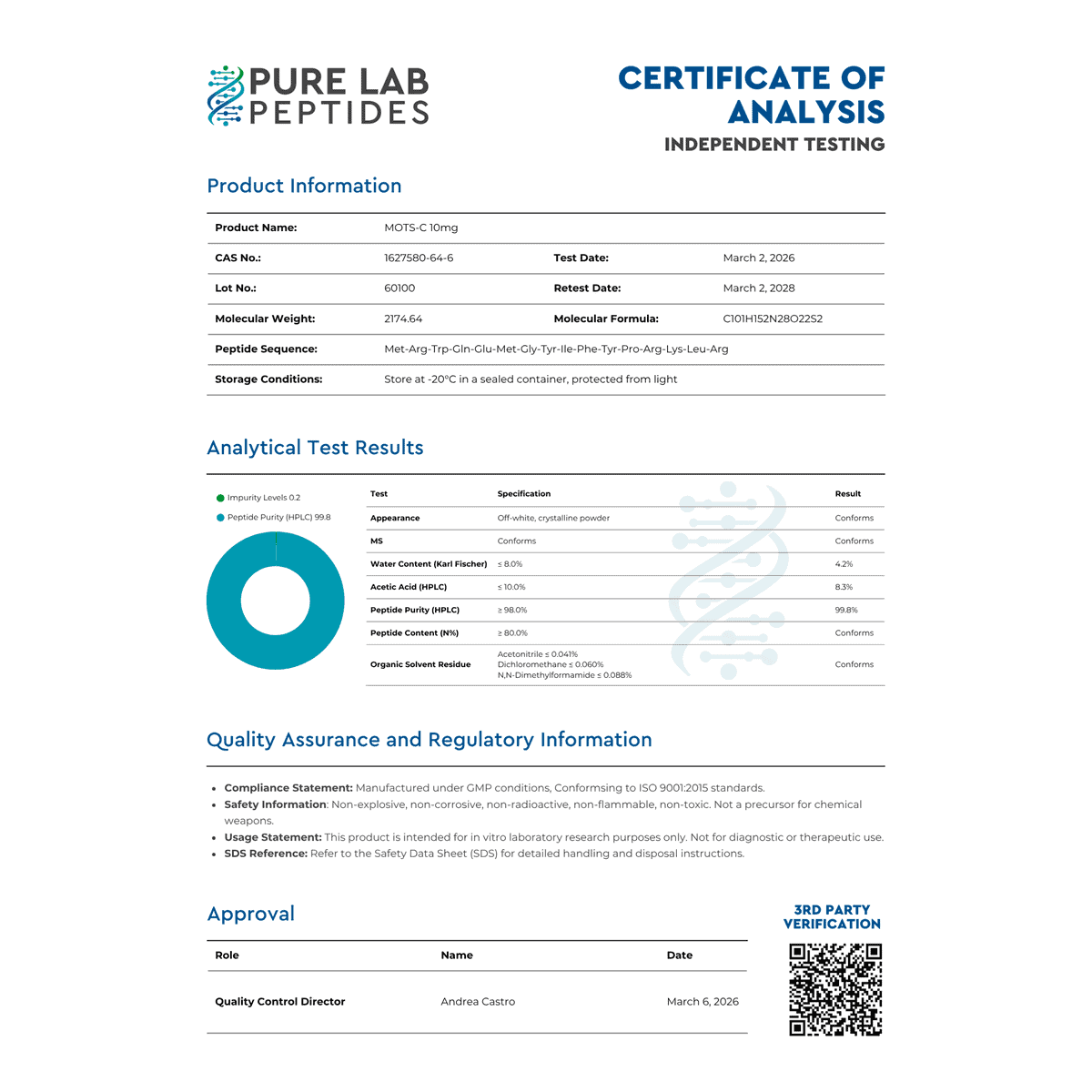
COA documentation should be batch-specific, clear, and consistent with the product label. Lot number, compound name, purity method, identity method, COA date, and supplier information should be easy to review.
NIST states that its Standard Reference Materials support accurate and compatible measurements through well-characterized composition or properties [24]. That principle is useful for thinking about why documented reference materials and traceable records matter in laboratory review.
A COA review should include compound name, lot number, assay or purity data, analytical method, identity support, testing date, and issuing lab or supplier source. ATCC’s COA resource shows the practical importance of exact lot-number matching when retrieving certificate documentation [25].
For MOTS-c, COA review should be paired with identity review. Purity and identity answer different questions.
Lot-specific data helps connect the product listing to the actual research material. Without lot-level alignment, a COA may not be useful for procurement review.
Research procurement teams should check whether the lot number appears consistently on the product label, COA, and supplier documentation. This is a documentation control issue, not a product-outcome issue.
COA dates help clarify when the analytical record was generated. Batch scope helps clarify which material the record covers.
A dated, lot-specific COA gives the procurement team a document that can be filed, reviewed, and compared. That is more useful than a generic purity statement.

Purity and identity testing serve different roles. HPLC can support purity review by separating peptide-related components, while mass spectrometry can support identity review through molecular-mass and mass-to-charge information [19] [23].
A strong documentation package explains which methods were used. It also connects those methods to a specific lot.
HPLC is widely used for peptide analysis and purification, including reversed-phase and other separation modes [19]. NIST’s peptide reference material documentation describes area percent purity measurements using HPLC and capillary electrophoresis as analytical approaches for peptide materials [23].
For a MOTS-c product page, HPLC data should be discussed as purity documentation. It should not be presented as proof of complete identity by itself.
LC-MS combines liquid chromatography separation with mass spectrometry detection. Tuli and colleagues describe liquid chromatography as a common way to separate peptides and proteins before mass-spectrometry-based detection and identification [21].
Short peptide identity can require careful analytical discrimination. Hollebrands and colleagues discuss LC-MS identification challenges for short homologous peptides, showing why identity review benefits from suitable analytical detail [20].
Mass spectrometry sorts ions by mass-to-charge ratio and can support molecular identity evaluation when paired with suitable reference data. NIST RM 8321 was designed to support peptide identification work in mass-spectrometry-based proteomics and LC-linked measurement approaches [22].
For peptide research procurement, mass spectrometry should be evaluated as part of a broader documentation package. The label, COA, lot number, and analytical record should match.
Batch traceability connects a research material to its documentation history. It gives technical procurement teams a way to review what was listed, what was tested, and what was supplied.
Supplier documentation should include RUO labeling, batch-specific COA access, analytical method information, and storage documentation. These items make the product page useful for laboratory research review.
Lot numbers allow researchers to tie a COA to a specific research material. ATCC’s COA lookup process requires the lot number exactly as displayed on the label or packing documentation, which illustrates why lot-level precision matters [25].
For MOTS-c research materials, the same review logic applies. Lot mismatch should trigger documentation review before procurement decisions proceed.
Labeling consistency means the compound name, lot number, amount, and RUO status should match across the product page, label, COA, and supporting records. If one document describes the material differently, the discrepancy should be resolved.
This is especially important for peptides with similar naming conventions. MOTS-c, MOTS-C, and MOTS c may appear in search behavior, but technical documentation should use one clear compound identity.
Storage documentation should clarify the material format, stated storage conditions, and recordkeeping needs. NIST peptide reference-material documentation shows that peptide materials can be described with format and storage details, including lyophilized materials in a controlled documentation context [23].
For a product page, the key point is not practical handling instruction. The key point is that storage information should be documented in laboratory records.
MOTS-c research is often misunderstood when pathway language is pulled away from its literature context. The safest product-page approach is to keep every research claim tied to a model, method, citation, or documentation item.
Misunderstandings usually happen when a page tries to answer consumer-intent questions instead of research procurement questions. This guide avoids that shift.
Research use means the page is written for laboratory research context. It does not mean the product page should make claims based on every area of published literature.
A product page can say MOTS-c appears in metabolic pathway literature. It should not say that a product creates the pathway findings described in a study.
Metabolic peptide pages need extra restraint because keywords in this lane can easily drift into consumer-facing language. Safer copy emphasizes “metabolic pathway research,” “mitochondrial signaling,” “COA documentation,” and “analytical testing.”
The same restraint applies to insulin sensitivity and glucose metabolism language. These terms belong in cited research context, not as product positioning.
Product pages should emphasize documentation, identity, lot traceability, and RUO status. They should also explain how to read the literature without turning it into claims.
Common misunderstandings to correct are simple: published literature is not product guidance, pathway relevance is not a product claim, a purity percentage does not prove complete identity, a COA should match the lot, and catalog amounts are listing details.
A documentation-first product page gives research buyers a practical review path. It answers the commercial research question without moving outside RUO boundaries.
Use this lab-test verification workflow for documentation review:
Practical quality and documentation checklist:
Pure Lab Peptides product-page content should support buy MOTS-c for research intent through clear RUO framing, accessible documentation, and technical procurement language. The most useful page elements are compound identity, COA review points, analytical testing notes, lot traceability, and careful literature interpretation.
Pure Lab Peptides supplies compounds for laboratory research use only. Products are not intended for human or animal consumption, diagnostic use, therapeutic use, clinical use, veterinary use, or as food, drugs, cosmetics, dietary supplements, or household products. Researchers are responsible for ensuring lawful, appropriate handling and use in accordance with applicable regulations and institutional guidelines.
Review the product-page documentation, COA details, and RUO labeling before evaluating this compound for laboratory research.
Researchers should consider documentation first before they buy MOTS-c for research. A research-use-only review should focus on COA availability, peptide identity, lot traceability, analytical testing, and supplier documentation. For high-quality research peptides, the product listing, label, and batch-specific records should align before any laboratory research use is evaluated.
MOTS-c is described in mitochondrial research literature as a mitochondrial derived peptide associated with the MT-RNR1, or 12S rRNA, region [1] [2] [3]. The literature frames MOTS-c as part of metabolic and mitochondrial signaling research, where researchers examine pathway models, gene expression, and cellular energy context without converting those findings into product claims.
MOTS-c fits into metabolic pathway research through literature that examines metabolism, AMPK-related signaling pathway context, and energy homeostasis in experimental models [4]. These topics should be interpreted as research context only. A product page should describe what published literature investigates while keeping product documentation, RUO labeling, and analytical review separate from claims.
Mitochondrial signaling matters for MOTS-c research pages because it helps explain why the compound appears in literature about the mitochondrion, metabolic stress, and gene regulation [5]. That context can support research interpretation, but it should not be written as product positioning. RUO pages should keep the focus on compound identity, documentation, and published literature boundaries.
Researchers should interpret boundary-sensitive language around MOTS-c as wording that requires strict separation from product claims. Terms such as physical performance, metabolic dysfunction, insulin resistance, and clinical applications can drift into consumer-facing or clinical-use framing. On an RUO page, those terms should remain tied to literature boundaries, documentation review, analytical testing, and lot traceability.
Product format documentation matters for MOTS-c research materials because it helps laboratory teams record how a material is labeled and described. If a listing identifies a lyophilized format, that information should be treated as documentation context, not product guidance. Researchers should compare the format, lot number, COA, and storage records across supplier documentation.
The following authors are recognized for published research that helped shape the scientific context discussed in this article.
Author profile: Changhan Lee – Google Scholar
Changhan Lee’s research on mitochondrial‑derived peptides, including work on MOTS‑c regulation of metabolic and mitochondrial signaling mechanisms, contributes to the foundational scientific understanding of how small mitochondrial peptides interact with cellular pathways related to energy metabolism and skeletal muscle regulation. Lee’s publications have been cited in peer‑reviewed literature that examines MOTS‑c as a mitochondrial open reading frame peptide and its biochemical relationships with metabolic pathway models, providing context for published literature on mitochondrial peptide research that informs the broader article discussion.
Selected publications:
Author profile: M. Cristina Kenney – PubMed
M. Cristina Kenney is an author on a comprehensive review that examines MOTS‑c as a recent mitochondrial‑encoded peptide and its regulatory roles in cellular metabolic context, helping provide literature context on mitochondrial‑encoded peptides and their signaling mechanisms in metabolic research. Her work synthesizes findings related to 12S rRNA‑encoded peptides and mitochondrial dysfunction, offering perspective on how peptide identity and mitochondrial signaling have been characterized in peer‑reviewed scientific publications relevant to research peptide literature.
Selected publications:
This research disclaimer clarifies how this page handles published literature and search language around MOTS-c. In metabolic and mitochondrial research content, phrases such as effects of MOTS-c, efficacy of MOTS-c, bioavailability, clinical outcomes, wellness language, consumer outcomes, product performance, therapeutic language, and administration-focused language can drift into product-claim territory when framed incorrectly. On this page, those phrases are treated only as examples of wording that requires careful separation from product positioning.
The focus remains on research procurement, compound characterization, research documentation, supplier documentation, peptide identity, COA review, analytical testing, peptide purity, lot traceability, RUO labeling, and published literature boundaries. MOTS-c literature may include model-specific research context, but that context should not be converted into personal-use guidance, product-performance claims, or consumer-facing outcomes. This page keeps the discussion centered on documentation review and research-use-only interpretation.
Discount Applied Successfully!
Your savings have been added to the cart.




There are no reviews yet.