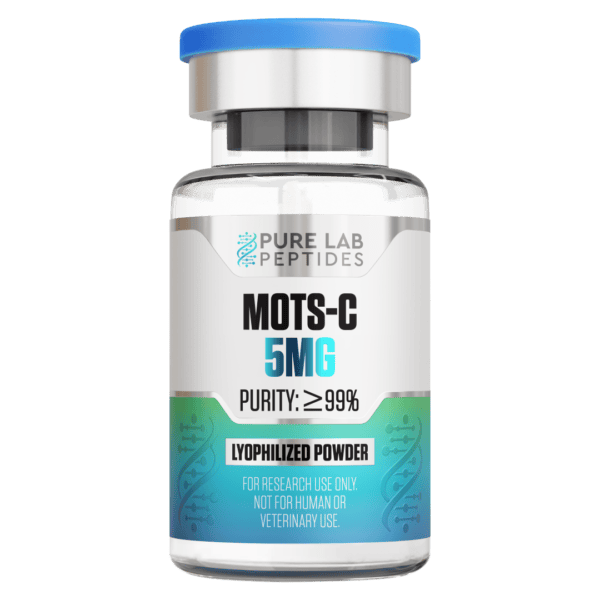

MOTS-C 10mg

$99.97

(5.0)

Research Studies:

  • Facilitates AMPK activation by inhibiting the folate cycle and inducing AICAR accumulation assays
  • Supports investigation into stress-induced nuclear translocation and antioxidant response element gene expression
  • Enables research on GLUT4 translocation and fatty acid oxidation in metabolic homeostasis models
  • Useful for evaluating myostatin inhibition through the AKT-FOXO1 and mTORC2 signaling pathways

Description

MOTS-C 10mg is a research-use-only laboratory material supplied for controlled research workflows, compound characterization, and analytical documentation review. It is manufactured under rigorous quality standards to support consistency, traceability, and batch-specific verification for qualified laboratory settings.

Key Product Details

  • Manufactured in accordance with rigorous quality standards to support ≥99% purity, as reflected in batch-specific documentation where available.
  • Every batch is third-party analyzed for identity, assay/potency, and sterility documentation where applicable.
  • Supplied in lyophilized powder form to help preserve stability throughout transport and storage.
  • Produced with lot-level traceability to support research documentation and laboratory recordkeeping.

Research Documentation Context

  • Supports compound characterization in controlled laboratory settings.
  • Provides batch-specific identity and purity documentation for research review.
  • Allows lot-level traceability across laboratory documentation workflows.
  • Supports comparison of product labeling, analytical documentation, and storage information during research planning.
  • Supports analytical review of peptide research materials within a strictly laboratory-focused context.

Specifications and Documentation

  • Certificate of Analysis: Available with batch-specific documentation where applicable.
  • Material Safety Data Sheet: Coming Soon.
  • Handling and Storage Instructions: Coming Soon.
  • Product Form: Lyophilized powder.
  • Purity Specification: ≥99% purity.
  • Intended Use: Laboratory research use only.

MOTS-C 10mg is intended strictly for laboratory research use only. This product is not intended for human or animal consumption, therapeutic use, diagnostic use, clinical use, veterinary use, or as a food, drug, cosmetic, dietary supplement, or household product.

Additional information

CAS No.

1627580-64-6

Purity

≥99%

Sequence

Met-Arg-Trp-Gln-Ile-Lys-Gly-His-Phe

Molecular Formula

C51H76N16O12

Molecular Weight

1111.25 g/mol

Synthesis

Solid-phase synthesis

Format

Lyophilized powder

Solubility

Soluble in water or 1% acetic acid

Stability & Storage

Stable for up to 24 months at -20°C. After reconstitution, may be stored at 4°C for up to 4 weeks or at -20°C for up to 6 months.

Applications

Mitochondrial function research, exercise endurance studies, aging and longevity research

Appearance

White lyophilized powder

Shipping Conditions

Shipped at ambient temperature; once received, store at -20°C

Regulatory/Compliance

Manufactured in a facility that adheres to cGMP guidelines

Safety Information

Refer to provided MSDS

There are no reviews yet.

We value your feedback. Please leave a review below:

Research Procurement Information

Buy MOTS-c Online for Laboratory Research | COA Guide

Researchers searching for buy MOTS-c online should evaluate MOTS-c as a research-use-only laboratory material, not a consumer product. For laboratory buyers, the key considerations are compound identity, purity documentation, batch-specific COAs, lot traceability, RUO labeling, and storage information. This guide explains how qualified research institutions and technical procurement teams can evaluate MOTS-c 10mg for controlled research procurement through Pure Lab Peptides while keeping scientific literature separate from product-use claims.

Fast Answer: buy MOTS-c online for laboratory research

Researchers can buy MOTS-c online for laboratory research by reviewing RUO labeling, batch-specific COA documentation, purity data, identity information, storage guidance, and supplier transparency before selecting a source. Products discussed in this article are intended for laboratory research use only and are not intended for human or animal consumption.

What Does “Buy MOTS-c Online” Mean in a Research Context?

The phrase `buy MOTS-c online` is addressed here as laboratory research procurement intent, not personal-use intent. In this context, the search query belongs to qualified researchers, laboratory buyers, technical procurement teams, and research institutions comparing research-use-only materials and supplier documentation.

RUO procurement is documentation-centered. Researchers should review whether a material is clearly labeled for research use only, whether the supplier provides batch-specific documentation, whether the product name and lot number match the COA, and whether purity and identity data are supported by an analytical method. The U.S. regulation for IVD labeling uses the RUO statement “For Research Use Only. Not for use in diagnostic procedures” in a specific IVD context, and FDA guidance discusses RUO labeling as distinct from clinical or diagnostic use for IVD products [1] [2]. For MOTS-c research procurement, the practical takeaway is straightforward: commercial search intent should be converted into documentation review, not into product-use assumptions.

MOTS-c Research Material Overview

MOTS-c is described in scientific databases and peer-reviewed literature as a mitochondrial-derived peptide associated with the mitochondrial 12S rRNA region. PubChem lists MOTS-c with molecular formula C101H152N28O22S2, while UniProt identifies the human MOTS-c entry as a 16-amino-acid sequence associated with MT-RNR1 [3] [4]. Published literature first characterized MOTS-c as a short mitochondrial open reading frame peptide and later examined its relationship to mitochondrial-nuclear signaling and metabolic-stress models [5] [6].

For procurement purposes, MOTS-c should be treated as a MOTS-c research material whose identity is evaluated through sequence, molecular-weight, chromatographic, and mass-based documentation. Peptides are generally understood as compounds formed by amide linkage between amino-acid residues, and IUPAC peptide nomenclature describes peptide bonds in that chemical context [7]. Literature reviews discuss MOTS-c within mitochondrial-derived peptide research, mitochondrial signaling, and AMPK-pathway model systems, but those publications should be read as scientific context rather than instructions for RUO material use [8] [9] [10].

Metabolic pathway literature should not be translated into weight-loss, performance, or wellness claims for RUO materials. MOTS-c research-use-only procurement should remain focused on compound characterization, batch-specific COA review, purity documentation, identity testing, supplier transparency, and laboratory recordkeeping.

Why Researchers Search “Buy MOTS-c Online”

Researchers search “buy MOTS-c online” to identify sources that can support laboratory purchasing requirements. The relevant questions are not consumer questions. They are procurement questions: Is the material labeled RUO? Is a batch-specific COA available? Does the COA identify the compound and lot number? Is purity supported by a suitable analytical method? Does supplier language avoid dosing, therapeutic, or personal-use claims?

When a technical team uses the shorter query buy MOTS-c, the evaluation should still remain documentation-driven. A credible MOTS-c supplier documentation package should support traceability from product page to label to COA. For MOTS-c purity documentation, researchers should look for the stated purity claim, testing method, and lot-level alignment. For MOTS-c identity testing, the review should include whether chromatographic or mass-spectrometric data support the listed compound. A purchasing record should also include storage and handling documentation so that the material can be managed consistently in controlled laboratory settings.

Research Procurement Checklist for MOTS-c

  • Verify that MOTS-c is labeled for research use only.
  • Review the batch-specific certificate of analysis before procurement.
  • Confirm that the COA includes identity and purity documentation.
  • Check whether HPLC, LC-MS, mass spectrometry, or another analytical method is listed.
  • Compare the product name, lot number, and documentation for consistency.
  • Assess whether the supplier avoids dosing, therapeutic, diagnostic, or personal-use claims.
  • Document storage and handling information in laboratory records.
  • Evaluate whether the lyophilized powder form matches the planned research workflow.
  • Confirm that the product is not marketed for human or animal consumption.

MOTS-c Quality Signals to Review Before Buying Online

Before researchers buy MOTS-c online for laboratory research, the strongest quality signals are batch-specific documentation, clear RUO labeling, analytical support for identity and purity, lot-level traceability, and supplier language that stays within research procurement boundaries.

Evaluation Area What Researchers Should Review Why It Matters for RUO Procurement
RUO labeling Confirm the product is clearly labeled for research use only Helps separate research procurement from human-use positioning
COA availability Review the available batch-specific certificate of analysis Supports lot-level documentation and quality review
Purity data Look for analytical support for the stated purity Helps evaluate material consistency
Identity testing Review HPLC, LC-MS, mass spectrometry, or related identity data Helps confirm the material matches the listed compound
Lot traceability Match lot numbers across product and documentation Supports research recordkeeping
Product form Confirm whether the material is supplied as lyophilized powder or another documented form Supports laboratory planning
Storage information Review storage and handling documentation Helps maintain material integrity in laboratory settings
Supplier language Confirm the supplier avoids dosing, therapeutic, or personal-use claims Supports research-use-only positioning

COA, Purity, and Identity Documentation

A MOTS-c COA should be reviewed as a batch-specific research record, not as a marketing summary. Researchers should check the compound name, lot number, test date, purity percentage, test method, identity confirmation, molecular weight where listed, sequence where listed, chromatogram or mass data where available, product form, and storage documentation. A purity percentage alone does not establish complete compound identity; researchers should evaluate purity, identity, method, lot number, and documentation together.

HPLC is widely used in peptide analysis and purification, including reversed-phase, ion-exchange, size-exclusion, and mixed-mode approaches [11]. Modern peptide purity work can require chromatographic separation strategies because structurally related peptide species or isomers may not be resolved by mass information alone [12]. LC-MS and high-resolution mass spectrometry are also used in peptide impurity and identity work, especially when structurally related impurities require characterization [13].

Analytical validation guidance is not a substitute for supplier documentation, but it explains why specificity, accuracy, precision, range, and method suitability matter in analytical review. ICH Q2(R2) provides a framework for analytical procedure validation, while FDA guidance for analytical procedures and methods validation discusses documentation supporting identity, quality, purity, and related attributes in regulated drug and biologic contexts [14] [15]. ISO/IEC 17025 describes competence and consistent operation expectations for testing and calibration laboratories, and Eurachem provides method-validation guidance for analytical laboratories [16] [17]. NIST reference-material documentation also illustrates how certificate records and lot identifiers support traceability in measurement workflows [18].

Use this workflow when reviewing MOTS-c purity documentation and MOTS-c identity testing records:

flowchart TD A[Receive product and COA] --> B{RUO labeling present?} B -- No --> C[Flag procurement gap] B -- Yes --> D{Lot number matches across label and COA?} D -- No --> E[Request batch-specific documentation] D -- Yes --> F{Identity supported by analytical method?} F -- No --> G[Request HPLC, LC-MS, or equivalent] F -- Yes --> H[Proceed to laboratory documentation and storage]

For research records, the COA should be kept with the purchase record, lot number, product page documentation, and any internal receiving notes. Researchers should review the product page and batch-specific documentation before adding MOTS-c 10mg to a controlled laboratory inventory.

Research Literature Context

Published literature has examined MOTS-c as a mitochondrial-derived peptide and as a model-system subject in mitochondrial signaling research. Early work identified MOTS-c as a 16-amino-acid peptide and examined pathway relationships in preclinical systems [5]. Later work reported nuclear translocation and nuclear gene-expression regulation in response to metabolic stress, which is relevant to research context but not to RUO product-use guidance [6] [19].

Review articles discuss mitochondrial-derived peptides, MOTS-c research models, and the broader literature landscape [8] [9] [20]. Some papers examine MOTS-c in human observational or intervention settings by measuring endogenous MOTS-c levels in biological samples; those studies should be understood as literature about endogenous biology, not validation of any synthetic RUO research material [21] [22] [23].

Published clinical literature should not be interpreted as use guidance for RUO materials. Findings from database records, in vitro studies, preclinical models, reviews, and human measurement studies do not establish product-use instructions, procurement suitability, or intended-use claims for MOTS-c 10mg. The proper RUO interpretation is narrower: literature can help researchers understand nomenclature, category context, and analytical identity, while supplier documentation determines whether a particular lot is adequately documented for laboratory procurement.

Evidence Landscape

Research Area What Literature Examines Evidence Type RUO Interpretation
Compound identity Molecular structure, sequence, formula, and mitochondrial-derived peptide classification Database / analytical Supports identification, not product-use claims
Pathway or category context Mitochondrial-derived peptide literature, mitochondrial-nuclear signaling models, and AMPK-pathway research context Review / in vitro / preclinical Useful for research context, not therapeutic claims
Analytical testing Purity, identity, and batch verification through chromatography and mass-based methods HPLC / LC-MS / mass spectrometry / COA Supports documentation review
Storage and stability Material form, storage notation, and handling considerations documented by supplier records Laboratory documentation Supports research workflow planning

Claim Boundary Table

Research-Safe Statement Why It Is Acceptable Non-Compliant Version to Avoid
“MOTS-c is discussed in published research related to mitochondrial-derived peptide and cellular signaling models.” Describes literature context without making a product claim “MOTS-c helps with a human outcome.”
“Researchers should review COA and identity data before procurement.” Focuses on documentation and quality review “Users should buy MOTS-c for results.”
“Pure Lab Peptides supplies MOTS-c as a research-use-only material.” Clarifies intended use “Pure Lab Peptides supplies MOTS-c for therapy.”
“The phrase buy MOTS-c online is addressed as research procurement intent.” Qualifies commercial search intent “Buy MOTS-c online for personal use.”
“MOTS-c supplier documentation should be evaluated at the lot level.” Connects procurement to traceability and records “Supplier claims can replace analytical documentation.”

How Pure Lab Peptides Presents MOTS-c

Pure Lab Peptides presents MOTS-c 10mg as a research-use-only material for laboratory research procurement. The product is supplied as lyophilized powder, carries a ≥99% purity claim, and has a batch-specific COA available for review. Researchers should evaluate the product page, RUO labeling, purity information, storage and handling documentation, lot-level traceability, and supplier transparency before procurement.

Review the Pure Lab Peptides MOTS-c research-use-only product details for RUO labeling, product details, purity information, and batch-specific documentation. Researchers comparing multiple materials can also review the broader research peptide collection for documentation consistency across product pages.

Common Misunderstandings About Buying MOTS-c Online

Misunderstanding: “Buy MOTS-c online” means personal use

Buy MOTS-c online should not be interpreted as personal-use guidance on this page. The phrase is addressed as laboratory procurement intent for qualified researchers reviewing RUO labeling, documentation, purity data, identity information, and supplier transparency.

Misunderstanding: Published literature equals product-use guidance

Published MOTS-c literature provides research context, not instructions for using a research-use-only material. Database records, pathway studies, reviews, and measurement studies should be separated from supplier documentation and should not be converted into product-use claims.

Misunderstanding: Purity percentage alone proves identity

Purity data are important, but they do not fully establish identity by themselves. Researchers should evaluate the MOTS-c COA, method information, lot number, chromatographic or mass data, product label, and supplier documentation together.

Misunderstanding: COA documentation does not need to be batch-specific

Batch specificity matters because research records should connect the product received to the documentation reviewed. A MOTS-c COA should align with the product name, lot number, and testing information for the material under review.

Misunderstanding: RUO labeling supports human or animal use

RUO labeling does not support human-use, animal-use, diagnostic, therapeutic, or consumer positioning. It limits the material to controlled laboratory research contexts and keeps procurement evaluation focused on documentation, identity, purity, storage, and traceability.

FAQs About Buying MOTS-c Online for Research

Where can researchers buy MOTS-c online for laboratory research?

Researchers can buy MOTS-c online for laboratory research by reviewing an RUO supplier that provides clear product labeling, purity information, batch-specific COA access, identity documentation, and storage details. Pure Lab Peptides provides a MOTS-c 10mg product page for research procurement review.

What should researchers check before buying MOTS-c online?

Before buying MOTS-c online, researchers should check RUO labeling, the available batch-specific COA, purity claim, identity testing method, lot number consistency, product form, storage documentation, and supplier language. The supplier should avoid personal-use, dosing, therapeutic, diagnostic, or consumer-positioned claims.

Why does a COA matter when buying MOTS-c?

A COA matters when buying MOTS-c because it gives researchers a batch-specific record to review against the label and purchase record. A useful COA should support identity and purity review through listed methods, lot information, test details, and documentation that matches the product being procured.

Is MOTS-c intended for human or animal consumption?

MOTS-c discussed here is not intended for human or animal consumption. The material is addressed only as a research-use-only laboratory compound. Researchers should evaluate it through procurement controls, batch documentation, RUO labeling, storage records, and supplier transparency, not through consumer or clinical frameworks.

What does research use only mean for MOTS-c?

Research use only means MOTS-c is positioned for controlled laboratory research and documentation review, not for personal, clinical, veterinary, diagnostic, or consumer use. For procurement teams, RUO status shifts the evaluation toward identity, purity, COA availability, lot traceability, and supplier language.

How should published literature about MOTS-c be interpreted?

Published literature about MOTS-c should be interpreted as scientific context for compound identity, mitochondrial-derived peptide classification, analytical review, and research-model discussion. It should not be interpreted as product-use guidance for RUO materials, and it should not replace batch-specific supplier documentation.

Next Steps

Qualified researchers evaluating MOTS-c should review product labeling, COA status, identity documentation, storage information, and supplier transparency before selecting any research-use-only material. Review the MOTS-c 10mg product page for RUO labeling, purity information, and available batch-specific documentation.

References

  1. Electronic Code of Federal Regulations. “21 CFR 809.10 – Labeling for in vitro diagnostic products.” eCFR. Current. https://www.ecfr.gov/current/title-21/chapter-I/subchapter-H/part-809/subpart-B/section-809.10
  2. U.S. Food and Drug Administration. “Distribution of In Vitro Diagnostic Products Labeled for Research Use Only or Investigational Use Only.” FDA Guidance Document. 2013; page current 2018. https://www.fda.gov/regulatory-information/search-fda-guidance-documents/distribution-in-vitro-diagnostic-products-labeled-research-use-only-or-investigational-use-only
  3. National Center for Biotechnology Information. “Mots-c | C101H152N28O22S2 | CID 146675088.” PubChem Compound Database. https://pubchem.ncbi.nlm.nih.gov/compound/Mots-c
  4. UniProt Consortium. “MT-RNR1 – Mitochondrial-derived peptide MOTS-c.” UniProtKB. Entry A0A0C5B5G6. https://www.uniprot.org/uniprotkb/A0A0C5B5G6/entry
  5. Lee C, Zeng J, Drew BG, Sallam T, Martin-Montalvo A, Wan J, et al. “The mitochondrial-derived peptide MOTS-c promotes metabolic homeostasis and reduces obesity and insulin resistance.” Cell Metabolism. 2015;21(3):443-454. https://pubmed.ncbi.nlm.nih.gov/25738459/
  6. Kim KH, Son JM, Benayoun BA, Lee C. “The Mitochondrial-Encoded Peptide MOTS-c Translocates to the Nucleus to Regulate Nuclear Gene Expression in Response to Metabolic Stress.” Cell Metabolism. 2018;28(3):516-524.e7. https://pubmed.ncbi.nlm.nih.gov/29983246/
  7. IUPAC-IUB Joint Commission on Biochemical Nomenclature. “Nomenclature and Symbolism for Amino Acids and Peptides.” IUPAC Recommendations. https://iupac.qmul.ac.uk/AminoAcid/A1113.html
  8. Lee C, Kim KH, Cohen P. “MOTS-c: A novel mitochondrial-derived peptide regulating muscle and fat metabolism.” Free Radical Biology and Medicine. 2016;100:182-187. https://pubmed.ncbi.nlm.nih.gov/27216708/
  9. Wan W, Zhang L, Lin Y, Rao X, Wang X. “Mitochondria-derived peptide MOTS-c: effects and mechanisms related to stress, metabolism and aging.” Journal of Translational Medicine. 2023;21:36. https://pubmed.ncbi.nlm.nih.gov/36670507/
  10. Zheng Y, Wei Z, Wang T. “MOTS-c: A promising mitochondrial-derived peptide for therapeutic exploitation.” Frontiers in Endocrinology. 2023. https://www.frontiersin.org/journals/endocrinology/articles/10.3389/fendo.2023.1120533/full
  11. Mant CT, Chen Y, Yan Z, Popa TV, Kovacs JM, Mills JB, Tripet B, Hodges RS. “HPLC Analysis and Purification of Peptides.” Methods in Molecular Biology. 2007;386:3-55. https://pubmed.ncbi.nlm.nih.gov/18604941/
  12. Stoll DR, Sylvester M, Euerby MR, Buckenmaier SMC, Petersson P. “A Strategy for Assessing Peak Purity of Pharmaceutical Peptides in Reversed-Phase Chromatography Methods Using Two-Dimensional Liquid Chromatography Coupled to Mass Spectrometry. Part II.” Journal of Chromatography A. 2023;1693:463873. https://pubmed.ncbi.nlm.nih.gov/36871316/
  13. Stoppacher N, Josephs RD, Daireaux A, Choteau T, Westwood S, Wielgosz RI. “Accurate quantification of impurities in pure peptide material – angiotensin I: comparison of calibration requirements and method performance characteristics of LC-MS systems.” Rapid Communications in Mass Spectrometry. 2015;29(18):1651-1660. https://pubmed.ncbi.nlm.nih.gov/26467117/
  14. U.S. Food and Drug Administration. “Q2(R2) Validation of Analytical Procedures.” FDA Guidance Document. 2024. https://www.fda.gov/regulatory-information/search-fda-guidance-documents/q2r2-validation-analytical-procedures
  15. U.S. Food and Drug Administration. “Analytical Procedures and Methods Validation for Drugs and Biologics.” FDA Guidance Document. 2015. https://www.fda.gov/regulatory-information/search-fda-guidance-documents/analytical-procedures-and-methods-validation-drugs-and-biologics
  16. International Organization for Standardization. “ISO/IEC 17025:2017 – General requirements for the competence of testing and calibration laboratories.” ISO Standard. 2017; reviewed 2023. https://www.iso.org/standard/66912.html
  17. Cantwell H, ed. “The Fitness for Purpose of Analytical Methods: A Laboratory Guide to Method Validation and Related Topics.” Eurachem Guide. 2025. https://www.eurachem.org/index.php/publications/guides/mv
  18. National Institute of Standards and Technology. “Standard Reference Materials FAQs.” NIST. https://www.nist.gov/srm/faqs
  19. Benayoun BA, Lee C. “MOTS-c: A Mitochondrial-Encoded Regulator of the Nucleus.” BioEssays. 2019;41(9):e1900046. https://pubmed.ncbi.nlm.nih.gov/31378979/
  20. Mohtashami Z, Singh MK, Salimiaghdam N, et al. “MOTS-c, the Most Recent Mitochondrial Derived Peptide in Human Aging and Age-Related Diseases.” International Journal of Molecular Sciences. 2022;23(19):11991. https://www.mdpi.com/1422-0067/23/19/11991
  21. D’Souza RF, Woodhead JST, Hedges CP, et al. “Increased expression of the mitochondrial derived peptide, MOTS-c, in skeletal muscle of healthy aging men is associated with myofiber composition.” Aging. 2020;12(6):5244-5258. https://pubmed.ncbi.nlm.nih.gov/32182209/
  22. Dieli-Conwright CM, Sami N, Norris MK, et al. “Effect of aerobic and resistance exercise on the mitochondrial peptide MOTS-c in Hispanic and Non-Hispanic White breast cancer survivors.” Scientific Reports. 2021;11:16916. https://www.nature.com/articles/s41598-021-96419-z
  23. von Walden F, Fernandez-Gonzalo R, Norrbom J, et al. “Acute endurance exercise stimulates circulating levels of mitochondrial derived peptides in humans.” Journal of Applied Physiology. 2021;131(4):1035-1042. https://pubmed.ncbi.nlm.nih.gov/34351816/