



Shipping Research Peptides: Records and Stability Evidence

Shipping research peptides requires a material record as well as delivery dates. Match identity and form to the transport history and applicable stability evidence. A transit estimate plans receipt; it doesn’t establish the conditions experienced or a later analytical result.
TL;DR · The short version
Start with the preparation, container and material-specific instructions. Transport conditions and analytical results have different jobs. A published dried-mixture study doesn’t establish an acceptable journey for every peptide or solution, so this guide offers no universal time or temperature promise.
Shipping research peptides: start with the material
Quick takeaway: Match the preparation before borrowing a shipping conclusion.
A dried analytical mixture, single peptide salt and solution are different preparations. A shared peptide name may still conceal composition or container differences.
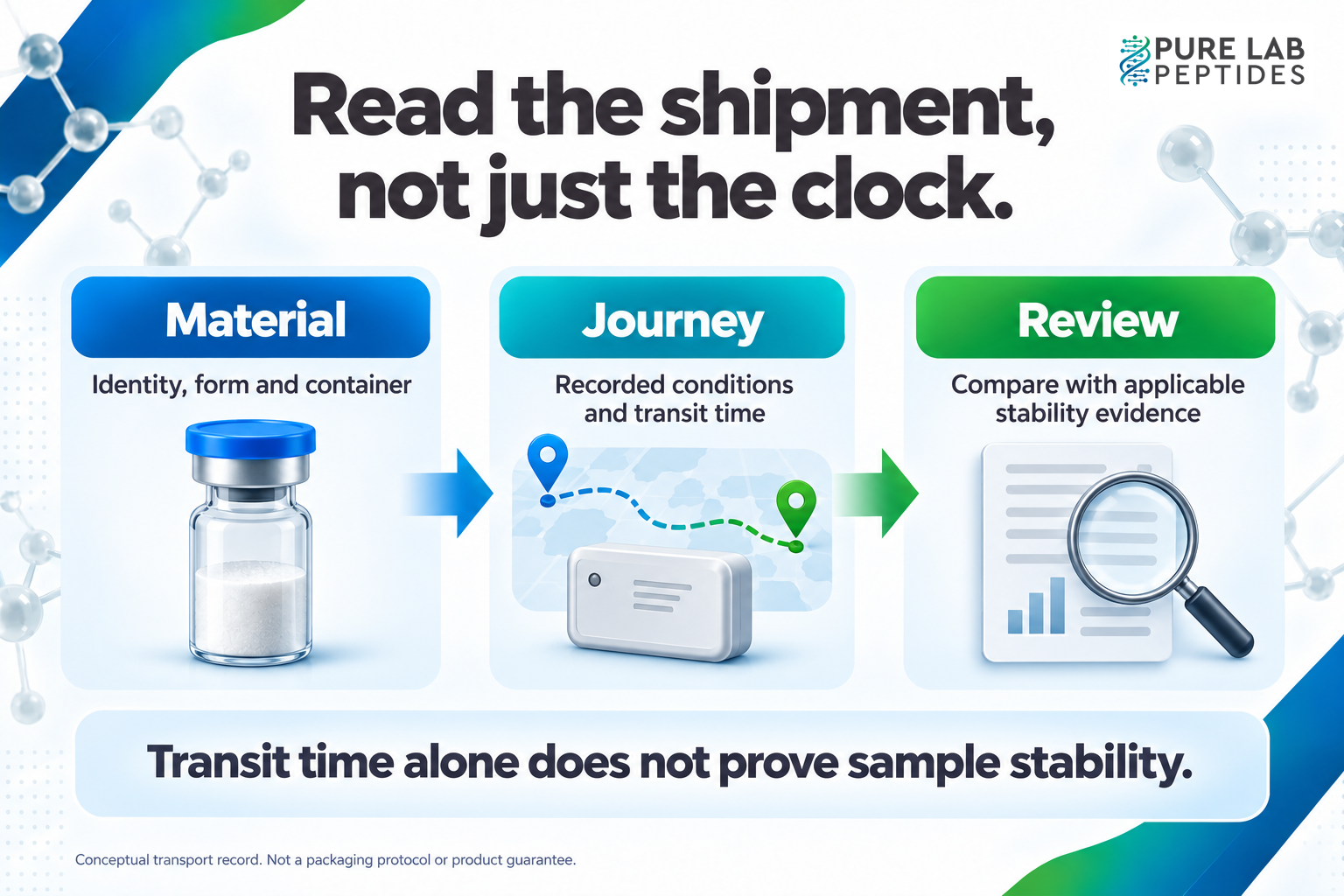
Record identity, form, formulation and container before comparing a journey with a study. Check whether its endpoint was chemical integrity or performance in an analytical assay; those aren’t interchangeable results.
For more on how form and measurement affect interpretation, see peptide stability and research documentation.
Keep the journey and the result separate
Quick takeaway: A delivery record describes the journey. An assay describes the tested sample.
| Record | What to retain | Question it helps answer |
|---|---|---|
| Material record | Product identity, batch, form and container description | Which material was shipped? |
| Transport record | Dispatch and receipt times, available condition records and relevant shipment references | What is known about the journey? |
| Stability evidence | Tested preparation, exposure, comparison sample and analytical endpoint | Which findings are applicable? |
| Receipt note | Observed package and container condition, recorded date and follow-up questions | What was actually observed on arrival? |
A delivery estimate isn’t a temperature history. Retain a condition logger’s data and location if one was used. Otherwise, mark conditions unknown rather than rebuilding the journey from a weather forecast.
Unknown conditions don’t independently make a shipment unsuitable. They identify a boundary between the available observations and assumptions.
What original transport studies can tell you
Quick takeaway: Read the tested preparation and endpoint alongside the headline result.
In a 2018 multi-laboratory study by Steffen and colleagues, dried tryptic peptide samples from human cell lysates were shipped from Australia to Europe and China without cooling. The laboratories compared LC-MS findings, including quantitative reproducibility and peptide chemical modification, with the starting samples. The findings supported that transport approach for the study’s downstream proteomics analysis.
A 2021 study by Gaither and colleagues examined a lyophilized mixture of 125 synthetic peptides and its performance in multiple reaction monitoring mass-spectrometry assays. It included room-temperature observations up to 20 days and a shipment from Canada to Iceland without dry ice, with desiccant. The reported assay performance was retained under the conditions tested.
These studies are useful because they measured outcomes. Neither supplies a 20-day shipping allowance for an unrelated product, a complete packaging protocol or evidence about every functional endpoint. The material and assay are part of the finding, not background details to discard.
A COA has a sample and a date
Quick takeaway: Connect a laboratory report to the material tested and when it was tested.
Read the COA’s lot, sample reference and date. If the transport question depends on whether testing occurred before or after shipment, document that relationship explicitly.
Don’t turn pre-shipment testing into post-shipment evidence. A delay or package feel also isn’t an analytical result. Either observation can prompt a specific follow-up question.
Keep the report and shipment identifiers linked in your research record. Our lot traceability guide explains how to preserve that connection, and the testing-methods guide explains the different measurements.
Make the receiving note useful
Quick takeaway: Record what you can observe, then use the material-specific instructions.
A practical receipt note can identify the shipment, date, batch and observed package and container condition. If instructions or condition records accompany the material, retain them alongside it. Photographing a label can help with identification, but it does not replace the corresponding document.
For a hypothetical delayed shipment, ask which preparation and conditions the supplier’s evidence covers. Save that clarification with the lot record. The delay alone doesn’t answer the stability question.
Follow the particular material’s supplied instructions. This guide doesn’t prescribe a universal cold chain, ice pack, temperature or packaging procedure. Accurate records help you assess the evidence without inventing the missing conditions.