



Preclinical vs Clinical Research: How to Read Peptide Evidence

TL;DR: Preclinical vs clinical research distinguishes settings and study designs. Cell and animal experiments explore questions before or alongside human research; studies in people still depend on their population, design and outcomes. None certifies the contents of a retail research vial.
An encouraging title leads you into a peptide paper. In the methods, the experiment turns out to use a cell line. That detail sets the scope of the conclusion, even if the finding itself is sound.
The model tells you which question was answered. We’ll keep it beside the result as we compare study types, so several experiments don’t collapse into one broader claim.
Preclinical vs clinical research: the practical difference
Quick take: Start with the model, then check what was measured.
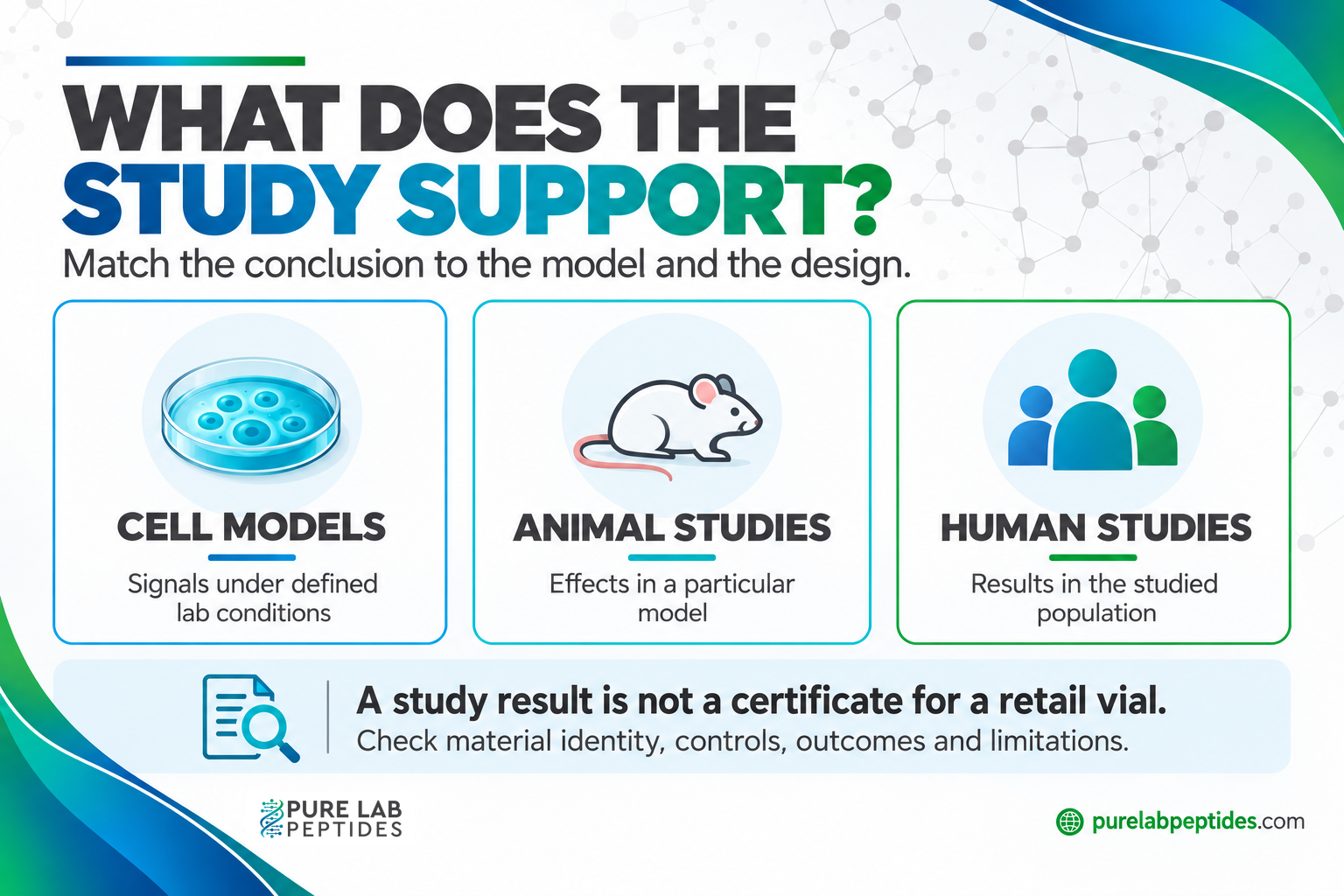
Preclinical research often uses cell systems and animal models to investigate biological activity, exposure or toxicity before human trials. NCATS defines preclinical studies in that development context. Exploratory peptide experiments can be much narrower than a complete drug-development program.
Clinical research involves people. It includes observational studies as well as clinical trials that test an intervention. The National Institute on Aging’s explanation makes that distinction clear. “Studied in humans” doesn’t tell you, by itself, whether researchers assigned a treatment or simply observed an association.
Drug-development trial phases also have different purposes. Phase 1 usually emphasizes safety and tolerability; Phase 2 adds preliminary efficacy evidence; Phase 3 provides broader comparative safety and effectiveness data; and Phase 4 examines use after approval. These stages help you interpret a paper’s purpose. An early-phase result doesn’t answer every later-stage question.
| Evidence setting | Useful question | Limit to keep with the result |
|---|---|---|
| In vitro cell model | What changed in this controlled system? | The result belongs to the cells and experimental conditions tested |
| Animal study | What happened in this organism and model? | Species, model, exposure and endpoints affect relevance |
| Observational human study | Which factors were associated with an outcome? | Association can reflect confounding or selection |
| Interventional human trial | What happened after the assigned intervention? | Design, comparator, population and follow-up limit the conclusion |
A strong cell experiment can resolve a mechanism while leaving human efficacy open. A human study may measure a relevant clinical endpoint but still be too small or poorly controlled to settle it. The setting doesn’t replace the design.
Study design matters at every stage
Quick take: A more advanced setting doesn’t rescue weak methods.
For an animal study, identify the species, model, experimental unit, sample size and control. Then check random allocation, assessor knowledge and the handling of exclusions. Those details explain how the comparison was made.
The ARRIVE 2.0 checklist brings those reporting details together. It also asks for defined outcomes, procedures and results with appropriate measures of variability. This is information you need to assess a study, not a stamp guaranteeing that the findings are correct.
For a randomized trial, follow allocation, blinding, comparator, prespecified outcomes, missing data and follow-up. Read the effect with its uncertainty and participant count. A percentage means less when you can’t see the denominator.
CONSORT 2025 sets out reporting items for randomized trials, including participant flow and benefits and harms. Use it as a reading aid. A completed checklist improves transparency; it doesn’t turn an uncertain result into a proven treatment.
If the statistics are slowing the reading down, note the comparator, measurement and uncertainty first. Those three answers are more useful than the abstract’s descriptive adjectives.
Why an animal result may not translate into the same human result
Quick take: Translation is a research question, not an automatic next step.
A cell dish, a selected animal model and a group of human participants have different biology and conditions. Exposure can differ too: a laboratory concentration or an animal dosing schedule isn’t a human-use instruction. Pharmacokinetics, the way a compound is absorbed, distributed and cleared, can change what reaches the target.
A molecular marker, animal behavior and patient-centered outcome need separate evidence. An improvement in one doesn’t establish an improvement in the others.
A 2024 umbrella review of animal-to-human translation examined distinct stages, including entry into human studies and eventual regulatory approval, across its included interventions. Its value here is the distinction between those stages. A pooled figure from that selected literature isn’t the success probability of every peptide, nor a verdict on an individual study.
Keep the scope in both directions. An animal result isn’t human efficacy, but preclinical work can provide strong mechanistic evidence. Judge the question the study tested.
A worked example: tighten the claim without losing the finding
Quick take: Name the material, model and outcome before writing the conclusion.
Imagine a hypothetical paper reporting that Peptide A changed a signaling marker in a cultured cell line, compared with a vehicle control. The investigators measured the marker after a defined exposure. No people were enrolled.
A useful summary would be: “In this cell model, Peptide A changed the measured signaling marker under the tested conditions.” That gives the finding its proper shape.
“Peptide A improves health” adds a population, outcome and benefit that the experiment never tested. “Peptide A has no value because there are no human data” goes too far the other way. The study may support the next experiment even while clinical relevance remains open.
For a closer look at that leap from pathway to benefit, read mechanism of action versus efficacy.
The material in a paper is not automatically the material in a vial
Quick take: Literature and lot documentation answer separate questions.
Match the name in the paper with the actual sequence, modifications, chemical form and formulation described in its methods. A shared shorthand name is a place to start, not the whole identity record. Our sequence and notation guide helps with those details.
Then review the documentation for the particular research lot. Analytical identity, purity and labeled amount are separate from the biological findings in a publication. A COA can report tests on a sample; it doesn’t transfer a clinical trial’s outcome to a retail vial. See purity versus identity if those terms are being used as though they mean the same thing.
Be especially careful when a study used a formulated intervention or modified peptide and a catalogue uses a family name. The headline can’t supply the missing material match.
A short checklist for the next paper you read
Quick take: Save a precise conclusion and the main limit together.
- Material: What exact substance or formulation was studied?
- Model: Cells, an animal model, an observational population or an intervention trial?
- Comparison: What was the control, and how were groups selected?
- Outcome: What changed, by how much, and with what uncertainty?
- Conclusion: What does that result support, and what hasn’t been tested?
The our practical guide to reading peptide research covers the full reading process. Add the study setting to every saved summary; it makes comparisons clearer and keeps conclusions tied to their evidence.