



Albumin Binding Peptide Research: Affinity, DAC and Half-Life

An albumin-binding sequence and a DAC reactive handle use different chemistry. Compare evidence of association, retained activity and pharmacokinetics without conflating them.
Cell Migration Assays: Scratch, Transwell and 3D Models

A cell migration assay must match the movement question. Scratch assays measure net gap closure, transwells measure passage through a membrane, and matrix barriers add invasion-related constraints. Control for cell number, division, survival and starting geometry before attributing a difference to movement.
Angiogenesis Assays: Networks, Sprouting and Perfusion Evidence

A branching image and evidence of blood flow answer different questions. Compare angiogenesis studies by model, matrix, measured endpoint and controls.
Ghrelin Receptor: Baseline Activity, Controls and Evidence

A receptor result needs more than a target name. Check baseline activity, receptor construct, controls and the endpoint before comparing GHSR findings.
GHRP-2 Research: Receptor Context and Release Assays

GHRP-2 research includes receptor and hormone-release experiments. Two pituitary-cell studies reported contrasting antagonist findings, so species and preparation belong beside the conclusion. Secretion, signaling and binding results should not be merged into an unrestricted potency or benefit claim.
Amino Acid Abbreviations: Codes and Sequence Examples

Amino acid abbreviations encode residues in a defined order. GHK means Gly-His-Lys. The letter D in a sequence means aspartic acid, while the prefix in D-Phe describes stereochemistry. Preserve modifications and ambiguity labels when transcribing a sequence.
Third-Party Peptide Testing: What the Report Establishes

Third-party peptide testing is work performed by an external laboratory on a submitted sample. Its value comes from the sample match, suitable methods and readable results. Independence alone does not establish every property or describe every future batch.
Peptide Purity, Identity and Content: What Each Result Means
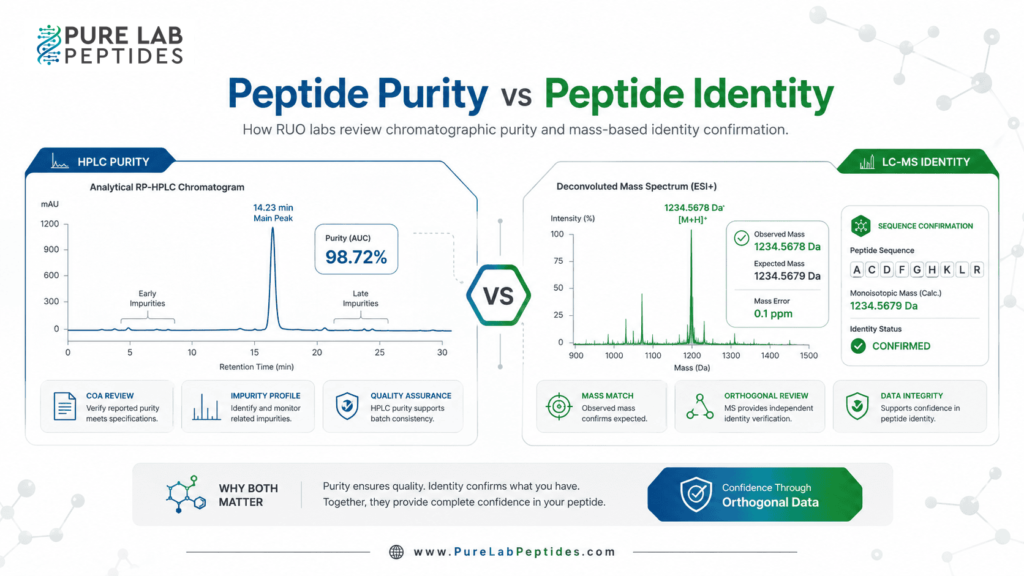
Purity, identity and content answer different analytical questions. This guide explains which evidence supports each one and how to compare reports.
Peptide Purity Testing: HPLC, Identity and Vial Content

Peptide purity testing gives several different answers. HPLC area purity describes detected peaks; identity testing examines what the material is; a content assay measures how much is present. Read the method and reporting basis before comparing percentages.
LC-MS Peptide Identity: What the Test Results Support

A matching mass is one part of peptide identity review. Learn how separation, precursor ions and MS/MS fragments support an assignment, and what to ask the lab.