



Batch Release Documentation: Read the Evidence Trail

Batch release documentation connects a batch with the records reviewed for its release decision. A COA answers a narrower question about tests on its stated sample. Follow the material, specification, test results and documented decision together rather than treating the certificate as the whole record.
TL;DR · The short version
Give the specification, report and release record separate jobs. Match the batch identifiers and test scope, keeping source reports accessible. A laboratory result alone won’t establish every aspect of identity or suitability for your experiment.
What batch release documentation includes
Quick takeaway: Start with the job each document does. Similar-looking PDFs can carry very different information.
A specification describes the characteristics to be evaluated and the applicable criteria. A report records findings from a defined sample and method. A release record documents a review and its outcome. The European Commission’s 2011 GMP Chapter 4 distinguishes specifications, records and certificates of analysis within pharmaceutical documentation. Those distinctions provide useful vocabulary; they are not a claim that a research reagent has pharmaceutical certification.
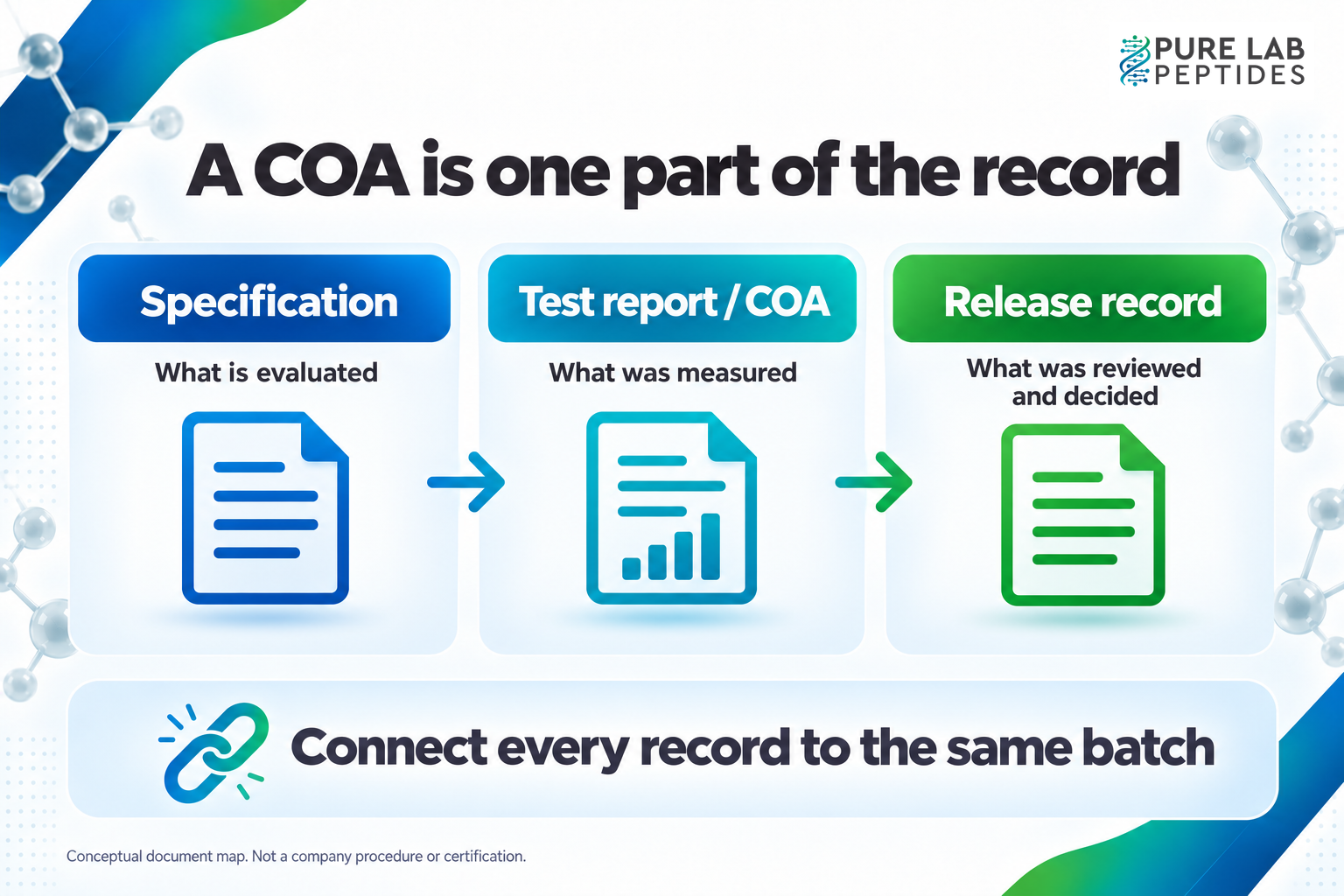
Read the contents rather than relying on the PDF title. A certificate may report tests; a review form may link several sources. Check what is recorded and which other documents it refers to.
| Document | Question it helps answer | Connection to check |
|---|---|---|
| Specification | Which characteristics and criteria apply? | The material identity and specification version |
| Test report or COA | What did the laboratory measure? | The sample, lot, report number, method and units |
| Release record | What information was reviewed, and what was decided? | The batch, supporting records, reviewer and recorded date |
Follow one batch through the paperwork
Quick takeaway: Build one traceable chain before comparing the numbers.
Imagine a research notebook entry for lot R-104. That identifier should lead you to the relevant product record and report. A laboratory may also assign its own sample identifier. Different identifiers are not automatically a problem, provided the records show how they connect.
For this hypothetical example, a useful note would read: “Lot R-104; laboratory sample S-28; report L-203; downloaded on the recorded date.” It gives the next reader a way to retrace the check. A folder named “latest test” is much less useful once another batch arrives.
A lot identifies material, while a report number identifies a document. Keep both in their own fields. The lot traceability in research documentation shows how to map them.
Read the measurement within its limits
Quick takeaway: A number is useful when you know the method, units and sample behind it.
Purity and amount answer different questions. Retain the method and calculation basis for a chromatographic percentage, and the units and analyte for an amount. Don’t substitute either for the other.
The same caution applies to identity. A peptide name, molecular mass and analytical result each contribute information, but they don’t all establish the same thing. Check whether the report describes a sequence-related measurement, a mass measurement or another identity method. Our guide to peptide testing methods explains how those questions differ.
Copy the result and units as reported, then add its method and sample reference. An unspecified basis should remain an open question, not become an assumption hidden in a complete-looking record.
Keep formal pharmaceutical release in context
Quick takeaway: A pharmaceutical release procedure has a defined scope. Do not infer it from a research product’s COA.
The European Commission’s 2015 Annex 16 describes medicinal-product batch release in terms of review, certification by a Qualified Person and transfer to saleable stock. It considers manufacturing and testing records within that regulated setting.
Pharmaceutical release is a defined process. A research-material report should be assessed for its recorded evidence; its existence doesn’t establish GMP status, authorization as a medicine or human-use suitability.
This guide explains document relationships. It does not describe an undisclosed supplier procedure or certify a particular product.
Make the research record easy to revisit
Quick takeaway: Preserve the source report and a short reading note. Both are more useful than an isolated screenshot.
A workable record can be brief:
- Material: the exact product identity and batch identifier.
- Evidence: the original report, its number and the laboratory sample reference.
- Interpretation: which results answer your research question, with method and units.
- Review: what you checked, when you checked it and any clarification you requested.
When a revised document arrives, retain the earlier version and identify which you’re using. That preserves the review trail without assuming the revision changed the material.
When comparing two batches, use the same questions for both. Different laboratories may use different methods or reporting conventions, so a side-by-side number comparison may need more explanation than it first appears. For chromatographic reports, the HPLC chromatogram reading guide is a useful next step.
Aim for a record another researcher can follow from this batch to these tests and this interpretation. The connections are more useful than document volume.