



Analytical Method Validation: What a Peptide Test Can Support

TL;DR · The short version
Analytical method validation asks whether a procedure supports an intended measurement. Identity, purity and content have different evidence needs. System suitability checks a routine run; it doesn’t replace the broader validation work.
A report names HPLC, states a result and marks it within specification. Next ask what supports that procedure’s ability to measure the reported property. The method name alone leaves that question open.
Start with the quantity and trace it back to the procedure and performance evidence. You can ask that question clearly without reproducing an analytical chemist’s full evaluation.
Start analytical method validation with the measurement
Section takeaway: Define the result you need before deciding which performance characteristics matter.
“Test the peptide” leaves the objective undefined. Identity, vial content, a trace impurity and relative peak area require different measurements. Specify the one you need before discussing procedure performance.
State the analyte, sample type, property, units and range of interest in a short objective. The laboratory can then evaluate a concrete task.
ICH Q2(R2) sets out a fit-for-purpose approach to analytical procedure validation. Its pharmaceutical scope should be kept in view: this article uses that framework to explain measurement evidence, rather than claiming that every research-use-only reagent is governed by the same pharmaceutical registration requirements.
Development, validation, verification and run checks
Section takeaway: These terms describe different questions. A passing run doesn’t answer all of them.
The 2025 Eurachem method-validation guide addresses validation and verification across laboratory applications, including sample handling, performance assessment, documentation and follow-up. Its broader laboratory context is useful alongside pharmaceutical guidance.
Distinguish development, evidence for the application and checks on a routine run. For an adopted method, ask what was verified with this laboratory’s samples and setting. Those questions lead to different records.
Different questions. Different records.
| Stage or check | Useful question to ask | Record to look for |
|---|---|---|
| Method development | Why were this procedure and these conditions chosen? | Development rationale and the resulting procedure |
| Validation | What evidence supports the intended measurement? | Protocol, acceptance criteria, results and conclusions |
| Verification | What was checked when an existing method was adopted here? | Documented assessment for the laboratory’s application |
| System suitability | Did the analytical system meet the run’s specified checks? | Run-specific observations and acceptance decision |
That table is a document-request aid. It doesn’t prescribe a universal study design or establish that a particular laboratory has completed one.
Read method performance in plain English
Section takeaway: Each performance characteristic answers a particular question about the result.
The following questions translate common analytical vocabulary into a useful conversation. The FDA’s analytical procedures document also distinguishes characteristics by test purpose. Don’t turn the list into a requirement that every identity test must satisfy every quantitative-assay check.
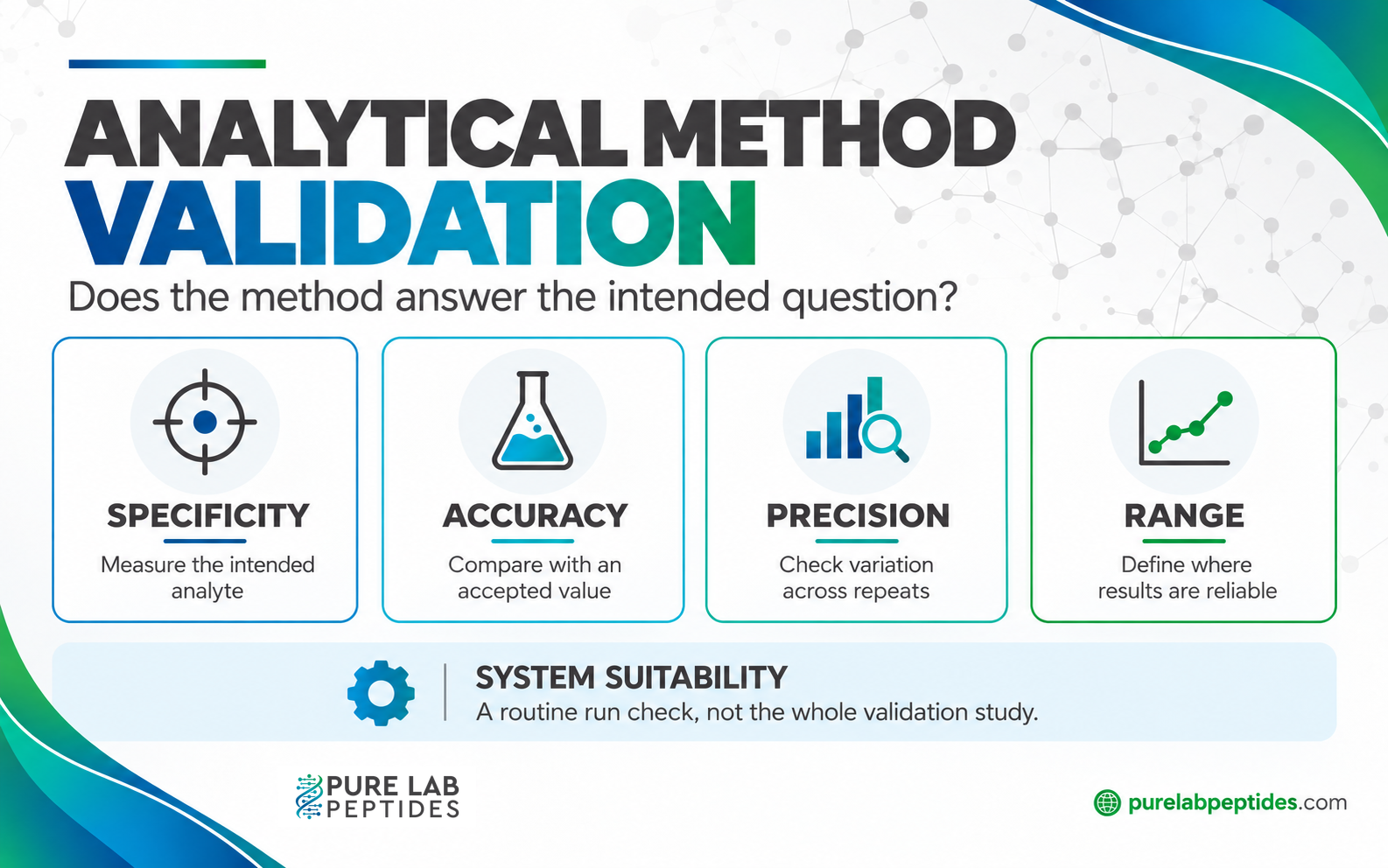
- Specificity or selectivity: Can the procedure distinguish the analyte from relevant interference, such as related compounds or the sample matrix?
- Accuracy: How close are the measurements to an accepted reference value?
- Precision: How much do results vary when the measurement is repeated?
- Range and response: Over which interval can results be supported? Does the calibration model fit the relationship between amount and signal?
- LOD and LOQ: Where relevant, what can be detected, and what can be quantified with acceptable performance?
- Robustness: What happens when relevant method conditions change by small, deliberate amounts?
The international metrology vocabulary’s precision entry emphasizes the conditions under which measurements are repeated. That detail matters when interpreting a study.
ICH distinguishes routine system suitability from the wider validation evidence and places robustness work typically within method development. A sharp peak or a repeatable injection is therefore part of the assessment, rather than a shortcut to “fully validated.”
If the report’s method terminology is unfamiliar, our peptide testing methods guide explains what HPLC, LC-MS and NMR examine.
A peptide example: repeat injections versus repeat preparations
Section takeaway: Check which part of the process was repeated before interpreting repeatability.
Consider a hypothetical study in which one prepared peptide solution is injected several times. The resulting peak areas are closely grouped. Now imagine a second study in which separate portions of the material are prepared independently before analysis.
Repeated injections examine variation in measuring one solution. Independent preparations also expose variation introduced during preparation. Describe which design was used rather than treating their results as interchangeable.
There’s another distinction worth keeping visible. A procedure that reports relative chromatographic peak area and one that reports peptide mass per vial may both involve HPLC, but their reported quantities differ. Ask for the result’s definition, calculation and supporting calibration. Our HPLC chromatogram guide covers how to read the chromatographic record.
The number is most useful when its measurement question remains visible.
What to request from the testing laboratory
Section takeaway: Ask for enough documentation to connect the reported result to a defined procedure and its evidence.
A focused request is easier to answer than “send everything.” You could ask:
- Which analytical method and version produced this result?
- What quantity or property does the reported value represent?
- What sample preparation and reference material were used?
- Which performance characteristics were evaluated for this application?
- What acceptance criteria were set, and what evidence supports the conclusion?
- Which system-suitability and quality-control checks applied to this run?
- Were there changes or deviations that affect interpretation?
Choose follow-up questions for the report: blanks and interference for a matrix-dependent measurement, or lower reporting limits for a trace impurity. Asking for every possible record may miss the actual gap.
ICH describes a protocol prepared before the validation study and a report summarizing the results afterward. A criteria table without results, or a results table without the intended measurement, leaves part of that connection missing.
Keep the evidence current when the procedure changes
Section takeaway: A method name alone doesn’t establish that old evidence covers a new application.
A changed procedure, setting or sample type raises a coverage question. Which prior conclusions still apply, and what new evidence is needed? Document that judgment instead of assuming either no work or full revalidation is always necessary.
Keep the method version and original COA with the lot. If a result is unclear, ask about that measurement. A large percentage can’t establish identity, content and procedure suitability all at once.
Continue with our purity-versus-identity guide if you need to separate those reported properties.
References
- ICH. Q2(R2): Validation of Analytical Procedures. Adopted 2023, corrected final version.
- Cantwell H, editor. Eurachem Guide: The Fitness for Purpose of Analytical Methods, third edition, 2025. Publisher overview and guide access.
- FDA. Analytical Procedures and Methods Validation for Drugs and Biologics. 2015.
- JCGM. International Vocabulary of Metrology, entry 2.15: measurement precision.