



Aliquoting in Peptide Research: Portions, Labels and Records

Aliquoting divides a sample into smaller portions for later work. It can let you use a defined portion without handling the whole preparation repeatedly. Keep each aliquot connected to its parent so smaller containers improve traceability rather than obscure the sample’s history.
TL;DR · The short version
Identify each portion, its parent, amount and handling events. Splitting must suit the material and method, because transfers may affect recovery. Portions of one preparation aren’t independent biological samples, and there is no universal size, temperature or freeze-thaw allowance.
Aliquoting starts with a parent sample
Quick takeaway: Label the relationship, not just the contents.
A tube marked “peptide” tells you almost nothing later. An identifier such as P01-A2 can point to parent preparation P01 and a record containing the material identity, batch, preparation details and date. The identifier is just an example, not a required naming system.
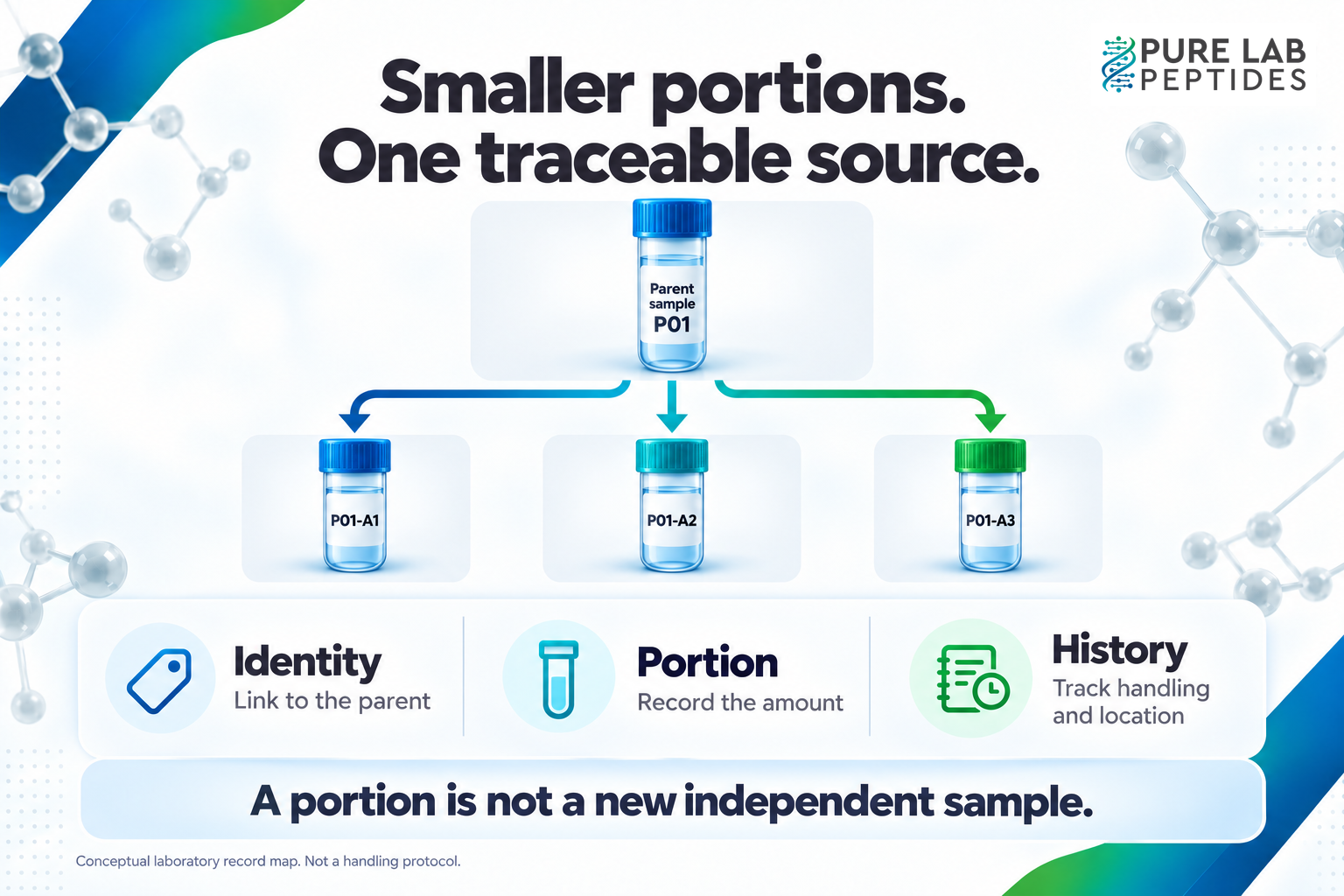
Suppose three portions come from P01. The record should let you find all three and see which one was used. If a portion is split again, preserve that relationship too. The labels can stay short because the notebook or sample register carries the detail.
Supplier batches, preparations and aliquots need different identifiers. Keep those levels separate and map them through the lot traceability guide.
| Record field | What to capture | Why it helps |
|---|---|---|
| Identity and parent | Aliquot ID, parent preparation and source batch | Connects the portion to its original material |
| Portion | Recorded volume or amount, with units and the relevant basis | Separates a measured quantity from an assumed one |
| Location | Container reference and current storage position | Makes the portion retrievable |
| History | Preparation, transfer and use records relevant to the method | Lets later comparisons account for handling differences |
Decide what splitting is meant to achieve
Quick takeaway: Define the purpose before choosing the number or size of portions.
Separate runs, planned time points and a retained reference require different portions. Start with their jobs; a size convenient for one assay may leave another short of volume or controls.
Use the approved method and experiment’s needs to choose the portions, then record the reason. An online protocol for unrelated material isn’t a standard volume for this preparation.
The choice is formulation-specific. Cell Signaling Technology’s antibody guidance, for example, recommends against aliquoting some formulations and treats others differently. That is antibody guidance, not a peptide handling instruction. It shows why the product-specific recommendation matters.
Extra transfers can change recovery
Quick takeaway: Material missing from solution may have adsorbed to a surface rather than chemically degraded.
In a 2015 study by Kristensen and colleagues, researchers examined three cationic peptides in contact with glass and plastic surfaces. They measured peptide recovery using HPLC and investigated the effect of successive transfers. Adsorption was a real source of loss from solution under the tested conditions.
Assess containers and transfers for the material being studied. The experiment doesn’t establish that every peptide behaves like those three or that one tube type resolves all recovery losses.
Compare transfer and contact histories as well as recovered concentrations. A lower result doesn’t identify its cause. The peptide degradation guide separates chemical change from other reasons for signal loss.
Check representativeness and handling separately
Quick takeaway: Matching portion sizes does not prove matching composition or stability.
Equal volumes are a record of volume. Whether they represent the parent preparation equally depends on the sample and collection method. In Ellis and Venturini’s 2013 frozen-sample study, the researchers compared portions with parent plasma and serum using selected biochemical measurements. They tested representativeness rather than simply assuming it.
Handling effects also vary by analyte. Lee and colleagues’ 2015 study found different responses among protein biomarkers after repeated freezing and thawing of plasma and serum samples. Those results do not supply a freeze-thaw limit for research peptides. They support a more careful question: what has been measured for this material, preparation and endpoint?
Reduced handling can be useful without replacing material-specific evidence. The peptide stability and research documentation puts that tradeoff in the wider stability context.
Don’t count portions as independent samples
Quick takeaway: Splitting one preparation into three tubes does not create three independent biological sources.
Technical portions still share their origin. Identify whether the experimental unit is a parent preparation, an independent biological source or a repeat assay. Those aren’t interchangeable counts.
Ask whether a colleague could identify the parent, find each portion and follow its quantity and history from the record. If so, the aliquoting documentation is serving the work.